Phlogenzym
Ukraine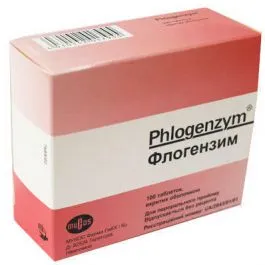
Table of Contents
I N S T R U C T I O N for medical use of the medicinal product FLOGENZYM (PHLOGENZYM®)
Composition:
Active substances: 1 tablet contains bromelain 90 mg, trypsin 48 mg, rutoside 100 mg;
Excipients: lactose monohydrate; corn starch, magnesium stearate, stearic acid, colloidal anhydrous silicon dioxide, talc, polyethylene glycol 6000; Eudragit L 12.5; triethyl citrate; vanillin.
Pharmaceutical form. Coated tablets.
Main physicochemical properties: round, biconvex tablets with a uniform coating, without score marks, greenish-yellow in color, with a characteristic odor.
Pharmacotherapeutic group. Medicinal products used in pathologies of the musculoskeletal system. Enzymes. Trypsin, combinations. ATC code M09A B52.
Pharmacological Properties
Pharmacodynamics
Anti-inflammatory and Anti-edemic Effects
Phlogenzym, or the enzymes it contains—bromelain and trypsin—reduce both inflammatory edema and edema associated with trauma or surgical intervention. These enzymes help degrade fibrin and other high-molecular-weight substances and inflammatory mediators (such as bradykinin) that arise or penetrate from blood into the interstitium during acute inflammation. As impaired microcirculation is restored and blood rheological properties simultaneously improve, degradation products are effectively transported via the circulatory and lymphatic systems.
Fibrinolytic and Thrombolytic Effects, Influence on Blood Rheology
Phlogenzym, or the enzymes it contains, activate fibrinolysis through plasminogen activation, depolymerization, and modification of the fibrin mesh structure. They dissolve microthrombi and reduce blood viscosity (improve blood rheology, enhance circulation). Additionally, they reduce platelet aggregation and increase erythrocyte flexibility.
Immunomodulatory Effects
Numerous experiments demonstrate the ability of the enzymes in Phlogenzym to positively influence the function of certain immune cells (macrophages, granulocytes, NK cells, T-lymphocytes). For example, they enhance phagocytic and cytolytic activity, induce the production of certain cytokines (TNF-alpha, IL-1 beta, IL-6), and promote the generation of oxygen radicals (in vitro, ex vivo).
In cases of non-physiological elevation of certain cytokines (e.g., TNF-alpha, TGF-beta), the enzymes in Phlogenzym help reduce their levels and mitigate their adverse effects (pro-inflammatory, cachectic, fibrotic).
The enzymes in Phlogenzym also selectively affect the expression of certain surface adhesion molecules on various cells (e.g., CD4, CD44, B7-1).
Pathogenic immune complexes play a key role in many immunopathological processes. High concentrations of immune complexes lead, among other effects, to phagocyte function blockade. Combination enzyme preparations improve immune complex clearance by increasing hydrolytic activity in blood serum and enhancing phagocytic efficiency.
Studies have shown that proteases eliminate circulating, concentrated, and tissue-fixed immune complexes, and also suppress the formation of pathogenic immune complexes.
Secondary Analgesic Effect
Since the enzymes in Phlogenzym affect the underlying causes of pain induced by acute inflammatory reactions, they may exert an analgesic effect. Pain mediators are degraded, oncotic pressure and tissue tension are reduced, and blood rheology improves. This promotes better circulation, facilitates the removal of toxic metabolic products, and enhances oxygen delivery to tissues.
The above-mentioned effects of proteases are complemented and potentiated by rutin. The anti-inflammatory action of the drug has been demonstrated, along with reduced capillary permeability, thereby decreasing extravasation. The drug also acts as a potent scavenger of free radicals.
Pharmacokinetics
The pharmaceutical formulation of Phlogenzym is designed to resist dissolution in gastric juice and to dissolve only in the small intestine. The enzymes contained in Phlogenzym, as well as other high-molecular-weight substances, are absorbed in the distal segments of the small intestine. The kinetics of individual enzymes show that with repeated administration, their concentration increases and reaches maximum levels within 24–48 hours. With continued administration, these concentrations are maintained at a steady level and return to baseline approximately 48 hours after discontinuation of treatment.
During absorption, the enzymes bind to natural specific antiproteases, such as protease inhibitor 1 (α1-antitrypsin), or nonspecific antiproteases such as α2-macroglobulin, which can bind all classes of proteases.
In the protease-antiprotease complex, the enzymes are protected from recognition by both humoral and cellular components of the immune system, so prolonged administration does not reveal antigenic or allergenic properties. Furthermore, these complexes have the ability to accumulate at sites of injury and inflammation (where increased microvascular permeability facilitates their entry). Here, due to various physical and chemical conditions, the complexes dissociate, releasing active proteases to exert their effects.
Absorbed enzymes are taken up by cells of the mononuclear phagocyte system and are primarily eliminated via the liver. Non-absorbed active substances are degraded during intestinal digestion or excreted in feces.
Clinical characteristics.
Indications.
Phlogenzym is used as an alternative to previously applied methods in post-traumatic (including sports injuries) and postoperative (including after plastic and reconstructive surgeries) edema.
Phlogenzym is also used as part of combination therapy in:
- inflammatory processes of the oral cavity, upper and lower respiratory tract, and urogenital tract;
- rheumatic diseases—such as soft tissue rheumatism, "tennis elbow", tendinitis, shoulder and forearm pain;
- inflammatory degenerative joint diseases.
Contraindications.
Phlogenzym should not be used in cases of confirmed hypersensitivity to the active substances or excipients.
The medicinal product should not be administered to patients with severe congenital or acquired disorders of blood coagulation (e.g., hemophilia, severe liver dysfunction, patients on dialysis).
Interaction with other medicinal products and other types of interactions.
Unfavorable interaction of Phlogenzym with other concomitant medications is unknown. There is evidence of increased blood levels of antibiotics and chemotherapeutic agents when administered simultaneously with Phlogenzym.
Special precautions for use
Sometimes, in chronic diseases, symptoms may worsen after initiation of therapy with Phlogenzym. In such cases, the drug should not be discontinued, but consideration should be given to temporarily reducing the dose. The mild fibrinolytic effect of the product should be taken into account prior to surgical interventions.
This medicinal product is not a substitute for antibiotic therapy in infectious inflammations; however, it enhances the effectiveness of antibiotics.
Carbohydrates contained in 1 tablet correspond to 4.65 kcal = 19.5 kJ.
If you have been diagnosed with intolerance to certain sugars, consult your doctor before taking this medicinal product.
Use during pregnancy or breastfeeding
Due to insufficient data on the use of the medicinal product during pregnancy and breastfeeding, it should be used during pregnancy and lactation only after careful assessment of the risks to the fetus or child versus the benefits of treatment for the mother.
Ability to influence reaction rate while driving or operating machinery
No adverse effects on the ability to drive or operate machinery have been observed.
Method of administration and dosage.
Adults: the recommended dose is 6 tablets per day (3x2 or 2x3). In special cases (severe disease course, onset of acute inflammation, post-traumatic and postoperative conditions requiring rapid absorption of swelling, bruises, and strains), temporary administration of up to 12 tablets per day (3x4 or 4x3) is possible.
The tablets should be taken on an empty stomach (i.e. at least 30 minutes before and not less than 2 hours after meals), without chewing, and washed down with a large amount of liquid (not less than 250 ml).
Children.
The drug is not intended for children.
Overdose.
Even with prolonged use of higher doses, no toxic effects have been observed; mild diarrhea may occur, which resolves after discontinuation of the drug.
Adverse reactions.
Phlogenzym is generally well tolerated, even with long-term use of high doses, and in most cases no adverse effects have been observed. In isolated cases, slight changes in consistency, color, and odor of stool may occur. Rare adverse effects may include: headache, increased appetite, and sweating. With higher single doses, sensations of stomach heaviness, bloating, and occasionally nausea may occur. These sensations can be avoided by dividing the total daily dose into several administrations. Rare allergic reactions (skin rashes) resolve after discontinuation of the drug.
Shelf life. 2 years.
Storage conditions.
Store at a temperature not exceeding 25 °C!
Store in the original packaging to protect from light. Do not freeze.
Packaging.
20 tablets per blister, 2, 5, or 10 blisters per cardboard box; 800 tablets in bottles.
Availability. Over-the-counter (without prescription).
Manufacturer.
MUCOS Emulsionsgesellschaft mbH, Germany.
Manufacturer's address.
Miraustrasse 17, 13509 Berlin, Germany.