Fleboton
Ukraine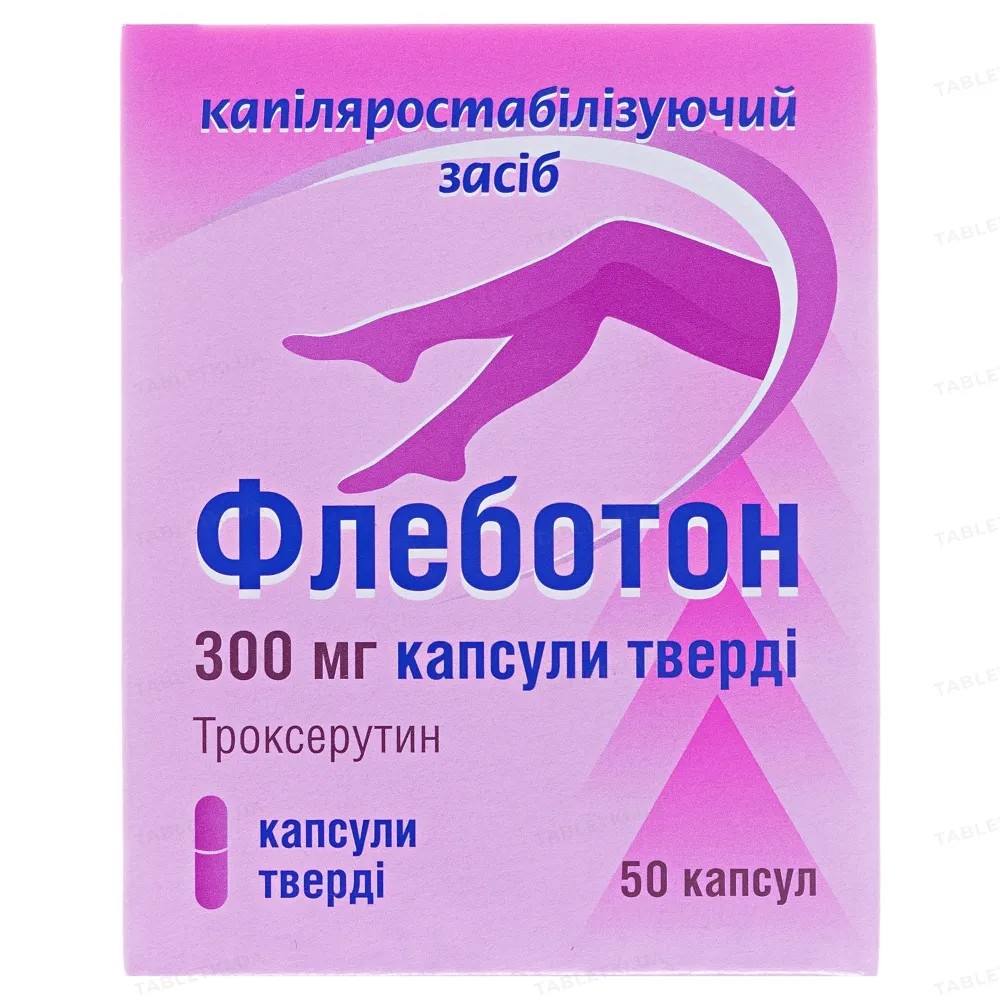
Table of Contents
INSTRUCTIONS FOR MEDICAL USE OF THE MEDICINAL PRODUCT FLEBOTON (PHLEBOTON)
Composition:
Active substance: troxerutin;
1 capsule contains 300 mg of troxerutin;
Excipients: lactose monohydrate, colloidal anhydrous silicon dioxide, macrogol, magnesium stearate, hard gelatin capsule (gelatin, quinoline yellow (E 104), yellow FCF (E 110), titanium dioxide (E 171)).
Pharmaceutical form. Hard capsules.
Main physicochemical properties: hard, cylindrical, opaque gelatin capsules of yellow color.
Pharmacotherapeutic group.
Angioprotectors. Capillary stabilizing agents. ATC code C05CA04.
Pharmacological Properties
Pharmacodynamics
Phleboton is a capillary- and venotonic agent. It exerts anti-inflammatory and antioxidant effects and inhibits hyaluronidase. It prevents oxidation of hyaluronic acid, ascorbic acid, and adrenaline, and suppresses lipid peroxidation. Troxerutin reduces capillary permeability and fragility, protects the basal membrane of endothelial cells from damage by various factors, and additionally possesses membrane-stabilizing, antihemorrhagic, detoxifying, antiallergic, and venotonic properties. It reduces edema, improves trophicity, and alleviates manifestations of other symptoms associated with venous insufficiency or impaired lymphatic drainage.
Pharmacokinetics
Maximum plasma concentrations are reached between 2 and 8 hours after oral administration. Plasma concentration decline follows a biexponential pattern. Initially, plasma concentration progressively decreases within 40 hours, after which it declines very slowly. Plasma protein binding ranges between 27–29%. It is metabolized via glucuronidation. Within 24 hours, the majority (up to 70%) is excreted in bile, while a minor portion (25%) is excreted in urine.
Clinical characteristics.
Indications.
For symptomatic treatment:
- edema and pain in varicose vein enlargement; varicose dermatitis;
- chronic venous insufficiency;
- varicose ulcers;
- hemorrhoidal disease;
- diabetic retinopathy (as part of complex therapy).
Contraindications.
Hypersensitivity to the active substance or to any of the excipients.
Peptic ulcer of the stomach and duodenum, chronic gastritis (in the phase of exacerbation).
Interaction with other medicinal products and other forms of interactions.
The drug enhances the effect of ascorbic acid on strengthening the structure and reducing the permeability of the vascular wall.
Special precautions for use.
The drug should not be administered to patients with lower limb edema due to cardiac, renal, or hepatic diseases, as it is ineffective in these conditions.
The drug should be prescribed with caution to patients with severe liver or gallbladder disorders. Since the drug irritates the gastric mucosa, it should be taken during meals.
The drug contains lactose; therefore, it should not be administered to patients with galactose intolerance, Lapp lactase deficiency, or glucose-galactose malabsorption.
Dye E 110 may cause allergic reactions.
The risk of allergy is higher in patients with increased sensitivity to acetylsalicylic acid.
Use during pregnancy or breastfeeding.
According to general clinical practice, use during the first trimester of pregnancy is not recommended.
During the second and third trimesters, as well as during breastfeeding, the drug should be used only as prescribed by a physician when the expected benefit to the mother outweighs the potential risk to the fetus.
Ability to influence reaction rate while driving or operating machinery.
Fléboton does not affect the reaction rate while driving or operating machinery.
Method of administration and dosage.
Capsules should be taken during meals with a glass of water.
The usual dose is 2 capsules per day. Maintenance therapy: 1 capsule per day for 3–4 weeks. This treatment may be combined with simultaneous use of gel. The therapeutic efficacy depends on regular administration, correct dosage, and duration of therapy. Clinical experience shows that the desired effect may sometimes be achieved with doses exceeding 600 mg (2 capsules) per day. The dosage and duration of treatment should be determined by a physician, taking into account the nature, severity, and course of the disease.
Children.
There are no data on the use of the drug in children.
Overdose.
Symptoms: The adverse reactions may be intensified.
Treatment: Discontinue the drug. Induction of emesis or gastric lavage is recommended, along with symptomatic treatment. If necessary, peritoneal dialysis may be performed.
Side effects.
The undesirable side effects listed below are classified by organ systems and by frequency of occurrence: very common (≥ 1/10), common (≥ 1/100 and <1/10), uncommon (≥ 1/1000 and <1/100), rare (≥ 1/10,000 and <1/1000), very rare (<1/10,000), frequency not known (based on available data, it is not possible to estimate the frequency).
Side effects are rarely observed during treatment. In individual cases, the following may occur:
Immune system disorders:
Very rare – anaphylactic shock, anaphylactoid reactions, hypersensitivity reactions.
Nervous system disorders:
Very rare – dizziness, headache, sleep disturbances.
Vascular disorders:
Very rare – ecchymoses (larger bruises).
Gastrointestinal disorders:
Rare – abdominal pain, discomfort, dyspepsia, flatulence, diarrhea, gastrointestinal dysfunction.
Skin and subcutaneous tissue disorders:
Rare – rash, pruritus, urticaria.
General disorders and administration site conditions:
Very rare – increased fatigue.
Shelf life. 5 years.
Storage conditions.
Keep out of reach of children. Store in the original packaging to protect from moisture, at a temperature not exceeding 25 °C.
Packaging.
10 capsules in a blister pack made of PVC film/aluminum foil; 5 blisters per cardboard box.
Classification of supply.
Over-the-counter (without prescription).
Manufacturer.
JSC "Sofarma".
Manufacturer's address and location of its business operations.
16 Iliensko Shose Str., Sofia, 1220, Bulgaria.