Flebaven® 500
Ukraine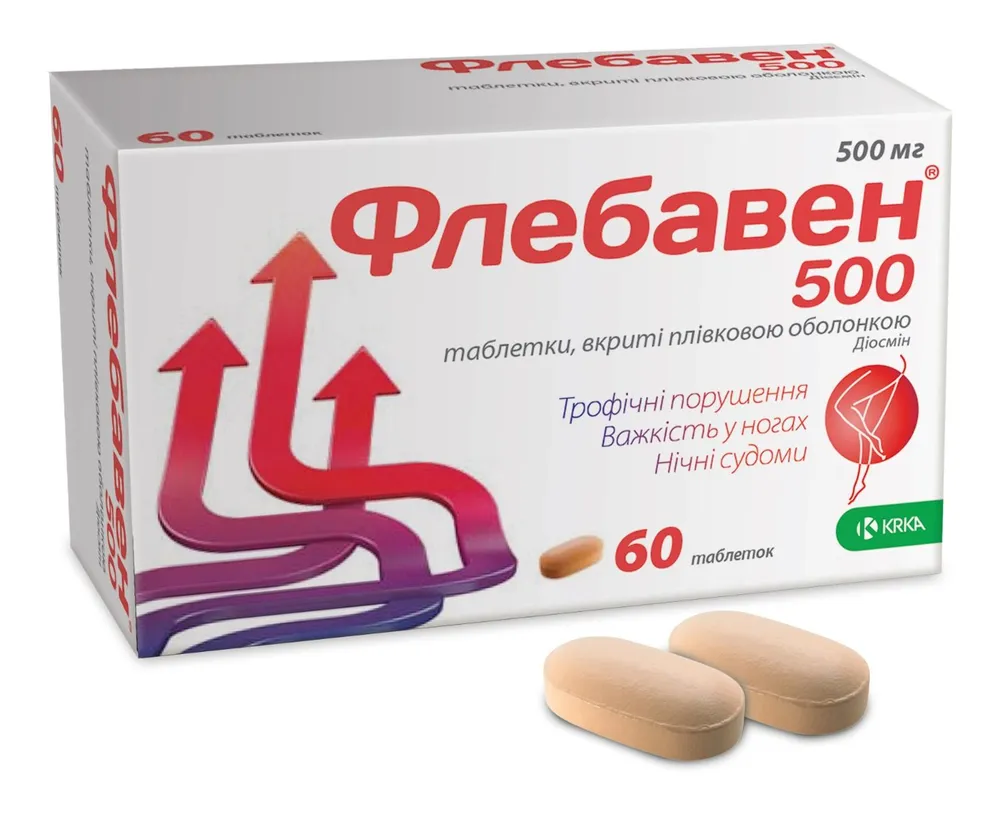
Table of Contents
INSTRUCTIONS FOR MEDICAL USE OF THE MEDICINAL PRODUCT Flebaven® 500 (Flebaven® 500)
Composition:
Active ingredient: diosmin;
One film-coated tablet contains 500 mg of micronized diosmin;
Excipients: microcrystalline cellulose, polyvinyl alcohol, sodium starch glycolate (type A), talc, magnesium stearate;
Film coating: polyvinyl alcohol, titanium dioxide (E 171), macrogol 3000, talc, yellow iron oxide (E 172).
Pharmaceutical form. Film-coated tablets.
Main physicochemical properties: brownish-yellow, biconvex, film-coated, capsule-shaped tablets.
Pharmacotherapeutic group.
Angioprotectors. Bioflavonoids. Capillary-stabilizing agents. Diosmin.
ATC code C05CA03.
Pharmacological properties.
Pharmacodynamics.
Mechanism of action
Phlebotonic activity
Diosmin reduces venous distensibility and decreases venous stasis. Diosmin increases venous tone and thus reduces venous capacity, venous distensibility, and blood stasis: venous occlusion mercury plethysmography shows a shortened venous emptying time.
The final effect is a reduction in venous hypertension in patients with venous disorders.
Microcirculatory activity
Diosmin reduces capillary permeability and increases capillary resistance. It also exerts an anti-inflammatory effect by influencing prostaglandin synthesis. Controlled double-blind clinical studies have demonstrated a statistically significant difference between diosmin and placebo. In patients with capillary fragility, treatment with diosmin increases capillary resistance and reduces clinical manifestations. After administration of 1 g of diosmin daily, compared to placebo, a reduction in capillary permeability was also observed, as determined by the use of technetium-labeled albumin or plethysmography.
Pharmacodynamic effects
The pharmacological activity of diosmin in humans has been confirmed in controlled double-blind clinical studies, as well as by objective and quantitative methods assessing the effect of the active substance on venous hemodynamics.
Effect on the lymphatic system
Diosmin stimulates lymphatic activity, improving interstitial space drainage and increasing lymphatic flow. Administration of 1 g of diosmin daily reduces the diameter of lymphatic capillaries and intralymphatic pressure, improving the number of functioning lymphatic capillaries in patients with severe chronic venous insufficiency without ulcers.
Clinical efficacy and safety
Controlled double-blind clinical studies demonstrate the therapeutic activity of the drug in the treatment of signs and symptoms of established chronic venous disease and in the treatment of acute hemorrhoidal disease.
Pharmacokinetics.
Absorption
After oral administration, diosmin is rapidly hydrolyzed in the intestine by intestinal flora and absorbed in the form of its aglycone derivative—diosmetin. The oral bioavailability of micronized diosmin is approximately 60%.
Distribution
The volume of distribution of diosmetin is 62.1 L, indicating extensive tissue distribution.
Biotransformation
Diosmetin is intensively metabolized to phenolic acids or their glycine conjugate derivatives, which are excreted in urine. In humans, the predominant metabolite found in urine is m-hydroxy-phenylpropionic acid, which is mainly excreted in conjugated form. Metabolites found in smaller amounts include phenolic acids corresponding to 3-hydroxy-4-methoxybenzoic acid and 3-methoxy-4-hydroxyphenylacetic acid.
Elimination
Elimination of micronized diosmin occurs relatively rapidly, with approximately 34% of the radiolabeled dose of 14C-diosmin excreted in urine and feces within the first 24 hours and reaching approximately 86% within the first 48 hours. About half of the dose is excreted in feces as unchanged diosmin or diosmetin, whereas these two compounds are not excreted in urine.
The elimination half-life of diosmetin showed a mean value of 31.5 hours, ranging from 26 to 43 hours.
Clinical characteristics.
Indications.
Symptomatic treatment of chronic venous and lymphatic insufficiency (leg heaviness, pain, nocturnal cramps, leg swelling, trophic disorders, including varicose ulcers).
Symptomatic treatment of hemorrhoids.
Contraindications.
Hypersensitivity to the active substance or to any of the excipients.
Interaction with other medicinal products and other forms of interaction.
Interaction studies have not been conducted. During the post-marketing period, no interactions between diosmin and other medicinal products have been reported.
Special precautions for use.
The use of the medicinal product Flebaven® 500 in acute hemorrhoids does not replace specific therapy and does not preclude the treatment of other proctological diseases. If symptoms do not rapidly resolve during a short course of treatment, a proctological examination should be performed and the therapy reassessed.
In venous circulation disorders, therapy is more effective when combined with adherence to the following lifestyle recommendations:
- avoid excessive sun exposure and prolonged periods of immobility while standing;
- maintain a healthy body weight;
- walk regularly and, in some cases, wear special compression stockings to improve circulation.
Particular attention should be paid if the patient's condition worsens during treatment. This may manifest as skin inflammation, phlebitis, subcutaneous induration, severe pain, skin ulcers, or atypical symptoms (e.g., sudden swelling of one or both legs).
Flebaven® 500 is ineffective in reducing lower limb edema caused by heart, liver, or kidney diseases.
Use during pregnancy or breastfeeding.
Pregnancy
Flebaven® 500 should be used with caution in pregnant women. Consultation with a physician is recommended prior to use.
Studies have not revealed teratogenic effects of the drug; adverse effects have not been reported.
Breastfeeding
Due to the lack of data on the passage of the active substance into breast milk, the product should not be used during breastfeeding.
Fertility
Reproductive toxicity studies in animals showed no effect on fertility.
Ability to influence reaction rate when driving or operating machinery.
Studies on the effect of diosmin on the ability to drive or operate machinery have not been conducted. However, based on the overall safety profile, diosmin has no effect or only a negligible effect on this ability. Patients should pay attention to any adverse reactions listed in the section "Adverse reactions."
Dosage and Administration.
For oral use.
It is intended for adults. The tablets should be taken with food.
Chronic venous-lymphatic insufficiency
The recommended dose is 2 tablets daily, either as a single dose or divided into 2 doses. Treatment duration should be at least 4–5 weeks.
Hemorrhoidal disease
Treatment of acute hemorrhoidal episodes: 6 tablets daily (3 tablets taken twice daily) for 4 days; followed by 4 tablets daily (2 tablets taken twice daily) for the next 3 days. Maintenance therapy: 2 tablets daily (1 tablet taken twice daily).
The duration of treatment should be determined by the physician depending on the indication and course of the disease (see section "Special Instructions").
Children.
Due to lack of data, the medicinal product Flebaven® 500 should not be used in children.
Overdose.
Cases of overdose have not been reported.
Adverse reactions.
During clinical studies with the use of diosmin, transient adverse effects of moderate intensity were observed, mainly affecting the gastrointestinal tract (diarrhea, dyspepsia, nausea, vomiting).
Listed below are the adverse reactions that have been reported. The reactions are categorized by frequency as follows: very common (≥ 1/10); common (≥ 1/100, < 1/10); uncommon (≥ 1/1000, < 1/100); rare (≥ 1/10000, < 1/1000); very rare (< 1/10000); frequency not known (cannot be estimated from the available data).
| System organ classification |
Frequency |
Adverse reaction |
||||
| Nervous system disorders |
Uncommon |
Dizziness |
||||
| Headache |
||||||
| Malaise |
||||||
| Gastrointestinal disorders |
Common |
Diarrhea |
||||
| Dyspepsia |
||||||
| Nausea |
||||||
| Vomiting |
||||||
| Uncommon |
Colitis |
|||||
| Frequency unknown* |
Abdominal pain |
|||||
| Skin and subcutaneous tissue disorders |
Uncommon |
Pruritus |
||||
| Rash |
||||||
| Urticaria |
||||||
| Frequency unknown* |
Localized swelling of the face, lips, eyelids. In exceptional cases – Quincke's edema |
|||||
* Data from post-marketing surveillance.
Reporting of suspected adverse reactions
Reporting of adverse reactions after marketing authorization is of great importance. It allows continuous monitoring of the benefit-risk balance of the medicinal product. Healthcare and pharmaceutical professionals, as well as patients or their legal representatives, should report all suspected adverse reactions and lack of efficacy via the Automated Information System for Pharmacovigilance at the following link: https://aisf.dec.gov.ua.
Shelf life. 3 years.
Storage conditions.
Store at a temperature not exceeding 25 °C in the original packaging to protect from moisture.
Keep out of reach and sight of children.
Packaging.
15 tablets per blister pack; 2 or 4 blisters per cardboard box.
Supply category.
Over-the-counter.
Manufacturer.
KRKA, d.d., Novo mesto, Slovenia / KRKA, d.d., Novo mesto, Slovenia.
Manufacturer's address and location of its operations.
Šmarješka cesta 6, 8501 Novo mesto, Slovenia / Smarjeska cesta 6, 8501 Novo mesto, Slovenia.