Flavovir®
Ukraine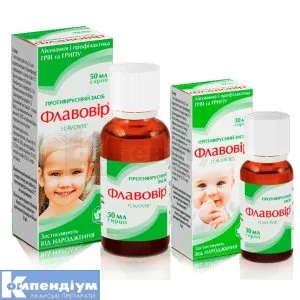
Table of Contents
INSTRUCTIONS FOR MEDICAL USE OF THE MEDICINAL PRODUCT FLAVOVIR® (FLAVOVIR®)
Composition:
1 ml of syrup contains:
0.02 ml of liquid extract Proteflazid, obtained from a mixture of herbs (1:1) Deschampsia caespitosa L. (Herba Deschampsia caespitosa L.) and Calamagrostis epigeios L. (Herba Calamagrostis epigeios L.) (extraction solvent – 96% ethanol), equivalent to not less than 0.0035 mg of flavonoids calculated as rutin;
excipients: propylene glycol, 96% ethanol, sorbitol (E 420), methylparaben (E 218), propylparaben (E 216), sodium sulfite (E 221), purified water.
Medicinal form: Syrup.
Basic physico-chemical properties: clear sweet liquid of yellow-green color with a weak specific odor.
Pharmacotherapeutic group:
Direct-acting antiviral agents. ATC code J05A X.
Immunostimulants. ATC code L03A X.
Pharmacological Properties
Pharmacodynamics
Flavonoids contained in the medicinal product have the ability to inhibit DNA- and RNA-virus replication both in vitro and in vivo. In preclinical and clinical studies, the drug demonstrated inhibitory activity against influenza viruses and acute respiratory infections, as well as herpes viruses.
It has been established that the mechanism of direct antiviral action involves inhibition of synthesis of virus-specific enzymes—DNA- and RNA-polymerases, thymidine kinase, reverse transcriptase, 3CL-protease, neuraminidase—and induction of endogenous interferon synthesis.
The flavonoids in the syrup inhibit the activity of SARS-CoV-2 coronavirus 3CL-protease, confirmed by molecular docking methods and using an assay kit containing MBP-tagged (maltose-binding protein) SARS-CoV-2 coronavirus 3CL-protease.
Using a dual Renilla luciferase reporter gene assay (mimicking replication of the seasonal coronavirus CoV-229E), inhibition was demonstrated.
Preclinical in vitro studies on Vero E6 and A549/ACE2 cell cultures demonstrated antiviral activity against the pandemic human coronavirus SARS-CoV-2, with significant suppression of viral replication.
The drug protects mucous membranes of the upper respiratory tract by normalizing local immunity parameters (lactoferrin, sIgA, and lysozyme).
Studies have shown that the drug normalizes the synthesis of endogenous α- and γ-interferons to physiologically active levels, thereby enhancing the body's nonspecific resistance to viral and bacterial infections.
Clinical studies have shown that, when the drug is taken daily according to age-related dosing regimens and administration schedules, immune system refractoriness does not develop: no suppression of α- and γ-interferon synthesis is observed. This property of Flavovir® syrup supports maintenance of interferon levels sufficient for an adequate immune response to infectious agents. This, in turn, allows the drug to be used over prolonged periods when necessary.
The medicinal product has antioxidant activity, inhibits free-radical processes, thereby preventing accumulation of lipid peroxidation products, enhances cellular antioxidant status, reduces intoxication, and promotes recovery after infection and adaptation to adverse environmental conditions.
The drug acts as a modulator of apoptosis: it enhances the effect of apoptosis-inducing factors by activating caspase-9, thus promoting faster elimination of virus-infected cells and primary prevention of chronic diseases arising on the background of latent viral infections.
Pharmacokinetics
The active ingredients of the drug are rapidly absorbed from the gastrointestinal tract into the bloodstream, reaching maximum concentrations within 20 minutes after administration (in vivo studies). The elimination half-life from plasma is approximately 2.3 hours. Oral bioavailability is 80%. Elimination from the body is slow. The level of active ingredient accumulation in blood cells is significantly higher compared to plasma. Sustained concentrations of active ingredients ensure prolonged drug action and accumulation in organs and tissues due to release from blood cells. This pharmacokinetic profile of accumulation and release of active ingredients by blood cells necessitates twice-daily administration of the drug to achieve effective concentrations.
Clinical characteristics.
Indications.
- Etiotropic treatment and prevention of acute respiratory viral infections (ARVI);
- etiotropic treatment and prevention of influenza, including that caused by pandemic viral strains.
Contraindications.
Hypersensitivity to the components of the medicinal product. Exacerbation stage of gastric or duodenal ulcer. Autoimmune diseases.
Interaction with other medicinal products and other forms of interaction.
During clinical use, combination of Flavovir® syrup with antibiotics and antifungal agents for the treatment of viral-bacterial and viral-fungal infections has been found possible. No negative effects due to interactions with other medicinal products have been observed.
Special precautions for use
For patients with chronic gastroduodenitis, in case of exacerbation of gastroduodenitis or development of gastroesophageal reflux, the syrup should be taken 1.5–2 hours after eating.
This medicinal product contains 3.85% v/v ethanol (alcohol), i.e. from 15.4 mg/dose (for children from birth to 1 year) up to 277.2 mg/dose (for children aged 12 years and above and adults), which is equivalent to 0.4 ml beer, 0.2 ml wine (for children from birth to 1 year) up to 6.9 ml beer, 2.9 ml wine (for children aged 12 years and above and adults) per dose.
Harmful for patients suffering from alcoholism. Caution should be exercised when administering to pregnant and breastfeeding women, children, and patients with liver disorders or epilepsy.
If you have been diagnosed with carbohydrate intolerance, consult your doctor before taking this medicinal product, as it contains sorbitol.
Methylparaben and propylparaben may cause allergic reactions (possibly delayed).
Sodium sulfite may rarely cause hypersensitivity reactions and bronchospasm.
Use during pregnancy or breastfeeding
Preclinical studies have shown no evidence of teratogenic, mutagenic, embryotoxic, fetotoxic or carcinogenic effects. Clinical experience with the use of this medicinal product during the first, second and third trimesters of pregnancy and during breastfeeding has not revealed any negative effects. However, the principles of medicinal product use during pregnancy or breastfeeding should be followed, assessing the benefit–risk ratio and consulting a physician.
Ability to affect reaction speed when driving or operating machinery
No negative effect on the ability to perform potentially hazardous activities requiring special attention and rapid reactions has been observed.
Method of administration and dosage.
Before use, the syrup bottle must be shaken.
The syrup should be dosed using a measuring device and taken orally 20–30 minutes before meals. To achieve a greater therapeutic effect when exposed to respiratory viruses, it is advisable to hold the syrup in the mouth for 20–30 seconds, rinsing the throat before swallowing.
Dosage and duration of treatment depend on the nature of the disease and the patient's age.
Dosage of the medicinal product
| Patient age |
Dosage |
| From birth to 1 year |
0.5 ml twice daily |
| From 1 to 2 years |
1 ml twice daily |
| From 2 to 4 years |
3 ml twice daily |
| From 4 to 6 years |
4 ml twice daily |
| From 6 to 9 years |
5 ml twice daily |
| From 9 to 12 years |
6 ml twice daily |
| From 12 years, including adults |
9 ml twice daily |
For the treatment of influenza and acute respiratory viral infections (in uncomplicated cases), the syrup should be used for 5 days. To achieve maximum therapeutic efficacy, administration of the syrup should begin at the first signs of illness or after contact with infected individuals. Depending on the course of the disease, the treatment duration may be extended up to 2 weeks.
For the prevention of influenza and acute respiratory viral infections, the syrup should be used for 1 to 4 weeks at a dose equal to half the therapeutic dose.
During epidemics of pandemic strains, the duration of syrup use for prophylaxis may be extended up to 6 weeks.
In case of bacterial complications arising from influenza or other acute respiratory viral infections, the syrup may be used for 4 weeks or longer to normalize immune system parameters.
Children.
Flavovir® can be used in children from birth.
Overdose.
Cases of overdose are unknown. In the event of an overdose, seek medical advice immediately.
Side effects.
Allergic reactions: hypersensitivity reactions may occur in individuals with increased sensitivity. Allergic reactions may include rash, itching, skin swelling, urticaria, and skin hyperemia.
Gastrointestinal system disorders: gastrointestinal disturbances may occur, such as epigastric pain, nausea, vomiting, and diarrhea (if these symptoms occur, the syrup should be taken 1.5–2 hours after meals). In patients with chronic gastroduodenitis, exacerbation of gastroduodenitis and development of gastroesophageal reflux (reflux esophagitis) are possible.
General disorders: transient increase in body temperature up to 38 °C may occur on days 3–10 of treatment, as well as headache.
In case of any adverse reactions, consult a physician.
Shelf life: 2 years.
Do not use after the expiry date stated on the packaging.
Storage conditions.
Store in the original packaging, out of reach of children, at a temperature not exceeding 25 °C. Do not freeze.
After first opening, keep the bottle closed and stored in the original packaging for no more than 30 days.
Packaging.
30 ml, 50 ml, or 60 ml in dark glass or plastic bottles, closed with plastic caps with tamper-evident closure or plastic caps with tamper-evident closure and child-resistant protection. A dosing device is included in the cardboard package.
Supply category.
Over-the-counter.
Manufacturer.
LLC "NVC "Ekofarm", Ukraine.
Manufacturer's location and address of business activity:
Ulashanivka village, Shepetivka district, Khmelnytskyi region, 30070, Ukraine, 116 Shevchenka Street.
Applicant.
LLC "NVC "Ekofarm".
Applicant's address.
136-B Naberezhno-Korchuvatska Street, Kyiv, 03045, Ukraine.