Flavamed® forte
Ukraine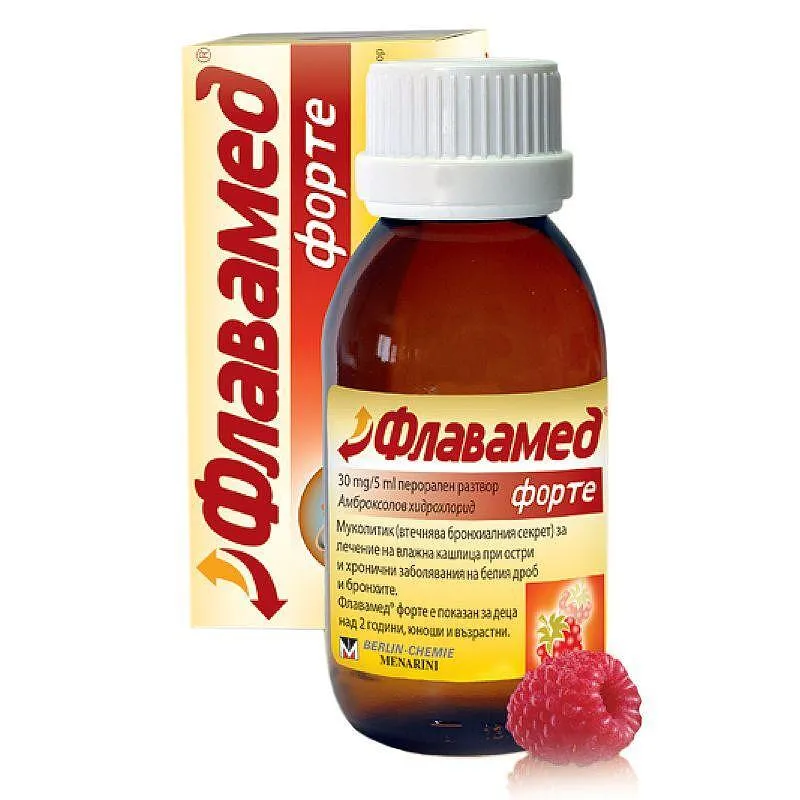
Table of Contents
INSTRUCTIONS FOR MEDICAL USE OF THE MEDICINAL PRODUCT FLAVAMEDâ FORTE (FLAVAMEDâ FORTE)
Composition:
Active substance: ambroxol hydrochloride;
5 ml of oral solution contain 30 mg of ambroxol hydrochloride;
Excipients: benzoic acid (E 210); glycerol (85 %); sorbitol solution, non-crystallizing (E 420) (Ph. Eur.); hydroxyethylcellulose, purified water, raspberry flavoring agent № 516028.
Pharmaceutical form. Oral solution.
Main physicochemical properties: clear solution, colorless to slightly yellow, with a fruity odor close to that of raspberry.
Pharmacotherapeutic group. Medicinal products used in cough and colds. Mucolytics. ATC code R05C B06.
Pharmacological Properties
Pharmacodynamics
The active ingredient of FLAVAMED® FORTE, ambroxol hydrochloride, increases respiratory tract secretion. Ambroxol enhances pulmonary surfactant secretion by directly affecting type II pneumocytes in the alveoli and Clara cells in the bronchioles, and also stimulates ciliary activity, thereby reducing mucus viscosity, promoting mucus secretion and its elimination (improvement of mucociliary clearance). Improved mucociliary clearance has been demonstrated in clinical pharmacological studies.
Activation of fluid secretion and increased mucociliary clearance facilitate mucus expulsion and reduce coughing.
The local anesthetic effect of ambroxol hydrochloride is explained by its ability to block sodium channels, as observed in a rabbit eye model. In vitro studies have shown that ambroxol hydrochloride blocks neuronal sodium channels; binding was reversible and concentration-dependent.
Ambroxol hydrochloride has demonstrated anti-inflammatory effects in vitro. In vitro studies revealed that ambroxol hydrochloride significantly reduces cytokine release from mononuclear and polymorphonuclear blood and tissue cells.
Pharmacological properties leading to rapid relief of pain and pain-related discomfort in the nasal cavity, ear region, and trachea upon inhalation of air are consistent with data from supportive symptom observation in clinical efficacy studies of ambroxol hydrochloride in the treatment of upper respiratory tract disorders.
After administration of ambroxol hydrochloride, concentrations of antibiotics (amoxicillin, cefuroxime, erythromycin, and doxycycline) increase in bronchopulmonary secretions and sputum.
Pharmacokinetics
Absorption. Absorption of ambroxol hydrochloride is rapid and nearly complete, with a linear dose-dependency within the therapeutic range. Maximum plasma concentrations are reached within 1–2.5 hours after oral administration of immediate-release dosage forms.
Distribution.
After oral administration, distribution of ambroxol hydrochloride from blood to tissues is rapid and extensive, with the highest concentration of the active substance found in the lungs. The volume of distribution after oral administration is 552 L. In plasma, approximately 90% of the drug is protein-bound within the therapeutic range.
Metabolism and Elimination. Approximately 30% of the dose is eliminated via presystemic metabolism after oral administration. Ambroxol hydrochloride is primarily metabolized in the liver through glucuronidation and cleavage to dibromoantranilic acid (approximately 10% of the dose). Clinical studies have shown that CYP3A4 is responsible for the metabolism of ambroxol hydrochloride to dibromoantranilic acid.
Within 3 days of oral administration, about 6% of the dose is excreted unchanged in urine, while approximately 26% is excreted in conjugated form.
The elimination half-life from plasma is approximately 10 hours. Total clearance is about 660 mL/min, with renal clearance accounting for approximately 8% of total clearance. Within 5 days, approximately 83% of the total dose is excreted in urine.
Pharmacokinetics in Special Patient Populations. In patients with impaired liver function, elimination of ambroxol hydrochloride is reduced, resulting in plasma levels 1.3 to 2 times higher.
However, since the therapeutic range of ambroxol hydrochloride is sufficiently wide, dosage adjustment is not required.
Age and sex have no clinically significant effect on the pharmacokinetics of ambroxol hydrochloride; therefore, no dose adjustment is necessary.
Food intake does not affect the bioavailability of ambroxol hydrochloride.
Clinical characteristics.
Indications.
Mucolytic therapy in acute and chronic bronchopulmonary diseases associated with impaired bronchial secretion and impaired mucus clearance.
Contraindications.
FLAVAMED® FORTE must not be used in patients with known hypersensitivity to ambroxol hydrochloride or to any of the excipients of the syrup.
In rare cases of congenital conditions leading to intolerance to excipients (see section "Special precautions"), the use of this medicinal product is contraindicated.
Interaction with other medicinal products and other forms of interaction.
There are no reports of clinically relevant adverse interactions with other medicinal products.
Concomitant use of FLAVAMED® FORTE and cough suppressants may lead to excessive mucus accumulation due to suppression of the cough reflex. Therefore, such combination should only be used after careful assessment by a physician of the benefit-risk ratio.
Special precautions for use
Severe skin reactions have been reported after ambroxol administration, including erythema multiforme, Stevens-Johnson syndrome/toxic epidermal necrolysis (Lyell's syndrome), and acute generalized exanthematous pustulosis. If symptoms or signs of a progressive skin rash (sometimes associated with blistering and mucosal lesions) occur, ambroxol should be discontinued immediately and medical advice should be sought. In most cases, these reactions could be explained by the severity of the underlying disease in patients and/or concomitant use of other medications. At the initial stage of Stevens-Johnson syndrome or Lyell's syndrome, patients may present with non-specific, flu-like symptoms such as fever, malaise, rhinitis, cough, and sore throat. In such cases, symptomatic treatment with cough and cold remedies may be mistakenly initiated.
Since FLAVAMED® FORTE may enhance mucus secretion, it should be used with caution in patients with impaired bronchial motility and increased mucus secretion (e.g. in rare conditions such as primary ciliary dyskinesia).
Patients with impaired renal function or severe hepatic impairment should take FLAVAMED® FORTE only after consultation with a physician. When ambroxol is administered to patients with severe renal insufficiency, like any other active substance metabolized by the liver and subsequently excreted by the kidneys, hepatic metabolites may accumulate.
Each 5 mL of medicinal product (1 measuring spoon) contains 1.75 g of sorbitol. Sorbitol is a source of fructose. If a patient has been diagnosed with intolerance to certain sugars or with hereditary fructose intolerance—a rare genetic disorder in which the body cannot metabolize fructose—consultation with a physician is required before taking this medicinal product. Sorbitol may cause gastrointestinal discomfort and has a mild laxative effect.
Each 5 mL of medicinal product (1 measuring spoon) contains 5.75 mg of benzoic acid. Benzoic acid may exacerbate jaundice (yellowing of the skin and eyes) in newborn infants (up to 4 weeks of age).
FLAVAMED® FORTE does not contain glucose.
Does not contain alcohol.
Since mucolytic agents may impair the gastric mucosal barrier, ambroxol should be used with caution in patients with a history of gastric or duodenal ulcer.
Use during pregnancy or breastfeeding
Ambroxol hydrochloride crosses the placental barrier. No direct or indirect harmful effects on pregnancy, embryonal/fetal development, delivery, or postnatal development have been observed.
There have been reports of use of the drug after the 28th week of pregnancy, during which no harmful effects on the fetus were observed.
However, usual precautionary measures regarding medication use during pregnancy should be followed. In particular, FLAVAMED® FORTE is not recommended during the first trimester of pregnancy.
Ambroxol hydrochloride passes into breast milk. Although adverse effects are not expected, FLAVAMED® FORTE is not recommended during breastfeeding.
Ability to influence reactions while driving or operating machinery
There are no data regarding the effect of FLAVAMED® FORTE on the ability to drive or operate machinery. Studies on the influence of the drug on reaction speed during driving or operating machinery have not been conducted.
Dosage and Administration
If otherwise not specified, the recommended dosage regimen for FLAVAMED® FORTE is as follows:
Children under 2 years of age: ¼ measuring spoon (1.25 mL) twice daily (equivalent to 15 mg of ambroxol hydrochloride per day).
Children aged 2 to 5 years: ¼ measuring spoon of the solution (1.25 mL) three times daily (equivalent to 22.5 mg of ambroxol hydrochloride per day).
Children aged 6 to 12 years: ½ measuring spoon of the solution (2.5 mL) 2–3 times daily (equivalent to 30–45 mg of ambroxol hydrochloride per day).
Adults and adolescents aged 12 years and older: 1 measuring spoon of the solution (5 mL) three times daily (equivalent to 90 mg of ambroxol hydrochloride per day) for the first 2–3 days, followed by
1 measuring spoon of the solution (5 mL) twice daily (equivalent to 60 mg of ambroxol hydrochloride per day).
If necessary, the therapeutic effect in adults and patients aged 12 years and older may be enhanced by increasing the dose to 10 mL twice daily (equivalent to 120 mg of ambroxol hydrochloride per day).
FLAVAMED® FORTE is administered orally, independent of food intake, using the provided measuring spoon.
In general, there are no restrictions regarding the duration of treatment; however, prolonged administration should be carried out under medical supervision.
FLAVAMED® FORTE should not be used for longer than 4–5 days without consulting a physician.
Children
The product can be used in pediatric practice. For children under 2 years of age, use only on medical advice.
Overdose
There are currently no reports of overdose cases in humans. Symptoms described in isolated reports of overdose and/or accidental drug ingestion are consistent with the known adverse effects of FLAVAMED® FORTE at recommended doses and require symptomatic treatment.
Side effects
The following adverse reactions have occurred with the specified frequency:
Very common (≥1/10); common (≥1/100 to <1/10); uncommon (≥1/1000 to <1/100); rare (≥1/10,000 to <1/1000); very rare (<1/10,000); not known (cannot be estimated from the available data).
Gastrointestinal disorders:
Common – nausea; uncommon – vomiting, dryness of mouth and throat, diarrhoea, dyspepsia, abdominal pain, constipation, reduced sensitivity in the oral cavity and pharynx, salivation, heartburn.
Immune system disorders:
Uncommon – anaphylactoid reactions; rare – hypersensitivity reactions; not known – anaphylactic reactions, including anaphylactic shock, Quincke's edema (angioedema), pruritus.
Skin and subcutaneous tissue disorders:
Rare – rash, urticaria; not known – severe cutaneous adverse reactions (including erythema multiforme, Stevens-Johnson syndrome/toxic epidermal necrolysis (Lyell's syndrome), and acute generalized exanthematous pustulosis).
Nervous system disorders:
Common – dysgeusia (taste disturbance).
Respiratory, thoracic and mediastinal disorders:
Common – reduced sensitivity in mouth and pharynx; not known – dryness of throat.
Other disorders:
Dysuria, rhinorrhea.
Reporting of suspected adverse reactions
Reporting of suspected adverse reactions after marketing authorization is important. It allows continued monitoring of the benefit-risk balance of the medicinal product. Healthcare professionals are asked to report any suspected adverse reactions.
Shelf life.
3 years. After first opening of the bottle – 6 months. Do not use the medicinal product after the expiry date stated on the packaging.
Storage conditions.
No special storage conditions required. Keep out of reach and sight of children!
Packaging.
Brown glass bottle with a tamper-evident closure containing 100 ml of oral solution, and a polypropylene measuring spoon graduated at 1.25 ml, 2.5 ml, and 5 ml (spoon edge), in a cardboard box.
Classification. Over-the-counter (without prescription).
Manufacturer.
BERLIN-CHEMIE AG / BERLIN-CHEMIE AG.
Manufacturer's address and place of business.
Glienicker Weg 125, 12489 Berlin, Germany / Glienicker Weg 125, 12489 Berlin, Germany.
Marketing Authorization Holder.
BERLIN-CHEMIE AG / BERLIN-CHEMIE AG.
Marketing Authorization Holder's address and place of business.
Glienicker Weg 125, 12489 Berlin, Germany / Glienicker Weg 125, 12489 Berlin, Germany.