Fitolit
Ukraine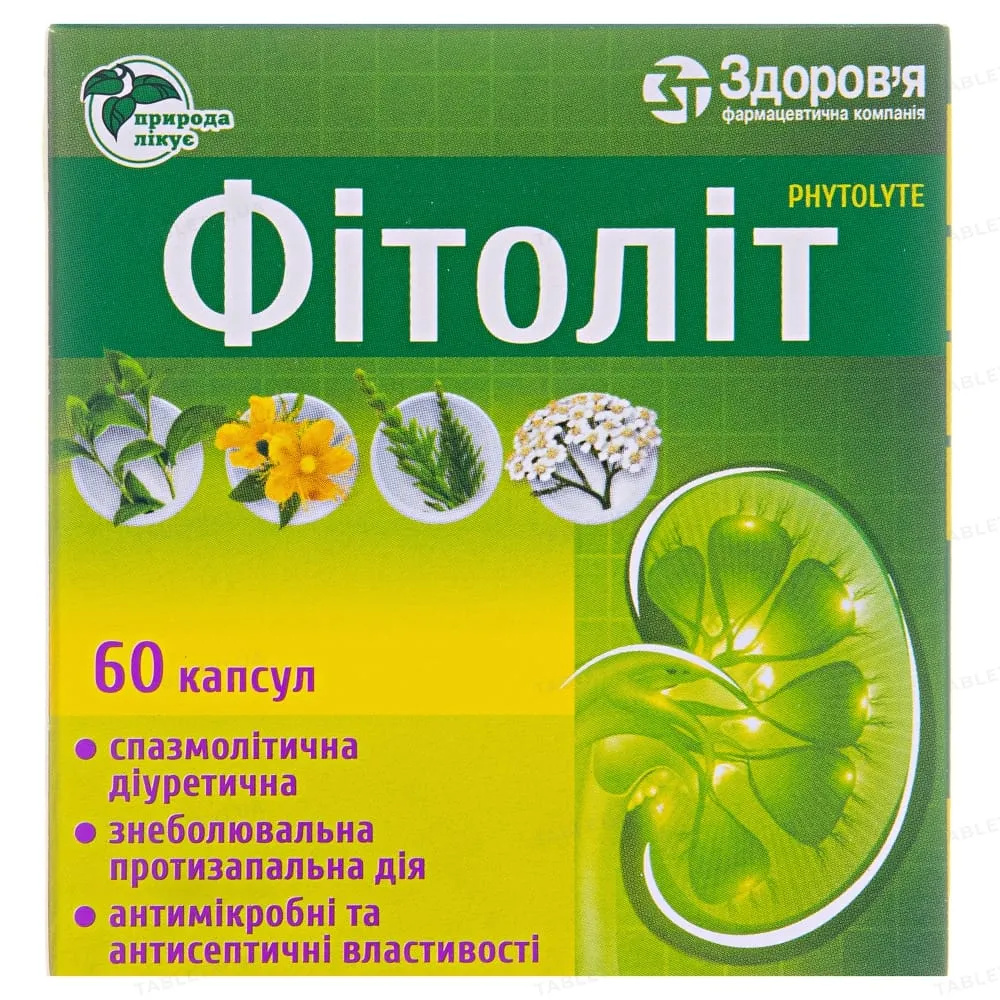
Table of Contents
INSTRUCTIONS FOR MEDICAL USE OF THE MEDICINAL PRODUCT FHYTOLYTE (PHYTOLYTE)
Composition:
Active substances: 1 capsule contains
- Equiseti herbae (common horsetail) dry extract (7.69:1) (extractant – purified water) 50 mg,
- Hyperici herbae (St. John's wort) dry extract (9.26:1) (extractant – ethanol 50%) 30 mg,
- Equiseti arvensis herbae (field horsetail) dry extract (9.17:1) (extractant – ethanol 50%) 25 mg,
- Avens (12.5:1) (extractant – ethanol 70%) 25 mg;
Excipients: magnesium carbonate light, sucrose, potato starch, colloidal anhydrous silicon dioxide, modified silicon dioxide, calcium stearate;
the capsule shell contains quinoline yellow (E 104), erythrosine FD&C Red 3 (E 127), titanium dioxide (E 171), gelatin.
Pharmaceutical form. Capsules.
Main physicochemical characteristics: hard gelatin capsules of yellow color. The capsule contents – a mixture of granules and powder ranging from light brown to dark brown with a greenish tint. The presence of powder particle agglomerates is permissible. The manufacturer's trademark (ZT) may be printed on the capsule.
Pharmacotherapeutic group. Medicinal products used in urology. Agents promoting dissolution of urinary calculi. ATC code G04BC.
Pharmacological properties.
Pharmacodynamics. A combined medicinal product containing plant extracts.
The drug has spasmolytic, diuretic, analgesic, and anti-inflammatory effects, possesses antimicrobial and antiseptic properties, and regulates mineral metabolism. It reduces the frequency and intensity of renal colic, normalizes the physicochemical parameters of urine, restores optimal urodynamics and urinary homeostasis, and decreases leukocyturia. It promotes the flushing out of sand and small concrements, and prevents the growth of existing concrements or the formation of new ones.
The drug exerts a beneficial effect on the state of spermatogenesis under conditions of experimental prostatitis (increases spermatozoa concentration, prolongs the duration of spermatozoa motility and the percentage of motile forms, reduces the number of pathologically altered spermatozoa, and favorably affects acid and osmotic resistance).
Pharmacokinetics. Not studied.
Clinical characteristics.
Indications. Treatment and prevention of urolithiasis (presence in kidneys and urinary tract of primary and recurrent stones of various sizes and locations); complications caused by passage of stone fragments after extracorporeal shock wave lithotripsy; in renal colic; prevention of urinary calculi formation after their surgical removal and/or spontaneous passage; as part of comprehensive supportive therapy for chronic pyelonephritis, chronic inflammatory diseases of lower urinary tract (cystitis, urethritis), and chronic prostatitis.
Contraindications. Hypersensitivity to any component of the drug, thrombophlebitis, changes in blood rheological properties, acute inflammatory diseases of kidneys and urinary bladder, presence of stones in urinary tract larger than 6 mm, nephritides, nephroses, nephronephritis, glomerulonephritis, arterial hypertension.
Interaction with other medicinal products and other types of interactions. It is not recommended to use in patients taking anticoagulants, antibiotics, sulfonamides, contraceptives, calcium channel blockers, female sex hormones, hypocholesterolemic agents (statins), cardiac glycosides.
If concomitant use of any other medicinal products is necessary, medical advice should be sought.
Special precautions for use.
The drug can be used in combination with antimicrobial agents.
If any of the adverse reactions listed below occur, the drug should be taken after a meal, but treatment should not be discontinued. To facilitate the excretion of concrements, it is recommended to drink a large amount of water (1.5–2 L) within 2–3 hours.
The drug contains sugar. If the patient has been diagnosed with intolerance to certain sugars, medical advice should be sought before taking this medicinal product.
In patients with urolithiasis and marked pyuria, administration of antimicrobial agents is indicated.
Use during pregnancy or breastfeeding. The drug is contraindicated during pregnancy. If it is necessary to use the drug, breastfeeding should be discontinued for the duration of treatment.
Ability to affect reaction speed when driving vehicles or operating machinery. Data are lacking.
Method of Administration and Dosage
For oral administration to adults and children aged 12 years and older, taken before meals.
Urolithiasis. Take 2–3 capsules three times daily. The treatment course lasts 20–30 days. After a break, the course may be repeated.
Prevention of recurrent stone formation in kidneys and urinary tract following extracorporeal shock wave lithotripsy. Take 2–3 capsules three times daily for 5–15 days; after surgical removal of stones and/or their spontaneous passage — take 2–3 capsules three times daily for 1–2 months.
Renal colic. Take 2–3 capsules after alleviating pain with analgesics.
Chronic pyelonephritis. The drug should be taken either concurrently with or following basic therapy as monotherapy: 2 capsules three times daily before meals for 3 weeks. Treatment courses (with 1–2 week intervals) may be repeated for 2–3 months, transitioning to a maintenance dose of 1–2 capsules per day.
Chronic cystitis, urethritis, and prostatitis. Take 2–3 capsules three times daily for 21–28 days. The course may be repeated after 2 weeks (2 capsules three times daily).
The number of treatment courses and their duration should be determined individually by a physician based on the patient's condition.
Children. The drug is contraindicated for use in children under 12 years of age.
Overdose. No toxic effects of the drug have been reported. After a single intake of more than 30 capsules, adverse reactions may be intensified. Overdose or prolonged use may cause a bitter taste in the mouth and discomfort in the liver area. In case of overdose, gastric lavage and administration of activated charcoal are recommended. Symptomatic treatment is indicated.
Adverse reactions.
The drug is well tolerated by patients and usually does not cause adverse reactions. Mild dyspeptic symptoms such as nausea and epigastric discomfort, vomiting, diarrhea, photosensitization, kidney tissue irritation (manifested by back pain and pain at the end of urination), and increased blood pressure may occur.
In individuals with increased sensitivity, allergic reactions are possible (including redness, rash, itching, swelling). Prolonged use of the medicinal product may lead to tooth enamel discoloration and disturbances in bone tissue structure (osteoporosis).
If any adverse reactions occur, consult a physician.
Shelf life. 3 years.
Storage conditions. Store in the original packaging at a temperature not exceeding 25 °C. Keep out of reach of children.
Packaging. Capsules № 10×3, № 10×6 in blisters in a box.
Availability category. Over-the-counter.
Manufacturer. LIMITED LIABILITY COMPANY "CORPORATION "ZDOROVIYA".
Limited Liability Company "FARMEKS GROUP".
Manufacturer's address and location of business activity. Ukraine, 61013, Kharkiv region, city of Kharkiv, Shevchenka Street, 22.
(LIMITED LIABILITY COMPANY "CORPORATION "ZDOROVIYA")
Ukraine, 08301, Kyiv region, city of Boryspil, Shevchenka Street, 100.
(Limited Liability Company "FARMEKS GROUP")