Fitobronhol
Ukraine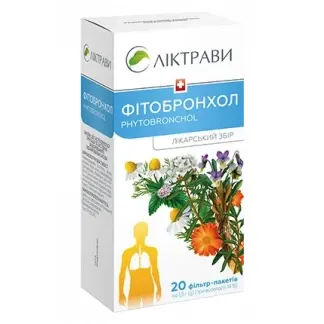
Table of Contents
INSTRUCTION FOR MEDICAL USE OF THE MEDICINAL PRODUCT PHYTOBRONCHOL
Composition:
Active substance: 1 g of herbal mixture contains:
- chamomile flowers (Matricariae flores) – 200 mg,
- common bogbean herb (Ledum palustre cormus) – 200 mg,
- marigold flowers (Calendulae flores) – 200 mg,
- violet herb (Viola e herba) – 200 mg,
- licorice roots (Glycyrrhizae radices) – 150 mg,
- peppermint leaves (Menthae piperitae folia) – 50 mg.
Pharmaceutical form. Herbal mixture.
Main physicochemical characteristics:
Powdered herbal material: a heterogeneous mixture of yellowish-green fragments with yellow-orange, reddish-brown, greyish-brown, dark green, greyish-green, yellowish-white, yellowish-grey, or bluish-violet specks;
Coarse powder: a heterogeneous mixture of brownish-yellow fragments with green, white, yellow-orange, and brown specks.
Pharmacotherapeutic group. Medicinal products used for cough and colds. Expectorants. ATC code R05C A10.
Pharmacological Properties
Pharmacodynamics.
The biologically active substances of the herbal mixture exert expectorant, anti-inflammatory, and soothing effects; enhance the functional activity of the respiratory tract epithelium; promote liquefaction and elimination of sputum; and relieve and reduce cough.
Clinical characteristics.
Indications.
In complex therapy of inflammatory diseases of the respiratory tract (including bronchitis, tracheitis), associated with impaired bronchial secretion and reduced mucus clearance.
Contraindications.
Hypersensitivity to the drug or to salicylates. Glomerulonephritis, hepatitis, spasmophilia, croup, bronchial asthma. Organic heart lesions (myocarditis, pericarditis, myocardial infarction), impaired liver and kidney function.
Interaction with other medicinal products and other types of interactions.
When used concurrently, may enhance the effect of sedatives and agents that suppress the central nervous system. Should not be used together with cough suppressants. Concurrent use with cardiac glycosides, antiarrhythmic agents (quinidine), thiazide and loop diuretics, adrenocorticosteroids, and laxatives may increase the risk of hypokalemia.
Special precautions for use.
In patients with gastroesophageal reflux (heartburn), an exacerbation of heartburn is possible.
Use during pregnancy or breastfeeding. Contraindicated.
Ability to affect the speed of reactions when driving or operating machinery. Not studied.
Method of administration and dosage.
Place 2 tablespoons of the preparation into an enameled container, pour 200 mL of hot boiled water, cover with a lid, and steep in a boiling water bath for 15 minutes. Cool at room temperature for 45 minutes, then strain and squeeze the residue into the strained decoction. Adjust the volume of the infusion to 200 mL with boiled water.
Take warm before meals for 2–3 weeks: for adults and children aged 12 years and older – ⅓ cup three times a day; for children aged 6 to 12 years – 1–2 tablespoons three times a day; for children aged 3 to 5 years – 2–3 teaspoons three times a day.
Shake the infusion before use.
Place 2 filter packets into a glass or enameled container, pour 100 mL of boiling water, cover, and let steep for 15 minutes. Squeeze the filter packets. Adjust the volume of the resulting aqueous extract to 100 mL with boiled water.
Take warm before meals for 2–3 weeks: for adults and children aged 12 years and older – 100 mL three times a day; for children aged 6 to 12 years – 2–3 tablespoons three times a day; for children aged 3 to 5 years – 1–2 tablespoons three times a day.
Store the prepared aqueous extract in the refrigerator (at 2–8 °C) for no more than 2 days.
Children. The preparation may be used in children aged 3 years and older.
Overdose. Overdose or prolonged use (more than 2 months) may cause disturbances in water-electrolyte balance, potentially leading to hypokalemic myopathy and myoglobinuria, as well as nausea, vomiting, diarrhea, and allergic skin rashes. Exacerbation of adverse effects is possible.
Side effects.
Increase in blood pressure. Allergic reactions are possible (including hyperemia, rash, itching, skin swelling, contact dermatitis, nausea, vomiting, diarrhea). If adverse reactions occur, discontinue use of the product and consult a physician.
Shelf life. 2 years.
Do not use after the expiry date stated on the packaging.
Storage conditions. Store in the original packaging at a temperature not exceeding 25 °C, in a place inaccessible to children.
Packaging. 50 g in packs with an inner pouch; 1.5 g in a tea bag; 20 tea bags per pack or in a pack with an inner pouch.
Supply category. Over-the-counter.
Manufacturer/Marketing authorization holder. JSC "Liktravy", Ukraine.
Manufacturer's location and address of place of business / location of the marketing authorization holder.
Ukraine, 10001, Zhytomyr Oblast, city of Zhytomyr, Kyivske Shose, building 21.