Firulin 10000
Ukraine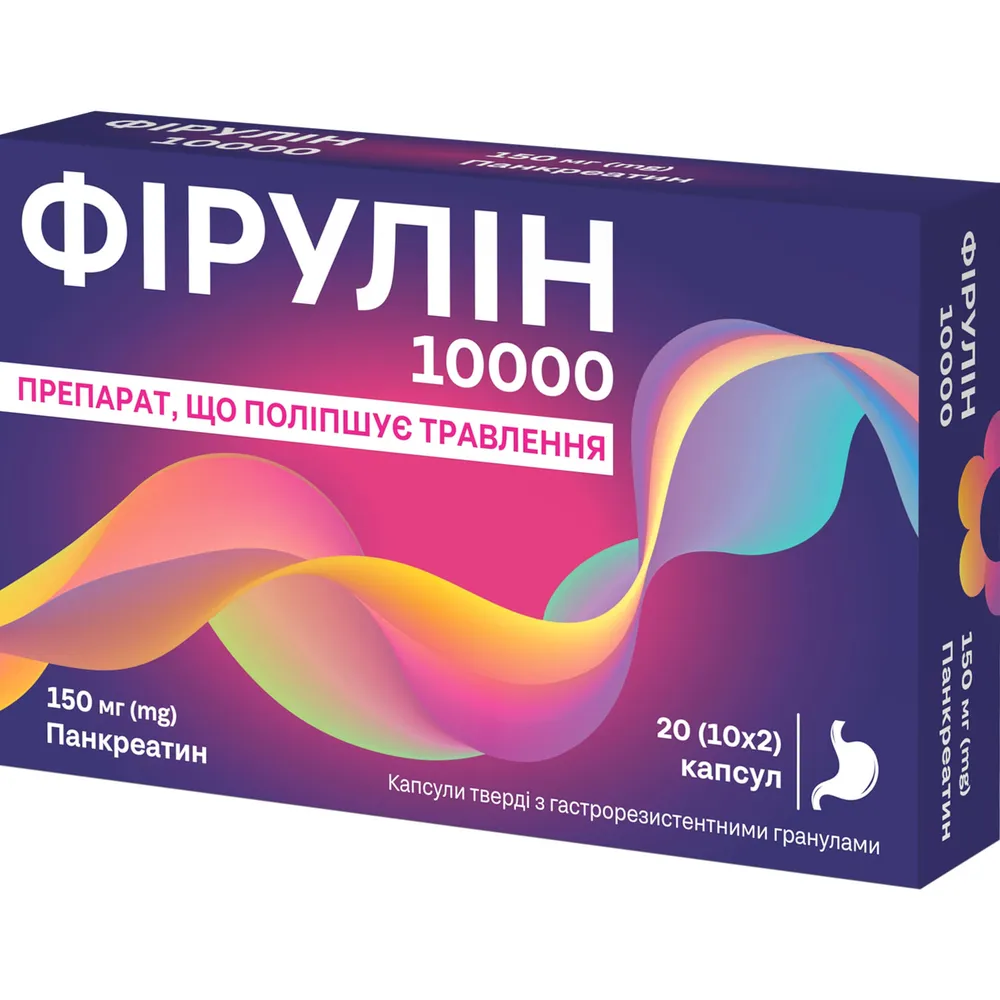
Table of Contents
INSTRUCTIONS FOR MEDICAL USE OF THE MEDICINAL PRODUCT FERULIN 10000 (FIRULIN 10000)
Composition:
Active substance: pancreatin;
1 hard capsule contains 150 mg of pancreatin in gastro-resistant granules, which have enzymatic activity: lipase 10,000 IU Ph. Eur., amylase 8,000 IU Ph. Eur., protease 600 IU Ph. Eur.;
Excipients: macrogol 8000, hypromellose, hypromellose phthalate, triethyl citrate, dimethicone;
hard capsule: gelatin, purified water, iron oxide yellow (E 172), iron oxide red (E 172), iron oxide black (E 172), titanium dioxide (E 171), sodium lauryl sulfate.
Pharmaceutical form. Hard capsules with gastro-resistant granules.
Main physicochemical characteristics: hard gelatin capsule size 1 with an opaque brown cap and a transparent colorless body, containing brownish gastro-resistant granules.
Pharmacotherapeutic group. Digestive enzymes and other agents improving digestion. Pancreatic enzyme preparations.
ATC code A09AA02.
Pharmacological Properties
Pharmacodynamics
FIRULIN 10000 contains porcine pancreatic enzymes in the form of enteric-coated (acid-resistant) granules in gelatin capsules. The capsules dissolve rapidly in the stomach, releasing a large number of granules according to the multi-dose principle, ensuring good mixing with gastric contents, transport from the stomach along with its contents, and optimal distribution of enzymes in the intestinal contents after release. When the granules reach the small intestine, the coating dissolves rapidly (at pH > 5.5), releasing enzymes with lipolytic, amylolytic, and proteolytic activity, which enables the breakdown of fats, carbohydrates, and proteins. The products of pancreatic digestion are subsequently absorbed either directly or after further hydrolysis by intestinal enzymes.
Clinical efficacy
Treatment with pancreatin has been shown to significantly reduce symptoms associated with impaired exocrine pancreatic function, including stool consistency, abdominal pain, flatulence, and frequency of defecation, regardless of the underlying disease in patients with exocrine pancreatic insufficiency.
Preclinical safety data
Preclinical studies have not indicated relevant acute, subchronic, or chronic toxicity. Studies on genotoxicity, carcinogenicity, or toxic effects on reproductive function have not been conducted.
Pharmacokinetics
Animal studies have not shown evidence of absorption of enzymes in unchanged form; therefore, classical pharmacokinetic studies have not been performed. Medicinal products containing pancreatic enzymes do not require systemic absorption to achieve their therapeutic effect. On the contrary, their full therapeutic action occurs within the lumen of the gastrointestinal tract. Moreover, as proteins, they undergo proteolytic digestion in the gastrointestinal tract before being absorbed in the form of peptides and amino acids.
Clinical characteristics
Indications
Treatment of exocrine pancreatic insufficiency in adults and children caused by various diseases and conditions, including but not limited to the following:
- Chronic pancreatitis;
- Pancreatectomy;
- Gastrectomy;
- Gastrointestinal anastomosis surgery (e.g., gastroenterostomy according to Billroth II);
- Shwachman-Diamond syndrome;
- Condition following an acute pancreatitis attack and restoration of enteral or oral nutrition.
Contraindications
Hypersensitivity to the active substance, to pork (pork allergy), or to any other component of the medicinal product.
Acute hepatitis.
Mechanical jaundice.
Obstructive intestinal obstruction.
Interaction with other medicinal products and other forms of interaction
Iron. Concomitant use of pancreatin with iron preparations may reduce iron absorption.
Folic acid. Absorption of folic acid may be reduced in patients taking pancreatin; therefore, monitoring of folic acid levels is recommended during concomitant use.
Acarbose, miglitol. Pancreatin may reduce the effectiveness of acarbose and miglitol. Therefore, blood glucose levels should be monitored in patients during concomitant use.
Special precautions for use
During the use of high doses of pancreatin, narrowing of the ileocecal region and colon (fibrosing colonopathy) has been observed. Therefore, if unusual abdominal symptoms occur or there is a change in the nature of existing abdominal symptoms, consultation with a physician is recommended to rule out fibrosing colonopathy, especially in patients receiving more than 10,000 IU of lipase/kg/day (see section "Adverse reactions").
There is a theoretical risk of transmission of porcine viral infections, including those caused by new or undefined viruses. The possibility of porcine viruses infecting humans cannot be completely excluded. However, to date, no cases of infectious disease transmission have been reported following the use of porcine pancreatin preparations.
Use with caution in patients with renal insufficiency or hyperuricemia.
Should not be used in acute or chronic pancreatitis during the exacerbation phase until the patient is switched to enteral nutrition.
Excipients
This medicinal product contains sodium in the amount of 0.00022 mmol/capsule, i.e. practically sodium-free.
Use during pregnancy or breastfeeding
There are no data on the use of pancreatin in pregnant women. Animal studies are insufficient to determine the impact of pancreatin on pregnancy, embryonal/fetal development, delivery, or postnatal development of the child. The potential risk for humans is unknown. Therefore, the medicinal product FERULIN 10000 should not be used during pregnancy and breastfeeding, except in individual cases where, in the opinion of the physician, the benefit of its use outweighs the possible risks.
Ability to affect reaction speed when driving or operating machinery
The effect of the medicinal product on the ability to drive or operate machinery is absent or negligible.
Method of Administration and Dosage
Method of Administration
The medicinal product should be taken during or immediately after a meal.
Capsules and granules must be swallowed whole, without breaking or chewing, and taken with an adequate amount of liquid during or immediately after a meal, particularly a light snack.
If a patient is unable to swallow the capsule whole (e.g., children or elderly patients), it may be carefully opened and the granules mixed with soft food with an acidic environment (pH < 5.5) that does not require chewing, or with a liquid with an acidic environment (pH < 5.5). Suitable options include apple puree, yogurt, or fruit juice with pH < 5.5, such as apple, orange, or pineapple juice.
When mixing granules with liquid or food, it is important to consume the mixture immediately. This mixture must not be stored.
Breaking or chewing the granules, or mixing them with food or liquid with pH > 5.5, may damage their protective enteric coating. This could lead to premature release of enzymes in the oral cavity, reduced efficacy of the medicinal product, and irritation of the mucous membranes.
Care must be taken to ensure that no residue of the medicinal product remains in the oral cavity.
Adequate fluid intake during pancreatin treatment is very important, especially during periods of increased fluid loss. Fluid deficiency may worsen constipation.
Any mixture of granules with food or liquid must be taken immediately and must not be stored.
Dosage
The dosage of the medicinal product is based on individual patient needs and depends on the severity of the disease and dietary composition.
Treatment should be initiated at the lowest recommended dose, gradually increasing while carefully monitoring the patient's response to treatment, disease symptoms, and nutritional status. Patients should be warned against self-adjusting the dose. Several days may be required to adjust the dosage appropriately.
Adults
The usual initial dose is 10,000 to 25,000 IU of lipase activity per main meal. However, some patients may require higher doses to control steatorrhea and maintain adequate nutritional status. According to standard clinical practice, a minimum of 20,000 to 50,000 IU of lipase activity should be taken with food. The dose for main meals (breakfast, lunch, or dinner) may range from 25,000 to 80,000 IU of lipase activity, while for light snacks between main meals, the dose should be half the individual main-meal dose.
Children (from birth to 18 years of age)
Dosage and duration of treatment for children are determined individually by the physician.
Duration of Treatment
The duration of treatment is determined by the physician based on the nature and course of the disease.
Children
The medicinal product FERULIN 10000 may be used in children (see section "Method of Administration and Dosage").
Overdose
Cases of hyperuricosuria and hyperuricemia associated with the intake of extremely high doses of pancreatin have been reported.
Supportive measures are recommended, including discontinuation of enzyme therapy and ensuring adequate rehydration.
Adverse Reactions
Gastrointestinal disorders, mostly of mild or moderate severity, have been most frequently reported and were primarily associated with the underlying disease.
The frequency categories of adverse reactions are defined as follows: very common (≥ 1/10); common (≥ 1/100, < 1/10); uncommon (≥ 1/1000, < 1/100); rare (≥ 1/10000, < 1/1000); very rare (< 1/10000); frequency not known (cannot be estimated from available data).
Gastrointestinal disorders:
Very common — abdominal pain*;
Common — nausea, vomiting, constipation, bloating, diarrhoea*;
Very rare — changes in bowel habits, irritation of the skin around the mouth or anus, especially after high-dose administration;
Frequency not known — narrowing of the ileocaecal region and ascending colon (fibrosing colonopathy)**.
Skin and subcutaneous tissue disorders:
Uncommon — rash;
Frequency not known — pruritus, urticaria.
Immune system disorders:
Frequency not known — immediate-type allergic reactions***, hypersensitivity (anaphylactic reactions and gastrointestinal-localized reactions).
Effects on laboratory and instrumental test results:
Frequency not known — hyperuricaemia, hyperuricosuria, folic acid deficiency.
* The frequency was similar to or lower than that observed with placebo.
** Cases of narrowing of the ileocaecal region and colon (fibrosing colonopathy) have been reported in patients receiving high doses of pancreatin-containing products (see section "Special precautions").
*** Allergic reactions were predominantly cutaneous (rash, urticaria); other manifestations included sneezing, lacrimation, bronchospasm, and dyspnoea.
Paediatric population
No specific adverse reactions have been identified in children. The frequency, type, and severity of adverse reactions in children are similar to those observed in adults.
Reporting suspected adverse reactions
Reporting suspected adverse reactions after medicinal product authorization is important. It allows continued monitoring of the benefit-risk balance of the medicinal product. Medical and pharmaceutical professionals, as well as patients or their legal representatives, are encouraged to report all suspected adverse reactions and lack of efficacy via the Automated Pharmacovigilance Information System at the following link: https://aisf.dec.gov.ua.
Shelf life. 2 years.
Storage conditions
Store at temperatures not exceeding 25°C in the original packaging.
Keep out of the reach and sight of children.
Packaging. 10 capsules per blister, 2 or 10 blisters per cardboard box.
Availability. Over-the-counter (without prescription).
Manufacturer. Kusum Healthcare Pvt Ltd.
Manufacturer's address
Plot No. M-3, Indore Special Economic Zone, Phase-II, Pithampur, Distt. Dhar, Madhya Pradesh, Pin 454774, India.