Ferezol
Ukraine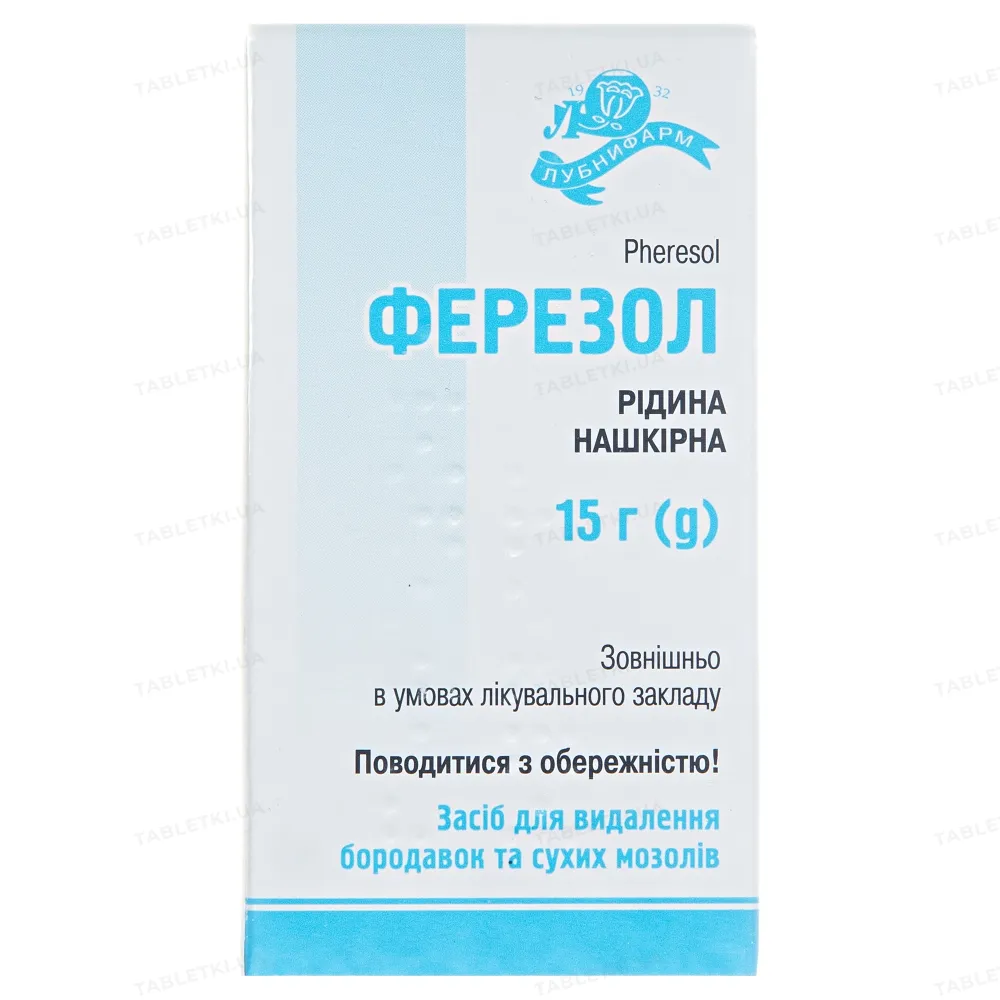
Table of Contents
INSTRUCTION for medical use of the medicinal product FEREZOL (PhereSol)
Composition:
Active substances: 1 g of the liquid contains phenol 600 mg, tricresol 400 mg.
Pharmaceutical form. Topical liquid.
Main physico-chemical properties: free-flowing oily liquid, light brown to dark brown in color, with a phenolic odor.
Pharmacotherapeutic group.
Agents used in dermatology. Agents used for removal of warts and corns. ATC code D11AF.
Pharmacological properties.
Pharmacodynamics.
Ferezol is a combination drug that exerts a cauterizing and bactericidal effect. The mechanism of antimicrobial action consists in the irreversible coagulation of proteins that are part of the vital structures of pathogens (cytoplasmic membrane, flagella), leading to loss of their functions and microbial death. The drug does not exhibit pronounced selectivity towards specific types of microorganisms and is active against gram-positive and gram-negative bacteria, fungi, viruses, and protozoa. The mechanism of cauterizing action is due to the destruction of cellular macromolecules and fibers of the skin and mucous membranes (chemical burn). Upon contact with body tissues, it causes chemical burns.
Pharmacokinetics.
Not established.
Clinical characteristics.
Indications.
For removal of papillomas, cutaneous genital warts, keratomas, warts, and dry calluses.
Contraindications.
Hypersensitivity to the components of the drug. Nevi.
Interaction with other medicinal products and other forms of interaction.
The components of the drug dissolve easily in ointment bases; therefore, applying any ointments to skin areas treated with Ferезol is not recommended.
Special precautions for use
The product must not come into contact with the eyes or mucous membranes. Dressing of the treated area of skin or removal of scabs is not permitted; the product must not be reapplied before the time intervals specified above. Areas of skin treated with Ferizol must not come into contact with synthetic clothing.
To prevent dermatitis, the skin area treated with Ferizol should be allowed to dry in open air. The area treated with Ferizol must not be coated with any ointments; washing with water is permitted. When used correctly, the product does not leave scars.
Ferizol must not be used on skin surfaces larger than 20 cm².
Use during pregnancy or breastfeeding
Ferizol may be used during pregnancy or breastfeeding only if the expected benefit to the mother outweighs the potential risk to the fetus or infant.
During breastfeeding, removal of lesions located on the mammary glands or hands is not recommended.
Effect on the ability to drive or operate machinery
No systemic effect. However, when treating skin areas near the eye with Ferizol, retinal edema may occur, which could negatively affect visual acuity. In such cases, driving or operating machinery should be avoided.
Method of Administration and Dosage.
Ferezol is intended for use in adults only and must be administered exclusively in a medical facility and externally. The medication is applied directly to the affected lesion, taking care to avoid contact with adjacent skin areas and especially mucous membranes. Papillomas, warts, and condylomas are treated continuously for 10–60 minutes (depending on their size). For papillomas with a thin stalk, only the stalk should be treated. Repeat treatment may be performed 6–8 days after the eschar has detached.
Warts on hands, keratomas, and dry calluses with signs of hyperkeratosis should first be softened by soaking, followed by continuous application of the medication for 1 hour. If necessary, the procedure may be repeated after 2 weeks. Up to 4–5 procedures are permitted.
Each procedure is performed by moistening a firm pledget made of surgical cotton wool with Ferezol and carefully applying the medication to the affected area.
Children.
Not recommended for use in children.
Overdose.
If the medication comes into contact with a large skin surface area, chemical burns and systemic intoxication may occur.
Treatment. Symptomatic therapy.
Adverse reactions.
Skin-related: application of FereSol to skin areas near the eye may cause retinal edema, which usually resolves spontaneously.
Immune system-related: allergic reactions are possible in individual cases.
General and application site reactions: sensation of burning at the application site.
Shelf life. 4 years.
Storage conditions.
Store in the original packaging at a temperature not exceeding 25 °C.
Keep out of reach of children.
If crystals form, the vial should be heated in a water bath at 30–40 °C before use, gently shaking its contents; after the crystals dissolve, the preparation is suitable for use. Do not use the preparation after the expiry date.
Packaging.
15 g in vials, pack of 1.
Prescription status. By prescription.
Manufacturer.
JSC "Lubnypharm".
Manufacturer's address and place of business.
16, Barvinkova Street, Lubny, Poltava region, 37500, Ukraine.
INSTRUCTION
for medical use of medicinal product
FereSol
(PhereSol)
Composition:
Active substances: 1 g of liquid contains phenol 600 mg, tricresol 400 mg.
Pharmaceutical form. Topical liquid.
Main physicochemical properties: freely flowing oily liquid, light brown to dark brown in color, with a phenolic odor.
Pharmacotherapeutic group.
Agents used in dermatology. Agents used for removal of warts and calluses. ATC code D11AF.
Pharmacological properties.
Pharmacodynamics.
FereSol is a combined agent exerting cauterizing and bactericidal effects. The mechanism of antimicrobial action involves irreversible coagulation of proteins in vital structures of microorganisms (cytoplasmic membrane, flagella), resulting in loss of their functions and microbial death. The drug has no pronounced selectivity towards specific types of microorganisms and is active against Gram-positive and Gram-negative bacteria, fungi, viruses, and protozoa. The cauterizing effect is due to destruction of macromolecules in skin cells and fibers, as well as mucous membranes (chemical burn). Upon contact with body tissues, it causes chemical burns.
Pharmacokinetics.
Not established.
Clinical characteristics.
Indications.
For removal of papillomas, skin genital warts, keratomas, warts, and dry calluses.
Contraindications.
Hypersensitivity to the components of the drug. Nevi (moles).
Interaction with other medicinal products and other forms of interaction.
The components of the drug are easily soluble in ointment bases; therefore, it is not recommended to apply any ointments to skin areas treated with FereSol.
Special precautions.
Contact of the drug with eyes and mucous membranes must be avoided. Bandaging of treated skin areas, or removal of scabs, is not allowed. Reapplication of the drug before the recommended intervals is prohibited. Synthetic clothing must not come into contact with skin areas treated with FereSol.
To prevent dermatitis, the treated skin area should be allowed to dry in the open air. The area treated with FereSol must not be covered with any ointments; washing with water is permitted. When used correctly, the drug does not leave scars.
The skin surface treated with FereSol must not exceed 20 cm².
Use during pregnancy or breastfeeding.
The use of FereSol during pregnancy or breastfeeding is possible only when the expected benefit to the mother outweighs the potential risk to the fetus or infant.
During breastfeeding, removal of lesions located on the breasts or hands is not recommended.
Ability to affect reaction rate while driving or operating machinery.
No effect. However, application of FereSol to skin near the eye may cause retinal edema, which may negatively affect visual acuity. In such cases, driving or operating machinery should be avoided.
Method of administration and dosage.
FereSol is intended for topical use in adults only and must be administered only in a healthcare facility. The drug is applied directly to the affected lesions, avoiding contact with adjacent skin areas and especially mucous membranes. Papillomas, warts, and condylomas are treated continuously for 10–60 minutes (depending on their size). For papillomas with a thin stalk, only the stalk is treated. Repeat treatment is performed 6–8 days after the scab has detached.
Warts on hands, keratomas, and dry calluses with signs of keratosis should first be softened by steaming, then treated continuously with the drug for 1 hour. If necessary, the procedure may be repeated after 2 weeks. Up to 4–5 procedures are permitted.
Each procedure should be performed using a firm pledget made of surgical cotton, moistened with FereSol, and carefully applied to the affected area.
Children.
Not used in children.
Overdose.
Application of the drug to a large skin surface area may result in chemical burns and systemic intoxication.
Treatment: symptomatic therapy.
Adverse reactions.
Skin-related: application of FereSol to skin areas near the eye may cause retinal edema, which usually resolves spontaneously.
Immune system-related: allergic reactions are possible in individual cases.
General and application site reactions: sensation of burning at the application site.
Shelf life. 4 years.
Storage conditions.
Store in the original packaging at a temperature not exceeding 25 °C.
Keep out of reach of children.
If crystals form, the vial should be heated in a water bath at 30–40 °C before use, gently shaking its contents; after the crystals dissolve, the preparation is suitable for use. Do not use the preparation after the expiry date.
Packaging.
15 g in vials, pack of 1.
Prescription status. By prescription.
Manufacturer.
JSC "Lubnypharm".
Manufacturer's address and place of business.
16, Barvinkova Street, Lubny, Poltava region, 37500, Ukraine.