Fenokit
Ukraine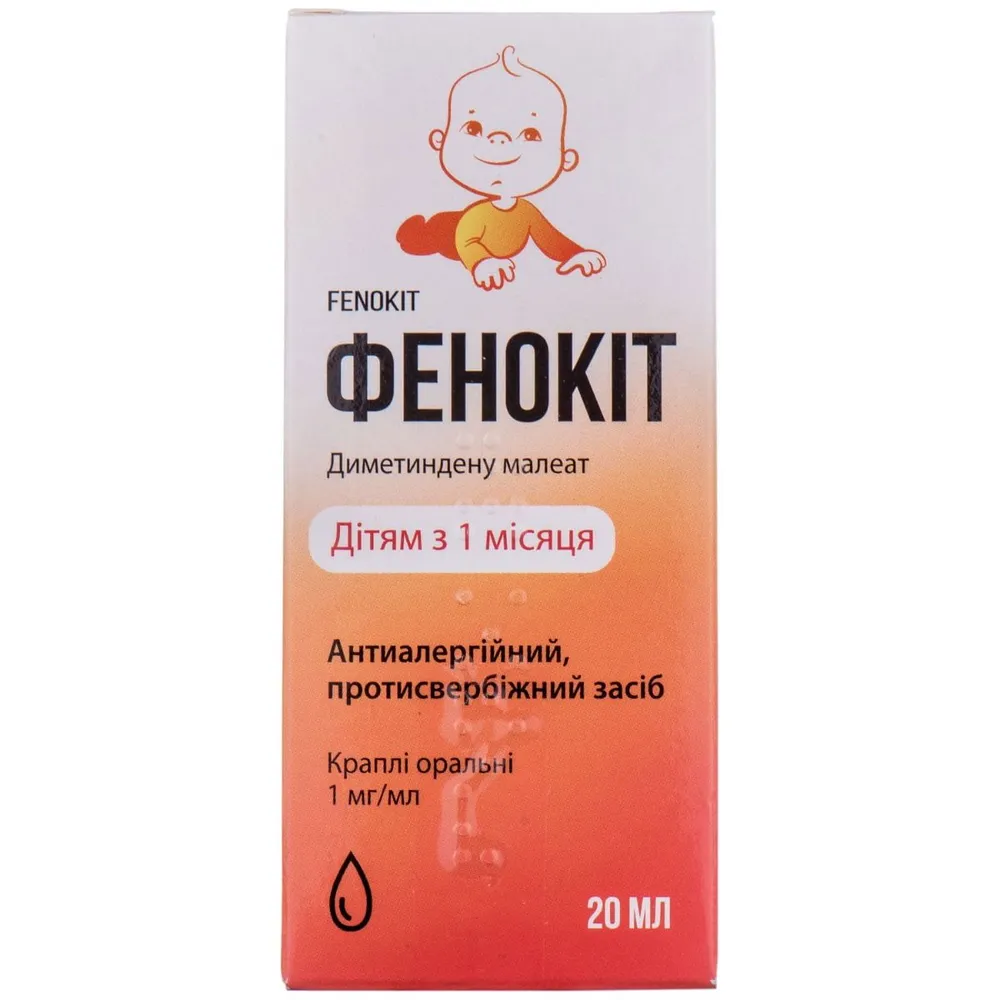
Table of Contents
INSTRUCTIONS FOR MEDICAL USE OF THE MEDICINAL PRODUCT FENOKIT (FENOKIT)
Composition:
Active ingredient: dimetindene maleate;
1 ml contains dimetindene maleate 1 mg;
Excipients: benzoic acid (E 210); citric acid monohydrate; sodium hydrogen phosphate dodecahydrate; disodium edetate; propylene glycol; sodium saccharin; purified water.
Pharmaceutical form. Oral drops.
Main physicochemical properties: clear, colorless solution, practically odorless.
Pharmacotherapeutic group. Antihistamines for systemic use.
ATC code R06AB03.
Pharmacological Properties
Pharmacodynamics
Dimetindene maleate is a phenindene derivative. It is a histamine antagonist at the H1-receptor level. At low concentrations, it exerts a stimulating effect on histamine methyltransferase, resulting in histamine inactivation. It exhibits high affinity for H1-receptors and acts as a mast cell stabilizer. Dimetindene maleate has no effect on H2-receptors. It also possesses local anesthetic properties.
Dimetindene maleate is an antagonist of bradykinin, serotonin, and acetylcholine. It exists as a racemic mixture with R-(-)-dimetindene, which has more pronounced H1-antihistaminic activity. Dimetindene maleate significantly reduces the increased capillary permeability associated with immediate-type allergic reactions. In combination with histamine H2-receptor antagonists, the drug inhibits virtually all histamine effects on circulation.
Studies have shown that the effect of a single 4 mg dose of dimetindene in the form of drops on skin reactions persists up to 24 hours after administration.
Pharmacokinetics
Systemic bioavailability of dimetindene in the form of oral drops is approximately 70%. After oral administration, maximum plasma concentration of dimetindene is reached within 2 hours. The elimination half-life is approximately 6 hours.
At concentrations ranging from 0.09 to 2 μg/mL, plasma protein binding of dimetindene is approximately 90%. The drug is metabolized in the body via hydroxylation and methoxylation. Dimetindene and its metabolites are excreted via bile and urine.
Preclinical studies revealed no risk associated with the use of the drug at recommended doses. Dimetindene maleate showed no mutagenic or clastogenic properties.
Clinical characteristics.
Indications.
Symptomatic treatment of allergic diseases: urticaria, seasonal (hay fever) and perennial allergic rhinitis, drug and food allergies.
Pruritus of various origins, except that associated with cholestasis. Pruritus in skin disorders with rashes, such as chickenpox. Insect bites.
An adjunctive agent in eczema and other pruritic dermatoses of allergic origin.
Contraindications.
Hypersensitivity to dimetindene maleate or to any other component of the medicinal product. Presence of pyloric or duodenal stenosis in the patient.
Contraindicated in children under 1 month of age, especially premature infants.
Interaction with other medicinal products and other forms of interaction.
When used concomitantly with drugs that depress the central nervous system (CNS), such as opioid analgesics, anticonvulsants, antidepressants (tricyclic antidepressants and monoamine oxidase inhibitors), other antihistamines, antiemetics, antipsychotics, anxiolytics, hypnotics, scopolamine, and ethanol, an enhanced CNS depression may occur, which could lead to adverse effects or even life-threatening consequences.
Tricyclic antidepressants and anticholinergic drugs, such as bronchodilators, gastrointestinal spasmolytics, mydriatics, and urological antimuscarinic agents, may produce an additive antimuscarinic effect when taken together with antihistamines, thereby increasing the risk of worsening glaucoma and urinary retention.
To minimize the risk of CNS depression or possible potentiation, concomitant use of procarbazine and antihistamines should be carried out with caution.
Special precautions for use
As with other antihistamines, caution should be exercised when administering the drug to patients with glaucoma, patients with bladder neck contracture and/or urinary retention, including those with benign prostatic hyperplasia, as well as patients with chronic obstructive pulmonary diseases.
As with all H1-receptor antagonists and partially H2-receptor antagonists, this drug should be used with caution in patients with epilepsy. Antihistamines may cause excitation in children.
The drug should be used with caution in elderly patients, in whom the risk of adverse reactions, including excitation and increased fatigue, is elevated. Misuse of the drug in elderly patients should be avoided. The recommended dosage and duration of use must not be exceeded without a physician's recommendation.
The drug in drop form should be administered with caution to children under 1 year of age: the sedative effect may be accompanied by episodes of nocturnal apnea. In young children, antihistamines may cause excitation.
Phenokit oral drops may be used in children aged 1 month to 1 year only upon physician's recommendation and when there are clear indications for antihistamine therapy. The recommended dose must not be exceeded.
This medicinal product contains 99.13 mmol (or 2.28 mg)/mL of sodium. Caution is advised when administering to patients on a sodium-restricted diet.
Use during pregnancy or breastfeeding.
Pregnancy. Clinical data on the use of the drug in pregnant women are lacking.
Animal studies with the original drug have not revealed teratogenic effects of dimetindene or any direct or indirect harmful effects on pregnancy, embryonal development, and/or postnatal development. Since information on the use of the drug during pregnancy is still lacking, Phenokit is not recommended for use during this period. Use is possible only in cases of extreme necessity and only under a physician's prescription, when the benefit to the mother outweighs the potential risk to the fetus.
Breastfeeding. It is highly likely that dimetindene maleate is excreted into breast milk. The drug is not recommended during breastfeeding. If treatment is necessary, breastfeeding should be discontinued for the duration of therapy.
Ability to affect reaction speed when driving or operating machinery.
When taking Phenokit, psychomotor reaction speed may be slowed, and drowsiness or dizziness may occur. Therefore, patients should refrain from driving vehicles or operating machinery.
Method of Administration and Dosage
The duration of use of the medication without medical consultation should not exceed 14 days.
Adults, children aged 12 years and older, and elderly patients.
The recommended daily dose is 3–6 mg, divided into 3 doses – 20–40 drops three times daily. For patients prone to drowsiness, it is recommended to take 40 drops before bedtime and 20 drops in the morning with breakfast.
Dose adjustment is not required for elderly patients.
Children.
Administration of the medication is recommended only after prior consultation with a physician. It may be used in children aged 1 month to 1 year only upon physician's recommendation. The daily dose is 0.1 mg (i.e., 2 drops) per kilogram of body weight per day, divided into 3 doses.
20 drops = 1 mL = 1 mg of dimetindene maleate.
Phenokit oral drops should not be exposed to high temperatures. They should be added directly to warm infant food immediately before feeding. If the child is fed with a spoon, the drops may be administered undiluted in a teaspoon. The drops have a pleasant taste.
Children.
Do not administer to children under 1 month of age, especially premature infants. Use oral drops with caution in children under 1 year of age: the sedative effect may be accompanied by episodes of nocturnal apnea. In young children, antihistamines may cause excitation.
Phenokit may be used in children aged 1 month to 1 year only after consultation with a physician and only when clear indications for antihistamine therapy exist. The recommended dose must not be exceeded.
Overdose.
In case of overdose of Phenokit, as with other antihistamines, the following symptoms may occur: central nervous system (CNS) depression, drowsiness (mainly in adults), CNS stimulation and antimuscarinic effects (especially in children and elderly patients), including excitement, ataxia, tachycardia, hallucinations, seizures, tremor, mydriasis, dry mouth, facial flushing, urinary retention, and fever. Subsequently, arterial hypotension, coma, and cardiopulmonary collapse may develop.
There is no specific antidote for antihistamine overdose. Standard measures should be taken: induce vomiting; if unsuccessful, perform gastric lavage; administer activated charcoal and a saline laxative to the patient, along with supportive measures to maintain cardiovascular and respiratory functions. The use of stimulants is not recommended. Vasoconstrictors may be used to treat arterial hypotension.
Adverse reactions.
The main adverse effect associated with the use of the drug is drowsiness, especially at the beginning of treatment. In very rare cases, allergic reactions may occur.
Immune system
Rare: anaphylactic reactions, including facial swelling, pharyngeal swelling, rash; muscle spasms and dyspnea.
Psychiatric disorders
Isolated cases: excitement.
Nervous system
Very common: increased fatigue.
Common: drowsiness, nervousness.
Isolated cases: headache, dizziness.
Gastrointestinal disorders
Isolated cases: gastrointestinal disturbances, nausea, dryness of mouth and throat.
Shelf life.
2 years.
Do not use the medication after the expiry date stated on the packaging.
Storage conditions.
Store at a temperature not exceeding 25 °C. Keep out of reach of children.
Packaging.
20 ml in a container with a dropper cap, closed with a cap, in a carton.
Prescription status.
Over-the-counter.
Manufacturer.
Ukrainian-Spanish joint enterprise "Sperco Ukraine".
Manufacturer's address and place of business.
21027, Vinnytsia, vul. 600-richchia, 25, Ukraine.
Tel.: + 38 (0432) 52-30-36. E-mail: [email protected]
www.sperco.ua