Femiclin
Ukraine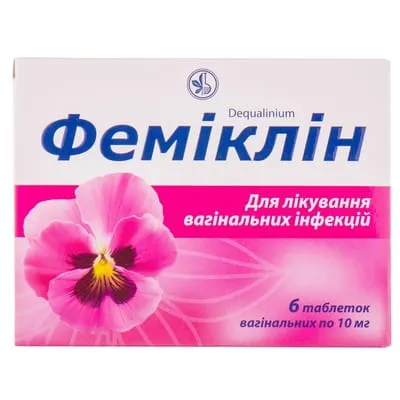
Table of Contents
INSTRUCTION FOR MEDICAL USE OF THE MEDICINAL PRODUCT FEMICLEAN (FEMICLEAN)
Composition:
Active substance: decqualinium chloride;
1 vaginal tablet contains 10 mg of decqualinium chloride;
Excipients: lactose monohydrate; microcrystalline cellulose; magnesium stearate.
Pharmaceutical form. Vaginal tablets.
Main physicochemical properties: elongated tablets with a biconvex surface, white or almost white in color.
Pharmacotherapeutic group. Antimicrobial and antiseptic agents used in gynecology, excluding combinations with corticosteroids. Quinoline derivatives. Decqualinium. ATC code G01AC05.
Pharmacological properties.
Pharmacodynamics.
Femiklin contains dequalinium chloride — a quaternary ammonium compound with a broad antimicrobial spectrum of activity against various Gram-positive and Gram-negative bacteria, fungi, and unicellular protozoa (Trichomonas vaginalis). The in vitro activity of dequalinium chloride has been demonstrated against the following microorganisms relevant to the vaginal area. This activity is expressed as the minimum inhibitory concentration (MIC).
| MIC (mg/l) |
MIC (mg/l) |
||
| Gram-positive bacteria |
Gram-negative bacteria |
||
| Streptococci group B |
2–8 |
Fusobacteria |
32–64 |
| Staphylococcus aureus |
0.2–10 |
Gardnerella vaginalis |
2.0–256 |
| Streptococci group A |
0.25–20 |
E. coli |
1–400 |
| Listeria sp. |
4–32 |
Serratia sp. |
3.1–400 |
| Peptostreptococci |
1–32 |
Klebsiella sp. |
3.1–400 |
| Streptococci group D |
0.2–64 |
Pseudomonas sp. |
5–400 |
| Fungi |
Bacteroides sp./Prevotella sp. |
64–512 |
|
| Candida tropicalis |
0.2–50 |
Proteus sp. |
20 – >1024 |
| Candida albicans |
0.2–200 |
Protozoa |
|
| Candida glabrata |
0.2–256 |
Trichomonas vaginalis |
28.8–400 |
| Candida krusei |
128 |
||
After dissolving a Femiklin vaginal tablet (10 mg of decquadinium chloride) in approximately 2.5–5 mL of vaginal fluid, the concentration of decquadinium chloride in it amounts to 4000–2000 mg/L, which is higher than the MIC90 for all tested pathogenic microorganisms. There have been no reports of microorganism resistance development to decquadinium chloride. As with other surfactants, the primary mechanism of action of decquadinium chloride involves increased cell permeability and subsequent loss of enzyme activity, leading to cell death. Decquadinium chloride in vaginal tablets exerts its effect locally within the vagina. A noticeable reduction in discharge and inflammation usually occurs within 24–72 hours.
Pharmacokinetics.
Since vaginal absorption is negligible, there are no data available on the pharmacokinetics of decquadinium chloride in humans.
Clinical characteristics.
Indications.
- Vaginal infections of bacterial and fungal origin (e.g. bacterial vaginosis and candidiasis).
- Trichomoniasis.
- Sanitation prior to gynecological interventions and childbirth.
Contraindications.
- Hypersensitivity to the active substance or to any of the excipients.
- Epithelial ulcers of the vagina and vaginal portion of the cervix uteri.
- Not to be used in young girls who have not yet experienced menarche and who have not reached sexual maturity.
Interaction with other medicinal products and other forms of interaction.
Interaction with other medicinal products is unknown. If concomitant use of any medicinal products is necessary, medical advice should be sought.
Anionic surfactants, such as soaps, detergents, etc., may reduce the antimicrobial activity of dequalinium chloride. Therefore, during treatment, it is not recommended to use soap intravaginally, as well as spermicidal agents and vaginal douching.
Dequalinium chloride in the form of vaginal tablets does not impair the functionality of latex condoms. There are no data regarding the effect of dequalinium chloride on non-latex condoms and other intravaginal devices such as diaphragms. Therefore, during treatment and for at least 12 hours after treatment, the use of non-latex condoms and other intravaginal devices is not recommended.
Special precautions for use.
Femiclin contains excipients that do not dissolve completely. Residues of the tablet may sometimes be found on underwear. This does not affect the efficacy of Femiclin.
Occasionally, when vaginal dryness is present, the vaginal tablet may not dissolve and may be expelled intact from the vagina. As a result, such treatment may not be effective. To prevent this, the tablet may be moistened with a small amount of water before insertion into a dry vagina.
Patients should use hygienic or daily sanitary pads. The medicinal product does not change the color of underwear. Patients should be advised to change their underwear and towels daily and to wash them at a temperature of at least 80 °C.
To minimize the risk of exposure of the newborn to dequalinium chloride, vaginal tablets should not be used within 12 hours before delivery.
There are no data on the efficacy and safety of repeated treatment in patients who did not respond to therapy or who experienced recurrence of infection immediately after initial treatment with the drug. Patients should be advised to consult their physician if symptoms persist at the end of treatment or if recurrence occurs.
Exceeding the recommended daily dose or duration of treatment increases the risk of vaginal epithelial ulceration.
There are no data on the efficacy and safety of treatment of bacterial vaginosis in women under 18 years of age or over 55 years of age.
Use during pregnancy or breastfeeding.
Pregnancy
Femiclin may be used during pregnancy or breastfeeding. However, caution should be exercised when prescribing Femiclin to pregnant women during the first trimester. Data from the use of dequalinium chloride in pregnant women indicate no adverse effects of dequalinium chloride on pregnancy or on the health of the fetus/newborn.
Post-marketing surveillance data from approximately 1.1 million cases of use during pregnancy indicate no adverse effects of dequalinium chloride on the course of pregnancy or on fetal/neonatal health.
There are no data on the passage of dequalinium chloride into breast milk.
Considering the data on negligible systemic absorption and the fact that treatment lasts only 6 days, adverse effects on the fetus or newborn are unlikely.
Reproductive toxicity studies in animals have not been conducted due to the expected low degree of absorption of dequalinium chloride following vaginal administration.
Femiclin should be used during pregnancy only if clearly needed.
Lactation
Because systemic absorption of Femiclin is negligible, harmful effects on the newborn/infant are unlikely.
Femiclin may be used during breastfeeding if clinically necessary.
Fertility
Studies on the effects on fertility in animals have not been conducted.
Effects on ability to drive and use machines.
Studies on the effects of the medicinal product on the ability to drive and operate machinery have not been conducted.
Method of Administration and Dosage
It is recommended to use 1 vaginal tablet daily for 6 days. The vaginal tablet should be inserted deeply into the vagina in the evening before going to bed. It is best to do this while lying on the back, with knees slightly bent.
During menstruation, treatment should be suspended and continued after menstruation ends.
Although reduction of discharge and inflammation usually occurs within 24–72 hours, treatment must be continued even if discomfort symptoms (such as itching, discharge, odor) have already resolved. Treatment lasting less than 6 days may lead to recurrence. The treatment course is 6 days.
Children
Since data on the safety and efficacy of using dequalinium chloride in children (under 18 years of age) are limited, the medicinal product is not recommended for patients in this age group.
Overdose
Cases of overdose have not been reported. However, exceeding the daily dose may lead to the development of vaginal ulcers. If overdose is accompanied by adverse effects, vaginal irrigation is recommended.
Adverse Reactions
The adverse reactions listed below are likely associated with dequalinium chloride.
Adverse reactions are classified by system organ class and frequency: common (≥ 1/100 to < 1/10), uncommon (≥ 1/1000 to < 1/100), frequency not known (these adverse reactions have been reported during the post-marketing period).
Reproductive system and breast.
Common: vaginal discharge, vulvovaginal pruritus, burning sensation in the vulvovaginal area.
Uncommon: vaginal bleeding, vaginal pain.
Frequency not known: vaginal epithelial ulceration and maceration, uterine bleeding, erythema, vaginal dryness.
Infections and infestations.
Common: vaginal candidiasis.
Uncommon: bacterial vaginosis, fungal skin infection, vulvitis, vulvovaginitis.
Frequency not known: cystitis.
Nervous system disorders.
Uncommon: headache.
Gastrointestinal disorders.
Uncommon: nausea.
General disorders and administration site conditions.
Frequency not known: allergic reactions with symptoms such as urticaria, erythema, exanthema, edema, rash, or pruritus, fever.
Reporting of suspected adverse reactions.
Reporting suspected adverse reactions after medicine authorization is important. It allows continued monitoring of the benefit-risk balance of the medicine. Healthcare and pharmaceutical professionals, as well as patients or their legal representatives, should report all suspected adverse reactions and lack of efficacy through the automated pharmacovigilance information system at the following link: https://aisf.dec.gov.ua
Shelf life. 3 years.
Storage conditions.
Store in the original packaging at a temperature not exceeding 25 °C.
Keep out of reach and sight of children.
Packaging.
6 tablets per blister; 1 blister per carton.
Supply category. Over-the-counter.
Manufacturer. JSC "KYIV VITAMIN PLANT".
Manufacturer's address and place of business.
38 Kopilivska Street, Kyiv, 04073, Ukraine.
Web-site: www.vitamin.com.ua.