Fexofen-sanovel
Ukraine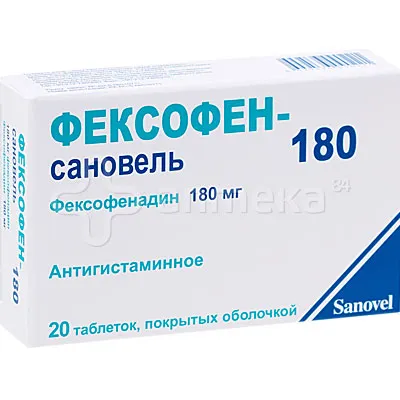
Table of Contents
INSTRUCTIONS FOR MEDICAL USE OF THE MEDICINAL PRODUCT FEXOFEN–sanovel (FEXOFEN–sanovel)
Composition:
Active ingredient: fexofenadine;
1 tablet contains 180 mg of fexofenadine hydrochloride;
Excipients: sodium croscarmellose, microcrystalline cellulose, pregelatinized starch, colloidal anhydrous silicon dioxide, povidone, magnesium stearate;
Coating: Opadry II Pink (lactose monohydrate; iron oxide red (E 172); polyethylene glycol 4000; hydroxypropylmethylcellulose; titanium dioxide (E 171)).
Pharmaceutical form. Film-coated tablets.
Main physicochemical properties: elongated biconvex film-coated tablets of pink color.
Pharmacotherapeutic group. Antihistamines for systemic use.
ATC code R06AX26.
Pharmacological properties.
Pharmacodynamics.
Fexofenadine is a specific H1-histamine receptor antagonist. Fexofenadine is the pharmacologically active metabolite of terfenadine.
In clinical studies of histamine-induced wheal and erythema of the skin, the antihistaminic effect of fexofenadine hydrochloride administered once or twice daily appeared within 1 hour, reached its maximum at 6 hours, and lasted for 24 hours. There was no evidence of tolerance development even after 28 days of treatment. Clinical effect was observed after single oral doses ranging from 10 to 130 mg. In this model of antihistaminic efficacy, doses of at least 130 mg were required to maintain a consistent effect over 24 hours. The maximum inhibition of swelling and erythema exceeded 80%.
In patients with seasonal allergic rhinitis receiving fexofenadine hydrochloride 240 mg twice daily for 2 weeks, no changes in QT interval were observed compared to placebo.
Similarly, no such changes were observed compared to placebo in healthy volunteers who received fexofenadine hydrochloride up to 60 mg twice daily for 6 months, 400 mg fexofenadine hydrochloride twice daily for 6.5 days, or 240 mg daily for one year.
Even at plasma concentrations 32 times higher than therapeutic levels, fexofenadine showed no effect on the human cardiac cloned delayed rectifier potassium channels.
Pharmacokinetics.
Fexofenadine hydrochloride is rapidly absorbed after oral administration. Maximum concentration is reached approximately within 1–3 hours. At a daily dose of 180 mg, the mean maximum concentration is approximately 494 ng/mL.
60–70% of fexofenadine is bound to plasma proteins. The active substance does not cross the blood-brain barrier.
Fexofenadine undergoes minimal metabolism (both hepatic and extrahepatic): only unchanged fexofenadine is found in significant amounts in human urine and feces.
Elimination of fexofenadine from plasma occurs in a biexponential manner, with a terminal half-life ranging from 11 to 15 hours after repeated administration. The kinetics of single and multiple doses are linear at oral doses up to 120 mg twice daily. At doses up to 240 mg twice daily, saturation phase resulted in an increase in AUC slightly greater than proportional (8.8%), indicating that the pharmacokinetics of fexofenadine are nearly linear within the daily dose range of 40–240 mg.
According to available study data, the majority of the dose is excreted via bile, while up to 10% is excreted unchanged in urine.
Clinical characteristics.
Indications.
Symptomatic treatment of chronic idiopathic urticaria in adults and children aged 12 years and older.|urticaria| e
Contraindications.
Hypersensitivity to any component of the medicinal product. Children under 12 years of age, due to lack of adequate safety and efficacy data.
Interaction with other medicinal products and other forms of interaction.
Fexofenadine is not metabolized in the liver and therefore does not interact with other medicinal products via this mechanism.
Fexofenadine is a substrate of P-glycoprotein (P-gp) and organic anion transporting polypeptide (OATP). Concomitant use of fexofenadine with inhibitors or inducers of P-gp may affect fexofenadine exposure. It has been established that concomitant administration of fexofenadine hydrochloride with P-gp inhibitors such as erythromycin or ketoconazole leads to a 2- to 3-fold increase in plasma levels of fexofenadine. These changes were not associated with any effect on the QT interval and were not linked to any increased incidence of adverse reactions compared to the medicinal products used separately.
A clinical drug interaction study showed that concomitant administration of apalutamide (a weak P-gp inducer) and a single 30 mg oral dose of fexofenadine resulted in a 30% reduction in fexofenadine AUC.
No interaction between fexofenadine and omeprazole was observed. However, administration of an antacid containing aluminium and magnesium hydroxides 15 minutes prior to fexofenadine hydrochloride caused reduced bioavailability, most likely due to binding in the gastrointestinal tract. A 2-hour interval is recommended between administration of fexofenadine hydrochloride and antacids containing aluminium and magnesium hydroxides.
Administration of antacids containing aluminium or magnesium hydroxides 15 minutes before taking 180 mg fexofenadine hydrochloride tablets reduces the bioavailability of fexofenadine hydrochloride, likely due to binding in the gastrointestinal tract. A 2-hour interval should be maintained between fexofenadine hydrochloride and antacids containing aluminium or magnesium hydroxides.
Concomitant administration of pseudoephedrine and fexofenadine hydrochloride does not affect the pharmacokinetics of either compound.
Consumption of fruit juices such as grapefruit, orange, and apple juice may reduce the bioavailability of fexofenadine hydrochloride. Therefore, fexofenadine hydrochloride should be taken with water.
Special precautions for use.
Fexofenadine hydrochloride should be used with caution in elderly patients and younger patients with pre-existing liver or kidney disease due to insufficient experience with the use of fexofenadine hydrochloride in these patient groups.
Patients with cardiovascular disorders (including those with a history of such conditions) should be aware that antihistamine-class drugs may cause adverse effects such as tachycardia and palpitations (see section "Adverse reactions").
The medicinal product contains lactose and therefore should not be used in patients with rare hereditary conditions of galactose intolerance, lactase deficiency, or glucose-galactose malabsorption syndrome.
Use during pregnancy or breastfeeding.
Pregnancy
Data on use in pregnant women are insufficient. Limited animal studies do not indicate any direct or indirect adverse effects on pregnancy, embryonal/foetal development, parturition, or postnatal development. Fexofenadine hydrochloride should not be used during pregnancy except when clearly needed and when the potential benefit to the mother outweighs the potential risk to the foetus (should be used only in cases of extreme necessity).
Breastfeeding period
Since fexofenadine passes into breast milk, it should not be used during breastfeeding.
Ability to influence reaction speed while driving or operating machinery.
Based on the pharmacodynamic profile and currently available data on adverse effects, fexofenadine hydrochloride has not shown any negative influence on the ability to drive a vehicle or operate machinery. Clinical trials have not revealed any significant effect of Fexofen-Sanovel on central nervous system function. Patients may drive vehicles or perform work requiring concentration.
However, since some patients may experience adverse reactions such as drowsiness, caution should be exercised when driving or operating machinery.
In patients with known hypersensitivity, it is recommended to first assess individual response to the medicinal product.
Dosage and Administration.
Take tablets with water, regardless of food intake. The recommended dose for adults and children aged 12 years and older is 180 mg once daily (preferably in the morning). The duration of treatment is determined individually by the physician in each specific case and depends on the course of the disease.
Children.
This medicinal product at this dosage must not be used in children under 12 years of age.
Overdose.
Cases of dizziness, somnolence, increased fatigue, and dry mouth have been reported following overdose of fexofenadine hydrochloride. Compared with placebo, administration of the drug at doses up to 60 mg twice daily for 2 weeks in children, as well as single doses up to 800 mg and doses of 690 mg twice daily for 1 month or 240 mg once daily for 1 year in healthy volunteers, did not result in clinically significant adverse effects compared to placebo. The maximum tolerated dose of fexofenadine hydrochloride has not been established.
In case of significant overdose, symptomatic treatment and monitoring of vital functions are indicated. Standard measures for removal of unabsorbed active substances are recommended. Hemodialysis is not effective. No antidote to this medicinal product is currently known.
Adverse Reactions
Adverse reactions observed in adults during controlled clinical trials are listed by organ systems and frequency of occurrence: very common (>1/10), common (>1/100, <1/10), uncommon (>1/1000, <1/100), rare (>1/10000, <1/1000), very rare (<1/10000), frequency not known (cannot be estimated based on available data).
Central nervous system: common – headache, somnolence, dizziness.
Gastrointestinal disorders: common – nausea; frequency not known – dry mouth.
General disorders and administration site conditions: uncommon – increased fatigue.
During post-marketing surveillance, the following adverse reactions have been reported in adults (frequency of these reactions is not known and cannot be estimated based on available data):
Immune system disorders: hypersensitivity reactions manifested as angioedema, chest tightness, dyspnea, flushing, and other systemic anaphylactic reactions.
Psychiatric disorders: insomnia, nervousness, increased nervous system excitability, sleep disorders or nightmares/unusual dreams (distressing dreams).
Cardiac disorders: tachycardia, palpitations.
Gastrointestinal disorders: diarrhea.
Skin and subcutaneous tissue disorders: rash, urticaria, pruritus.
Patients with cardiovascular diseases (including history thereof) should be aware that antihistamine class drugs may cause adverse effects such as tachycardia and rapid heartbeat; no significant effect of hydrochloride fexofenadine on QT interval has been observed.
Visual disturbances: frequency not known – blurred vision.
Other reported adverse reactions: dysmenorrhea, back pain, limb pain, pain, accidental injuries, fever, otitis, upper respiratory tract infections, rhinorrhea, nasopharyngitis, cough, vomiting, dyspepsia, myalgia.
Reporting suspected adverse reactions. Reporting suspected adverse reactions after marketing authorization is an important procedure. It allows continuous monitoring of the benefit-risk balance of the medicinal product. Healthcare professionals should report any suspected adverse reactions via the national reporting system.
Shelf life. 3 years.
Storage conditions.
Store in the original packaging, protected from light, in a place inaccessible to children, at a temperature not exceeding 25 °C.
Packaging. 10 tablets per blister; 1 or 2 blisters per cardboard box.
Availability. Over-the-counter (without prescription).
Manufacturer. Sanovel Ilac Sanai ve Ticaret A.S.
Manufacturer's address and location of operations.
Balaban Quarter, Cihangir Sokagi, No. 10, Silivri, Istanbul, 34580, Turkey