Famotidine-darnitsa
Ukraine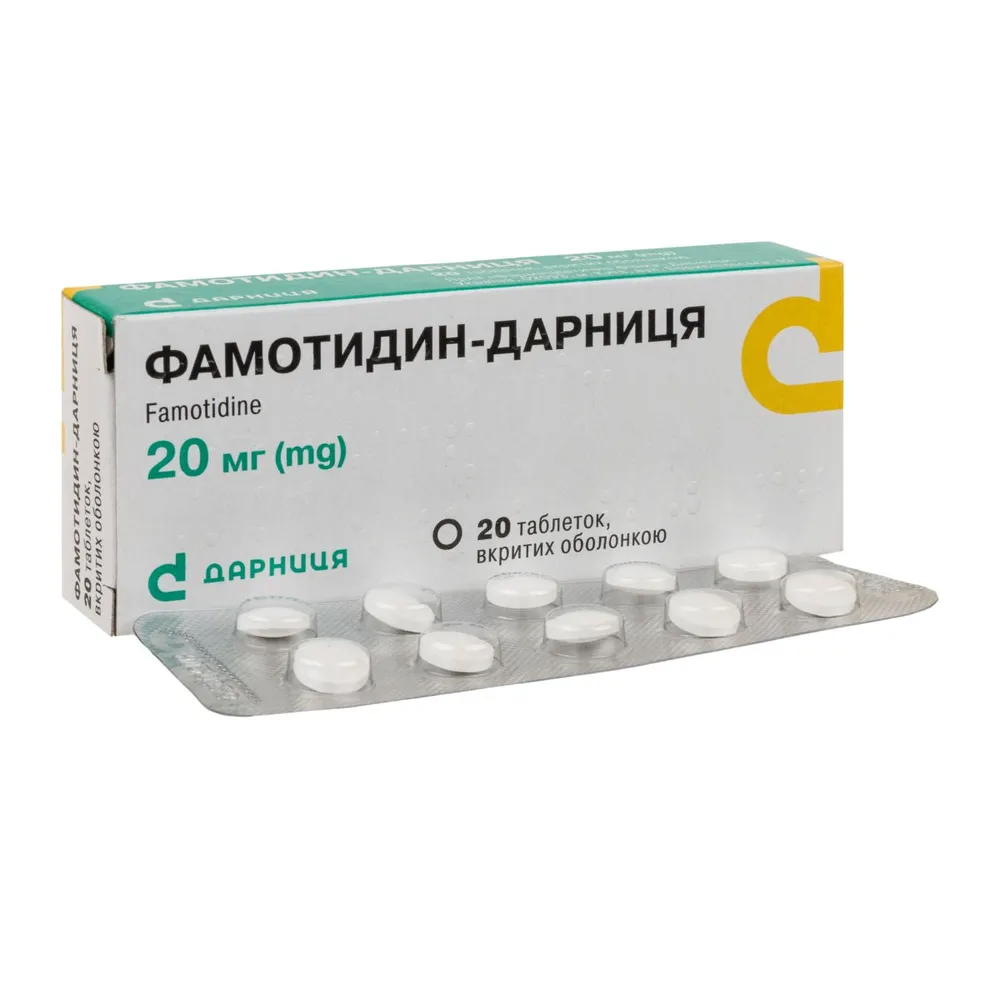
Table of Contents
INSTRUCTIONS FOR MEDICAL USE OF THE MEDICINAL PRODUCT FAMOTIDINE-DARNITSA (FAMOTIDINE-DARNITSA)
Composition:
Active substance: famotidine;
1 tablet contains 20 mg of famotidine;
Excipients: lactose monohydrate, microcrystalline cellulose, crospovidone, colloidal anhydrous silicon dioxide, talc, stearic acid, SepiFilm 752 white.
Pharmaceutical form. Film-coated tablets.
Main physico-chemical characteristics: white, round, biconvex, film-coated tablets.
Pharmacotherapeutic group. Drugs for treatment of peptic ulcer and gastroesophageal reflux disease. H₂-receptor antagonists. ATC code A02BA03.
Pharmacological Properties
Pharmacodynamics.
Famotidine is an H2-histamine receptor blocker of the gastric wall; therefore, it reduces gastric juice secretion. Under the influence of the drug, both the concentration and volume of gastric juice, and consequently the amount of pepsin, are reduced. The effect of 20 mg and 40 mg of famotidine lasts for 10–12 hours. A single evening dose (20 mg or 40 mg) reduces basal and nocturnal gastric juice secretion. The degree of nocturnal gastric juice secretion inhibition is 86–94% and lasts for at least 10 hours.
When the same dose is administered in the morning, the degree of inhibition of food-stimulated gastric juice secretion within 3–5 hours is 76–84%, and after 8–10 hours it is 25–30%.
Famotidine has practically no effect on either fasting gastrin levels or postprandial gastrin levels.
Famotidine does not affect gastric emptying, pancreatic secretory function, hepatic blood flow, or portal circulation. Famotidine does not influence the hepatic cytochrome P450 enzyme system. It does not affect serum hormone levels and has no androgenic effect.
Pharmacokinetics.
Absorption. Famotidine is rapidly and completely absorbed. Bioavailability is 40–45%, independent of gastric contents.
Distribution in the body: after oral administration, maximum plasma concentration of famotidine is reached within 1–3 hours. Repeated doses do not lead to drug accumulation. Plasma protein binding is low – 15–20%.
Plasma half-life ranges from 2.3 to 3.5 hours. In cases of severe renal insufficiency, the half-life may increase up to 20 hours.
Metabolism: metabolized in the liver; the only known metabolite is sulfoxide.
Excretion: renal clearance of the drug is 250–450 mL per minute, indicating tubular excretion. 25–30% of the orally administered dose is excreted unchanged in urine. Only a small amount of famotidine is excreted as sulfoxide.
Pharmacokinetic parameters of the drug in healthy elderly individuals and in children do not differ significantly from those in healthy adults.
Clinical characteristics.
Indications.
Benign gastric ulcer.
Peptic ulcer of the duodenum (treatment and prevention of recurrences).
Hypersecretory conditions, such as Zollinger-Ellison syndrome.
Treatment of gastroesophageal reflux disease (reflux esophagitis).
Prevention of symptoms and of erosions or ulcer formation associated with gastroesophageal reflux disease.
Contraindications.
Hypersensitivity to the active substance, other H2-receptor antagonists, or any of the excipients of the medicinal product.
Childhood, pregnancy, or breastfeeding (due to lack of sufficient clinical experience).
Interaction with other medicinal products and other forms of interaction.
The absorption of certain medicinal products (e.g., ketoconazole, amoxicillin, iron preparations) depends on gastric acidity. Therefore, famotidine should be taken at least 2 hours after such medicinal products.
Concomitant use with other H2-receptor antagonists may significantly reduce the effectiveness of tolazoline. Although no interaction between famotidine and tolazoline has been confirmed, such an interaction is likely. Therefore, the effect of tolazoline should be monitored at the beginning or after discontinuation of concomitant therapy. If the effect of tolazoline is reduced, its dose should be cautiously increased or famotidine treatment discontinued.
Food and antacid agents do not significantly affect famotidine therapy.
Famotidine does not influence the hepatic cytochrome P450 oxidase system; therefore, the metabolism of oral anticoagulants, antipyrine, aminopyrine, theophylline, phenytoin, diazepam, ethanol, and propranolol is not impaired.
Probenecid may inhibit the elimination of famotidine.
Concomitant administration of posaconazole oral suspension and famotidine should be avoided, as famotidine may reduce the absorption of posaconazole.
Concomitant use of famotidine with tyrosine kinase inhibitors (TKIs), such as dasatinib, erlotinib, gefitinib, and pazopanib, may lead to decreased plasma concentrations of TKIs and, consequently, reduced efficacy; therefore, such concomitant use is not recommended. For additional information, refer to the appropriate summary of product characteristics for the medicinal product containing the TKI.
Special precautions for use.
Treatment with this medicinal product should only be initiated after appropriate medical examination in the following situations:
- in the presence of kidney or liver disease;
- in the first occurrence of heartburn, symptoms of hyperacidic state, stomach pain, or hyperacidic state after food intake in middle-aged or elderly patients, as well as in any change in the nature of these symptoms in patients of this age group;
- in the presence of digestive disturbances associated with weight loss;
- in the presence of black-colored stools;
- in the presence of swallowing difficulties and/or chronic abdominal pain;
- in the presence of concomitant diseases or concomitant use of other medicinal products.
Prior to initiating treatment, the presence of malignant tumors in the stomach and duodenum should be ruled out. Treatment with this medicinal product may mask symptoms of gastric carcinoma.
Symptoms of duodenal ulcer disease may resolve within 1–2 weeks; however, therapy should be continued until healing (scarring) is confirmed by endoscopic or radiographic examination.
Famotidine should be used with caution in acute porphyria (including in medical history) and immunodeficiency.
In severe liver disease, the medicinal product should be administered with particular caution and at reduced doses.
In elderly patients with impaired liver or kidney function, disturbances of consciousness (confusion) may occur, necessitating dose reduction.
Regular monitoring of patients (especially elderly patients and those with a history of gastric and/or duodenal ulcer disease) who are using the medicinal product in combination with nonsteroidal anti-inflammatory drugs is required.
Since cross-sensitivity among H2-receptor antagonists has been reported, the use of this medicinal product is contraindicated in patients with hypersensitivity to other H2-receptor antagonists.
When used concomitantly with antacids, the interval between administration of the medicinal product and antacids should be at least 1–2 hours.
If a dose of the medicinal product is missed, it should be taken as soon as possible; however, the dose should not be doubled if it is time for the next scheduled dose.
In patients with lactose intolerance, it should be noted that each 20 mg tablet of Famotidine-Darnytsia contains 90.1 mg of lactose. Patients with rare hereditary forms of galactose intolerance, lactase deficiency, or glucose-galactose malabsorption should not take this medicinal product.
Use during pregnancy or breastfeeding.
Famotidine-Darnytsia should not be used during pregnancy or breastfeeding.
Ability to influence reaction rate while driving or operating machinery.
Caution should be exercised when driving or operating machinery requiring heightened attention and rapid psychomotor reactions, as famotidine may cause dizziness.
Dosage and Administration
Famotidine is most effective when taken in the evening before bedtime. When famotidine is administered twice daily, one dose should be taken in the morning and the second in the evening before bedtime.
The tablet should be swallowed whole, without chewing, with a glass of water. Famotidine may be taken independently of food intake.
Benign gastric and duodenal ulcer.
2 tablets of 20 mg each, taken in the evening before bedtime, for 4−8 weeks.
Prevention of duodenal ulcer relapse.
For prevention of relapses after achieving therapeutic effect, a maintenance dose of 1 tablet of 20 mg once daily at night should be prescribed for 1−4 weeks.
Gastroesophageal reflux disease (reflux esophagitis).
1 or 2 tablets of 20 mg (depending on disease severity) twice daily. Treatment duration is 6−12 weeks.
For gastroesophageal reflux disease associated with erosive esophagitis or ulceration: 40 mg twice daily for 6−12 weeks.
For prevention of recurrence of symptoms and erosions or ulcer formation associated with gastroesophageal reflux disease (maintenance therapy).
20 mg twice daily is prescribed.
Zollinger-Ellison syndrome.
The dosage should be individually adjusted. For patients who have not previously received antisecretory agents, the initial dose is 1 tablet of 20 mg four times daily (every 6 hours). For patients previously treated with other H2-receptor antagonists, a higher initial dose may be prescribed immediately—40 mg every 6 hours. The dose should then be adjusted according to gastric juice secretion levels and the patient's clinical condition. Treatment should continue as long as clinical symptoms of the disease persist.
If necessary, the daily dose should be gradually increased according to individual patient characteristics until the optimal dose is achieved.
According to available data, the highest doses of famotidine used in patients with severe forms of the disease have been up to 160 mg every 6 hours.
Dosing in renal insufficiency.
If creatinine clearance is less than 30 mL/min or serum creatinine exceeds 3 mg/100 mL, the daily dose should be reduced to 20 mg or the dosing interval should be extended to 36−48 hours.
Treatment with this medicinal product should be discontinued gradually due to the risk of rebound syndrome upon abrupt discontinuation.
Dosing in elderly patients.
No dose adjustment is required for elderly patients, except for those with renal insufficiency.
Children.
There is insufficient data on the safety and efficacy of famotidine for use in children.
Overdose.
Symptoms: vomiting, motor agitation, tremor, hypotension, tachycardia, collapse.
Treatment: discontinue the drug, induce vomiting and/or perform gastric lavage. If necessary, provide adequate symptomatic and supportive therapy: administer diazepam intravenously for seizures, atropine for bradycardia, lidocaine for ventricular arrhythmias. Hemodialysis is effective.
Adverse reactions.
Eye disorders: conjunctivitis.
Ear and labyrinth disorders: tinnitus.
Respiratory, thoracic and mediastinal disorders: airway obstruction, bronchospasm.
Gastrointestinal disorders: diarrhea, constipation, flatulence, abdominal pain, vomiting, nausea, taste disturbances, anorexia, dry mouth, acute pancreatitis.
Hepatobiliary disorders: cholestatic jaundice, pathological changes in liver enzyme activity, hepatitis.
Metabolism and nutrition disorders: anorexіa.
Nervous system disorders: headache, dizziness, seizures, paresthesia, balance disorders, psychiatric disturbances (excitation, hallucinations, confusion, depression, fear, insomnia, somnolence, decreased libido).
Cardiac disorders: atrioventricular block, arrhythmia, decreased blood pressure, bradycardia, palpitations, tachycardia.
Blood and lymphatic system disorders: thrombocytopenia, agranulocytosis, pancytopenia, leukopenia, neutropenia.
Immune system disorders: hypersensitivity reactions, including anaphylaxis, angioneurotic edema, eye edema.
Skin and subcutaneous tissue disorders: severe skin reactions (Stevens-Johnson syndrome, toxic epidermal necrolysis), acne, urticaria, rash, alopecia, pruritus, erythema, dry skin, exfoliative dermatitis, allergic dermatitis.
Musculoskeletal and connective tissue disorders: muscle spasms, joint pain.
Reproductive system and breast disorders: impotence, gynecomastia*.
General disorders: increased fatigue, elevated body temperature.
* Gynecomastia is extremely rare and reversible upon discontinuation of treatment.
Shelf life.
3 years.
Storage conditions.
Store in the original packaging, out of reach of children, at a temperature not exceeding 25 °C.
Packaging.
10 tablets in a blister pack; 2 blister packs in a carton.
Prescription status.
Prescription only.
Manufacturer.
JSC "Pharmaceutical Company "Darnytsia".
Manufacturer's address.
13, Borispilska Street, Kyiv, 02093, Ukraine.