Eucabal® balm
Ukraine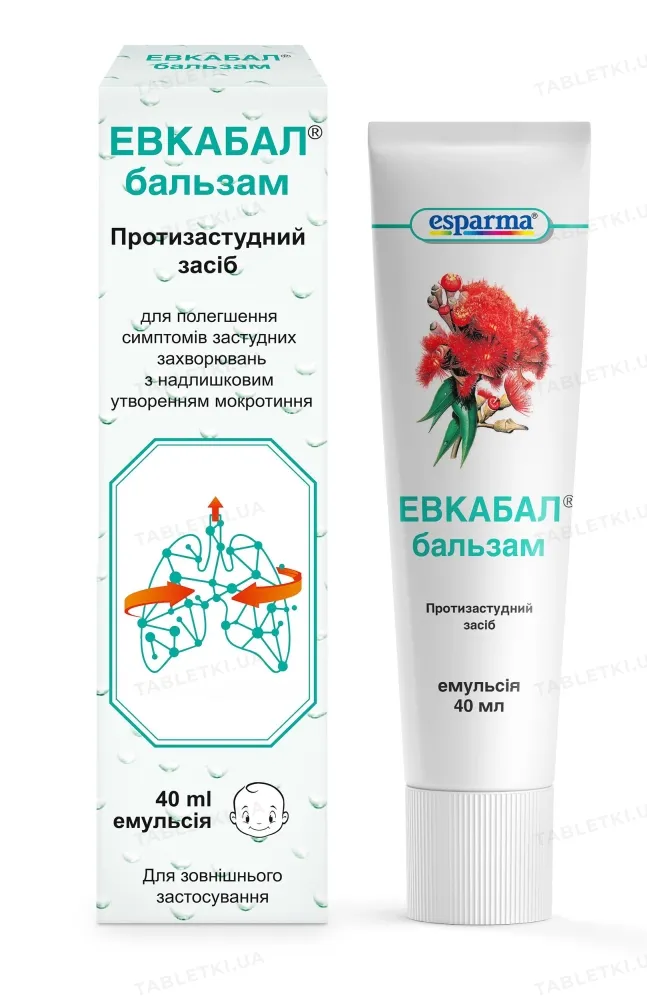
Table of Contents
INSTRUCTIONS FOR MEDICAL USE OF THE MEDICINAL PRODUCT Eucabal® balm (Eucabal® balsam)
Composition:
Active substances: 100 g of emulsion contains: eucalyptus oil (Eucalypti aetheroleum) 10 g, pine oil (Pini sylvestris aetheroleum) 3 g;
Excipients: cetostearyl alcohol, glycerol monostearate, polyethylene glycol stearate, sodium cetostearyl sulfate, tromethamine, citric acid monohydrate, guaiazulene, purified water.
Pharmaceutical form. Emulsion.
Main physicochemical characteristics. Blue emulsion with the aroma of pine and eucalyptus oils.
Pharmacotherapeutic group. Antitussives in combination with expectorants.
ATC code R05F B02.
Pharmacological properties.
Pharmacodynamics.
The main active component of the drug is eucalyptus oil containing not less than 80% of the spasmolytically active 1,8-cineole. Its action is combined with that of coniferous oil, which contains 30–40% alpha-pinene compounds improving blood supply. The pharmacological action of these essential oils leads to liquefaction and dissolution of bronchial secretions, enhanced elimination of secretions by the ciliated epithelium, reduction of catarrhal manifestations in the respiratory tract, and exerts anti-inflammatory effects. Due to their lipophilic properties, the active substances are well distributed across the skin and are absorbed. After absorption, they are partially excreted via the lungs, thus reaching the site of action directly through the bloodstream. Consequently, the initial effect occurring during inhalation is enhanced when taking baths. In cases of bed rest, this effect is complemented by the beneficial influence of a warm bath, which, in combination with the active substances, induces perspiration.
Pharmacokinetics.
Not studied.
Clinical characteristics.
Indications.
For relief of symptoms of respiratory colds associated with excessive mucus production.
Contraindications.
Hypersensitivity to any of the components of the medicinal product. Bronchial asthma, pertussis, pseudocroup, predisposition to seizures. Damaged skin, such as in burns or skin integrity impairment. Marked hypersensitivity of the respiratory tract, for example, due to vocal cord dysfunction.
Special precautions.
Do not apply near the eyes; do not apply to mucous membranes. After application, hands should be thoroughly wiped to prevent contact with the face (especially the eyes). Care must be taken to ensure that children do not touch with their hands the areas of skin to which the product has been applied. Cetyl stearyl alcohol may cause local skin irritation (e.g., contact dermatitis).
Interaction with medicinal products and other forms of interaction. To date, no interactions with other substances have been observed.
Special precautions for use.
Use during pregnancy or breastfeeding.
Since adequate safety studies of the use of the medicine during pregnancy have not been conducted, the balm should not be used during pregnancy. During breastfeeding, do not apply to the breast area.
Ability to influence reaction rate while driving or operating machinery. Does not affect.
Method of Administration and Dosage
Apply Eucabal® balm for rubbing or inhalation.
Rubbing
Apply Eucabal® balm undiluted for rubbing.
Unless otherwise prescribed, apply an emulsion strip 2–3 cm in length to the skin of the chest 2–3 times daily and rub in thoroughly (over an area approximately the size of the palm). In children aged 6 months to 2 years, apply the product only to the back. Ensure that children cannot come into contact with the applied emulsion (cover the child’s skin area with appropriate clothing).
Steam Inhalation
Perform 3 steam inhalations daily for several days until symptoms resolve. Dissolve an emulsion strip 3–5 cm long (1 teaspoon) in 1–2 liters of hot water (not exceeding 70 °C) and inhale the vapors under a towel placed over the head (keep a distance of at least 20 cm from the water surface), or use an inhaler. When using an inhaler, mix the emulsion strip with hot water in the lower chamber of the inhaler (for children aged 6 to 12 years: 2–3 cm; for children aged 12 years and adults: 3–5 cm).
If symptoms do not improve within 4–5 days or worsen, or if dyspnea, fever, or sputum with pus or blood occurs, consult a physician.
Children
In children aged 6 months to 2 years, apply the product only to the back. For inhalation, use only under adult supervision in children aged 6 years and older.
Overdose
When used correctly at recommended doses, intoxication is practically excluded. Accidental ingestion of the undiluted product may lead to gastrointestinal complications such as nausea, vomiting, and possibly diarrhea and convulsions. Systemic effects should be considered only in extreme cases.
In mild cases, discontinuation of the medicinal product is sufficient. In other cases, symptomatic treatment is required. In case of convulsions, administer 5–10 mg diazepam intravenously or a short-acting barbiturate; if ingested, perform gastric lavage and administer 30 g of sodium sulfate in 250 ml of water.
Side effects.
Allergic reactions, including skin rashes, itching, contact dermatitis, contact eczema, irritation of the skin and mucous membranes, bronchospasm.
Shelf life. 3 years.
Do not use the medicinal product after the expiry date stated on the packaging.
Storage conditions.
Store in a place inaccessible to children, at a temperature not exceeding 25 °C.
Packaging.
25 ml, or 40 ml, or 100 ml of emulsion in an aluminum tube in a cardboard box.
Availability. Over-the-counter.
Manufacturer.
Esparma GmbH, Germany.
Manufacturer's address and location of its business operations.
Valenroder Strasse 8-10, 13435 Berlin, Germany.
Marketing Authorization Holder.
Esparma GmbH, Germany.
Address of the Marketing Authorization Holder.
Bielefelder Strasse 1, 39171 Sulzetal, Germany.