Ethambutol
Ukraine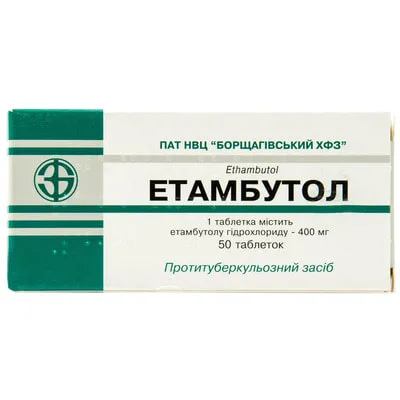
Table of Contents
INSTRUCTION for medical use of the medicinal product Ethambutol (Ethambutol)
Composition:
Active substance: ethambutol;
1 tablet contains 400 mg of ethambutol hydrochloride;
Excipients: microcrystalline cellulose, methylcellulose, sodium croscarmellose, colloidal anhydrous silicon dioxide, calcium stearate.
Pharmaceutical form. Tablets.
Main physicochemical properties: white or almost white tablets, flat cylindrical in shape, with beveled edges and a score line. Marbling on the tablet surface is permissible.
Pharmacotherapeutic group. Antimicrobial agents for systemic use. Agents acting on mycobacteria. Antituberculosis agents. Ethambutol.
ATC code J04A K02.
Pharmacological properties.
Pharmacodynamics.
Ethambutol is a second-line antituberculosis agent. It exerts a bacteriostatic effect only against M. tuberculosis, including strains resistant to streptomycin, kanamycin, isoniazid, PAS, and ethionamide. The mechanism of action is associated with rapid penetration into the cell, where it disrupts lipid metabolism and RNA synthesis; magnesium and copper ions are bound, and the structure of ribosomes and protein synthesis is impaired. Resistance to ethambutol develops rapidly during monotherapy. It is active only against actively dividing bacteria.
Pharmacokinetics.
After oral administration, approximately 80% of ethambutol is absorbed. Concomitant food intake accelerates and enhances the absorption process. The concentration in blood plasma after oral administration is proportional to the dose administered. Maximum ethambutol concentration in blood is reached approximately within 2 hours. The drug concentration in plasma decreases to 50% within 8 hours and to 10% within 24 hours. Ethambutol accumulates in erythrocytes; 2 hours after oral administration, the concentration of ethambutol in erythrocytes is approximately twice higher than its concentration in blood plasma. Plasma protein binding is largely concentration-dependent and ranges from 10% to 40%. Ethambutol penetrates into cerebrospinal fluid, breast milk, and crosses the placenta. The elimination half-life is 3.3–3.5 hours. Ethambutol is excreted predominantly in unchanged form, mainly via urine: it is completely eliminated within several days. Within the first 24 hours, approximately 60% of the administered dose is excreted in urine. Nearly 10–20% is excreted in feces as inactive metabolites (aldehyde, dicarboxylic acid derivative). In case of impaired renal excretory function, ethambutol may accumulate in the body.
Clinical characteristics.
Indications.
Treatment of various forms of tuberculosis (only in combination with other anti-tuberculosis agents).
Contraindications.
Hypersensitivity to the components of the drug; optic neuritis; cataract; diabetic retinopathy; inflammatory eye diseases; gout; severe renal insufficiency; conditions where visual function cannot be monitored (severe condition, psychiatric disorders).
Interaction with other medicinal products and other forms of interactions.
Concomitant use of the drug with other medicinal agents may result in:
with anti-tuberculosis drugs – enhancement of effects of anti-tuberculosis agents. For treatment of tuberculosis in combination therapy with ethambutol, the following may be used: isoniazid, para-aminosalicylic acid (PAS), streptomycin, cycloserine, pyrazinamide;
with ciprofloxacin, aminoglycosides, asparaginase, carbamazepine, lithium preparations, imipenem, methotrexate, quinine – enhanced effects and increased neurotoxicity of the aforementioned medicinal agents;
with digoxin – reduced efficacy of the latter;
with disulfiram – increased concentration of ethambutol and enhanced toxicity;
with pyrazinamide – synergistic effect on uric acid excretion;
with isoniazid when used concomitantly with cyclosporine A – enhanced breakdown of cyclosporine A with risk of transplant rejection;
with ethionamide – simultaneous use of ethambutol with ethionamide is not recommended due to pharmacological antagonism (the drugs are better administered on alternate days);
with aluminum-containing preparations and other antacids – reduced absorption of ethambutol from the gastrointestinal tract.
Ethambutol does not affect the metabolism of certain trace elements, primarily zinc.
Special precautions for use
The medicinal product should be administered only in combination with other anti-tuberculosis agents.
Ophthalmological monitoring, including examination of the fundus, intraocular pressure, refraction, visual fields, visual acuity, and color vision (particularly differentiation of red and green, blue and green colors), should be performed before initiating and during treatment with ethambutol.
In patients with renal function impairment, ophthalmological monitoring should be performed daily.
Ophthalmological monitoring should be carried out for each eye separately and for both eyes together, as changes in visual acuity may be unilateral or bilateral.
Patients must be informed to report any changes in visual function to their physician.
If visual disturbances occur, ethambutol treatment should be discontinued to prevent optic nerve atrophy. Visual changes are usually reversible and resolve within several weeks after discontinuation of treatment; in some cases, resolution may take several months. In rare instances, visual changes may be irreversible due to optic nerve atrophy.
Hydroxocobalamin or cyanocobalamin may be used in case of visual impairment.
The dose of ethambutol should be reduced in patients with renal insufficiency, as the drug accumulates in the body.
Ethambutol therapy may increase uric acid levels in blood due to reduced renal excretion of uric acid.
The medicinal product should be administered with caution in patients with hyperuricemia.
Periodic monitoring of liver and kidney function, as well as peripheral blood parameters, is recommended.
During the initial phase of treatment, cough may intensify and sputum production may increase. To alleviate these symptoms, administration of vitamin B complex and expectorants is recommended.
In patients previously treated with anti-tuberculosis agents, bacterial resistance to ethambutol develops more frequently.
Prolonged or repeated use of ethambutol may lead to the development of secondary infections. In case of suspected infection, medical advice should be sought.
If symptoms of tuberculosis do not resolve within 2–3 weeks or if clinical deterioration occurs, patients should consult their physician.
The full course of treatment with the medicinal product must be completed regardless of the presence or absence of disease symptoms, to prevent relapse or development of resistance.
Ethanol enhances the toxic effect of ethambutol on the eye; therefore, alcohol consumption should be avoided during treatment.
If adverse effects occur, dose reduction is required; if this is not feasible, switching to intermittent administration (every other day or twice weekly) should be considered.
This medicinal product contains 6.0 mg of sodium croscarmellose. Caution is advised when administering to patients on a sodium-controlled diet.
Use during pregnancy or breastfeeding
The medicinal product is contraindicated during pregnancy and breastfeeding.
Ability to affect reaction rate when driving or operating machinery
During treatment, driving and engaging in other potentially hazardous activities requiring high attention and rapid psychomotor reactions are not recommended.
Dosage and Administration.
For adults and children aged 13 years and older.
Initial treatment: the medicinal product is administered at a dose of 15 mg/kg body weight once daily.
Repeated course of treatment: the medicinal product is initially administered at a dose of 25 mg/kg once daily, followed by transition to administration of the medicinal product at a dose of 15 mg/kg once daily.
During the period when the patient is receiving the medicinal product at a dose of 25 mg/kg body weight, monthly ophthalmologist examinations are recommended.
In renal functional impairment: the medicinal product is administered according to creatinine clearance values:
| Creatinine clearance (ml/min) |
Daily dose (mg/kg/day) |
| greater than 100 |
20 |
| 70–100 |
15 |
| below 70 |
10 |
| during hemodialysis |
5 |
| on dialysis day |
7 |
The maximum daily dose for adults is 2 g.
The maximum daily dose for children is 1 g.
The duration of treatment depends on the form of tuberculosis and ranges from 6 to 12 months.
Taking Ethambutol after meals improves its tolerability.
Children.
The drug is contraindicated in children under 13 years of age.
Overdose.
Symptoms: nausea, vomiting, loss of appetite, diarrhea, fever, headache, development of neurological disorders, especially optic nerve damage leading to blindness, deterioration of visual acuity, or increased manifestations of other adverse reactions, dizziness, polyneuritis, confusion, headache, hallucinations, respiratory depression, asystole.
Treatment: symptomatic. Due to the rapid absorption of the drug, vomiting should be induced or gastric lavage performed immediately after ingestion, along with administration of enterosorbents. Monitoring and supportive measures for vital functions should be implemented; resuscitation measures are carried out if necessary. Forced diuresis, peritoneal dialysis, or hemodialysis are indicated. In case of allergic reactions, desensitizing agents are indicated. In life-threatening conditions, exchange blood transfusion is indicated, as it removes erythrocytes in which ethambutol accumulates in significant amounts. There is no specific antidote.
Side effects.
Eye disorders: retrobulbar optic neuritis, optic neuropathy, unilateral or bilateral decrease in visual acuity, including irreversible blindness, color vision disturbances (mainly green and red), development of central or peripheral scotoma, visual field defects, retinal hemorrhage. The occurrence of visual disturbances depends on the duration of treatment and pre-existing or concurrent eye diseases.
Respiratory, thoracic and mediastinal disorders: lung infiltrates with or without eosinophilia, pneumonitis, bronchospasm.
Gastrointestinal disorders: metallic taste in the mouth, nausea, vomiting, dyspepsia, heartburn, abdominal pain, diarrhea, anorexia, hepatic function disorders – increased liver transaminase activity, hepatitis, jaundice, pseudomembranous colitis (with concomitant use of rifampicin and isoniazid).
Renal and urinary disorders: increased creatinine levels, increased urea levels, interstitial nephritis.
Nervous system disorders: headache, dizziness, confusion, disorientation, hallucinations, seizures, delirium, depression, peripheral neuritis – paresthesia in extremities, numbness, paresis.
Cardiac disorders: pericarditis, myocarditis, arterial hypotension, tachycardia, vasculitis.
Blood and lymphatic system disorders: leukopenia, neutropenia, thrombocytopenia, eosinophilia, lymphadenopathy, increased liver transaminase activity.
Immune system disorders: hypersensitivity reactions, including anaphylactic and anaphylactoid reactions, anaphylactic shock, Stevens-Johnson syndrome, Lyell’s syndrome (toxic epidermal necrolysis), vasculitis.
Skin and subcutaneous tissue disorders: rash, pruritus, hyperemia, dermatitis.
Musculoskeletal and connective tissue disorders: arthralgia.
General disorders: increased body temperature, chills, general weakness, edema, tingling sensation.
Laboratory findings: decreased serum uric acid clearance, manifestations of uric acid diathesis, gout exacerbation.
Shelf life. 3 years.
Do not use the medicinal product after the expiry date stated on the packaging.
Storage conditions.
Store in the original packaging, out of reach of children, at a temperature not exceeding 25 °C.
Packaging.
10 tablets in a blister pack; 5 blister packs in a carton; 1000 tablets in containers.
Prescription status. Prescription only.
Manufacturer. JSC "Pharmaceutical Company "Darnytsia".
Manufacturer's name and address of the place of business.
13, Borispilska St., Kyiv, 02093, Ukraine.