Estesifin®
Ukraine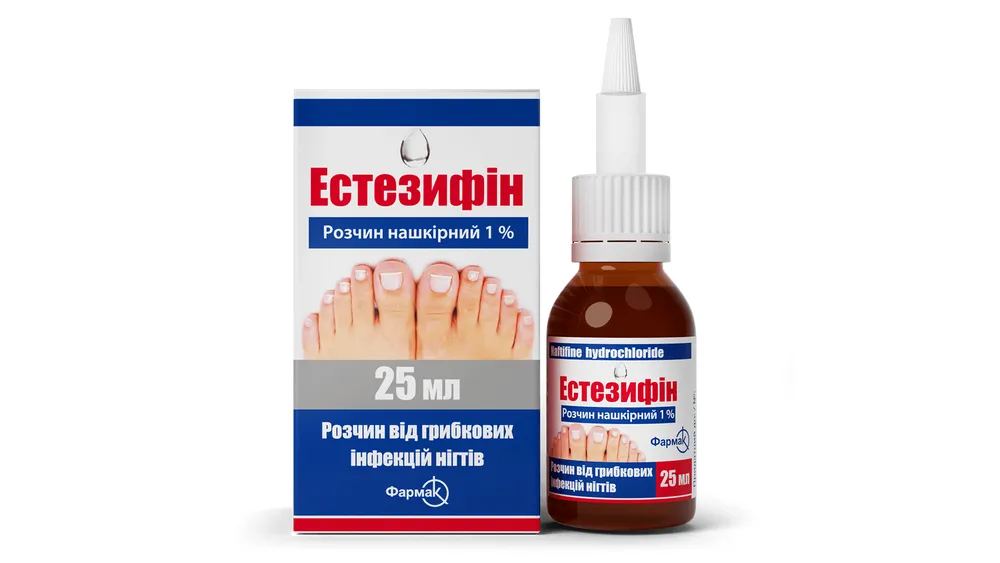
Table of Contents
INSTRUCTIONS FOR MEDICAL USE OF THE MEDICINAL PRODUCT ESTESIFIN® (ESTESIFIN)
Composition:
Active substance: naftifine hydrochloride;
1 ml of solution contains naftifine hydrochloride equivalent to 100 % dry substance 10 mg;
Excipients: propylene glycol, ethanol 96 %, purified water.
Pharmaceutical form. Topical solution.
Main physicochemical characteristics: clear solution ranging from colorless to light yellow with a characteristic alcoholic odor.
Pharmacotherapeutic group. Antifungal agents for dermatological use.
ATC code: D01A E22.
Pharmacological properties.
Pharmacodynamics.
Estefin**®** is an antifungal agent of the allylamine class, whose mechanism of action is associated with inhibition of ergosterol synthesis.
Estefin**®** is active against dermatophytes such as Trichophyton, Epidermophyton, and Microsporum, yeasts (Candida), molds (Aspergillus), and other fungi (e.g., Sporothrix schenckii). Against dermatophytes and Aspergillus, naftifine exerts a fungicidal effect in vitro; against yeasts, it demonstrates fungicidal or fungistatic activity depending on the microbial strain.
Estefin**®** also exhibits antibacterial activity against gram-positive and gram-negative microorganisms, which may cause secondary bacterial infections associated with fungal lesions.
In addition, Estefin**®** has anti-inflammatory properties, contributing to rapid relief of inflammation and itching symptoms.
Pharmacokinetics.
Naftifine hydrochloride is rapidly absorbed and achieves sustained antifungal concentrations in various skin layers. Approximately 4% of the applied dose is absorbed through the skin, resulting in very low systemic exposure. Only trace amounts of naftifine are detectable in plasma and urine. The active substance is almost completely metabolized; metabolites lack antifungal activity and are excreted in feces and urine. The elimination half-life is 2–4 days.
Clinical characteristics.
Indications.
Topical treatment of fungal infections caused by pathogens sensitive to naftifine:
- fungal infections of the skin and skin folds;
- interdigital mycoses;
- fungal nail infections (onychomycoses);
- cutaneous candidiasis;
- pityriasis versicolor;
- inflammatory dermatomycoses, with or without pruritus.
Contraindications.
Hypersensitivity to naftifine, propylene glycol, or to any other components of the medicinal product. The product must not be applied to wound surfaces. Do not use for treatment of the eyes.
Interaction with other medicinal products and other forms of interaction.
Interaction studies have not been performed.
Special precautions for use.
The medication should be used externally only!
The medication contains ethanol; therefore, contact of the solution with eyes and open wounds should be avoided.
The solution contains propylene glycol, which may cause skin irritation.
Use during pregnancy or breastfeeding.
Data on the use of naftifine in pregnant women are lacking or limited. Animal studies do not indicate any direct or indirect harmful effects of the medication on reproductive function. The medication may be used during pregnancy or breastfeeding only if clearly necessary, after careful assessment of the benefit-risk ratio determined by the physician.
Ability to affect reaction rate while driving or operating machinery.
No effect.
Method of Administration and Dosage.
Estesifin**®** solution should be applied once daily to the affected skin area after thorough cleansing and drying, extending to approximately 1 cm of healthy skin surrounding the affected area.
Duration of treatment:
For dermatomycoses – 2–4 weeks (if necessary, up to 8 weeks);
For candidiasis – 4 weeks;
For nail infections – up to 6 months.
For fungal nail infections, the drug is recommended to be applied twice daily. Prior to the first application, the affected portion of the nail should be trimmed as much as possible using scissors or a nail file (to facilitate this procedure, nails may be softened with a special softening agent as advised by a physician).
To prevent relapses, treatment with the drug should be continued for at least 2 weeks after the main symptoms of the disease have disappeared.
Children.
There is insufficient data on the efficacy and safety of using the drug in children; therefore, Estesifin**®** is not recommended for patients in this age group.
Overdose.
Acute overdose with topical application of naftifine has not been reported.
Systemic intoxication following topical application of the drug is unlikely due to minimal absorption of the active ingredient through the skin.
In case of accidental ingestion, symptomatic treatment should be initiated.
Side effects.
The frequency of adverse reactions is defined as follows: very common (≥ 1/10), common (≥ 1/100, < 1/10), uncommon (≥ 1/1000, < 1/100), rare (≥ 1/10000, < 1/1000), very rare (< 1/10000), frequency not known (cannot be estimated from available data).
General disorders: frequency not known – local reactions may occur in isolated cases: dry skin, redness and burning sensation, itching, local irritation.
Skin and subcutaneous tissue disorders with frequency "not known": contact dermatitis and erythema.
Shelf life. 2 years.
Do not use the medicinal product after the expiry date stated on the packaging.
Storage conditions.
Store in the original packaging at a temperature not exceeding 30 °C.
Keep out of the reach of children.
Packaging.
15 ml, 20 ml or 25 ml in a bottle. 1 bottle per carton.
Classification by prescription. Over-the-counter (without prescription).
Manufacturer.
JSC "Farmak".
Manufacturer's name and address of the place of business.
74, Kyrylivska Street, Kyiv, 04080, Ukraine.