Espol
Ukraine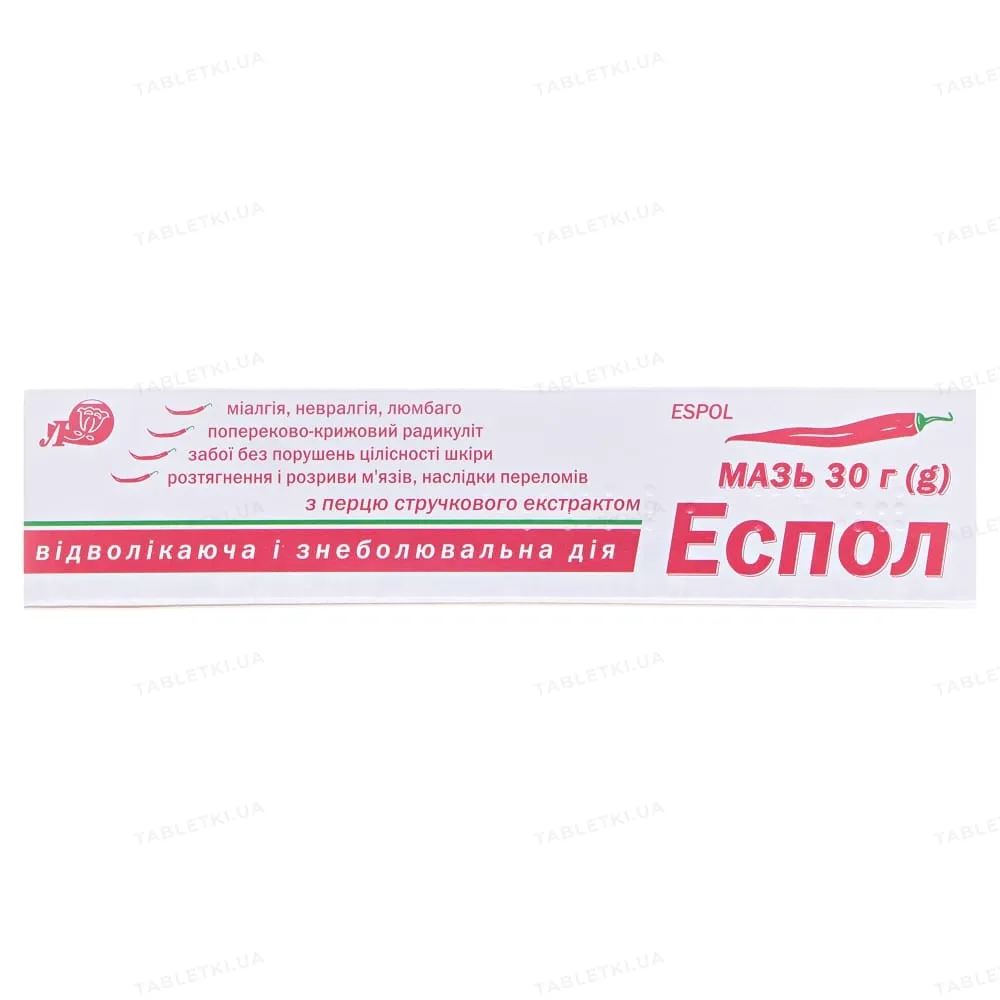
Table of Contents
INSTRUCTION FOR MEDICAL USE OF THE MEDICINAL PRODUCT ESPOL
Composition:
Active ingredient: 1 g of ointment contains 100 mg of extract of capsicum (Capsicum annuum), dry extract equivalent to 1.8% capsaicinoids (extracted with 80% ethanol);
Excipients: dimethyl sulfoxide, eucalyptus oil, lavender oil, chloroform, lanolin, white soft paraffin.
Pharmaceutical form. Ointment.
Main physicochemical properties: thick, homogeneous mass ranging from light brown to reddish-brown in color, with a characteristic odor.
Pharmacotherapeutic group.
Topical preparations used for joint and muscular pain. Capsicum pepper preparations and similar agents.
ATC code M02A B.
Pharmacological properties.
Pharmacodynamics.
Espol exerts analgesic, distracting, warming, resorbing, anti-inflammatory, and local irritant effects. The therapeutic effect is due to the combined action of the components contained in the medicinal product. Capsaicins from capsicum extract exert a strong local irritant effect on skin sensory receptors; dimethyl sulfoxide provides analgesic and anti-inflammatory actions and exhibits moderate fibrinolytic activity. The preparation enhances penetration of drugs through intact skin and mucous membranes, promoting deeper penetration of medicinal substances used concomitantly. Lavender oil demonstrates mild sedative and spasmolytic properties. The components of the ointment induce reflex dilation of small blood vessels and improve blood supply to the painful area, resulting in enhanced drainage of this region and removal of inflammatory mediators.
Pharmacokinetics.
The effect appears within 10–15 minutes after application and reaches its maximum within 30 minutes. The duration of analgesia lasts from 30 minutes to 2 hours.
Clinical characteristics.
Indications.
Myositis, injuries without skin integrity disruption, muscle strains and ruptures, neuralgia, lumbago, lumboischialgia, fractures.
Contraindications.
Hypersensitivity to the drug components, bronchial asthma, renal failure, hepatic failure, cardiac insufficiency, circulatory insufficiency, glaucoma, cataract, pronounced atherosclerosis, angina pectoris, stroke, myocardial infarction, comatose states, pregnancy, breastfeeding period, children under 12 years of age, skin injuries, skin integrity disruption, open wounds, eczema, active stage of any inflammatory process, purulent skin diseases.
Interaction with other medicinal products and other types of interactions.
Dimethyl sulfoxide, which is part of the drug, enhances the effect of ethanol (alcohol inhibits the drug's elimination) and insulin, acetylsalicylic acid, butadione; digitalis preparations, quinidine, nitroglycerin, antibiotics (streptomycin, monomycin, etc.), chloramphenicol, rifampicin, griseofulvin, and sensitizes the body to anesthetic agents. One should consider the enhancement by the drug of both the specific activity and the toxicity of medicinal products. The drug may be used in combination with nonsteroidal anti-inflammatory agents in complex therapy of deforming osteoarthritis and rheumatoid arthritis; in combination with topical antimicrobial agents (synthomycin liniment) – for the treatment of impetigo.
Do not use the ointment simultaneously with other locally irritating medicinal products, agents that increase blood supply and cause skin reddening.
Increases the likelihood of neuropathy when used with drugs containing sulindac.
Simultaneous use with analgesic gels is not recommended.
Interaction with other medicinal products applied to the same site is possible even within 12 hours after ointment removal.
When using any other medicinal products concurrently, inform your physician.
Special precautions for use
Do not allow the ointment to come into contact with damaged skin, eyes, or mucous membranes.
Bandaging is permissible only after most of the ointment has been absorbed.
The ointment should be rubbed into the skin only using an applicator. After applying the ointment, hands should be thoroughly washed.
Avoid using additional sources of heat during treatment (e.g., sunlight or infrared radiation, heating pads, or warm water). The warming effect may also be enhanced by physical activity (increased sweating).
If excessive warming occurs, treatment should be discontinued. In such cases, any excess ointment should be removed.
If symptoms worsen during treatment with Espol ointment, consult a physician.
Use during pregnancy or breastfeeding
Do not use during pregnancy or breastfeeding.
Ability to affect reaction speed when driving or operating machinery
Use with caution, taking into account the effect on the central nervous system, particularly the possibility of dizziness.
Method of Administration and Dosage
Before use, remove the tube from the refrigerator and allow it to reach room temperature for 2 hours. For adults and children aged 12 years and older, the product is intended for external use only.
Apply the ointment 2–3 times daily to the skin (only to the affected area) until a sensation of warmth or mild tingling is felt, using approximately 0.2 g per 1 cm², and gently rub in with the applicator. To enhance the effect, dry warming dressings may be applied to the affected areas.
The duration of treatment is determined individually by a physician and usually lasts from 1 to 10 days.
After the procedure, wipe off any remaining ointment on the skin with a cloth moistened with soapy water.
Children.
Do not use in children under 12 years of age. Do not use warming dressings.
Overdose.
Symptoms: allergic reactions, including skin rash, urticaria, and skin peeling.
Management: upon signs of overdose, remove any remaining ointment from the skin with a cloth moistened with soapy water and consult a physician. Symptomatic treatment should be provided.
Adverse reactions.
Skin reactions: dermatitis, skin rash, pruritus, skin desquamation at the application site, skin hyperemia, erythema, sensation of warmth and burning at the site of ointment application, tingling, contact eczema.
Hypersensitivity reactions: angioneurotic edema, bronchospasm, hypersensitivity, allergic reactions including urticaria, blistering.
Central nervous system reactions: dizziness, headache, insomnia, adynamia.
Gastrointestinal reactions: nausea, vomiting.
These phenomena resolve rapidly after discontinuation of the drug. If any adverse reactions occur, the drug should be discontinued and medical advice must be sought immediately.
Reporting of suspected adverse reactions
Reporting of adverse reactions after drug registration is of great importance. It enables ongoing monitoring of the benefit-risk balance of the medicinal product. Healthcare and pharmacy professionals, as well as patients or their legal representatives, are encouraged to report all suspected adverse reactions and lack of efficacy via the Automated Pharmacovigilance Information System at the following link: https://aisf.dec.gov.ua.
Shelf life.
3 years.
Do not use the medicinal product after the expiry date stated on the packaging.
Storage conditions.
Store in the original packaging at a temperature not exceeding 25 °C.
Keep out of reach of children.
Packaging.
30 g in a tube; 1 tube with an applicator in a cardboard box.
Availability.
Over-the-counter (without prescription).
Manufacturer.
JSC "Lubnifarm".
Manufacturer's address and location of its business activities.
16 Barvinkova Street, Lubny, Poltava Oblast, 37500, Ukraine.