Espa-carb®
Ukraine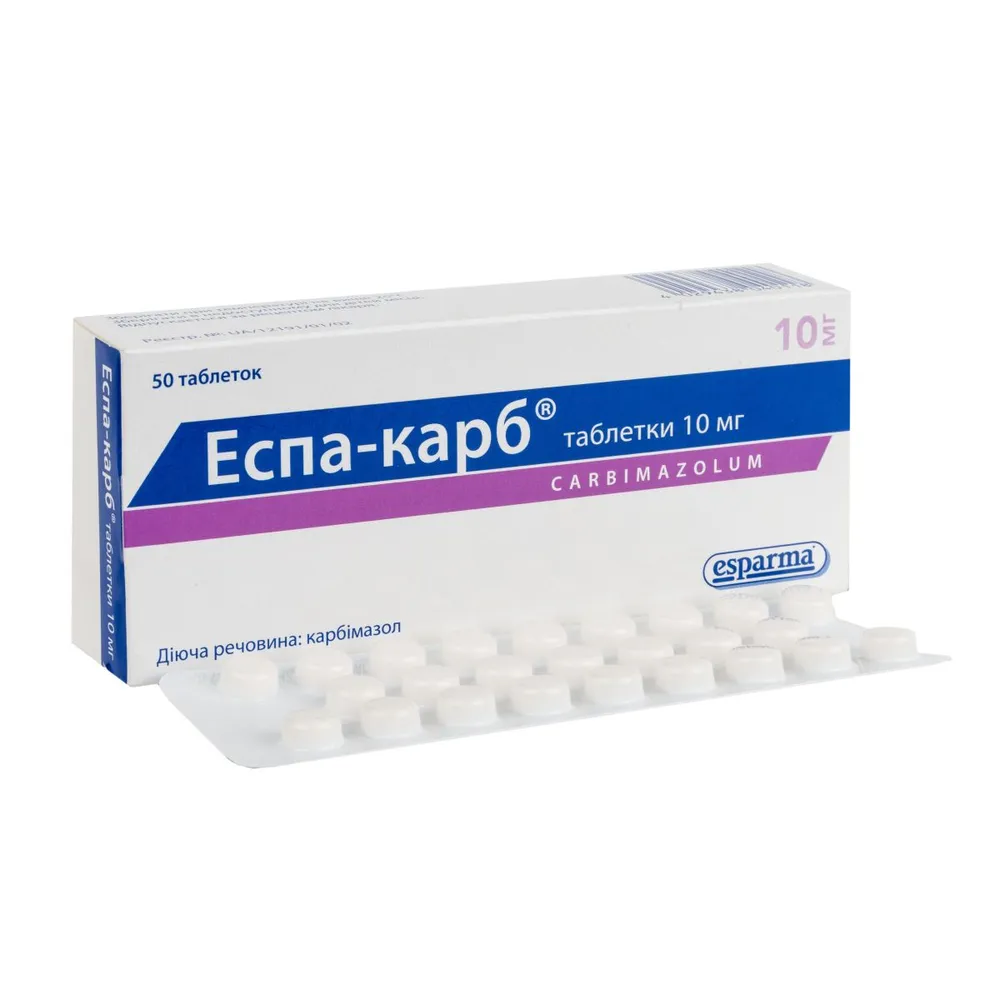
Table of Contents
INSTRUCTION for medical use of the medicinal product ESPA-CARB® (ESPA-CARB®)
Composition:
Active substance: carbimazole;
One tablet contains 5 mg or 10 mg of carbimazole;
Excipients:
5 mg tablets: mannitol (E 421), microcrystalline cellulose, maize starch, anhydrous citric acid, sodium starch glycolate (type A), magnesium stearate;
10 mg tablets: mannitol (E 421), microcrystalline cellulose, maize starch, anhydrous citric acid, sodium starch glycolate (type A), magnesium stearate, iron oxide yellow (E 172);
Pharmaceutical form. Tablets.
Main physicochemical properties:
5 mg tablets: white, round, convex tablets with a dividing line on one side;
10 mg tablets: yellowish, round, convex tablets with a dividing line on one side.
Pharmacotherapeutic group. Antithyroid agents. Sulfur-containing imidazole derivatives.
ATC code H03B B01.
Pharmacological properties.
Pharmacodynamics.
Depending on its dosage, carbimazole inhibits the incorporation of iodine into tyrosine, thereby suppressing the further synthesis of thyroid hormones. This property enables symptomatic treatment of hyperfunction of the thyroid gland regardless of its etiology. Whether carbimazole additionally affects the natural course of the disease in immunologically mediated forms of hyperthyroidism (Graves' disease), i.e., whether it suppresses the immunopathogenetic process underlying the disease, cannot currently be determined with certainty. It does not affect the release of already synthesized thyroid hormones. This explains the variable latency period of the drug's action in individual cases until serum concentrations of thyroxine and triiodothyronine normalize, i.e., until clinical improvement occurs. The drug also does not affect hyperthyroidism resulting from hormone release following destruction of thyroid cells, for example after radiotherapy or in thyroiditis.
Pharmacokinetics.
Carbimazole is rapidly and completely absorbed and is immediately converted into its active form—thiamazole. After administration of 15 mg of carbimazole, maximum serum levels of 150 ng/ml are reached within 24–72 minutes.
Protein binding of thiamazole is negligible. Thiamazole accumulates in the thyroid gland, where it is slowly metabolized. Since the duration of its action is more directly related to the concentration of the substance in the thyroid gland than to its plasma half-life, this results in prolonged antithyroid activity. This accounts for the nearly 24-hour duration of action of a single dose, allowing once-daily administration. According to current data, the kinetics of thiamazole are independent of thyroid function.
The elimination half-life is approximately 3 hours; it is prolonged in cases of impaired liver function. Thiamazole is excreted both via the urine and the bile. However, fecal excretion is minimal, suggesting enterohepatic circulation. Within 24 hours, 70% of thiamazole is excreted by the kidneys, with only a small amount excreted unchanged. There is currently no information regarding the pharmacological activity of metabolites.
Clinical characteristics.
Indications.
Thyroid gland function disorders associated with hyperproduction of its hormones (hyperthyroidism).
Preparation for thyroidectomy in hyperthyroidism.
Therapy before and after radioactive iodine treatment.
Contraindications.
Increased individual sensitivity to carbimazole, thiamazole, or to other components of the drug.
Severe blood system disorders, severe liver failure, cholestasis.
Concomitant use of radioactive iodine preparations.
Additional therapy with thyroid hormones during pregnancy.
History of acute pancreatitis after taking carbimazole or thiamazole.
Interaction with other medicinal products and other forms of interaction.
There are insufficient data on the interaction of carbimazole with other medicinal products.
Carbimazole should be used with caution in combination with agents that may cause agranulocytosis.
Since carbimazole is a vitamin K antagonist, the effect of anticoagulants may be enhanced.
Serum theophylline levels may increase, and toxicity may potentially develop if patients are receiving antithyroid therapy without reducing the theophylline dose.
There is a risk of cross-allergy between carbimazole, thiamazole, and propylthiouracil.
Special precautions for use.
If the first signs of liver dysfunction occur (upper abdominal pain, loss of appetite, generalized pruritus), the drug should be discontinued immediately and liver function should be monitored urgently.
Carbimazole should be used with caution in patients with mild to moderate hepatic impairment.
Treatment must be discontinued in cases of severe hepatic dysfunction. The elimination half-life may be prolonged due to impaired liver function.
Acute pancreatitis may occur as a result of carbimazole or its active metabolite methimazole. In such cases, carbimazole must be discontinued immediately. To avoid recurrence, carbimazole should not be prescribed to patients with a history of acute pancreatitis associated with prior use of carbimazole or methimazole. Re-exposure in such patients may lead to a recurrence of acute pancreatitis with a shortened time to onset of symptoms.
Carbimazole treatment should be discontinued during administration of radioactive iodine.
Carbimazole should not be prescribed to patients unable to follow instructions regarding drug use or unable to undergo regular monitoring.
Patients at risk of seizures or memory impairment should have regular blood tests.
This drug should not be administered to patients with rare hereditary conditions of galactose intolerance, lactase deficiency, or glucose-galactose malabsorption syndrome.
Caution is required in patients with retrosternal goiter, as initial treatment with carbimazole may exacerbate the condition. Tracheal obstruction may occur due to retrosternal goiter.
Non-pregnant women of reproductive age must use a reliable method of contraception during treatment.
There is a risk of cross-allergy between carbimazole, methimazole, and propylthiouracil.
Use during pregnancy or breastfeeding.
Carbimazole and its active metabolite methimazole cross the placenta and reach fetal blood at the same concentration as in maternal serum. Carbimazole may be used during pregnancy only at the lowest effective doses, without additional thyroid hormone supplementation, and only after careful individual assessment of benefit versus risk. If the maternal dose is within the standard range and maternal thyroid function is well-controlled, there is no evidence of thyroid dysfunction in newborns. Studies have shown that the incidence of congenital malformations is higher in children whose mothers had untreated hyperthyroidism than in those whose mothers were treated with carbimazole.
However, congenital malformations have been observed very rarely following the use of carbimazole or its active metabolite methimazole during pregnancy. A possible association between malformations—particularly choanal atresia and congenital aplasia cutis—cannot be ruled out due to transplacental effects of carbimazole and methimazole. The use of carbimazole in pregnant women, especially during the first trimester and at high doses, may cause congenital malformations. Reported malformations include: congenital skin aplasia, craniofacial malformations (choanal atresia, facial dysmorphism), omphalocele, esophageal atresia, biliary-intestinal tract anomalies, ventricular septal defect, hypoplastic breast form, and delayed mental and motor development. Therefore, carbimazole should be used in pregnant women and women of reproductive age only when the expected benefit to the mother outweighs the potential risk to the fetus.
Cases of renal and skull abnormalities, congenital cardiovascular malformations, umbilical hernia, gastrointestinal malformations, umbilical defects, and duodenal atresia have also been reported. Therefore, carbimazole should be prescribed during pregnancy only if propylthiouracil is unsuitable. If carbimazole must be used during pregnancy, the dose should be adjusted according to the patient's clinical status. Low doses may be used, and treatment may be discontinued 3–4 weeks before term to reduce the risk of neonatal complications. However, treatment should not be discontinued during pregnancy, as only a small amount of thyroxine crosses the placenta in the third trimester.
Concomitant thyroid hormone replacement therapy is contraindicated (the "block-and-replace" regimen is not used, as minimal thyroxine crosses the placenta in the third trimester).
The use of carbimazole in pregnant women requires close monitoring of the mother, fetus, and newborn.
Breastfeeding may continue during carbimazole therapy, but only low doses (up to 10 mg daily) are permitted, without additional thyroid hormone supplementation. Thyroid function in the infant must be monitored.
Ability to affect reaction speed when driving or operating machinery.
The effect of carbimazole on the ability to drive or operate machinery is unknown.
Dosage and Administration
EUSA-CARB® is used only for hyperthyroidism confirmed by laboratory tests.
Adults.
The initial dose should be 20–60 mg and should be titrated according to thyroid function until the patient achieves a euthyroid state, in order to reduce the risk of overtreatment and, consequently, hypothyroidism. If necessary, the tablet can be divided in half by placing it on a hard surface with the score side facing up and applying slight pressure with the thumb.
Further treatment may be continued according to one of two regimens.
Maintenance therapy: the maintenance dose is usually 5–15 mg daily, which may be taken as a single daily dose. Treatment should continue for at least 6–18 months. Continuous monitoring of thyroid function is recommended, with appropriate dose adjustments to maintain a euthyroid state.
Block-and-replace regimen: initial doses of 20–60 mg daily are maintained, and L-thyroxine 50–150 mcg daily is added to prevent hypothyroidism. Treatment should continue for at least 6–18 months.
Elderly patients
In the absence of any contraindications or precautions, these patients do not require special dosage adjustments.
Children
There is insufficient experience with the use of carbimazole in children; therefore, the drug is not recommended for this age group.
Overdose.
Cases of overdose have not been reported.
Adverse Reactions
According to frequency analysis of adverse events, the following categories have been identified:
Very common (≥ 10%);
Common (≥1% − < 10%);
Uncommon (≥ 0.1% − < 1%);
Rare (≥ 0.01% − < 0.1%);
Very rare (< 0.01%);
Unknown (frequency cannot be estimated due to lack of data).
Blood and lymphatic system disorders:
Uncommon: agranulocytosis occurs in approximately 0.3–0.6% of cases. It may also develop weeks or months after initiation of therapy and necessitates discontinuation of the drug. In most cases, it resolves spontaneously. According to recent data, treatment with granulocyte colony-stimulating factors (granulocyte colony-stimulating factor "Filgrastim") is confirmed for drug-induced agranulocytosis. However, use of such factors should be coordinated with a hematologist.
Very rare: thrombocytopenia, pancytopenia, aplastic anemia, hemolytic anemia.
Endocrine system disorders:
Due to overdosing, subclinical or clinical hypothyroidism may occur, as well as goiter growth associated with increased thyroid-stimulating hormone (TSH). Therefore, after achieving the euthyroid state, the dose of ESPA-CARB® should be reduced and/or levothyroxine sodium added. Complete discontinuation of ESPA-CARB® and continuation of thyroid hormone therapy alone is not advisable.
Goiter growth during ESPA-CARB® therapy under suppressed TSH should be regarded as a consequence of the underlying disease and should not be treated by additional administration of thyroid hormones.
After a single course of antithyroid therapy, there is a small percentage risk of developing post-hypothyroidism. In such cases, this is not considered a drug adverse effect, but rather inflammatory-destructive processes in the thyroid parenchyma related to the underlying disease.
Eye disorders:
Development or worsening of endocrine ophthalmopathy may occur regardless of the course of thyroid disease. Such complications, by themselves, are not a reason to alter the therapeutic regimen (antithyroid drugs, surgery, radioactive iodine), and should not be considered an adverse effect of properly conducted therapy.
Nervous system disorders: headache.
Gastrointestinal disorders: nausea, mild gastrointestinal disturbances, acute pancreatitis.
General disorders: fever, malaise, stuffiness.
Uncommon: drug-induced fever, taste disturbances (dysgeusia, ageusia), or olfactory disturbances, which resolve after discontinuation of treatment; normalization may take several weeks.
Very rare: arthralgia and myalgia, which usually develop slowly and persist after prolonged, multi-month therapy. Clinical signs of joint inflammation are absent.
Generalized lymphadenopathy, arthritis, nephritis, acute swelling of salivary glands, vasculitis, neuritis and polyneuropathies, insulin autoimmune syndrome (with severe drop in blood glucose levels).
During ESPA-CARB® administration, due to reduced pathologically elevated energy requirements in hyperthyroidism, body weight gain may occur (generally desirable). Patients should be informed that energy requirements normalize as the disease picture improves.
Hepatobiliary disorders:
Very rare: cholestatic jaundice or toxic hepatitis. Symptoms generally resolve after discontinuation of the drug. Clinically occult signs of cholestasis during treatment should be differentiated from already elevated serum gamma-glutamyl transferase activity prior to therapy onset, as a sign of enzyme induction due to hyperthyroidism, as well as elevated alkaline phosphatase or its bone isoenzymes.
Skin and subcutaneous tissue disorders:
Very common: allergic skin reactions (pruritus, exanthema, urticaria) of an intermittent nature. In most cases, they are mild and often resolve with continued therapy.
Very rare: severe manifestations up to generalized dermatitis.
Alopecia, drug-induced erythematous lupus.
Musculoskeletal and connective tissue disorders: in isolated cases – myopathy. Patients who develop muscle pain after carbimazole treatment should have creatine phosphokinase levels monitored regularly.
Hypersensitivity reactions: Quincke's edema (angioedema), multisystem hypersensitivity reactions (cutaneous vasculitis, reactions affecting liver, lungs, and kidneys).
Vascular disorders: bleeding.
Shelf life.
5 mg tablets: 18 months
10 mg tablets: 2 years
Storage conditions.
Store in original packaging at a temperature not exceeding 25°C.
Keep out of reach of children.
Packaging.
25 tablets per blister pack, 2 or 4 blisters per cardboard box.
Prescription status.
Prescription only.
Manufacturer.
Lindopharm GmbH
Manufacturer's address.
Neue Strasse 82, 40721 Hilden, Germany
Marketing Authorization Holder
Esparma GmbH, Germany
Address.
Bielefelder Strasse 1, 39171 Seeland, Germany