Ergocalciferol (vitamin d2)
Ukraine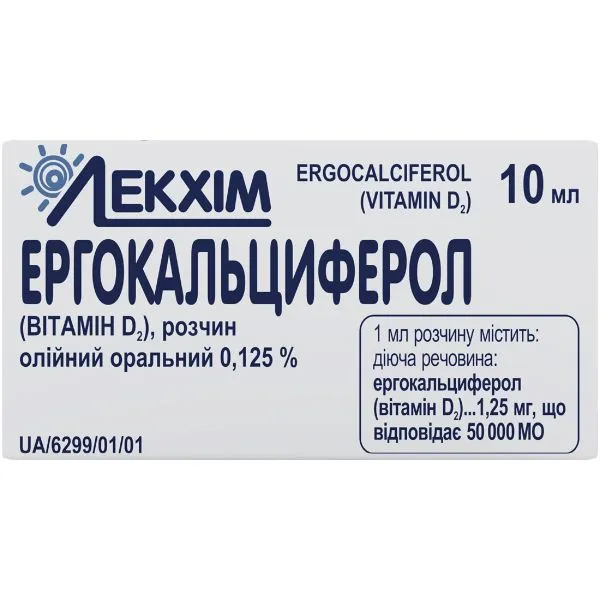
Table of Contents
INSTRUCTION FOR MEDICAL USE OF THE MEDICINAL PRODUCT ERGOCALCIFEROL (VITAMIN D2) (ERGOCALCIFEROL (VITAMIN D2))
Composition:
Active substance: ergocalciferol (vitamin D2);
1 ml of the preparation contains 1.25 mg of ergocalciferol, equivalent to 50,000 IU;
Excipient: refined, deodorized, chilled sunflower oil, grade "P".
Pharmaceutical form. Oral oily solution.
Main physicochemical properties: clear, oily liquid ranging from light yellow to dark yellow in color, without rancid odor.
Pharmacotherapeutic group. Vitamin D and its analogues preparations. ATC code A11CC01.
Pharmacological properties.
Pharmacodynamics.
Ergocalciferol (vitamin D2) regulates phosphorus and calcium metabolism in the body, promotes their absorption in the intestine by increasing permeability of its mucous membrane and adequate deposition in bone tissue. The action of ergocalciferol is enhanced when calcium and phosphorus compounds are simultaneously supplied.
Vitamin D2 belongs to the group of fat-soluble vitamins and is one of the regulators of phosphorus and calcium metabolism. It promotes absorption of these minerals from the intestine, their distribution and deposition in bones during bone growth. The specific effect of the vitamin is particularly evident in rickets (antirachitic vitamin).
Pharmacokinetics.
Orally administered vitamin D is absorbed into the blood in the small intestine, especially well in its proximal segment. The vitamin enters the liver cells via the bloodstream, where it undergoes hydroxylation with the participation of 25-hydroxylase to form its transport form, which is delivered by blood to the mitochondria of the kidneys. In the kidneys, further hydroxylation occurs via 1α-hydroxylase, resulting in the formation of the hormonal form of vitamin D. This active form of vitamin D is then transported by blood to target tissues, such as the intestinal mucosa, where it initiates Ca++ absorption.
Clinical characteristics.
Indications.
For the prevention and treatment of vitamin D deficiency, rickets, as well as bone diseases caused by disorders of calcium metabolism (various forms of osteoporosis, osteomalacia), disorders of parathyroid gland function (tetany), skin and bone tuberculosis, psoriasis, systemic lupus erythematosus (SLE) of the skin and mucous membranes.
Contraindications.
- Hypersensitivity to the components of the drug;
- hypervitaminosis D;
- active pulmonary tuberculosis;
- peptic ulcer of the stomach and duodenum;
- acute and chronic liver and kidney diseases;
- organic heart and vascular diseases in the decompensation stage;
- elevated levels of calcium and phosphorus in blood and urine;
- sarcoidosis;
- urolithiasis.
Interaction with other medicinal products and other types of interactions.
When used concomitantly with calcium salts, the toxicity of vitamin D2 increases. When administered with iodine-containing preparations, oxidation of the vitamin occurs. When used simultaneously with antibiotics (tetracycline, neomycin), impaired absorption of ergocalciferol is observed. Combination of the drug with mineral acids leads to its destruction and inactivation.
Thiazide diuretics and medicinal products containing Ca2+ increase the risk of developing hypercalcemia, which reduces tolerance to cardiac glycosides, resulting in slowed elimination of the drug and its accumulation in the body.
Under the influence of barbiturates (including phenobarbital), phenytoin, and primidone, the requirement for ergocalciferol may significantly increase, manifested by the intensification of osteomalacia or severity of rickets (due to accelerated metabolism of ergocalciferol into inactive metabolites as a result of induction of microsomal enzymes).
Long-term therapy with concomitant use of antacids containing Al3+ and Mg2+ increases their concentration in blood and the risk of intoxication (especially in the presence of chronic renal insufficiency). Calcitonin, derivatives of etidronic and pamidronic acids, plikamycin, gallium nitrate, and glucocorticosteroids reduce the effect. Cholestyramine, colestipol, and mineral oils reduce the absorption of fat-soluble vitamins in the gastrointestinal tract and require increased dosing.
Rifampicin, isoniazid, antiepileptic drugs, and cholestyramine reduce the effectiveness of ergocalciferol.
Use with caution with ketoconazole, inhibitors of cytochrome P450.
Increases absorption of phosphorus-containing drugs and the risk of developing hyperphosphatemia. Concurrent use with other vitamin D analogs (especially calcifediol) increases the risk of hypervitaminosis (not recommended).
Special precautions.
Vitamin D2 preparations should be stored under conditions that exclude exposure to light and air, which can inactivate them: oxygen oxidizes vitamin D2, while light converts it into toxic toxisterin.
It should be noted that vitamin D2 has cumulative properties.
During prolonged use, calcium (Ca²⁺) concentration in blood and urine should be monitored.
Excessively high doses of vitamin D2 administered over a long period or as bolus doses may lead to chronic vitamin D2 hypervitaminosis.
In cases of hypervitaminosis caused by ergocalciferol, an enhanced effect of cardiac glycosides and an increased risk of arrhythmias due to hypercalcemia may occur (adjustment of cardiac glycoside dosage may be necessary).
Use with caution in patients with long-term hypothyroidism and in elderly individuals, as vitamin D2 may promote calcium deposition in the lungs, kidneys, and blood vessels, potentially contributing to the development and progression of atherosclerosis.
In elderly patients, the requirement for vitamin D2 may increase due to reduced absorption of vitamin D, decreased capacity of the skin to synthesize previtamin D3, reduced exposure to sunlight, and a higher incidence of renal insufficiency.
When administered in high doses, vitamin A (10,000–15,000 IU daily), ascorbic acid, and B-complex vitamins should be co-administered to reduce the toxic effects on the body. Vitamin D2 intake should not be combined with irradiation from a quartz lamp.
Calcium preparations should not be used simultaneously with high-dose vitamin D. During treatment, monitoring of calcium and phosphorus levels in blood and urine is recommended.
Use with caution in patients with diabetes mellitus and in individuals who are immobilized.
The drug should be used under medical supervision. Individual requirements should take into account all possible sources of this vitamin.
Use during pregnancy or breastfeeding.
Ergocalciferol may be used starting from the 30th–32nd week of pregnancy. Particular caution is required when prescribing ergocalciferol to pregnant women over 35 years of age. Hypercalcemia in the mother (associated with prolonged intake of vitamin D2 during pregnancy) may lead to increased fetal sensitivity to vitamin D, suppression of parathyroid gland function, a characteristic elfin-like facial appearance, delayed mental development, and aortic stenosis. Overdose of vitamin D2 during pregnancy may cause hypercalcemia, potentially leading to impaired parathyroid function in the fetus.
During pregnancy, vitamin D2 should not be taken in high doses (exceeding 2000 IU/day) due to the potential teratogenic effects in case of overdose.
Vitamin D2 should be prescribed with caution during breastfeeding, as high-dose intake by the mother may cause symptoms of overdose in the infant.
Ability to affect reaction speed when driving or operating machinery.
When driving a vehicle or operating machinery, special caution is recommended due to the potential for adverse reactions affecting the nervous system.
Method of Administration and Dosage
Ergocalciferol should be taken orally during meals. 1 ml of the preparation contains 50000 IU.
The preparation should be used in the form of drops; 1 drop from the dropper contains approximately
1400 IU.
For the treatment of rickets, considering its severity and clinical course, Ergocalciferol (Vitamin D2) should be administered at a dose of 1400–5600 IU per day for 30–45 days. After achieving the therapeutic effect within the specified period, transition should be made to prophylactic administration of vitamin D at a dose of 500 IU* per day until the child reaches 3 years of age. During summer months, a break in the administration of the drug should be observed.
For rickets prophylaxis (in newborns and infants), Ergocalciferol should be prescribed to pregnant women and breastfeeding mothers. During pregnancy, the drug should be taken from week 30–32 at a dose of 1400 IU per day for 6–8 weeks. Breastfeeding mothers should take Ergocalciferol at a daily dose of 500–1000 IU* from the first days of lactation until the time when Ergocalciferol administration to the infant is initiated.
For prophylaxis, the drug should be prescribed to full-term infants starting from the third week of life. Premature infants, infants on artificial feeding, twins, and infants living under unfavorable environmental (including household) conditions should receive the drug starting from the second week of life.
For rickets prophylaxis, Ergocalciferol can be administered using different methods:
- Physiological method – daily administration to full-term infants, for 3 years, except during
the 3 summer months, at a dose of 500 IU* per day (annual course dose – 180000 IU); - Course method – daily administration of Ergocalciferol at 1400 IU per day for
30 days at the 2nd, 6th, 10th month of life; subsequently, 2–3 courses per year until 3 years of age, with 3-month intervals between courses (annual course dose – 180000 IU).
For premature infants, the daily prophylactic dose of vitamin D may be increased to
1000 IU*, administered daily during the first six months of life. Afterwards, 1400–2800 IU per day should be administered 2–3 times a year for one month each, with 3–4 month intervals between courses.
In regions with long winters, prophylaxis should be continued until the child reaches 3–5 years of age.
Treatment with the drug should be conducted under monitoring of calcium (Ca++) levels in urine.
In rickets-like diseases, pathological processes in bone tissue caused by impaired calcium metabolism, certain forms of tuberculosis, and psoriasis, the drug should be prescribed according to comprehensive treatment regimens for these conditions.
The daily therapeutic dose for adult lupus vulgaris is 100000 IU. In children under 16 years of age, depending on age, Ergocalciferol should be prescribed after meals in daily doses ranging from 25000 to 75000 IU (the daily dose should be divided into two administrations). The treatment course lasts 5–6 months.
* – if such dosing is feasible.
Children
The physician individually determines the child's daily requirement for vitamin D and the method of administration, adjusting it during periodic examinations, especially during the first months of life.
Neonates may exhibit varying sensitivity to vitamin D2; some may be sensitive even to very low doses.
When prescribing vitamin D to premature infants, simultaneous administration of phosphates is advisable.
Overdose
Symptoms of vitamin D hypervitaminosis
Early (due to hypercalcemia) – constipation or diarrhea, dryness of the oral mucosa, headache, thirst, polyuria, nocturia, polyuria, anorexia, metallic taste in the mouth, nausea, vomiting, increased fatigue, asthenia, hypercalcemia, hypercalciuria;
Late – bone pain, cloudy urine (appearance of hyaline cylinders in urine, proteinuria, leukocyturia), elevated arterial pressure, itching, photophobia, conjunctival hyperemia, arrhythmia, drowsiness, myalgia, nausea, vomiting, pancreatitis, gastralgia, weight loss, rarely – mood and mental changes (up to development of psychosis).
Symptoms of chronic vitamin D intoxication (after intake over several weeks or months: in adults at doses of 20000–60000 IU/day, in children at 2000–4000 IU/day): calcification of soft tissues, kidneys, lungs, blood vessels; arterial hypertension; renal and cardiovascular insufficiency, up to fatal outcome (these effects most commonly occur when hypercalcemia and hyperphosphatemia are present); impaired growth in children (prolonged intake at a maintenance dose of 1800 IU/day).
Treatment: discontinue the drug, strictly limit intake of vitamin D2 with food, induce vomiting or perform gastric lavage with activated charcoal, administer saline laxatives, correct water-electrolyte balance.
In cases of hypercalcemia, administer edetates. Hemodialysis and peritoneal dialysis are effective.
The toxic effect of high doses of the drug is reduced when vitamin A is taken simultaneously.
Side effects.
When high doses are used for a prolonged period, the following adverse reactions may occur:
- Immune system side effects: hypersensitivity reactions, including rash, urticaria, itching;
- Central nervous system side effects: headache, vertigo, sleep disturbances, irritability, depression;
- Metabolic disorders: hyperphosphatemia, increased urinary calcium levels (risk of calcification of internal organs);
- Gastrointestinal side effects: anorexia, loss of appetite, diarrhea, nausea, vomiting;
- Musculoskeletal system side effects: bone pain;
- Urinary system side effects: proteinuria, cylindruria, leukocyturia;
- General disorders: general weakness, malaise.
If the above effects occur, discontinue the drug and restrict calcium intake to the greatest extent possible, including dietary sources.
Shelf life. 2 years.
Storage conditions.
Store in the original packaging in a refrigerator (at a temperature of +2 °C to +8 °C).
Keep out of reach of children.
Packaging.
10 ml in glass or polymer bottles; 1 bottle per cardboard box.
Prescription status.
Prescription only.
Manufacturer.
JSC "Tekhnolog".
Manufacturer's name and address of manufacturing site.
8 Stara Prorizna Street, Uman, Cherkasy region, 20300, Ukraine.