Enzystal
Ukraine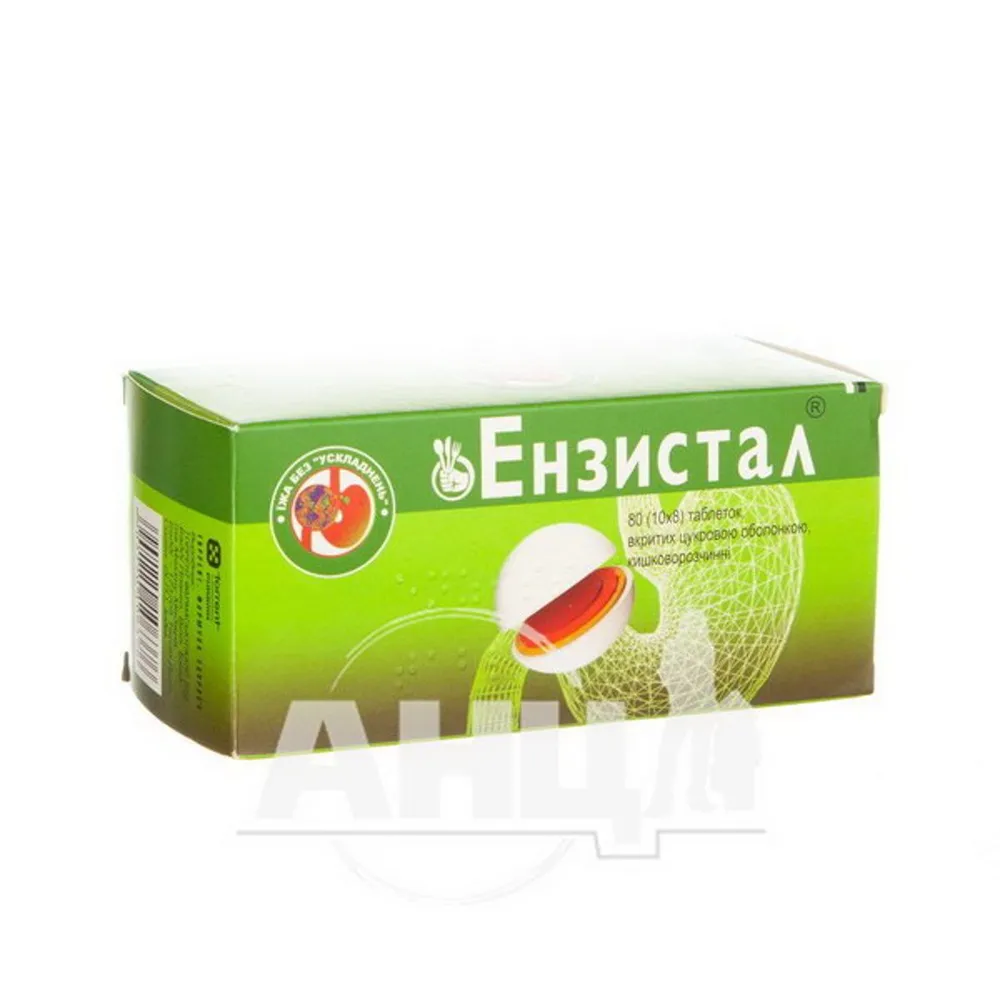
Table of Contents
INSTRUCTIONS FOR MEDICAL USE OF THE MEDICINAL PRODUCT ENZISTAL®
Composition:
Active substances: 1 tablet contains pancreatin 192 mg (lipase 6000 IU Ph. Eur., amylase 4500 IU Ph. Eur., protease 300 IU Ph. Eur.), hemicellulase 50 mg, bile extract 25 mg;
Excipients: lactose monohydrate, magnesium stearate, colloidal anhydrous silicon dioxide, cellulose acetate phthalate, diethyl phthalate, sugar, calcium carbonate, talc, acacia, gelatin, titanium dioxide (E 171), yellow wax.
Pharmaceutical form. Sugar-coated enteric-coated tablets.
Main physicochemical properties: white, round, biconvex sugar-coated tablets.
Pharmacotherapeutic group.
Drugs that improve digestion, including enzymes. Polyenzyme preparations.
ATC code A09AA02.
Pharmacological Properties.
Pharmacodynamics.
A combination drug. The enzymes contained in the medicinal product facilitate the digestion of proteins, fats, and carbohydrates, and promote more complete absorption of the latter in the small intestine. Bile extract promotes emulsification of fats, increases lipase activity, and improves absorption of fats and fat-soluble vitamins. The enzyme hemicellulase aids in the breakdown of plant fiber. These properties of the drug help improve gastrointestinal tract function and normalize the digestive process.
Pharmacokinetics.
The drug is not absorbed and acts within the intestinal lumen. The tablet contents are protected by an enteric coating, which prevents inactivation of the enzymes (contained in the drug) by gastric hydrochloric acid. The coating dissolves and releases the enzymes in the small intestine, i.e., in an alkaline environment, which is optimal for enzyme activity.
Clinical characteristics.
Indications.
Replacement therapy in mild to moderate impairment of exocrine pancreatic function in chronic pancreatitis (excluding cases of acute exacerbation of chronic pancreatitis), to improve digestion in ulcerative colitis, irritable bowel syndrome, and after gastrectomy; in meteorism and certain cases of non-infectious diarrhea; to improve food digestion in individuals with normal gastrointestinal tract function when disturbances in rational dietary regimen occur (e.g., excessive food intake, consumption of fatty, fried, or unusual food, irregular eating, etc.); in impaired masticatory function, and in conditions leading to prolonged immobilization; preparation for radiological and ultrasound examinations of abdominal organs; as an adjunctive agent for effective absorption of fat-soluble vitamins and certain medicinal agents (PAS, sulfonamides, antibiotics).
Contraindications.
Hypersensitivity to components of the drug or to animal-derived pancreatic enzymes, acute hepatitis, mechanical jaundice, obstructive intestinal obstruction, acute pancreatitis, acute exacerbation of chronic pancreatitis.
Interaction with other medicinal agents and other types of interactions.
Enzystal® enhances the effective absorption of fat-soluble vitamins, sulfonamides, antibiotics, and para-aminosalicylic acid (PAS).
When pancreatin is used concomitantly with antithrombotic agents, vitamin K antagonists, and acetylsalicylic acid, the effect of these drugs is reduced. The efficacy of non-selective inhibitors of neuronal monoamine reuptake is also reduced when used simultaneously with pancreatin.
Concomitant use with M-cholinolytics enhances the anticholinergic effect.
Folic acid absorption may be reduced during use of the drug. Pancreatin may reduce the effect of acarbose; therefore, these drugs should not be used simultaneously.
The drug reduces iron absorption during prolonged use; therefore, iron supplements should be prescribed concurrently if needed. Concurrent use of antacids containing calcium carbonate and/or magnesium hydroxide may reduce the effectiveness of Enzystal®. Concomitant use with tannins or alcohol-containing agents may reduce the effectiveness of pancreatin.
Cimetidine may potentiate the effect of the drug.
Special precautions for use.
The medicinal product should not be used in acute pancreatitis or in chronic pancreatitis during an exacerbation phase. During recovery or when expanding the diet, the drug may be taken only as prescribed by a physician.
In the presence of symptoms resembling intestinal obstruction, the possibility of intestinal strictures should be considered. Unusual symptoms should be monitored, especially when administering more than 10,000 units of lipase/kg/day.
To prevent the formation of uric acid calculi, urinary uric acid levels should be monitored.
Tablets should not be chewed or crushed, as this may cause premature release of enzymes, potentially leading to irritation of the oral mucosa and/or reduced enzymatic activity.
The medicinal product contains lactose; therefore, patients with rare hereditary forms of galactose intolerance, lactase deficiency, or glucose-galactose malabsorption should not use this product. The preparation contains sugar and should thus be used with caution in patients with diabetes mellitus.
The medicinal product contains purines in its composition; therefore, it should be used with caution in patients with the following conditions:
- Gout;
- Hyperuricemia;
- Renal insufficiency.
Use during pregnancy or breastfeeding.
The safety of pancreatin in pregnant women has not been established. Therefore, the use of this medicinal product should be avoided during pregnancy.
The safety of pancreatin in breastfeeding women has not been established; therefore, the use of the drug should be avoided during breastfeeding.
Ability to influence reaction rate while driving or operating machinery.
No effect.
Dosage and Administration.
Administer 1 tablet with a small amount of liquid during or immediately after each meal to adults. The tablet should not be chewed. If necessary, the dose may be increased to 2 tablets.
The duration of treatment may vary from several days (in cases of digestive disturbances due to dietary irregularities) to several months or even years (when continuous replacement therapy is required).
Children.
The drug is not intended for use in children.
Overdose. Prolonged use at high doses may lead to hyperuricemia and hyperuricosuria. Exacerbation of adverse reactions is possible.
Treatment: discontinue the drug, ensure adequate hydration, and provide symptomatic therapy.
Adverse reactions
The following classification is used to assess the frequency of adverse effects: very common: ≥ 10%; common: ≥ 1% and < 10%; uncommon: ≥ 0.1% and < 1%; rare: ≥ 0.01% and < 0.1%; very rare: < 0.01%; frequency not known (cannot be estimated from available data).
Immune system disorders. Frequency not known: anaphylactic reactions, including urticaria and angioneurotic edema.
Hypersensitivity reactions may occur, including skin rashes, itching, skin redness, lacrimation, and sneezing.
Reproductive system and breast disorders. Frequency not known: hyperuricosuria, especially when high doses of the drug are administered.
Gastrointestinal disorders. Frequency not known: vomiting, irritation of the oral mucosa. Abdominal pain, diarrhea, perianal irritation, constipation, extensive intestinal stricture, fibrotic colonopathy.
Very rarely: nausea, epigastric discomfort, flatulence, changes in bowel habits, intestinal colic, intestinal obstruction.
Gastrointestinal adverse reactions may also be caused by the underlying disease.
Metabolism and nutrition disorders. Frequency not known: hyperuricemia.
Administration of very high doses of the drug may lead to increased blood levels of uric acid.
Shelf life. 3 years.
Storage conditions.
Store at a temperature not exceeding 25 °C in the original packaging.
Keep out of reach of children.
Packaging.
10 tablets in a blister; 2 or 8 blisters in a cardboard pack.
Prescription status. Over-the-counter (without prescription).
Manufacturer.
Torrent Pharmaceuticals Ltd.
Manufacturer's address and location of operations.
Bhad and Makhu Majra, Tehsil: Baddi – 173205, Dist-Solan (H.P.), India.