Entyvio
Ukraine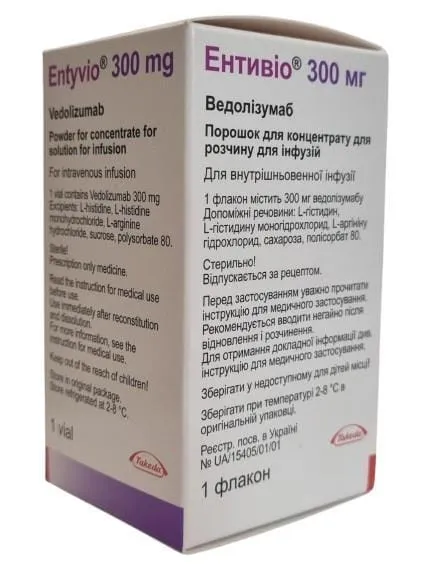
Table of Contents
INSTRUCTIONS FOR MEDICAL USE OF THE MEDICINAL PRODUCT ENTYVIO® (ENTYVIO®)
Composition:
Active substance: vedolizumab;
1 vial contains 300 mg of vedolizumab;
Excipients: L-histidine, L-histidine monohydrochloride, L-arginine hydrochloride, sucrose, polysorbate 80.
Pharmaceutical form. Powder for concentrate for solution for infusion.
Main physico-chemical characteristics: white or almost white powder or solid mass.
Pharmacotherapeutic group. Antineoplastic and immunomodulating agents. Immunosuppressive agents. Monoclonal antibodies.
ATC code L04A G05.
Pharmacological Properties
Pharmacodynamics
Vedolizumab is a gut-selective immunosuppressive biological agent. Vedolizumab is a humanized monoclonal antibody that specifically binds to the α4β7 integrin expressed predominantly on gut-tropic T-helper lymphocytes. By binding to α4β7 on these lymphocytes, vedolizumab inhibits their adhesion to mucosal addressin cell adhesion molecule-1 (MAdCAM-1) expressed on gut endothelial cells, but does not inhibit their adhesion to vascular cell adhesion molecule-1 (VCAM-1). MAdCAM-1 is primarily expressed on intestinal endothelial cells and plays a critical role in the migration of T-lymphocytes into gastrointestinal (GI) tissues. Vedolizumab does not bind to α4β1 or αEβ7 integrins and does not inhibit their function.
The α4β7 integrin is expressed on a subset of memory T-helper lymphocytes that preferentially migrate to gastrointestinal (GI) tissues and drive the inflammation characteristic of ulcerative colitis and Crohn’s disease—chronic immune-mediated inflammatory disorders of the GI tract. Vedolizumab reduces gastrointestinal inflammation in patients with ulcerative colitis, Crohn’s disease, and pouchitis. Inhibition of α4β7–MAdCAM-1 interaction by vedolizumab prevents the transmigration of specific memory T-helper lymphocytes across the vascular endothelium into intestinal tissues in animal studies and results in a reversible threefold increase in the levels of these cells in peripheral blood. The murine precursor of vedolizumab reduced gastrointestinal inflammation in animal models of colitis using an experimental model of ulcerative colitis.
In healthy volunteers and in patients with ulcerative colitis or Crohn’s disease, vedolizumab does not increase peripheral blood levels of neutrophils, basophils, eosinophils, B-helper cells, cytotoxic T-lymphocytes, memory T-helper lymphocytes, monocytes, or natural killer cells, and leukocytosis has not been observed with its use.
Vedolizumab did not affect immune surveillance or inflammation in the central nervous system (CNS) in animal studies of experimental autoimmune encephalomyelitis, an experimental model of multiple sclerosis. Vedolizumab did not affect immune responses to dermal or muscular antigen challenge (see section "Special Warnings and Precautions for Use"). In contrast, vedolizumab suppressed immune responses to antigens administered via the gastrointestinal tract in healthy volunteers (see section "Special Warnings and Precautions for Use").
In clinical studies using doses of vedolizumab ranging from 0.2 to 10 mg/kg, receptor occupancy of α4β7 on circulating lymphocyte subsets involved in gut immune surveillance exceeded 95%.
Vedolizumab did not affect the migration of CD4+ and CD8+ cells into the CNS, as confirmed by the absence of changes in the CD4+/CD8+ ratio in cerebrospinal fluid before and after vedolizumab administration in healthy volunteers. These findings are consistent with animal studies showing no effect of the drug on immune surveillance in the CNS.
Immunogenicity
During treatment with ENTYVIO®, antibodies to vedolizumab may develop, most of which are neutralizing. The formation of anti-vedolizumab antibodies is associated with increased clearance of vedolizumab and lower rates of clinical remission.
Infusion-related reactions following vedolizumab administration have been observed in patients with antibodies to vedolizumab.
Pharmacokinetics
The pharmacokinetics of vedolizumab after single and multiple doses have been studied in healthy volunteers and in patients with moderate to severe active ulcerative colitis or Crohn’s disease. Pharmacokinetic studies of vedolizumab in patients with pouchitis have not been conducted, but its pharmacokinetics are expected to be similar to those in patients with moderate to severe active ulcerative colitis or Crohn’s disease.
In patients receiving vedolizumab 300 mg as a 30-minute infusion at weeks 0 and 2, mean serum concentrations at week 6 were 27.9 µg/mL (standard deviation [SD] ± 15.51) in ulcerative colitis and 26.8 µg/mL (SD ± 17.45) in Crohn’s disease. Starting at week 6, patients received 300 mg of vedolizumab every 8 weeks or every 4 weeks. In patients with ulcerative colitis, mean steady-state serum concentrations were 11.2 µg/mL (SD ± 7.24) and 38.3 µg/mL (SD ± 24.43), respectively. In patients with Crohn’s disease, mean steady-state serum concentrations were 13.0 µg/mL (SD ± 9.08) and 34.8 µg/mL (SD ± 22.55), respectively.
Distribution. Population pharmacokinetic analyses indicate that the volume of distribution of vedolizumab is approximately 5 liters. Binding of vedolizumab to plasma proteins has not been evaluated. Vedolizumab is a therapeutic monoclonal antibody, and significant plasma protein binding is not expected.
Vedolizumab does not cross the blood-brain barrier after intravenous administration. In healthy volunteers, vedolizumab administered intravenously at a dose of 450 mg was not detected in cerebrospinal fluid.
Elimination. Population pharmacokinetic analyses based on intravenous and subcutaneous formulations indicate that the total clearance of vedolizumab is approximately 0.162 L/day (via a linear elimination pathway) and the serum half-life is 26 days. The exact elimination pathway of vedolizumab from the body is unknown. Population pharmacokinetic analyses suggest that low albumin levels, higher body weight, prior treatment with anti-tumor necrosis factor (TNF) antibody drugs, and the presence of anti-vedolizumab antibodies may increase the clearance of vedolizumab; however, the magnitude of these effects is not considered clinically significant.
Linearity. Vedolizumab exhibits linear pharmacokinetics at serum concentrations above 1 µg/mL.
Special Patient Populations. According to population pharmacokinetic analyses, age does not influence the clearance of vedolizumab in patients with ulcerative colitis or Crohn’s disease. Age is not expected to affect vedolizumab clearance in patients with pouchitis. Formal studies on the effects of renal or hepatic impairment on the pharmacokinetics of vedolizumab have not been conducted.
Clinical characteristics.
Indications.
- Treatment of active moderate to severe ulcerative colitis in adult patients who have had an inadequate response, loss of response, or intolerance to conventional therapy or tumor necrosis factor alpha (TNF-α) antagonists.
- Treatment of active moderate to severe Crohn's disease in adult patients who have had an inadequate response, loss of response, or intolerance to conventional therapy or tumor necrosis factor alpha (TNF-α) antagonists.
- Treatment of active moderate to severe chronic pouchitis in adult patients who have undergone proctocolectomy and ileal pouch-anal anastomosis for ulcerative colitis, and who have had an inadequate response or loss of response to antibiotic therapy.
Contraindications.
Hypersensitivity to the active substance or to any of the excipients.
Active severe infections such as tuberculosis, sepsis, cytomegalovirus, listeriosis, and opportunistic infections, including progressive multifocal leukoencephalopathy (PML) (see section "Special precautions").
Interaction with other medicinal products and other forms of interaction.
Interaction studies have not been performed.
Concomitant use of vedolizumab with corticosteroids, immunomodulators (azathioprine, 6-mercaptopurine, and methotrexate), and aminosalicylates was studied in adult patients with ulcerative colitis and Crohn's disease. According to population pharmacokinetic analysis, concomitant use of vedolizumab with these medicinal products had no clinically significant effect on the pharmacokinetics of vedolizumab.
Adult patients with pouchitis received vedolizumab concomitantly with antibiotics. Pharmacokinetic studies of vedolizumab in patients with pouchitis have not been conducted.
Studies on the effect of vedolizumab on the pharmacokinetics of concomitant medicinal products have not been conducted.
Vaccination.
Live vaccines, including oral live vaccines, should be used with caution concomitantly with ENTYVIO® (see section "Special precautions").
Special precautions for use
Vedolizumab should be administered in medical facilities equipped with equipment for emergency medical care in case of acute hypersensitivity reactions, including anaphylaxis. Appropriate monitoring and medical interventions must be available for immediate use during administration of Entyvio®.
Patients should be monitored during each infusion of the medicinal product. After the first two infusions, patients should be observed for approximately 2 hours after completion of the infusion for signs and symptoms of severe hypersensitivity reactions. After subsequent infusions, patients should be observed for 1 hour after completion of the infusion.
Traceability
To improve traceability of biological medicinal products, the name and batch number of the administered product should be clearly recorded.
Infusion-related reactions and hypersensitivity reactions
During clinical trials, infusion-related reactions and hypersensitivity reactions have been reported, mostly of mild to moderate severity (see section "Adverse reactions").
In the event of severe infusion-related reactions, anaphylactic reactions, or other severe reactions, administration of Entyvio® should be discontinued immediately and appropriate therapy initiated (e.g., epinephrine or antihistamines) (see section "Contraindications").
In case of mild or moderate infusion-related reactions, the infusion rate should be reduced or administration discontinued, and appropriate therapy initiated. After resolution of mild or moderate infusion-related reactions, infusion of the medicinal product may be resumed. Physicians should consider the need for premedication (e.g., with antihistamines, hydrocortisone and/or paracetamol) prior to the next infusion in patients with a history of mild to moderate infusion-related reactions to vedolizumab, in order to minimize risks (see section "Adverse reactions").
Infections
Vedolizumab is a gut-selective integrin antagonist without defined systemic immunosuppressive activity.
Physicians should consider the potential increased risk of opportunistic infections or infections for which the gut acts as a protective barrier (see section "Adverse reactions").
Treatment with Entyvio® should not be initiated in patients with active severe infections until the infections are controlled. Physicians should consider withholding treatment in patients who develop severe infections during prolonged treatment with Entyvio®. Caution should be exercised when considering the use of vedolizumab in patients with controlled chronic severe infections or recurrent severe infections in their medical history. Infections should be closely monitored before, during, and upon completion of treatment with the medicinal product.
Entyvio® is contraindicated in patients with active tuberculosis (see section "Contraindications"). Before initiating vedolizumab therapy, patients should be screened for tuberculosis according to local practice. If latent tuberculosis is diagnosed, appropriate anti-tuberculosis treatment should be initiated according to local guidelines prior to starting vedolizumab therapy. Patients who develop tuberculosis during vedolizumab therapy should discontinue treatment until the infection is cured.
The use of certain integrin antagonists and certain systemic immunosuppressants has been associated with the development of progressive multifocal leukoencephalopathy (PML), a rare opportunistic infection caused by the John Cunningham (JC) virus, which often leads to fatal outcomes. By binding to α4β7 integrin, predominantly expressed on gut lymphocytes, vedolizumab exerts an immunosuppressive effect in the gastrointestinal tract. Although a systemic immunosuppressive effect has not been observed in healthy volunteers, the impact on immune function in patients with inflammatory bowel disease is unknown.
Physicians should monitor patients receiving vedolizumab for the development or worsening of neurological signs and symptoms and refer the patient to a neurologist if such symptoms occur. If PML is suspected, treatment with vedolizumab should be withheld. If PML is confirmed, the drug should be discontinued.
Malignancies
Patients with ulcerative colitis and Crohn's disease have an increased risk of developing malignancies. Immunomodulatory medicinal products may increase the risk of malignancies (see section "Adverse reactions").
Biological agents
Clinical data on the use of vedolizumab in patients previously treated with natalizumab or rituximab are lacking. Caution should be exercised when administering Entyvio® to such patients.
Patients previously treated with natalizumab should generally wait at least 12 weeks before starting therapy with Entyvio®, unless otherwise indicated by the patient's clinical condition.
Clinical data on the concomitant use of vedolizumab with biological immunosuppressants are not available. Therefore, the use of Entyvio® in patients taking such agents is not recommended.
Live oral vaccines
During placebo-controlled studies in healthy volunteers, a single 750 mg dose of vedolizumab did not reduce protective immune response to hepatitis B virus in patients who received three doses of recombinant hepatitis B surface antigen vaccine intramuscularly. Patients receiving vedolizumab showed lower seroconversion rates after administration of an inactivated oral cholera vaccine. The effect on other oral and nasal vaccines is unknown. All patients are recommended to be vaccinated according to current vaccination guidelines prior to starting therapy with Entyvio®. Patients receiving vedolizumab may continue to receive inactivated vaccines. Data on secondary transmission of infection from live vaccines in patients receiving vedolizumab are lacking. The influenza vaccine should be administered by injection according to established clinical practice. Other live vaccines may be co-administered with vedolizumab only if the benefit outweighs the potential risk.
Induction of remission in Crohn's disease
Induction of remission in Crohn's disease may take up to approximately 14 weeks in some patients. The reasons for this are not fully understood and are likely related to the mechanism of action. This should be taken into account, particularly in patients with severe disease who have not previously received anti-TNF-α therapy.
A subgroup analysis conducted during clinical trials showed that vedolizumab was less effective in inducing remission in Crohn's disease in patients not receiving concomitant corticosteroid therapy compared to those who were (regardless of concomitant immunomodulator use).
Use during pregnancy or breastfeeding
Women of childbearing potential
Women of childbearing potential are recommended to use effective contraception to prevent pregnancy and continue its use for at least 18 weeks after the last dose of Entyvio®.
Pregnancy
Data on the use of vedolizumab in pregnant women are limited.
In a small prospective observational study, the rate of major congenital malformations was 7.4% in 99 women with ulcerative colitis or Crohn's disease who received vedolizumab, and 5.6% in 76 women with ulcerative colitis or Crohn's disease who received other biological agents (adjusted relative risk (RR) 1.07, 95% confidence interval (CI): 0.33, 3.52).
Animal studies do not indicate a direct or indirect harmful effect on reproductive toxicity. Entyvio® should be used during pregnancy only if the benefit outweighs the potential risk to the mother and fetus.
Breastfeeding
It has been established that vedolizumab passes into human breast milk. The impact of vedolizumab on breastfed infants and on milk production is unknown. In a dedicated breastfeeding study evaluating vedolizumab concentrations in breast milk of women with active ulcerative colitis or Crohn's disease, vedolizumab concentrations in breast milk were approximately 0.4–2.2% of the vedolizumab concentration in maternal serum observed in previous vedolizumab studies.
The calculated average daily dose of vedolizumab ingested by the infant was 0.02 mg/kg/day, equivalent to approximately 21% of the mother's average daily dose adjusted for body weight.
The use of vedolizumab in women who are breastfeeding should take into account the benefits of therapy for the mother and the potential risks for the infant.
Fertility
Data on the effect of vedolizumab on human fertility are not available. Effects on fertility in male and female animals have not been formally studied.
Ability to affect driving and operating machinery
Entyvio® has negligible influence on the ability to drive or operate machinery, as dizziness has been reported in a small number of patients.
Administration and Dosage
Treatment should be initiated and maintained under the supervision of a physician experienced in the diagnosis and treatment of ulcerative colitis, Crohn's disease, and pouchitis (see section "Special Precautions"). Patients should be provided with the medical instructions for the medicinal product.
Ulcerative colitis. The recommended dose is 300 mg of Entyvio® administered as an intravenous infusion. Administration is recommended at weeks 0, 2, and 6, followed by every 8 weeks thereafter.
Continuation of therapy in patients with ulcerative colitis should be carefully reconsidered if there is no evidence of therapeutic effect within 10 weeks (see section "Pharmacodynamic Properties").
Some patients who experience a loss of response to treatment may benefit from increasing the frequency of intravenous administration to 300 mg every 4 weeks.
Patients who respond to treatment with Entyvio® should have their corticosteroid dose reduced and/or discontinued according to standard treatment guidelines.
Re-initiation of therapy. If treatment has been interrupted and there is a need to re-initiate therapy, administration of Entyvio® every 4 weeks may be considered. In clinical trials, treatment interruptions of up to 1 year were reported. Upon re-initiation of therapy, efficacy was restored without an increase in the frequency of adverse events or infusion reactions (see section "Adverse Reactions").
Crohn's disease. The recommended dose is 300 mg of Entyvio® administered as an intravenous infusion. Administration is recommended at weeks 0, 2, and 6, followed by every 8 weeks thereafter.
Patients with Crohn's disease who do not respond to therapy may benefit from an additional dose at week 10 of treatment (see section "Special Precautions"). Patients who respond to treatment should continue therapy every 8 weeks, starting from week 14. Patients with Crohn's disease should not continue treatment with the drug if there is no therapeutic effect observed by week 14 (see section "Pharmacodynamic Properties").
Some patients who experience a loss of response to treatment may benefit from increasing the dosing frequency to 300 mg every 4 weeks.
Patients who respond to treatment with Entyvio® should have their corticosteroid dose reduced and/or discontinued according to standard treatment guidelines.
Re-initiation of therapy. If treatment has been interrupted and there is a need to re-initiate therapy, administration of Entyvio® every 4 weeks may be considered. In clinical trials, treatment interruptions of up to 1 year were reported. Upon re-initiation of therapy, efficacy was restored without an increase in the frequency of adverse events or infusion reactions (see section "Adverse Reactions").
Pouchitis. The recommended dose is 300 mg of vedolizumab administered as an intravenous infusion. Administration is recommended at weeks 0, 2, and 6, followed by every 8 weeks thereafter.
Treatment with vedolizumab should be initiated concomitantly with standard antibiotic therapy (e.g., ciprofloxacin treatment for 4 weeks).
Discontinuation of therapy should be considered if there is no evidence of therapeutic effect by week 14 of vedolizumab treatment.
Re-initiation of therapy
Data on re-initiation of therapy in patients with pouchitis are lacking.
Elderly patients do not require dose adjustment. Population pharmacokinetic analyses have shown no effect of age on pharmacokinetic parameters.
Patients with renal or hepatic impairment. The use of Entyvio® in these patients has not been studied. No specific dosage recommendations are available.
Administration method.
Entyvio® is intended for intravenous use only. The product must be reconstituted and diluted before administration (see dilution instructions below). Entyvio® should be administered as an intravenous infusion over not less than 30 minutes. Patients should be monitored during and after the infusion (see section "Special Precautions").
Dilution instructions.
- Reconstitution of the Entyvio® solution for intravenous administration must be performed under sterile conditions.
- Remove the protective cap from the vial and disinfect the rubber stopper with an alcohol swab. Prepare the reconstituted vedolizumab solution by adding 4.8 mL of sterile water for injection at room temperature (20–25 °C) using a syringe with a 21–25 gauge needle.
- Insert the needle into the center of the rubber stopper of the vial. Direct the stream of liquid onto the vial wall to avoid excessive foaming.
- Gently swirl the vial contents for 15 seconds. Do not shake or invert the vial.
- Allow the vial to stand for 20 minutes at room temperature (20–25 °C) to allow reconstitution and foam dissipation, if formed. The vial may be gently rotated during this time to check for complete dissolution. If the product is not fully dissolved within 20 minutes, allow it to stand for an additional 10 minutes.
- Before further dilution, visually inspect the reconstituted solution for the presence of particulate matter and/or discoloration (e.g., loss of color). The solution should be clear or opalescent, colorless to pale yellow, and free of visible particles. Do not use reconstituted solution that does not meet these characteristics or contains visible solid particles.
- After complete dissolution is achieved, gently invert the vial three times.
- Immediately withdraw 5 mL (300 mg) of the reconstituted Entyvio® solution using a syringe with a 21–25 gauge needle.
- Add 5 mL (300 mg) of the reconstituted Entyvio® solution to an infusion bag containing 250 mL of 0.9% sodium chloride solution (it is not necessary to remove 5 mL of 0.9% sodium chloride solution from the infusion bag before adding Entyvio®). Do not add any other medicinal products to the diluted Entyvio® solution or to the intravenous administration set. The infusion solution must be administered within 30 minutes.
The reconstituted solution should be used immediately after preparation. Do not store the reconstituted or diluted infusion solution for later use. The vial is intended for single use only. Any unused product or waste material should be disposed of in accordance with local requirements.
Children. The safety and efficacy of vedolizumab in children and adolescents up to 17 years of age have not been established. Appropriate data are lacking.
Overdose.
Doses up to 10 mg/kg, approximately 2.5 times the recommended dose, were used in clinical studies. Dose-limiting toxicity was not observed in clinical trials.
Adverse Reactions
Summary of Safety Profile
The most commonly reported adverse reactions were infections (such as nasopharyngitis, upper respiratory tract infections, bronchitis, influenza, and sinusitis), headache, nausea, pyrexia, fatigue, cough, and arthralgia.
Injection site reactions (with symptoms such as dyspnea, bronchospasm, urticaria, flushing, rash, increased blood pressure, and heart rate) have also been reported in patients receiving vedolizumab.
Below is a list of adverse reactions reported in clinical trials and during post-marketing use, categorized by system organ classes.
Adverse effects are classified by frequency as follows: very common (≥ 1/10), common (≥ 1/100, < 1/10), uncommon (≥ 1/1000, < 1/100), rare (< 1/10000), and not known (frequency cannot be estimated from available data). Within each frequency group, adverse reactions are listed in decreasing order of severity.
Infections and infestations
Very common: nasopharyngitis.
Common: pneumonia, Clostridium difficile-associated infections, bronchitis, gastroenteritis, upper respiratory tract infections, influenza, sinusitis, pharyngitis, herpes zoster.
Uncommon: respiratory tract infections, vulvovaginal candidiasis, oral candidiasis.
Immune system disorders
Rare: anaphylactic reaction, anaphylactic shock.
Nervous system disorders
Very common: headache.
Common: paraesthesia.
Eye disorders
Uncommon: blurred vision.
Vascular disorders
Common: arterial hypertension.
Respiratory, thoracic and mediastinal disorders
Common: oropharyngeal pain, nasal congestion, cough.
Not known: interstitial lung disease.
Gastrointestinal disorders
Common: anal abscess, anal fissure, nausea, dyspepsia, constipation, abdominal distension, flatulence, haemorrhoids, rectal bleeding*.
Skin and subcutaneous tissue disorders
Common: rash, pruritus, eczema, erythema, night sweats, acne.
Uncommon: folliculitis.
Musculoskeletal and connective tissue disorders
Very common: arthralgia.
Common: muscle spasms, back pain, muscle weakness, fatigue, limb pain.
General disorders and administration site conditions
Common: pyrexia, infusion-related reactions (asthenia*, chest discomfort*), infusion site reaction (including infusion site pain and irritation at infusion site).
Uncommon: chills, feeling cold.
*Reported in the EARNEST study involving patients with pouchitis.
Description of selected adverse reactions
Infusion-related reactions. In the controlled GEMINI 1 and 2 trials (ulcerative colitis and Crohn's disease), infusion-related reactions occurred in 4% of patients receiving vedolizumab and in 3% of patients in the placebo group (see section "Special warnings and precautions for use"). None of the infusion-related reactions occurred in more than 1% of patients. Most infusion-related reactions were mild to moderate in severity and led to discontinuation of the drug in less than 1% of cases. Infusion-related reactions generally resolved spontaneously or with minimal intervention after infusion. Most reactions occurred within the first 2 hours. Infusion-related reactions within the first two hours occurred more frequently in patients receiving vedolizumab compared to those in the placebo group. Most infusion-related reactions were not serious and occurred within the first hour after completion of infusion.
One serious adverse reaction was reported in a patient with Crohn's disease during the second infusion (symptoms included dyspnea, bronchospasm, urticaria, flushing, rash, increased blood pressure, and heart rate), which was successfully managed by stopping the infusion and administering antihistamines and intravenous hydrocortisone. In patients who received vedolizumab treatment at weeks 0 and 2, followed by placebo, and then resumed vedolizumab therapy after loss of response, there was no increase in the rate of infusion-related reactions.
In the controlled EARNEST trial (pouchitis) using intravenous vedolizumab, hypersensitivity reactions, including infusion-related reactions, were observed in 3 out of 51 (5.9%) patients in the vedolizumab group and in 2 out of 51 (3.9%) patients in the placebo group. Preferred terms included oral ulcers, edema, peripheral edema, chest discomfort, asthenia, acute kidney injury, obstructive airway disorder, and flushing. All reported cases were mild or moderate in severity, none were considered serious, and none led to discontinuation from the study.
Infections. In the controlled GEMINI 1 and 2 trials (ulcerative colitis and Crohn's disease), the incidence of infections was 0.85 per patient-year with vedolizumab and 0.70 in the placebo group. Infections primarily included nasopharyngitis, upper respiratory tract infections, sinusitis, and urinary tract infections. Most patients continued vedolizumab treatment after resolution of infection symptoms.
In the controlled GEMINI 1 and 2 trials, the rate of serious infections was 0.07 per patient-year with vedolizumab and 0.06 in the placebo group. There was no significant increase in the rate of serious infections over time.
In the controlled EARNEST trial of intravenous vedolizumab (pouchitis), only 1 out of 51 patients (2.0%) receiving vedolizumab experienced a serious infection, specifically gastroenteritis. The patient was hospitalized for observation, recovered, and completed the study.
Serious infections observed in patients receiving vedolizumab during controlled open-label trials (ulcerative colitis and Crohn's disease) included tuberculosis, sepsis (sometimes fatal), Salmonella septicemia, Listeria meningitis, and cytomegalovirus colitis.
In clinical trials of intravenous vedolizumab (ulcerative colitis and Crohn's disease), the rate of infections was higher in patients with a body mass index (BMI) of 30 kg/m² or higher compared to those with a BMI below 30 kg/m².
In clinical trials of intravenous vedolizumab (ulcerative colitis and Crohn's disease), a slightly higher rate of serious infections was observed in patients previously treated with TNFα antagonists compared to those who had not received prior TNFα antagonist therapy.
Malignancies. Overall, clinical trial results do not indicate an increased risk of malignancies with vedolizumab treatment; however, the number of malignancy cases was small and long-term exposure was limited. Long-term safety assessment is ongoing.
Reporting of suspected adverse reactions
Reporting suspected adverse reactions after medicine authorization is important. It allows continued monitoring of the benefit-risk balance of the medicine. Healthcare professionals, pharmacists, patients, and their legal representatives should report all suspected adverse reactions and lack of efficacy via the automated pharmacovigilance information system at: https://aisf.dec.gov.ua.
Shelf life. 3 years.
The reconstituted solution in the vial has demonstrated stability for 8 hours at 2–8 °C. The diluted product in an infusion bag with 0.9% sodium chloride solution has demonstrated stability for 12 hours at 20–25 °C or for 24 hours at 2–8 °C. The combined stability of ENTYVIO® in the vial and in the infusion bag with 0.9% sodium chloride solution is 12 hours at 20–25 °C or 24 hours at 2–8 °C. The 24-hour storage period may include up to 8 hours at 2–8 °C for the reconstituted solution in the vial and up to 12 hours at 20–25 °C for the diluted solution in the infusion bag; the remaining time until the 24-hour period is reached, the infusion bag should be stored in the refrigerator (2–8 °C).
Do not freeze the reconstituted solution in the vial or in the infusion bag.
| Solution state |
Storage conditions |
|
| 2–8 °C |
20–25 °C |
|
| Reconstituted solution |
8 hours |
Do not store1 |
| Diluted preparation in 0.9% sodium chloride solution |
24 hours2,3 |
12 hours2 |
1Up to 30 minutes for the reconstituted solution.
2It is assumed that the reconstituted solution is immediately diluted in 0.9% sodium chloride solution and stored exclusively in an infusion bag. The time the reconstituted solution remains in the vial should be subtracted from the storage time of the diluted solution in the infusion bag.
3This period may include storage for up to 12 hours at a temperature of 20 to 25 °C.
Storage conditions. Store at 2–8 °C in the original packaging. Keep out of reach of children!
Incompatibility. Due to lack of compatibility studies, this medicinal product must not be mixed with other medicinal products.
Packaging. Powder for concentrate for solution for infusion in a vial. One vial per cardboard box.
Prescription status. Prescription only.
Manufacturer. Takeda Austria GmbH, Austria.
Address of the manufacturer and its place of business.
St. Peter-Strasse 25, 4020 Linz, Austria.