Entoban
Ukraine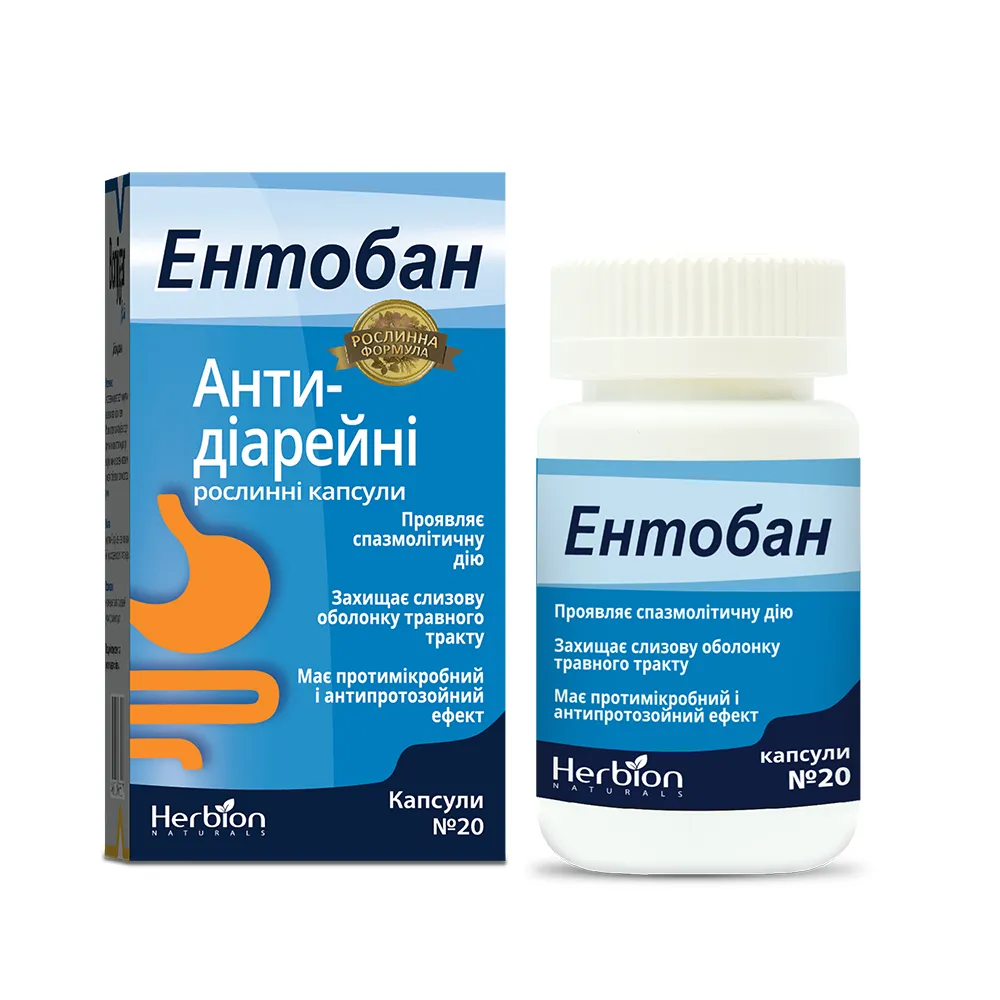
Table of Contents
INSTRUCTIONS FOR MEDICAL USE OF THE MEDICINAL PRODUCT ENTOBAN (ENTOBAN)
Composition:
Active substances: 1 capsule contains:
Dry bark extract of Holarrhena antidysenterica (3.05:1) (extracting agent – water) – 131 mg;
Dry fruit extract of Myrtus communis (3.05:1) (extracting agent – water) – 131 mg;
Dry fruit extract of Berberis aristata (3.57:1) (extracting agent – water) – 32 mg;
Dry fruit extract of Aegle marmelos (3.12:1) (extracting agent – water) – 32 mg;
Dry fruit extract of Quercus infectoria (3.12:1) (extracting agent – water) – 32 mg;
Dry stem extract of Butea frondosa (3.57:1) (extracting agent – water) – 42 mg.
Excipient: talc.
Pharmaceutical form. Capsules.
Main physicochemical properties: green-colored capsules containing amorphous brown powder, size "0", with "ENTOBAN" printed on the body and cap.
Pharmacotherapeutic group. Agents used in intestinal infections.
ATC code A07AX.
Pharmacological Properties
Pharmacodynamics
The pharmacological properties of the medicinal product are determined by the combined action of plant-derived components contained in its composition.
Entoban protects the mucous membrane of the gastrointestinal tract, reduces increased gastric acidity, regulates intestinal peristalsis, and exerts a calming and bactericidal effect.
It produces an antiprotozoal effect and has a spasmolytic action.
Holarrhena pubescens has amoebicidal activity. It is used as an astringent, anthelmintic, antipyretic, and diuretic agent, including in cases of bleeding, colic, and dyspepsia.
Myrtus communis has bactericidal, anti-inflammatory, spasmolytic, antipyretic, antibacterial, antidiarrheal, and astringent properties. It reduces capillary permeability.
Berberis aristata normalizes liver function and is also used as a tonic, astringent, and antipyretic agent.
Cydonia oblonga (Bengal quince) has bactericidal, anti-inflammatory, and antidiabetic effects.
Quercus infectoria (Dyer's oak) exerts an astringent effect in diarrhea.
Butaea monosperma (Lagerstroemia parviflora) exerts an astringent effect in diarrhea.
Pharmacokinetics
Not studied.
Clinical characteristics.
Indications. As part of complex therapy of acute intestinal infections accompanied by diarrhea.
Contraindications. Hypersensitivity to any component of the drug.
Pregnancy or breastfeeding.
Interaction with other medicinal products and other forms of interactions. Not studied.
Special precautions for use.
This medicinal product should be used with caution in patients with congestive heart failure and a history of edema, as well as in those with arterial hypertension, eclampsia, and hyperaldosteronism. Use with caution in patients with gastrointestinal ulcers or bronchial asthma.
If there is no clinical improvement within 48 hours, administration of the medicinal product should be discontinued and medical advice should be sought.
In patients with elevated body temperature or presence of blood in stools, the cause of diarrhea should be established before initiating treatment. During therapy, etiological and rehydration treatment should be administered concomitantly, with adequate replacement of fluid and electrolyte losses.
Use during pregnancy or breastfeeding.
Use during pregnancy is contraindicated due to the presence of Chelidonium majus in the formulation, which may lead to pregnancy loss.
This medicinal product should not be used during breastfeeding.
Ability to affect reaction speed when driving or operating machinery.
The effect on the ability to drive or operate machinery has not been studied.
Dosage and Administration.
For adults, the initial dose is 2 capsules as a single dose, followed by 1 capsule every 4 hours. In case of amoebiasis, it is recommended to continue treatment as described above with 1 capsule every 4 hours for up to 10 days, regardless of whether symptoms have ceased earlier.
The duration of treatment is determined individually by a physician.
Typically, the course of treatment lasts from 3 to 5 days.
Children. The medicinal product in this pharmaceutical form should not be administered to children. For children aged 4 years and older, the medicinal product should be used in the form of syrup.
Overdose.
There have been no reports of overdose. In case of overdose, gastric lavage and symptomatic therapy are recommended.
High doses of Aegle marmelos may cause constipation. Prolonged use of high doses of Butea monosperma may lead to kidney disease and anemia. The use of high doses of barberry may be fatal.
Adverse reactions.
In isolated cases, gastrointestinal disorders may occur, including nausea, vomiting, belching, flatulence, dyspepsia, headache, bradycardia, ataxia, tremor, anaphylactic shock, and allergic reactions to components of the medicinal product, including skin rashes, urticaria, and itching.
Reporting of suspected adverse reactions. Reporting of adverse reactions after medicinal product registration is of great importance. It enables continuous monitoring of the benefit-risk balance of the medicinal product. Medical and pharmaceutical professionals, as well as patients or their legal representatives, should report all suspected adverse reactions and lack of efficacy of the medicinal product through the Automated Pharmacovigilance Information System at the following link: https://aisf.dec.gov.ua
Shelf life. 3 years.
Storage conditions.
Store in the original packaging at a temperature not exceeding 25 °C.
Keep out of reach of children.
Packaging. 20 or 60 capsules in a bottle No. 1, in a cardboard box.
Availability category. Over-the-counter.
Manufacturer.
Herbion Pakistan Private Limited.
Manufacturer's address and location of business activity.
Plot No. 30, Sector 28, Korangi Industrial Area, Karachi, Pakistan.