Enterogermina
Ukraine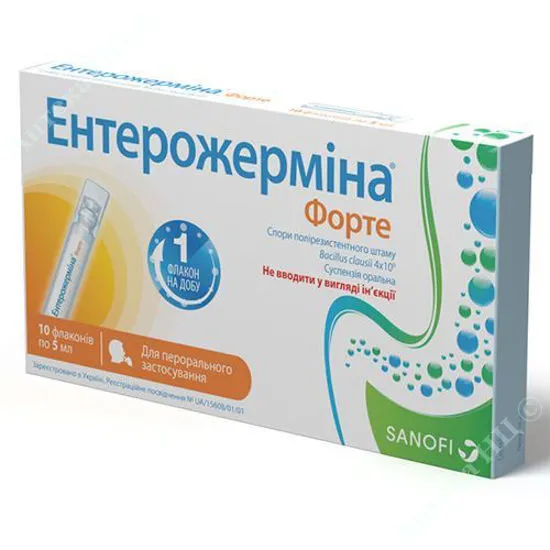
Table of Contents
INSTRUCTIONS FOR MEDICAL USE OF THE MEDICINAL PRODUCT ENTEROGERMINAÒ
Composition:
Active substance: 1 vial of 5 ml contains spores of the polyresistant strain Bacillus clausii − 2 × 10⁹;
Excipient: purified water.
Pharmaceutical form. Oral suspension.
Main physicochemical properties: opalescent white-colored liquid which may have a characteristic odor.
Pharmacotherapeutic group. Antidiarrheal microbial agents.
ATC code A07FA.
Pharmacological Properties
Pharmacodynamics
Enterogermina® is a suspension of spores of four strains (SIN, O/C, T, N/R) of Bacillus clausii, which are normally present in the intestine and do not exhibit pathogenic activity.
Spores are inherently resistant to high temperatures and gastric acidity. In a validated in vitro model, Bacillus clausii spores demonstrated the ability to survive in an environment simulating gastric conditions (pH 1.4–1.5) for up to 120 minutes (survival rate 96%). In a model simulating intestinal conditions (bile salts and pancreatin solution – pH 8), Bacillus clausii spores demonstrated the ability to multiply significantly compared to the initial count (from 109 to 1012 colony-forming units (CFU)), starting from 240 minutes after incubation. In a study involving 20 individuals, it was observed that Bacillus clausii spores persist in the human intestine and can be detected in feces for up to 12 days after a single oral dose.
Due to the action of Bacillus clausii, the drug restores intestinal microflora altered by medications causing dysbacteriosis (also known as dysbiosis), which may be associated with gastrointestinal symptoms such as diarrhea, abdominal pain, and meteorism (intestinal bloating). Additionally, due to the ability of Bacillus clausii to synthesize various vitamins, particularly those of the B group, the drug helps correct vitamin deficiencies caused by the use of antibiotics or chemotherapeutic agents. Thanks to the metabolic activity of Bacillus clausii, the use of the drug achieves a nonspecific immune-stimulating and antitoxic effect.
Due to their high resistance to chemical and physical agents, Bacillus clausii spores pass unharmed through the gastric juice barrier into the intestinal tract, where they transform into metabolically active vegetative cells.
In two open, randomized, controlled clinical studies, Enterogermina® demonstrated a reduction in the duration of acute diarrhea in children aged 6 months and older.
When administered during antibiotic therapy and for the following 7–10 days, Enterogermina® demonstrated a reduction in the frequency of abdominal pain and diarrhea associated with antibiotic treatment.
A prospective, observational, multicenter study included 261 patients to evaluate the use of the probiotic Bacillus clausii under real-life conditions for symptoms such as diarrhea, abdominal pain, bloating, meteorism, constipation, and abdominal discomfort. The evaluation was based on patient questionnaires administered by pharmacists before the start of treatment and 30 days after its initiation.
Patients reported using the drug primarily for the treatment of diarrhea (56.7% of patients), abdominal pain (13.41%), and bloating (12.64%).
The average duration of treatment was 7.1 days. Patients reported symptom improvement on average after three days of using the medication. After completion of treatment, 95% of patients reported reduced diarrhea, and 97% reported relief from abdominal pain.
The two main properties of Bacillus clausii described below contribute to the restoration of intestinal bacterial flora.
Inhibition of the growth of pathogenic bacteria
Three likely mechanisms of action of B. clausii are: colonization of free ecological niches, thereby preventing the growth of other microorganisms; competition for binding to epithelial cells, particularly relevant for spores in the early and intermediate phases of germination; and production of antibiotics and/or enzymes secreted into the intestinal environment. In an in vitro study, Bacillus clausii spores demonstrated the production of bacteriocins and antibiotics such as clausin, with antagonistic activity against gram-positive bacteria including Staphylococcus aureus, Clostridium difficile, and Enterococcus faecium.
Immunomodulatory activity
Orally administered Bacillus clausii spores have demonstrated stimulation of interferon-gamma production and increased proliferation of CD4+ T-lymphocytes in in vitro and in vivo mouse models.
Pharmacokinetics
The drug does not interact with the following antibiotics: penicillin (when not used in combination with beta-lactamase inhibitors), cephalosporins (partial resistance in most cases), tetracyclines, macrolides, aminoglycosides (except gentamicin and amikacin), chloramphenicol, thiamphenicol, lincomycin, clindamycin, isoniazid, cycloserine, novobiocin, rifampicin, nalidixic acid, and pipemidic acid (intermediate resistance), metronidazole.
Additionally, due to the ability of Bacillus clausii to synthesize various vitamins, particularly those of the B group, the drug helps correct vitamin deficiencies caused by the use of antibiotics or chemotherapeutic agents.
Clinical characteristics.
Indications.
Treatment and prevention of intestinal dysbacteriosis and associated endogenous vitamin deficiency.
Therapy aimed at restoring normal intestinal microflora disrupted during treatment with antibiotics or chemotherapeutic agents.
Acute and chronic gastrointestinal disorders associated with intoxication or intestinal dysbacteriosis and vitamin deficiency in breastfed infants.
Contraindications.
Hypersensitivity to the active substance or to any of the excipients of the medicinal product.
Interaction with other medicinal products and other forms of interaction.
There are no data on interactions between this medicinal product and other medicinal products.
Special precautions for use
Visible particles may be present in the vials of Enterogermina®. These particles are formed as a result of aggregation of Bacillus clausii spores and do not indicate that the product has undergone any changes.
The vial should be shaken before use.
The medicinal product has a high degree of heterologous resistance to antibiotics, which allows it to be used both for the prevention of intestinal flora alterations caused by the selective action of antibiotics (especially broad-spectrum antibiotics) and for the restoration of already disrupted intestinal flora balance.
If the medicinal product is prescribed concomitantly with antibiotics, it should be administered between two doses of the antibiotic.
This medicinal product is intended exclusively for oral use. Injection or any other route of administration is strictly prohibited. Incorrect use of this medicinal product has led to severe anaphylactic reactions, including anaphylactic shock.
Bacteraemia and sepsis
During post-marketing use, cases of bacteraemia, septicaemia, and sepsis have been observed in immunocompromised patients, critically ill patients, and in premature infants. In some severely ill patients, the outcome was fatal. This medicinal product should be avoided in these patient groups (see section "Undesirable effects").
Use during pregnancy or breastfeeding
Pregnancy. Available data on the use of Enterogermina® in pregnant women are limited; therefore, no conclusions can be drawn regarding the safety of the medicinal product during pregnancy.
Enterogermina® may be used during pregnancy only if the potential benefit to the pregnant woman outweighs the potential risks, including risks to the fetus.
Breastfeeding period. Available data on the use of Enterogermina® during lactation, particularly regarding the presence of the product in breast milk and its effects on the infant, are limited; therefore, no conclusions can be drawn regarding the safety of the product during breastfeeding.
Enterogermina® may be used during breastfeeding only if the potential benefit to the mother outweighs the potential risks, including risks to the breastfed infant.
Fertility. There are no data available on the effects of Enterogermina® on human fertility.
Ability to affect reaction speed when driving or operating machinery
No effect.
Dosage and Administration.
For adults – 1 bottle 2–3 times a day; for children aged 28 days to 18 years – 1 bottle 1–2 times a day.
The duration of treatment is determined by the physician depending on the patient's condition and course of the disease.
The suspension should be taken at regular intervals (every 3–4 hours). Before use, shake the contents of the bottle and take undiluted or diluted in water or other liquid (milk, tea, orange juice).
The presence of visible particles in the bottle (due to spore aggregation) does not affect the quality of the medicinal product.
This medicinal product is intended for oral use only. It must not be administered by injection or any other route.
Children.
The medicinal product can be used in children from 28 days of age.
Overdose.
There have been no reports of clinical manifestations of overdose with this medicinal product to date.
Side effects.
The adverse reactions observed during the use of the medicinal product Enterogermina® are listed below according to system organ class and frequency: very common (≥ 1/10); common (≥ 1/100, < 1/10); uncommon (≥ 1/1000, < 1/100); rare (≥ 1/10 000, < 1/1000); very rare (< 1/10 000); frequency not known (cannot be estimated from the available data).
Disorders of the skin and subcutaneous tissue
Frequency not known: hypersensitivity reactions, including rash, urticaria, and angioedema.
Infections and parasitic disorders
Frequency not known: bacteremia, septicaemia, and sepsis (in patients with weakened immunity or critically ill patients) (see section "Special precautions").
Reporting of suspected adverse reactions
Reporting suspected adverse reactions after authorization of the medicinal product is important. It allows continued monitoring of the benefit-risk balance of the medicinal product. Medical and pharmaceutical personnel, as well as patients or their legal representatives, should report all cases of suspected adverse reactions and lack of efficacy of the medicinal product via the Automated Pharmacovigilance Information System at the following link: https://aisf.dec.gov.ua.
Shelf life. 2 years.
Storage conditions.
Store in a place inaccessible to children, at a temperature not exceeding 30 °C.
To avoid contamination of the suspension, the vial must not be opened in advance.
Packaging.
No. 10; No. 20 (10 × 2): 5 mL in a vial; 10 vials connected by a polyethylene bridge in a cassette; 1 or 2 cassettes in a cardboard box.
Release category. Over-the-counter.
Manufacturer.
Opella Helcea Italia S.r.l., Italy.
Location of manufacturers and addresses of places of business.
Viale Europa, 11 – 21040 Origgio (VA), Italy.
Marketing Authorization Holder.
LLC "Opella Helcea Ukraine", Ukraine.
Location and address of the Marketing Authorization Holder.
Ukraine, 01033, Kyiv, Zhilyanska St., 48-50A.