Enterol 250
Ukraine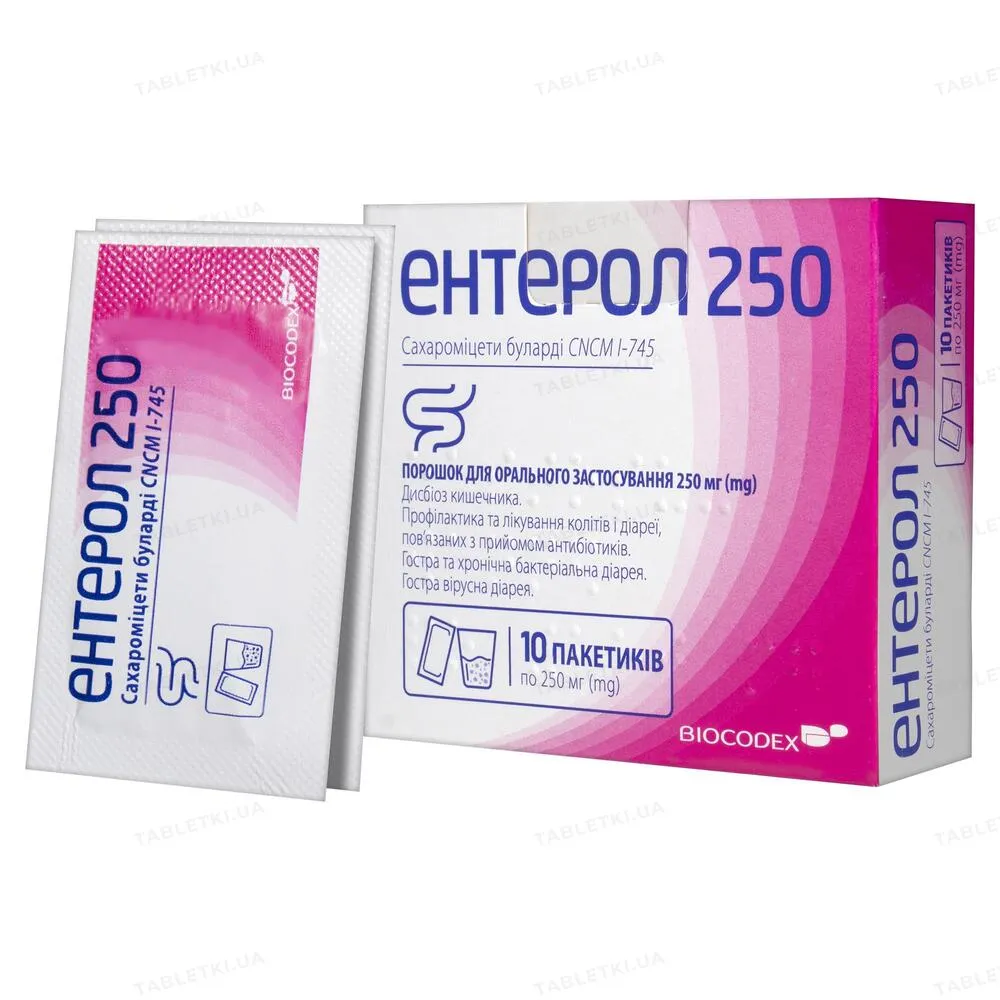
Table of Contents
INSTRUCTIONS FOR MEDICAL USE OF THE MEDICINAL PRODUCT ENTEROL 250 (ENTEROL® 250)
Composition:
Active substance: 1 sachet contains Saccharomyces boulardii CNCM I-745 (lyophilized cells) 250 mg;
Excipients: lactose monohydrate, fructose, colloidal anhydrous silicon dioxide, flavouring agent "tutti frutti" (contains sorbitol E420).
Pharmaceutical form. Powder for oral use.
Main physicochemical properties: light brown powder with a characteristic fruity odour.
Pharmacotherapeutic group. Microbial antidiarrhoeal agents.
Saccharomyces boulardii. ATC code A07FA02.
Pharmacological Properties
Pharmacodynamics
Enterol 250 normalizes intestinal microflora and has a pronounced etiopathogenic antidiarrheal effect. While passing through the gastrointestinal tract, Saccharomyces boulardii CNCM I-745 exerts a biological protective effect on the normal intestinal microflora.
Main mechanisms of action of Saccharomyces boulardii CNCM I-745:
- Direct antagonism (antimicrobial activity) due to the ability of Saccharomyces boulardii CNCM I-745 to inhibit the growth of pathogenic and opportunistic microorganisms and fungi that disrupt intestinal biocenosis, such as: Clostridium difficile, Clostridium pneumoniae, Staphylococcus aureus, Pseudomonas aeruginosa, Candida krusei, Candida pseudotropicalis, Candida albicans, Salmonella typhi, Salmonella enteritidis, Escherichia coli, Shigella dysenteriae, Shigella flexneri, Klebsiella, Proteus, Vibrio cholerae, as well as Entamoeba histolytica, Giardia lamblia; Enterovirus, Rotavirus;
- Antitoxic effect, caused by the production of proteases that degrade the toxin and the enterocyte receptor to which the toxin binds (particularly with respect to toxin A of Clostridium difficile);
- Antisecretory effect, due to reduction of cAMP in enterocytes, leading to decreased secretion of water and sodium into the intestinal lumen;
- Enhancement of nonspecific immune defense by increasing the production of IgA and secretory components of other immunoglobulins;
- Enzymatic action due to increased activity of small intestinal disaccharidases (lactase, sucrase, maltase);
- Trophic effect on the mucosa of the small intestine, mediated by the release of spermine and spermidine.
The genetically determined resistance of Saccharomyces boulardii CNCM I-745 to antibiotics provides the rationale for its concomitant use with antibiotics to protect the normal biocenosis of the gastrointestinal tract.
Pharmacokinetics
After administration, a high concentration of Saccharomyces boulardii CNCM I-745 is rapidly achieved in the colon and maintained for 24 hours. Saccharomyces boulardii CNCM I-745 do not penetrate into the systemic circulation or mesenteric lymph nodes. After completion of treatment, Saccharomyces boulardii CNCM I-745 are completely eliminated in feces within 3–5 days.
Clinical characteristics.
Indications.
Prevention and treatment of colitis and diarrhea associated with antibiotic use.
Intestinal dysbiosis.
Acute and chronic bacterial diarrhea.
Acute viral diarrhea.
Irritable bowel syndrome.
Traveler’s diarrhea.
Pseudomembranous colitis and diseases caused by Clostridium difficile.
Diarrhea associated with long-term enteral nutrition.
Contraindications.
Hypersensitivity to any component of the medicinal product. The product is contraindicated in patients with established central or peripheral venous catheters; critically ill patients and immunocompromised patients due to the risk of fungemia (see section "Special precautions"); patients receiving treatment in intensive care units; immunocompromised patients such as: HIV-infected individuals, oncology patients, organ transplant recipients, and those receiving chemotherapy and/or radiotherapy and/or prolonged high-dose corticosteroids.
Special precautions.
If symptoms persist for more than 2 days during treatment at the usual dosage, medical consultation is required and dosage adjustment should be considered.
Enterol 250 contains a live culture. Therefore, the product should not be mixed with very hot (over 50 °C) or cold beverages, liquids containing alcohol, or very hot or cold food.
Treatment does not replace rehydration when it is necessary. The volume and route of fluid administration (oral/intravenous) should be based on the severity of diarrhea, age, and the patient's general condition.
Very rare cases of fungemia (and positive blood cultures for Saccharomyces strains), as well as sepsis, have been reported, primarily in patients with central venous catheters, critically ill patients, or immunocompromised patients. The reported cases most commonly presented with fever. In most cases, outcomes were favorable after discontinuation of Saccharomyces boulardii, antifungal therapy, and, if necessary, catheter removal. In some critically ill patients, fungemia resulted in fatal outcomes. (See sections "Contraindications" and "Adverse reactions").
As with all medicinal products containing live microorganisms, careful handling of Saccharomyces boulardii CNCM I-745 is required, especially in the presence of patients, particularly those with central venous catheters, but also those with peripheral catheters—even patients not receiving Saccharomyces boulardii CNCM I-745 treatment—to prevent any contamination via hands and/or airborne spread of microorganisms.
The product contains lactose; therefore, it should not be administered to patients with rare hereditary conditions of galactose intolerance, lactase deficiency, or glucose-galactose malabsorption.
The product contains fructose; therefore, this medicinal product should not be administered to patients with fructose intolerance. Each sachet contains 0.10 mg of sorbitol.
Interaction with other medicinal products and other types of interactions.
Do not take simultaneously with antifungal agents when administered orally or systemically.
Usage features.
Use during pregnancy or breastfeeding.
Currently, no clinically significant malformative or fetotoxic effects have been identified.
Monitoring of pregnancy in women taking this medication is insufficient to exclude any risk. Therefore, as a precautionary measure, it is advisable to avoid using the medication during pregnancy.
During breastfeeding, the medication may be used under medical supervision.
Ability to affect reaction rate when driving or operating machinery. Does not affect.
Dosage and Administration.
The dose and duration of treatment are determined by a physician depending on the nature and course of the disease.
Newborns: no more than 1 sachet per day under medical supervision.
Children under 6 years of age: 1 sachet 1–2 times daily.
Adults and children aged 6 years and older: 1–2 sachets 1–2 times daily.
Recommended treatment duration:
- Acute diarrhea: 3–5 days;
- Treatment of dysbiosis, chronic diarrhea syndrome, irritable bowel syndrome:
10–14 days; - Prevention and treatment of antibiotic-associated diarrhea and pseudomembranous colitis:
Enterol 250 should be administered concomitantly with antibiotics, starting on the first day of antibiotic therapy and continuing until the end of antibiotic treatment; - Traveler’s diarrhea:
Start 5 days before travel begins, 1 sachet daily throughout the entire trip; discontinue on the day of return from the travel destination. The preparation should be taken every morning on an empty stomach. Maximum duration of use – 30 days.
The contents of the sachet should be mixed with milk or water.
Due to the risk of airborne contamination, sachets should not be opened in patient rooms. Healthcare personnel should wear disposable gloves when preparing probiotics for administration, remove them promptly afterward, and thoroughly wash their hands (see section "Special Safety Precautions").
Children. Can be used in children of all age groups.
Overdose. Not reported.
Side effects.
In individuals with individual hypersensitivity to any component of the drug, hypersensitivity reactions are possible, including skin rashes, pruritus, exanthema, urticaria, anaphylactic reactions, angioneurotic edema, anaphylactic shock, constipation with undefined frequency, flatulence, epigastric discomfort. Very rarely, there is a risk of fungemia or sepsis with unknown frequency in hospitalized patients with central or peripheral venous catheters, in critically ill patients, or in patients with impaired immunity.
Shelf life. 3 years.
Storage conditions. Store in the original packaging, out of reach of children, at a temperature not exceeding 25 °C.
Packaging. 10 sachets per cardboard box.
Supply category. Over-the-counter.
Manufacturer.
BIODX.
Manufacturer's location and address of its business activity.
1 Avenue Blaise Pascal, 60000 Beauvais, France