Endometrin
Ukraine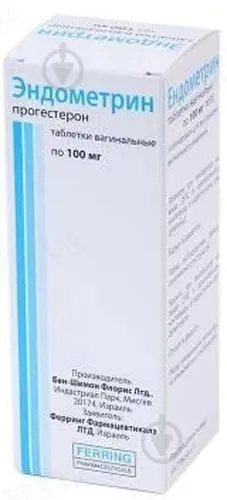
Table of Contents
INSTRUCTIONS for medical use of the medicinal product ENDO METRIN (ENDOMETRIN)
Composition:
Active ingredient: progesterone;
1 tablet contains 100 mg micronized progesterone;
Excipients: lactose monohydrate; pregelatinized corn starch; adipic acid; sodium bicarbonate; povidone; magnesium stearate; sodium lauryl sulfate; colloidal anhydrous silicon dioxide.
Pharmaceutical form. Vaginal tablets.
Main physico-chemical properties: oval elongated odorless tablets of white or slightly yellowish color, uncoated, with slightly glossy surface.
Pharmacotherapeutic group. Progestogens. Progesterone. ATC code G03DA04.
Pharmacological properties.
Pharmacodynamics.
Progesterone is a natural steroid secreted by the ovaries, placenta, and adrenal glands. In the presence of sufficient estrogen, progesterone transforms the endometrium from the proliferative phase to the secretory phase. Progesterone is necessary to enhance endometrial receptivity for embryo implantation. After embryo implantation, progesterone supports and maintains pregnancy.
Pharmacokinetics.
Absorption. Progesterone concentration in serum increased after administration of Endometrin vaginal tablets in 12 healthy premenopausal women. Following vaginal administration of 100 mg progesterone, mean Cmax was 17.0 ng/mL in the group receiving Endometrin twice daily, and 19.8 ng/mL in the group receiving Endometrin three times daily. With repeated administration, steady-state concentration was reached approximately 1 day after initiation of treatment. Both Endometrin dosing regimens achieved mean serum progesterone concentrations exceeding 10 ng/mL by day 5 of treatment.
Mean pharmacokinetic parameters of progesterone in serum are presented in Table 1.
Table 1
| Pharmacokinetic parameter (units) |
Endometrin 100 mg twice daily (N = 6) |
Endometrin 100 mg three times daily (N = 6) |
| Single administration |
||
| Cmax (ng/mL) Tmax (h) AUC0-24 (ng·h/mL) |
17.0 ± 6.5 24.0 ± 0.0 217 ± 113 |
19.8 ± 7.2 17.3 ± 7.4 284 ± 143 |
| Multiple administration, Day 5 |
||
| Cmax (ng/mL) Tmax (h) Cmin (ng/mL) Cavg (ng/mL) AUC0-24 (ng·h/mL) |
18.5 ± 5.5 18.0 ± 9.4 8.9 ± 4.5 14.0 ± 4.8 327 ± 127 |
24.1 ± 5.6 18.0 ± 9.4 10.9 ± 6.5 15.9 ± 4.3 436 ± 106 |
Cmax (ng/mL) – maximum concentration of progesterone in blood serum.
Tmax (hours) – time to reach maximum concentration of progesterone in blood serum.
Cmin (ng/mL) – minimum concentration of progesterone in blood serum.
Cavg (ng/mL) – average concentration of progesterone in blood serum.
AUC0–24 (ng*hour/mL) – area under the concentration-time curve during the 0 to 24 hour interval following administration.
Distribution. Progesterone is approximately 96–99% bound to serum proteins, primarily to serum albumin and corticosteroid-binding globulin.
Metabolism. Progesterone is metabolized mainly in the liver, primarily to pregnanediols and pregnanolones. Pregnanediols and pregnanolones are conjugated in the liver into metabolites—glucuronides and sulfates. Progesterone metabolites excreted in bile may undergo deconjugation and further metabolism in the intestine through reduction, dehydroxylation, and epimerization.
Excretion. Progesterone is excreted via urine and bile. After injection of radiolabeled progesterone, 50–60% of metabolites are excreted in urine, approximately 10% in bile and feces. Total excretion of radiolabeled substance amounts to 70% of the administered dose. Only a negligible portion of unchanged progesterone is excreted in bile.
Clinical characteristics.
Indications.
Progesterone replacement or supplementary therapy, including treatment of infertility in women and in assisted reproduction.
Contraindications.
- Hypersensitivity to progesterone or to any component of the medicinal product.
- Vaginal bleeding of unknown origin.
- Ectopic pregnancy or missed abortion.
- Severe hepatic disease.
- Malignant neoplasms of the breast or reproductive organs, or suspicion thereof.
- Active phase of arterial or venous thromboembolism or severe thrombophlebitis, as well as their history.
- Porphyria.
Interaction with other medicinal products and other forms of interaction.
Formal studies on interactions between Endometrin and other medicinal products have not been conducted. Known inducers of the hepatic cytochrome P450 3A4 system (such as rifampicin, carbamazepine, and herbal preparations containing Hypericum perforatum) may increase progesterone elimination. Ketoconazole and other inhibitors of cytochrome P450 3A4 may increase progesterone bioavailability.
The effect of concomitant use of other vaginal products on progesterone action has not been studied. It is not recommended to use Endometrin simultaneously with other vaginal products (such as antifungal agents), as this may affect the release of progesterone from vaginal tablets and its absorption.
Special precautions for use
Before initiating treatment, the physician should identify the cause of infertility.
There may be early manifestations of myocardial infarction, cerebrovascular disorders, arterial and venous thromboembolism (venous thromboembolism and pulmonary artery embolism), thrombophlebitis, and retinal vascular thrombosis. If any of these conditions are suspected, Endometrin should be discontinued immediately.
Endometrin should be used with caution in patients with mild to moderate hepatic impairment.
In patients with a history of depression, careful monitoring is required, and the drug should be discontinued if severe depressive symptoms occur.
Since progesterone may cause some degree of fluid retention, conditions that may be exacerbated by this effect (e.g., epilepsy, migraine, bronchial asthma, cardiac or renal insufficiency) should be monitored regularly.
Impaired glucose tolerance has been observed in some cases. The mechanism of this effect during combined estrogen-progestogen therapy is not known. Therefore, patients with a history of diabetes mellitus should be closely monitored during treatment.
The use of sex steroids may also increase the risk of retinal vascular lesions.
Endometrin should be used with caution in patients aged 35 years and older, smokers, and individuals with risk factors for atherosclerosis. Therapy should be discontinued in case of transient ischemic attacks, sudden severe headache, or visual disturbances associated with papilledema or retinal hemorrhage.
Abrupt discontinuation of the drug may lead to increased anxiety, nervousness, and possibly seizures.
Use during pregnancy or breastfeeding
Pregnancy
Endometrin is used only during the first trimester of pregnancy in connection with assisted reproductive technologies (ART).
There are limited and inconclusive data regarding the risk of congenital anomalies, including genital malformations in male or female infants, due to intrauterine exposure to the drug administered during pregnancy.
Breastfeeding
Progesterone passes into breast milk. Therefore, the use of Endometrin should be avoided during breastfeeding.
Ability to influence reaction speed while driving or operating machinery
Endometrin has a minor or moderate effect on the ability to drive or operate machinery. Progesterone may cause drowsiness and/or dizziness. This should be taken into account when using the medication.
Method of administration and dosage.
Administer vaginally, 1 tablet 2 or 3 times daily, starting from the day of embryo implantation. The total duration of treatment is up to 12 weeks.
Children.
The drug is not intended for use in pediatric practice. Clinical data on the use of the drug in children are lacking.
Overdose.
Treatment of overdose consists of discontinuing Endometrin and administering appropriate symptomatic and supportive therapy.
Adverse reactions.
During clinical trials, when progesterone was administered to patients undergoing assisted reproductive technologies, the most commonly observed adverse effects were headache, vulvovaginal disorders, and uterine muscle spasms, occurring in 1.5%, 1.5%, and 1.4% of patients, respectively.
Table 2 presents the main adverse reactions in women who received progesterone treatment during clinical trials. Adverse reactions are categorized by system organ classes and frequency.
Table 2
| System organ class |
Common (≥ 1/100 and < 1/10) |
Uncommon (≥1/1000 and <1/100) |
Unknown |
| Nervous system disorders |
Headache |
Dizziness, insomnia |
Increased fatigue |
| Gastrointestinal disorders |
Abdominal distension, abdominal pain, nausea |
Diarrhea, constipation |
Vomiting |
| Skin and subcutaneous tissue disorders |
Urticaria, rash |
Hypersensitivity reactions |
|
| Reproductive system and breast disorders |
Ovarian hyperstimulation syndrome, uterine muscle spasms |
Vulvovaginal discomfort, vaginal burning, vaginal discharge, vulvovaginal dryness, vaginal bleeding, vaginal fungal infection, pain, sensitivity and breast swelling, genital pruritus |
|
| Infections and infestations |
Urinary tract infections |
||
| General disorders |
Peripheral edema |
During treatment with progesterone, sudden mood swings, irritability, and drowsiness may occur.
Shelf life. 5 years.
Storage conditions. Store at a temperature not exceeding 25 °C in the original container, in a place inaccessible to children.
Packaging. 6, 15 or 30 tablets in a container with an applicator for intravaginal administration, in a cardboard box.
Prescription status. Prescription only.
Manufacturer.
Ben-Shimon Floris Ltd., Israel / Ben-Shimon Floris Ltd., Israel.
Manufacturer's address and location of business activity.
Ind. Park, Misgav, 2017400, Israel / Ind. Park, Misgav, 2017400, Israel.