Elocom
Ukraine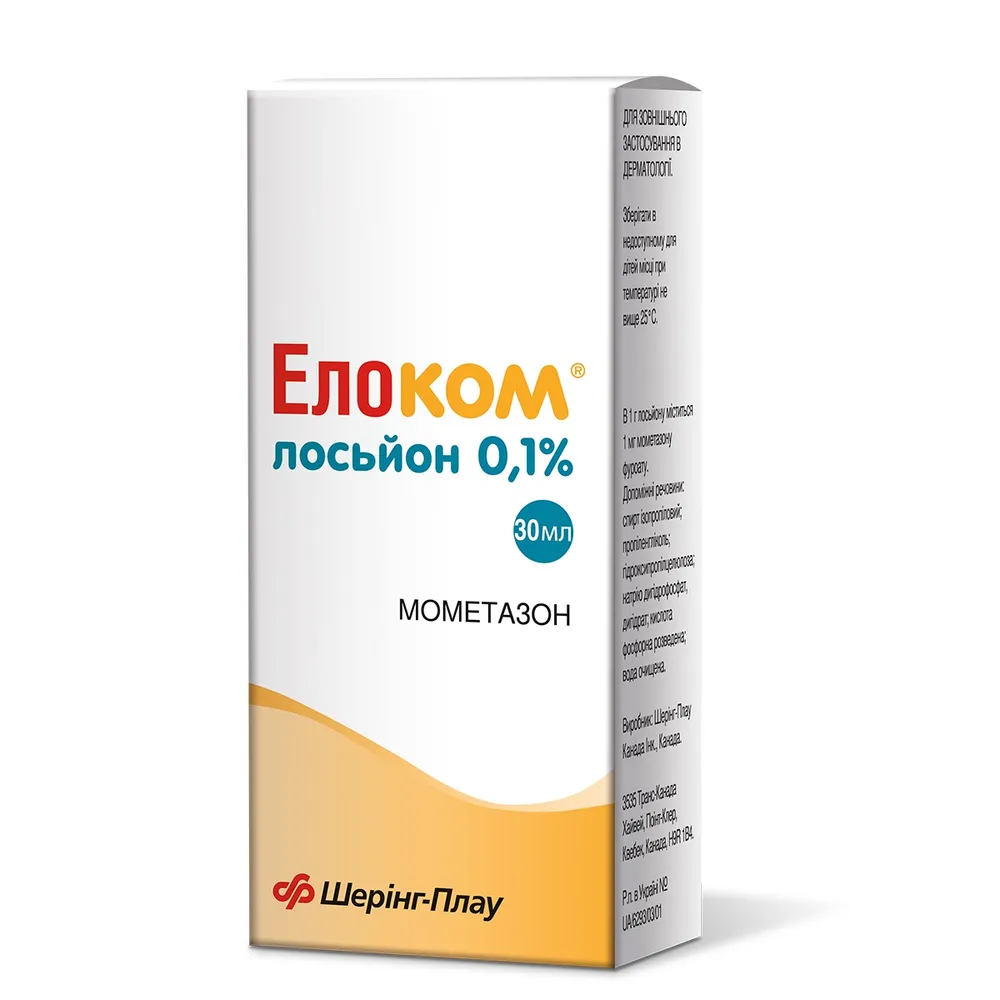
Table of Contents
INSTRUCTIONS FOR MEDICAL USE OF THE MEDICINAL PRODUCT ELOCOM® (ELOCOM®)
Composition:
Active substance: mometasone furoate;
1 g of lotion contains 1 mg of mometasone furoate;
Excipients: isopropyl alcohol; propylene glycol; hydroxypropylcellulose; sodium dihydrogen phosphate dihydrate; phosphoric acid diluted; purified water.
Pharmaceutical form. Lotion.
Main physicochemical properties: colorless or slightly yellowish homogeneous lotion.
Pharmacotherapeutic group. Corticosteroids for dermatological use.
ATC code D07AC13.
Pharmacological properties.
Pharmacodynamics.
Mometasone furoate – a synthetic glucocorticosteroid for topical use with anti-inflammatory, antipruritic, and anti-exudative effects.
Pharmacokinetics.
Pharmacokinetic studies have shown that systemic absorption after topical application of 0.1% mometasone furoate is minimal; approximately 0.4% of the applied dose is excreted from the body within 72 hours after application. Determining the nature of metabolites was practically impossible due to the small amount present in blood plasma and excretions.
Clinical characteristics.
Indications.
Treatment of inflammation and itching caused by dermatoses of the scalp skin, as well as dermatoses responsive to corticosteroid therapy, such as psoriasis (except generalized plaque psoriasis) and atopic dermatitis in adults and children aged 2 years and older.
Contraindications.
Elacom® is contraindicated in rosacea, vulgaris acne, skin atrophy, perioral dermatitis, perianal and genital itching, diaper rash, bacterial (e.g., impetigo, pyoderma), viral (e.g., herpes simplex, herpes zoster, varicella, common warts, genital warts, molluscum contagiosum), parasitic, and fungal (e.g., Candida or dermatophytes) infections, tuberculosis, syphilis, or post-vaccination reactions. Elacom® should not be used on wounds or ulcerated skin. The drug is contraindicated in patients with hypersensitivity to any of the components of the drug or to other corticosteroids.
Interaction with other medicinal products and other forms of interaction.
Not established.
Special precautions for use.
If irritation or sensitization occurs, treatment should be discontinued and appropriate therapy initiated.
If a concurrent skin infection develops, appropriate antifungal or antibacterial agents should be used. If positive response is not achieved within a short period of time, use of Elocom® lotion should be discontinued until the infection is fully resolved.
Systemic absorption following topical application of various glucocorticosteroids may result in reversible suppression of the hypothalamic-pituitary-adrenal (HPA) axis, with potential glucocorticosteroid insufficiency after discontinuation of treatment. In some patients, manifestations of Cushing's syndrome, hyperglycemia, and glucosuria may occur.
Patients receiving topical steroids over large skin areas or under occlusive dressings should be periodically evaluated for HPA axis suppression. This evaluation may include an ACTH stimulation test, measurement of morning plasma cortisol levels, and assessment in other media except urine.
Any adverse effects associated with systemic corticosteroids, including suppression of adrenal cortex function, may also occur with topical application of glucocorticosteroids, particularly in infants and children.
Occlusion should not be used in children or on the face. Contact of the product with mucous membranes should be avoided.
Topical steroids may be hazardous in psoriasis for various reasons, including relapses following development of tolerance, risk of generalized pustular psoriasis, and development of local or systemic toxicity due to impaired skin barrier function. Careful patient monitoring is essential when using this product in psoriasis.
Abrupt discontinuation of prolonged treatment may result in rebound phenomenon, presenting as dermatitis with intense redness, irritation, and burning. This can be prevented by gradual withdrawal of the drug, for example, intermittent therapy, until complete discontinuation.
Glucocorticoids may alter the signs of certain skin lesions and complicate the establishment of an appropriate diagnosis, thereby delaying recovery.
Elocom® lotion contains propylene glycol, which may cause skin irritation.
Elocom® is not intended for ophthalmic use, including application to the eyelids. Contact of the product with the eyes should be avoided.
With systemic and topical use of corticosteroids (including intranasal, inhaled, and intraocular administration), visual disturbances may occur. If symptoms such as blurred vision or other visual disturbances occur, the patient should undergo an ophthalmological examination to evaluate possible causes, which may include cataract, glaucoma, or rare conditions such as central serous chorioretinopathy, reported after systemic and topical corticosteroid use.
Use during pregnancy or breastfeeding.
During pregnancy or breastfeeding, treatment with this product should be used only under medical supervision. Even then, application over large skin areas or for prolonged periods should be avoided. There are insufficient data to establish the safety of the product in pregnant women. As with other topically applied glucocorticosteroids, Elocom® should be used during pregnancy only if the potential benefit justifies the potential risk to the fetus.
It is not known whether topical application of corticosteroids may result in significant systemic absorption leading to detectable levels of the drug in breast milk. Elocom® should be used during breastfeeding only after careful assessment of the benefit-risk ratio. If treatment involves high doses or prolonged use, breastfeeding should be discontinued.
Ability to affect reaction speed while driving or operating machinery.
Not established.
Dosage and Administration
Apply a few drops of Elom® lotion to the affected areas once daily; gently and thoroughly rub in until the product is completely absorbed.
The use of topical corticosteroids in children and on the face should be limited to the minimum amount necessary compared to effective therapeutic regimens, and the treatment duration should not exceed 5 days.
Children
Elom® should be used in children aged 2 years and older only under a physician's supervision.
Because children have a larger skin surface area to body mass ratio than adults, they are at a higher risk of hypothalamic-pituitary-adrenal (HPA) axis suppression and Cushing's syndrome when using any topical corticosteroids, particularly when applied over areas exceeding 20% of the body surface.
It is recommended to use the smallest amount of glucocorticosteroids necessary to achieve the therapeutic effect, especially in children. Treatment duration should not exceed 5 days. Prolonged glucocorticosteroid therapy may impair growth and development in children.
The safety of Elom® use in children for periods longer than 6 weeks has not been studied.
There are only limited data available regarding treatment in children under 2 years of age.
Mometasone should not be used to treat diaper dermatitis.
The lotion should not be applied under occlusive dressings unless specifically directed by a physician, nor should it be applied to areas under non-breathable diapers or tight clothing.
Overdose
Excessive or prolonged use of topical corticosteroids may suppress the hypothalamic-pituitary-adrenal (HPA) axis, potentially leading to secondary adrenal insufficiency, which is usually reversible.
If HPA axis suppression occurs, the application interval should be increased, a corticosteroid with lower potency should be used, or the treatment should be discontinued.
The steroid content in each bottle of Elom® is so low that in the unlikely event of accidental ingestion, the toxic effect would be negligible or absent.
Adverse Reactions.
The adverse reactions reported in connection with the use of Elocom® are listed below by system organ class and frequency: very common (≥1/10); common (≥1/100, <1/10); uncommon (≥1/1000, <1/100); rare (≥1/10000, <1/1000); very rare (<1/10000); not known (cannot be estimated from the available data).
Infections and infestations: very rare – folliculitis; not known – infections, furuncles.
Nervous system disorders: very rare – burning sensation; not known – paraesthesia.
Skin and subcutaneous tissue disorders: very rare – pruritus; not known – contact dermatitis, skin hypopigmentation, hypertrichosis, skin atrophic striae, acneiform dermatitis, skin atrophy.
General disorders and administration site conditions: not known – pain at application site, reactions at application site.
Eye disorders: not known – blurred vision (see also section "Special precautions for use").
Propylene glycol, an ingredient of the medicinal product, may cause skin irritation.
Local adverse reactions reported uncommonly with topical dermatological corticosteroids include: dryness and irritation of the skin, dermatitis, perioral dermatitis, maceration of the skin, striae, miliaria, telangiectasia, papular, pustular eruptions, and prickling sensation.
Shelf life. 3 years.
Storage conditions.
Keep out of the reach and sight of children. Store below 25 ºC.
Packaging.
30 ml bottles; 1 bottle per cardboard box.
Prescription category. Prescription only.
Manufacturer.
Delpharm Montréal Inc., Canada.
Manufacturer's address and place of business.
3535 Route Trans Canada Highway, Pointe-Claire, QC, Canada, H9R 1B4.