Eligard 22.5 mg
Ukraine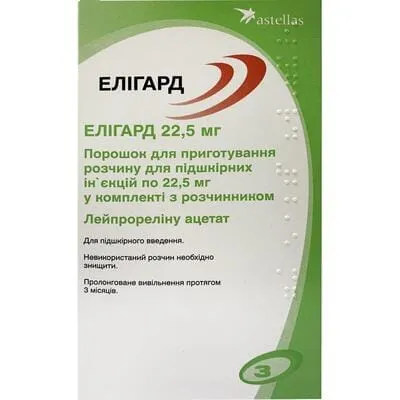
Table of Contents
INSTRUCTIONS FOR MEDICAL USE OF THE MEDICINAL PRODUCT ELIGARD 7.5 mg (ELIGARD® 7.5 mg) ELIGARD 22.5 mg (ELIGARD® 22.5 mg)
Composition:
Active substance: leuprolide;
Prefilled syringe B contains: available amount after reconstitution with solvent of leuprolide acetate 7.5 mg or 22.5 mg (equivalent to leuprolide 6.96 mg or 20.87 mg, respectively);
Excipients: prefilled syringe A contains solvent (poly(DL-lactide-co-glycolide) polymer, N-methyl-2-pyrrolidone) 378 mg or 490 mg, respectively.
Pharmaceutical form. Powder for solution for subcutaneous injection, 7.5 mg or 22.5 mg, in combination with solvent.
Main physicochemical properties: prefilled syringe B – white or almost white powder;
prefilled syringe A – solvent (for ELIGARD 7.5 mg): clear, viscous liquid, light reddish-brown to reddish-brown in color; may contain air bubbles, but free from visible particles and mechanical inclusions; solvent (for ELIGARD 22.5 mg): clear, viscous liquid, colorless to light yellow in color; may contain air bubbles, but free from visible particles and mechanical inclusions.
Pharmacotherapeutic group. Gonadotropin-releasing hormone analogs. Leuprolide.
ATC code L02AE02.
Pharmacological properties.
Pharmacodynamics.
Leuprorelin acetate is a synthetic nonapeptide analogue of the natural gonadotropin-releasing hormone (GnRH) that, when administered long-term, inhibits pituitary gonadotropin secretion and suppresses testicular steroidogenesis in men. This effect is reversible upon discontinuation of the drug. The analogue is more potent than the natural hormone, and its effects are reversible after cessation of treatment.
Administration of leuprorelin acetate initially causes an increase in circulating levels of luteinizing hormone (LH) and follicle-stimulating hormone (FSH), resulting in a transient rise in gonadal steroids, testosterone, and dihydrotestosterone in men. With prolonged administration of leuprorelin acetate, levels of LH and FSH decrease. In men, testosterone levels decline to castrate levels (≤ 50 ng/dL). This occurs within 3–5 weeks after initiation of treatment.
The mean testosterone level after 6 months of treatment is as follows: for leuprorelin acetate 7.5 mg – 6.1 (±0.4) ng/dL; for leuprorelin acetate 22.5 mg – 10.1 (±0.7) ng/dL, corresponding to testosterone levels after bilateral orchidectomy. In all patients enrolled in the main clinical study receiving leuprorelin acetate 7.5 mg, castrate levels were achieved within 6 weeks, in 94% by day 28 and in 98% by day 35; for leuprorelin acetate 22.5 mg, castrate levels were achieved within 5 weeks, with 99% reaching this level by day 28. In most patients, testosterone levels were below 20 ng/dL. However, the full benefit of such low levels has not been fully evaluated.
Prostate-specific antigen (PSA) levels decreased by 94% at the 7.5 mg dose and by 98% at the 22.5 mg dose over 6 months.
Long-term studies have shown that with prolonged treatment, testosterone levels remain below castrate levels for up to 7 years and likely for the remainder of life.
Pharmacokinetics.
Absorption: In patients with advanced prostate carcinoma, after the first injection of leuprorelin acetate 7.5 mg, the mean serum concentration of leuprorelin rapidly increases to 25.3 ng/mL within 4–8 hours (Cmax) after injection; after administration of leuprorelin acetate 22.5 mg, it increases to 127 ng/mL within 4.6 hours (Cmax). Following the initial peak after each injection (plateau phase from days 2–28 after administration of leuprorelin acetate 7.5 mg and from days 3–84 after administration of leuprorelin acetate 22.5 mg), serum levels remained relatively stable: for leuprorelin acetate 7.5 mg – 0.28–1.67 ng/mL; for leuprorelin acetate 22.5 mg – 0.2–2.0 ng/mL. Data on accumulation of the substance with repeated injections are not available.
Distribution: The mean volume of distribution of leuprorelin after intravenous bolus administration in healthy male volunteers was 27 liters. In vitro plasma protein binding of leuprorelin acetate 7.5 mg and 22.5 mg in human plasma was 43–49%.
Elimination: After intravenous administration of 1 mg leuprorelin acetate to healthy volunteers, the mean clearance was 8.34 L/h with an elimination half-life of approximately 3 hours.
No studies on the elimination of Eligarid 7.5 mg and Eligarid 22.5 mg have been conducted.
No studies on the metabolism of Eligarid 7.5 mg and Eligarid 22.5 mg have been conducted.
Clinical characteristics.
Indications.
Treatment of hormone-dependent advanced prostate cancer and treatment of high-risk localized prostate cancer and locally advanced prostate cancer in combination with radiotherapy.
Contraindications.
Hypersensitivity to leuprorelin acetate, other gonadotropin-releasing hormone (GnRH) agonists, or to any of the excipients.
Patients who have previously undergone orchidectomy (like other GnRH agonists, Eligard 7.5 mg, Eligard 22.5 mg does not cause further reduction in serum testosterone levels after surgical castration).
As monotherapy in patients with spinal cord compression or significant spinal metastases (see section "Special precautions").
Eligard 7.5 mg, Eligard 22.5 mg is contraindicated in women and children.
Interaction with other medicinal products and other forms of interaction.
No studies on the pharmacokinetic interactions of Eligard 7.5 mg, Eligard 22.5 mg with other drugs have been conducted. There are no reported interactions between leuprorelin acetate and other medicinal products.
Since androgen deprivation therapy may prolong the QT interval, concomitant use of Eligard 7.5 mg, Eligard 22.5 mg with medicinal products that prolong the QT interval or medicinal products that may induce torsades de pointes, such as class I antiarrhythmics (e.g., quinidine, disopyramide) or class III antiarrhythmics (e.g., amiodarone, sotalol, dofetilide, ibutilide), methadone, moxifloxacin, or neuroleptics, should be carefully evaluated (see section "Special precautions").
Special precautions for use.
Proper reconstitution. Incorrect preparation of the injection solution may lead to lack of efficacy (see section "Dosage and administration"). In case of suspected or known administration errors, testosterone levels in blood should be evaluated.
Androgen deprivation therapy may prolong the QT interval.
In patients with a history of risk factors for QT interval prolongation and in patients receiving concomitant medicinal products that may prolong the QT interval (see section "Interaction with other medicinal products and other forms of interaction"), physicians should assess the benefit-risk ratio before initiating treatment with Eligard 7.5 mg, Eligard 22.5 mg, including the potential risk of torsades de pointes.
Cardiovascular diseases. In men treated with GnRH agonists, an increased risk of myocardial infarction, sudden cardiac death, or stroke has been reported. This risk is relatively low, but cardiovascular risk factors should be carefully evaluated before initiating treatment in patients with prostate cancer. Patients receiving GnRH agonists should be monitored for symptoms and signs suggestive of cardiovascular disease and managed according to current clinical practice.
Idiopathic intracranial hypertension. Idiopathic intracranial hypertension (pseudotumor cerebri) has been reported in patients receiving leuprorelin. Patients should be informed about the signs and symptoms of idiopathic intracranial hypertension, including severe or persistent headache, visual disturbances, and tinnitus. If idiopathic intracranial hypertension occurs, discontinuation of leuprorelin should be considered.
Severe skin adverse reactions. Severe skin adverse reactions (SCARs), including Stevens-Johnson syndrome (SJS) and toxic epidermal necrolysis (TEN), which may be life-threatening or fatal, have been reported in patients receiving leuprorelin. Patients should be informed about the signs and symptoms and closely monitored for serious skin reactions. If signs or symptoms suggestive of these reactions occur, leuprorelin should be discontinued immediately and alternative treatment considered (if necessary).
Transient increase in testosterone concentration. Leuprorelin acetate, like other GnRH agonists, causes a transient increase in serum testosterone, dihydrotestosterone, and acid phosphatase concentrations during the first week of treatment. Patients may experience worsening or new onset of symptoms, including bone pain, neuropathy, hematuria, ureteral obstruction, or intravesical obstruction (see section "Adverse effects"). These symptoms usually resolve with continued treatment.
Concomitant administration of an appropriate antiandrogen should be initiated three days before starting leuprorelin therapy and continued for the first two or three weeks of treatment to prevent the consequences of the initial rise in serum testosterone levels.
After surgical castration, Eligard 7.5 mg, Eligard 22.5 mg does not cause further reduction in serum testosterone levels in male patients.
Bone mineral density. Decreased bone mineral density has been reported in men undergoing orchiectomy or treated with a GnRH agonist (see section "Adverse effects").
Antiandrogen therapy significantly increases the risk of fracture due to osteoporosis. Limited data are available on this issue. Fractures due to osteoporosis occurred in 5% of patients after 22 months of pharmacological androgen deprivation therapy and in 4% of patients after 5–10 years of treatment. The risk of fractures due to osteoporosis is generally higher than the risk of pathological fractures.
In addition to prolonged testosterone deficiency, osteoporosis development may be influenced by advanced age, smoking, alcohol consumption, obesity, and insufficient physical activity.
Pituitary haemorrhage. During post-marketing surveillance, cases of pituitary haemorrhage (second most common clinical syndrome after pituitary infarction) have been rarely reported following administration of GnRH agonists, mostly within 2 weeks after the first dose, and in some cases within the first hour. In these cases, pituitary haemorrhage caused sudden onset headache, vomiting, visual deterioration, ophthalmoplegia, mental status changes, and sometimes cardiovascular collapse. Emergency medical intervention is required.
Metabolic changes. Hyperglycaemia and increased risk of diabetes have been reported in some patients receiving GnRH agonist therapy. Hyperglycaemia may indicate the onset of diabetes mellitus or worsening glycaemic control in diabetic patients. Blood glucose and/or glycated haemoglobin (HbA1c) levels should be periodically monitored in patients receiving GnRH agonists, and hyperglycaemia or diabetes should be managed according to current clinical practice.
Metabolic changes associated with GnRH agonist therapy may also include hepatic steatosis.
Seizures. Post-marketing reports have documented seizures in patients receiving leuprorelin acetate, with or without risk factors for seizure development. Seizures should be managed according to current clinical practice.
Other events. Cases of ureteral obstruction and spinal cord compression, which may lead to paralysis with or without fatal complications, have been reported during treatment with GnRH agonists. Standard treatment for these complications should be initiated promptly if spinal cord compression or renal failure occurs.
Close monitoring is recommended during the first few weeks of treatment in patients with metastases in the spine and/or brain, as well as in patients with urinary tract obstruction.
Use during pregnancy or breastfeeding.
Data are lacking; the medicinal product Eligard 7.5 mg, Eligard 22.5 mg is contraindicated in women.
Ability to affect reaction speed when driving or operating machinery.
No studies have been conducted on the effect of Eligard 7.5 mg, Eligard 22.5 mg on the ability to drive a vehicle or operate machinery.
The ability to drive or operate machinery may be impaired due to fatigue, dizziness, and visual disturbances — possible adverse effects of treatment or consequences of the underlying disease.
Method of Administration and Dosage
Eligard 7.5 mg, Eligard 22.5 mg must be administered under the supervision of a healthcare professional experienced in evaluating the response to treatment.
Eligard 7.5 mg should be given as a subcutaneous injection once every month. The injected solution forms a depot that ensures continuous release of leuprolide acetate over one month.
Eligard 22.5 mg should be given as a subcutaneous injection once every 3 months. The injected solution forms a depot that ensures continuous release of leuprolide acetate over three months.
Generally, hormone-dependent advanced prostate cancer treatment with Eligard 7.5 mg, Eligard 22.5 mg is intended as long-term therapy and should not be interrupted after improvement or remission occurs.
Eligard 7.5 mg, Eligard 22.5 mg should be used as part of neoadjuvant or adjuvant therapy in combination with radiation therapy for the treatment of high-risk localized prostate cancer and locally advanced prostate cancer.
Response to treatment with Eligard 7.5 mg, Eligard 22.5 mg should be monitored by observing clinical manifestations of the disease and measuring serum prostate-specific antigen (PSA) levels.
Clinical studies have shown that in most patients without orchidectomy, testosterone levels increase during the first three days of treatment and then decrease within 3–4 weeks to levels below medical castration. Castration-level testosterone is maintained with long-term use of the drug (testosterone levels <1% are achieved). If the patient's response to treatment is inadequate, it is advisable to check whether castration-level testosterone has been reached and remains maintained. Lack of therapeutic efficacy may occur if the injection solution is incorrectly prepared or incorrectly administered; in case of suspected or known incorrect administration of the drug, testosterone levels should be evaluated (see section "Special Warnings and Precautions for Use").
In patients with metastatic castration-resistant prostate cancer who have not undergone surgical castration and who are receiving GnRH agonists such as leuprolide, and who have no contraindications to treatment with androgen biosynthesis inhibitors or androgen receptor inhibitors, treatment with GnRH agonists may be continued.
Administration. Eligard 7.5 mg, Eligard 22.5 mg must be prepared and administered only by healthcare professionals experienced in the use of this drug.
The contents of two pre-filled sterile syringes must be mixed immediately before administering Eligard 7.5 mg, Eligard 22.5 mg as a subcutaneous injection.
The mixing procedure is described below in subsection 4 "Instructions for Use and Handling of Syringes".
Accidental intravascular (arterial or venous) injection is strictly contraindicated.
As with any subcutaneously administered drug, the injection site for Eligard 7.5 mg, Eligard 22.5 mg should be rotated regularly.
Dose Adjustment in Special Patient Populations
Clinical studies in patients with hepatic or renal impairment have not been conducted.
Instructions for Use and Handling of Syringes
Before use, allow the medication to stand at room temperature for 30 minutes.
The patient should be prepared for injection first, followed by preparation of the medication according to the instructions below.
Incorrect preparation of the subcutaneous injection solution may result in lack of therapeutic efficacy.
Step 1. Open the tray by pulling the free edge of the aluminum foil. Remove the desiccant. Place the pre-connected syringe system on a clean working surface (Fig. 1.1). Open the needle guard by peeling off the paper protective label (Fig. 1.2). Note: Syringe A and Syringe B should not be aligned in a straight line.
|
| Step 2. Using the index finger and thumb, grasp the connector button and press until a distinct click is heard (Fig. 2). The syringes must remain in a horizontal position. Do not tilt the syringes (note that this may cause leakage of liquid, as the syringes may partially unscrew). |
Fig. 2 |
| Step 3. Carefully mix the medicinal product by holding the syringe system in a horizontal position and alternately pressing the plunger of syringe A and syringe B a total of 60 times (1 cycle is one press of syringe A followed by one press of syringe B) until a homogeneous viscous solution is obtained (Fig. 3). Do not tilt the syringes (note that this may cause leakage of liquid, as the syringes may partially unscrew). |
Fig. 3 |
After thorough mixing, a viscous solution ranging from colorless to light yellow in color is obtained (shades of white or light yellow may be observed).
Important: The solution must be used immediately after preparation, as its viscosity increases over time. Do not freeze the prepared medicinal product.
Note that the medicinal product must be mixed as described above; shaking does not ensure adequate mixing of the product.
| Step 4. After mixing, hold the syringes vertically (syringe A above syringe B). The syringes must remain securely connected. By pushing the plunger of syringe A and slightly pulling back the plunger of syringe B, transfer the entire mixture into syringe B (short wide syringe) (Fig. 4). |
Fig. 4 |
| Step 5. Having ensured that the plunger of syringe A is fully depressed, unscrew it from syringe B by holding the connector. Syringe A remains attached to the connector (Fig. 5). Make sure that the medicinal product does not leak, as the attached needle will no longer provide leak protection. Note. One large or several small air bubbles may appear. This is a normal occurrence and does not affect depot formation after administration. Please do not attempt to remove bubbles from syringe B at this stage, as some of the medicinal product may be lost. |
Fig. 5 |
|
| Step 6.
Important: Do not overtighten the needle, as this may crack the needle hub, leading to leakage of the medicinal product during injection. If the needle hub is cracked, shows visible signs of damage, or leakage occurs, the medicinal product must not be used. Replacing a damaged needle with another is not permitted; the product must not be administered if the needle is damaged. The entire medicinal product should be safely disposed of. If the needle hub is damaged, a new package of the medicinal product must be used. |
Fig. 6 |
|
| Step 7. Move the safety device away from the needle and remove the needle cap before administering the medicinal product (Fig. 7). Important: Do not activate the needle safety device before administering the medicinal product. If the needle sheath is damaged or leaking, do not replace the damaged needle, and do not use the medicinal product. In case of damage to the needle sheath, a new medicinal product set must be used. |
Fig. 7 |
|
| Step 8. Before injection, remove large air bubbles from syringe B. Inject the medication subcutaneously, while holding the safety device parallel and away from the needle. Injection procedure:
|
Fig. 8.1 Fig. 8.2 |
Step 9. After injection, immediately activate the needle safety cap using either of the two methods described below.
| Method 1. Closing on a flat surface. Place the syringe with the needle onto a flat surface, with the lever of the protective device facing down, and press the lever to activate the safety mechanism (Fig. 9.1). Ensure that the lever is moved to the closed position and the needle tip is completely covered (until a distinct click is heard). |
Fig. 9.1 |
| Method 2. Closing with the thumb. Place your thumb on the protective device (Fig. 9.2), cover the needle tip, and activate the safety mechanism. Ensure that the lever is moved to the closed position and the needle tip is completely covered (until a distinct click is heard). After closing the safety mechanism, immediately place the needle and syringe into an appropriate sharps container. |
Fig. 9.2 |
Children. The safety and efficacy of the drug in children have not been evaluated, as it is not used in pediatric practice.
Overdose. There have been no cases of overdose reported with Eligard 7.5 mg, Eligard 22.5 mg in clinical practice. In the event of overdose, the patient should be monitored and appropriate symptomatic treatment should be administered as necessary.
Adverse reactions
Adverse effects observed during administration of the medicinal product Eligard 7.5 mg, Eligard 22.5 mg are mainly due to the specific pharmacological action of leuprorelin — fluctuations in levels of certain hormones. In most cases, the following adverse reactions are reported: hot flashes, malaise, nausea, fatigue, and transient local irritation at the injection site. Mild or moderate hot flashes occur in approximately 58% of patients.
The adverse reactions listed below were observed during clinical trials of Eligard in patients with advanced prostate cancer. Adverse reactions are classified by frequency of occurrence: very common (≥ 1/10), common (≥ 1/100, < 1/10), uncommon (≥ 1/1000, < 1/100), rare (≥ 1/10,000, < 1/1000), very rare (< 1/10,000), and not known (cannot be estimated from the available data).
| Adverse reactions in clinical trials of the drug |
|
| Infections and infestations common uncommon |
nasopharyngitis urinary tract infection, local skin infections |
| Metabolism and nutrition disorders uncommon |
exacerbation of diabetes mellitus |
| Psychiatric disorders uncommon |
abnormal dreams, depression, decreased libido |
| Nervous system disorders uncommon rare |
dizziness, headache, hypoesthesia, insomnia, taste disorders, olfactory disorders, vertigo abnormal involuntary movements |
| unknown |
idiopathic intracranial hypertension (pseudotumor cerebri) [see section "Special precautions"] |
| Cardiac disorders unknown |
QT interval prolongation (see sections "Special precautions", "Interaction with other medicinal products and other forms of interaction") |
| Vascular disorders very common uncommon rare |
hot flushes increased blood pressure, decreased blood pressure fainting, collapse |
| Respiratory, thoracic and mediastinal disorders uncommon unknown |
rhinorrhea, dyspnea interstitial lung disease |
| Gastrointestinal disorders common uncommon rare |
nausea, diarrhea, gastroenteritis/colitis constipation, dry mouth, dyspepsia, vomiting flatulence, belching |
| Skin and subcutaneous tissue disorders very common common uncommon rare unknown |
bruising, erythema itching, night sweats clammy sweat, increased sweating alopecia, skin rashes Stevens-Johnson syndrome/toxic epidermal necrolysis (SJS/TEN), (see section "Special precautions"), toxic skin rashes, erythema multiforme |
| Musculoskeletal and connective tissue and bone disorders common uncommon |
arthralgia, limb pain, muscle pain, tremor, weakness back pain, muscle spasms |
| Renal and urinary disorders common uncommon |
urination frequency disturbance, difficulty in urination, dysuria, nocturia, oliguria bladder spasm, hematuria, increased frequency of urination, urinary retention |
| Reproductive system and breast disorders common uncommon very rare |
breast pain, testicular atrophy, testicular pain, infertility, breast hypertrophy, erectile dysfunction, reduction in penis size gynecomastia, impotence, testicular disorders breast pain |
| General disorders very common common uncommon rare very rare |
fatigue, burning sensation at injection site, paraesthesia at injection site malaise, pain, bruising and stinging at injection site itching at injection site, injection site induration, lethargy, pain, increased temperature ulceration at injection site injection site necrosis |
| Blood and lymphatic system disorders common |
changes in complete blood count, anemia |
| Investigations common uncommon |
increased blood creatine phosphokinase, prolonged blood coagulation time increased alanine aminotransferase, increased blood triglycerides, prolonged prothrombin time, increased body weight |
Other adverse effects generally observed during treatment with leuprorelin acetate include peripheral edema, pulmonary embolism, tachycardia, muscle pain, muscle weakness, altered skin sensation, chills, rash, amnesia, and visual disturbances. With prolonged use of this class of drugs, muscle atrophy has been reported. Rarely, pituitary infarction has been reported after administration of GnRH agonists, particularly in cases where it had occurred previously. Cases of thrombocytopenia and leukopenia have also been reported rarely. Changes in glucose tolerance have been reported.
Seizures have been observed following administration of GnRH agonist analogs (see section "Special precautions").
Local adverse reactions following administration of Eligard 7.5 mg and Eligard 22.5 mg are similar to local reactions associated with other subcutaneously administered similar agents.
Generally, these local adverse reactions occurring after subcutaneous injections are mild and transient.
Anaphylactic/anaphylactoid reactions have been reported following administration of GnRH agonist analogs.
Bone density changes
Medical literature has reported reduced bone density in men who have undergone orchidectomy or who have been treated with GnRH analogs. Long-term treatment with leuprorelin is likely to increase symptoms of osteoporosis. Increased risk of fractures as a consequence of osteoporosis is possible (see section "Special precautions").
Worsening of disease signs and symptoms
Treatment with leuprorelin may cause a temporary worsening of signs and symptoms of the disease during the first few weeks. Metastases to the spine and/or urinary tract obstruction or hematuria may occur, as well as neurological disorders such as weakness and/or paresthesia of the lower limbs or worsening urinary symptoms.
Shelf life. 2 years.
After removal from the refrigerator, the product may be stored in the original packaging at room temperature (not above 25°C) for up to 4 weeks.
After first opening of the trays, the powder and solvent for injection solution must be mixed immediately and administered to the patient.
After mixing: administer immediately, as the viscosity of the solution continuously increases.
Storage conditions.
Store in the original packaging at 2–8°C. Prior to administration, the medicinal product should be kept at room temperature. After removal from the refrigerator, it may be stored in the original packaging at room temperature (not above 25°C) for up to 4 weeks.
Keep out of reach of children.
Incompatibility. Use only the provided solvent.
Packaging. The kit contains 1 tray and a sterile needle. The tray contains a desiccant packet and a pre-connected syringe system: prefilled syringe A containing solvent, prefilled syringe B containing powder, and a locking connector for syringes A and B with a button.
Kit in a cardboard box.
Prescription status. Prescription only.
Manufacturer. Tolmar Inc.
Manufacturer's address and location of manufacturing site.
701 Center Avenue, Fort Collins, CO 80526, USA.
Marketing Authorization Holder. Recordati Industria Chimica e Farmaceutica S.p.A.
Address of Marketing Authorization Holder. Via M. Civitali 1, 20148, Milan, Italy.