Alert
Ukraine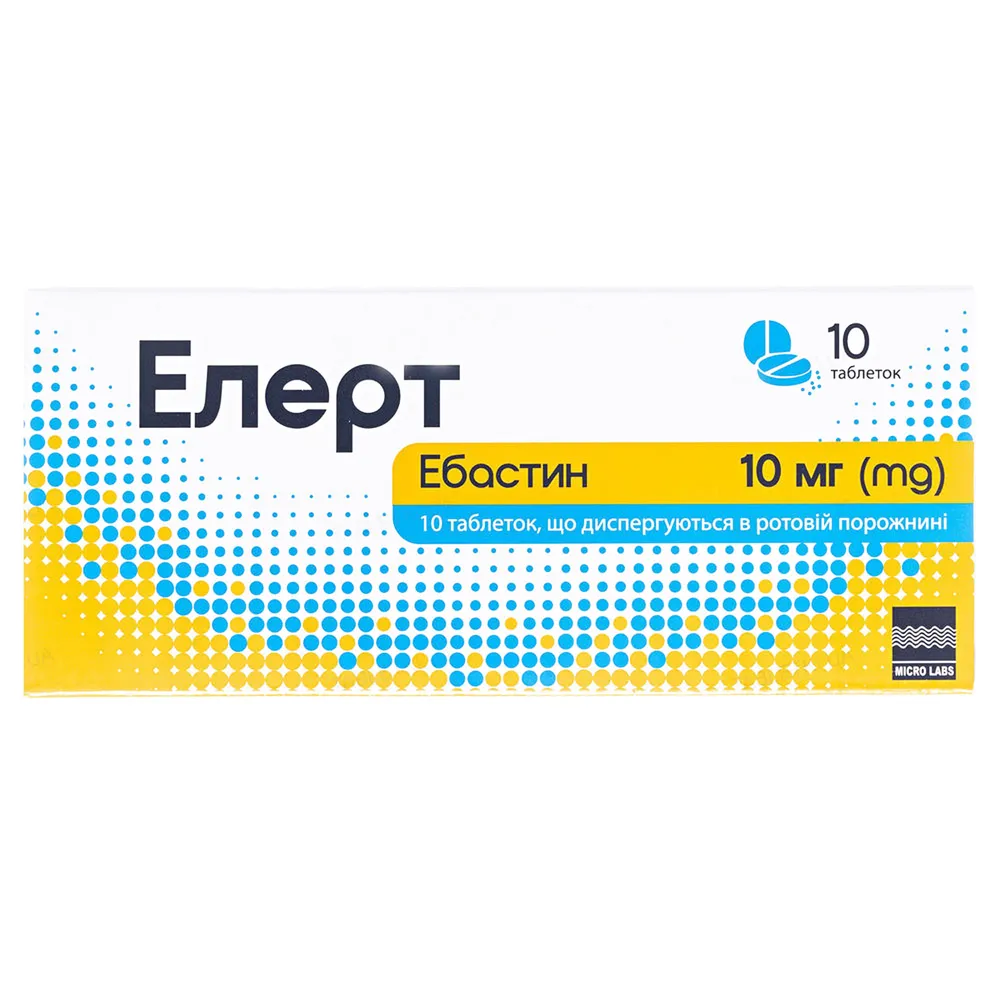
Table of Contents
INSTRUCTIONS FOR MEDICAL USE OF THE MEDICINAL PRODUCT ELERT (ELERT)
Composition:
Active substance: ebastine;
1 dispersible tablet in the oral cavity contains 10 mg of ebastine;
Excipients: mannitol (Pearlitol 200SD) (E 421), crospovidone (Polyplasdone Ultra-10), silicon dioxide (Syloid 244FP), aspartame (Nutrasweet) (E 951), peppermint, magnesium stearate.
Dosage form. Orally disintegrating tablets.
Main physicochemical properties: round, flat, uncoated tablets of white to almost white color with beveled edges, flat on both sides.
Pharmacotherapeutic group. Antihistamines for systemic use. Ebastine. ATC code R06AX22.
Pharmacological Properties
Pharmacodynamics
Mechanism of action
Ebastine causes rapid and sustained inhibition of histamine-induced effects, thereby demonstrating high affinity for binding to H1-receptors.
After oral administration, neither ebastine nor its metabolites penetrate the blood-brain barrier. This property indicates low sedative potential, which was observed during studies evaluating the effects of ebastine on the central nervous system (CNS).
Data from in vitro and in vivo studies indicate that ebastine is a potent, highly selective, long-acting H1-histamine receptor antagonist, which does not exert adverse effects on the CNS and lacks anticholinergic activity.
Pharmacodynamic effects
Studies of histamine-induced wheal responses demonstrate clinically and statistically significant antihistaminic activity of ebastine, beginning within 1 hour and lasting for more than 48 hours. After a five-day course of treatment with Elerth, antihistaminic activity persists for over 72 hours following discontinuation of the drug. This activity correlates with plasma levels of the main active metabolite, carebastine.
Following repeated administration, inhibition of peripheral receptors remains at a steady level without development of tachyphylaxis. These data indicate that ebastine at doses of at least 10 mg induces rapid, intense, and prolonged inhibition of peripheral H1-histamine receptors, which is maintained with once-daily dosing.
Sedative effects were evaluated using electroencephalography, cognitive function assessments, visual-motor coordination tests, and subjective evaluations. No significant increase in sedative effects was observed when the recommended dose was used. These findings are consistent with data from double-blind clinical trials, in which the incidence of sedation in the ebastine group was comparable to that in the placebo group.
The effects of ebastine on the heart were investigated in clinical studies. Detailed analysis showed no significant cardiac effects when doses up to 100 mg per day (10 times higher than the recommended daily dose) were administered.
Pharmacokinetics
After oral administration, ebastine is rapidly absorbed and almost completely metabolized in the liver into its active metabolite, carebastine.
Following a single oral dose of 10 mg, the maximum plasma concentration of carebastine is reached within 2.6–4 hours and ranges from 80–100 ng/mL. The elimination half-life of the active metabolite is 15 to 19 hours. Approximately 66% of the drug is excreted primarily as conjugates in urine. With repeated administration of 10 mg once daily, steady-state plasma concentrations are achieved within 3–5 days and range from 130–160 ng/mL.
In vitro studies using human liver microsomes show that ebastine is metabolized to carebastine via the CYP3A4 enzyme system. Concomitant administration of ebastine with ketoconazole or erythromycin (both CYP3A4 inhibitors) in healthy volunteers was associated with a significant increase in plasma levels of ebastine and carebastine, particularly with ketoconazole (see section "Interaction with other medicinal products and other forms of interaction").
Plasma protein binding of ebastine and carebastine exceeds 97%.
Pharmacokinetic parameters in elderly patients do not differ significantly from those in younger volunteers.
Plasma concentrations of ebastine and carebastine remained consistent from day 1 to day 5 of treatment in patients with mild, moderate, or severe renal impairment (20 mg daily), as well as in patients with mild, moderate (20 mg daily), or severe (10 mg daily) hepatic impairment, similar to levels observed in healthy volunteers. This indicates that the pharmacokinetic parameters of ebastine and its metabolite are not significantly altered in patients with varying degrees of renal or hepatic impairment.
Clinical Characteristics
Indications
Symptomatic treatment of:
- Allergic rhinitis (seasonal and perennial), with or without allergic conjunctivitis;
- Chronic idiopathic urticaria and allergic dermatitis.
Contraindications
Hypersensitivity to the components of the drug.
Interaction with other medicinal products and other forms of interaction
Studies on the interaction of ebastine with ketoconazole or erythromycin indicate QT interval prolongation on ECG. Pharmacokinetic and pharmacodynamic interactions were observed when both combinations were used, leading to increased plasma concentrations of ebastine and, to a lesser extent, increased levels of carebastine in plasma, without any clinically significant pharmacodynamic effects. QT interval increased by only 10 ms when used concomitantly compared to ketoconazole or erythromycin used alone. Caution should be exercised when administering the drug AlerT to patients taking azole antifungal agents such as ketoconazole and itraconazole, and macrolide antibiotics such as erythromycin. A pharmacokinetic interaction was observed when ebastine was co-administered with rifampicin. This interaction results in low plasma concentrations of the drug and reduced antihistaminic activity. Ebastine does not interact with theophylline, warfarin, cimetidine, diazepam, or ethanol. When ebastine is taken with food, plasma levels of the main metabolite of ebastine and AUC (area under the concentration-time curve) increase 1.5 to 2 times. This increase does not alter the time to reach maximum concentration (Tmax). Taking ebastine with food does not affect its clinical effects. Ebastine may influence the results of skin allergy tests; therefore, it is recommended to discontinue the drug 5–7 days before testing. The drug may enhance the effects of other antihistamines.
Special precautions for use
Ebastine should be used with special caution in patients with an existing risk of developing cardiac complications, namely: patients with prolonged QT syndrome, hypokalemia, or those receiving concomitant treatment with other medicinal products that prolong the QT interval or inhibit the CYP3A4 enzyme (e.g., azole antifungals (ketoconazole, itraconazole) and macrolide antibiotics (e.g., erythromycin)) (see section "Interaction with other medicinal products and other forms of interaction").
Pharmacokinetic interactions may occur when ebastine is used concomitantly with rifampicin (see section "Interaction with other medicinal products and other forms of interaction").
Ebastine should be used with caution in patients with severe hepatic impairment (see section "Dosage and administration").
Since the therapeutic effect of the medicinal product occurs 1–3 hours after administration, Elerct should not be used in acute allergic reactions.
The Elerct medicinal product contains aspartame (E 951), a phenylalanine derivative, which may be harmful for patients with phenylketonuria.
The Elerct medicinal product contains mannitol (E 421), which may have a mild laxative effect.
Use during pregnancy or breastfeeding
Pregnancy
Data on the use of ebastine in pregnant women are limited. Animal studies have not revealed any direct or indirect adverse effects with regard to reproductive toxicity. As a precautionary measure, the use of this medicinal product during pregnancy is not recommended.
Breastfeeding period
It is unknown whether ebastine passes into human breast milk. However, the high plasma protein binding of ebastine and its main metabolite carebastine (> 97%) suggests that penetration into breast milk is unlikely. As a precautionary measure, the use of this medicinal product during breastfeeding is not recommended.
Fertility
There are no data available on the effect of ebastine on human fertility.
Ability to influence reaction speed when driving or operating machinery
According to clinical studies, the medicinal product does not affect psychomotor function. Elerct at recommended therapeutic doses does not impair reaction speed when driving or operating complex machinery. However, individuals sensitive to ebastine should consider the possibility of individual adverse reactions such as drowsiness or dizziness before driving or operating complex machinery (see section "Adverse reactions").
Dosage and Administration
Place the tablet on the tongue. No liquid is required. Food intake does not affect the efficacy of the medicinal product.
The recommended dose for adults and children aged 12 years and older is 10 mg (1 tablet) once daily. In cases of pronounced symptoms, the daily dose may be increased to 20 mg.
Elderly patients do not require dose adjustment.
Patients with renal impairment do not require dose adjustment.
Patients with hepatic impairment: Patients with mild or moderate hepatic impairment do not require dose adjustment. In patients with severe hepatic impairment, the maximum recommended dose of 10 mg per day should not be exceeded, as there are no safety data available for higher doses in this patient population.
The duration of treatment may be extended until symptoms resolve and should be determined individually by the physician.
Children
The medicinal product is not recommended for use in children under 12 years of age.
Overdose
During studies using high doses of the drug (up to 100 mg once daily), no significant clinical signs or symptoms of overdose were observed.
There is no specific antidote. In case of overdose, gastric lavage is recommended, along with medical monitoring of vital functions (ECG) and symptomatic treatment.
Adverse Reactions
Based on pooled data from placebo-controlled clinical trials involving 5708 patients treated with ebastine, the most commonly reported adverse reactions were headache, dry mouth, and somnolence.
The adverse events reported in clinical trials conducted in children (460 pediatric patients) were similar in nature to those observed in adults.
The following frequency categories were used to classify adverse reactions:
Very common (≥ 1/10), common (≥ 1/100, < 1/10), uncommon (≥ 1/1000, < 1/100), rare (≥ 1/10000, < 1/1000), very rare (< 1/10000), unknown (cannot be estimated due to lack of data).
Immune system disorders
Rare: hypersensitivity reactions (anaphylaxis and angioedema).
Psychiatric disorders
Rare: nervousness, insomnia.
Nervous system disorders
Common: somnolence, headache.
Rare: dizziness, hypoaesthesia, dysgeusia.
Cardiac disorders
Very rare: palpitations, tachycardia.
Respiratory, thoracic and mediastinal disorders
Uncommon: epistaxis, pharyngitis, rhinitis.
Very rare: sinusitis.
Gastrointestinal disorders
Common: dry mouth.
Rare: nausea, vomiting, abdominal pain, dyspepsia.
Hepatobiliary disorders
Rare: hepatitis, cholestasis, changes in liver function tests (elevated levels of transaminases, gamma-glutamyl transferase, alkaline phosphatase, and bilirubin).
Skin and subcutaneous tissue disorders
Very rare: exanthema, urticaria, eczema, rash, dermatitis.
Reproductive system and breast disorders
Very rare: menstrual disorder.
General disorders and administration site conditions
Rare: oedema, asthenia.
Unknown: increased appetite, weight gain.
Reporting of suspected adverse reactions after marketing authorization is important. It allows continued monitoring of the benefit-risk balance of the medicinal product. Healthcare professionals, pharmacists, as well as patients or their legal representatives are encouraged to report any suspected adverse reactions and lack of efficacy via the Automated Pharmacovigilance Information System at the following link: https://aisf.dec.gov.ua.
Shelf life. 3 years.
Storage conditions. Store at a temperature not exceeding 25 ℃. Keep out of reach of children.
Packaging. 10 tablets per blister; 1, 2, or 3 blisters per cardboard box.
Supply classification. Over-the-counter (without prescription).
Manufacturer. Micro Labs Limited.
Manufacturer's address and location of its business operations
Plot No. S.155 - S.159 and N1, Verna Industrial Estate, Phase III and Phase IV, Verna Salcette, In-403 722, India.