Eldopril
Ukraine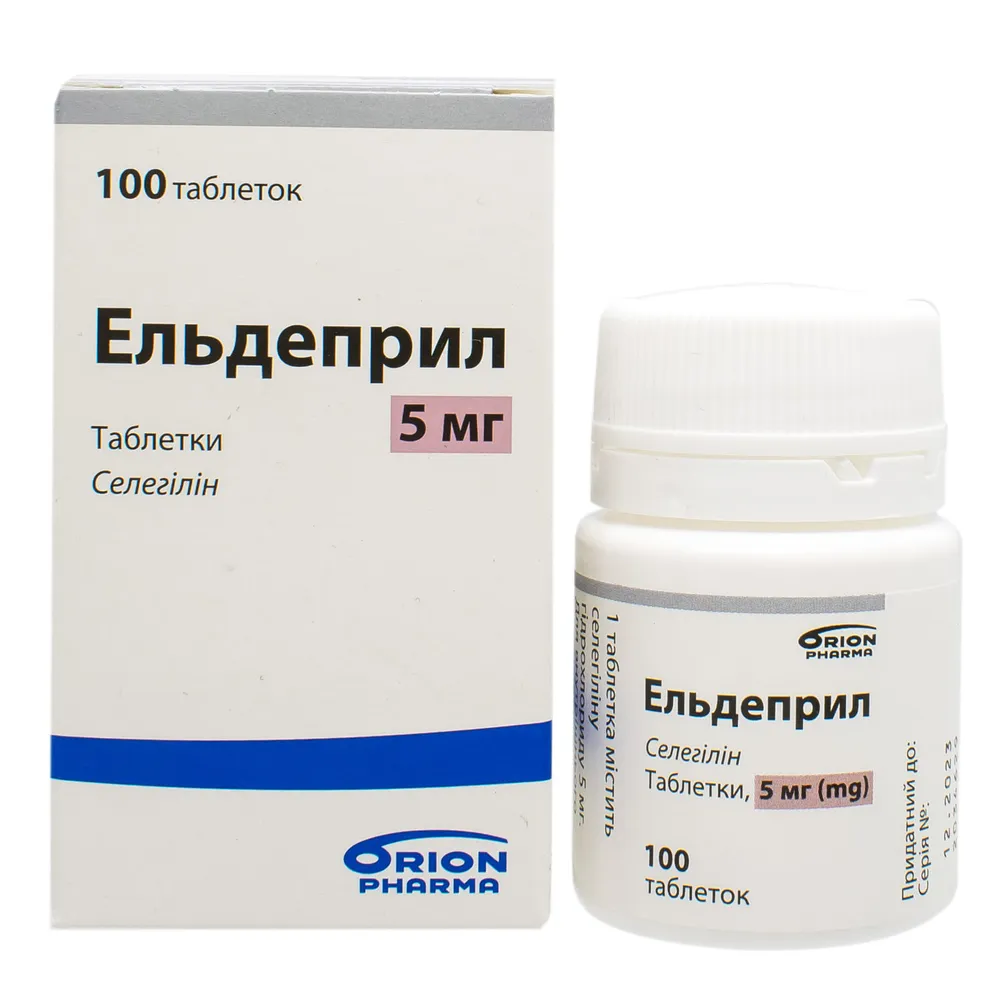
Table of Contents
INSTRUCTIONS FOR MEDICAL USE OF THE MEDICINAL PRODUCT ELDPRIL (ELDEPRIL)
Composition:
Active substance: selegiline;
1 tablet contains selegiline hydrochloride 5 mg;
Excipients: mannitol (E 421), maize starch, microcrystalline cellulose, povidone, magnesium stearate.
Medicinal form. Tablets.
Main physicochemical properties: round, biconvex tablets with a score line, white or almost white in color. Tablet diameter 6 mm.
Pharmacotherapeutic group. Anti-Parkinson agents. Monoamine oxidase type B inhibitors. ATC code N04B D01.
Pharmacological Properties.
Pharmacodynamics. Selegiline is a selective MAO-B inhibitor which also inhibits dopamine reuptake and presynaptic dopamine receptors. These effects potentiate dopaminergic function in the brain. In early stages of Parkinson's disease, double-blind studies have shown that patients receiving selegiline as monotherapy remained significantly longer without needing levodopa stimulation therapy compared to patients receiving placebo. Patients' functional capacity remained high. Selegiline potentiates and prolongs the effect of levodopa, allowing reduction of its dosage. In combination with levodopa preparations, selegiline increases the duration of the "on" period, reduces the duration of the "off" period, and diminishes the severity of end-of-dose wearing-off phenomenon. Selegiline does not potentiate the hypertensive effects of substances such as tyramine ("cheese effect").
Pharmacokinetics.
Selegiline is rapidly absorbed from the gastrointestinal tract. Peak concentrations are reached within 30 – 45 minutes after oral administration. The bioavailability of the drug is low; on average, only 10% of unchanged selegiline reaches the systemic circulation (however, there is considerable inter-individual variability). Selegiline is a lipophilic, weakly basic compound that readily penetrates tissues, including the brain. It rapidly distributes throughout the body, with a volume of distribution of approximately 500 L after intravenous administration of a 10 mg dose. At therapeutic doses, 75 – 85% of selegiline is plasma protein-bound. Based on in vitro studies, CYP2B6 is the main hepatic cytochrome P450 isoenzyme involved in selegiline metabolism. Enzymes CYP3A4 and CYP2A6 may also participate in its metabolism. Selegiline is rapidly metabolized, primarily in the liver, to desmethylselegiline, 1-methamphetamine, and 1-amphetamine. These three metabolites have been detected in blood plasma and urine following single and multiple doses of selegiline. The mean elimination half-life is 1.5 – 3.5 hours. Total body clearance of selegiline is approximately 240 L per hour. Selegiline metabolites are primarily excreted in urine, with approximately 15% found in feces. Due to irreversible inhibition of MAO-B, the duration of therapeutic effect is independent of the elimination time of selegiline, thus once-daily administration is sufficient. A single 10 mg dose results in nearly complete inhibition of platelet MAO-B activity for more than 24 hours; activity returns to normal levels after approximately two weeks.
Clinical characteristics.
Indications.
Parkinson's disease or symptomatic parkinsonism – as monotherapy in the early stage of the disease or in combination with levodopa preparations (in combination with peripheral decarboxylase inhibitors or without them).
Selegiline in combination with levodopa is particularly indicated in patients who experience the onset of fluctuations as a "wearing-off" effect associated with high-dose levodopa therapy.
Contraindications.
Hypersensitivity (including severe dizziness or hypotension) to selegiline or to any of the excipients.
Active peptic ulcer disease.
Concomitant use with serotonin reuptake inhibitors (e.g., citalopram, escitalopram, fluoxetine, fluvoxamine, paroxetine, and sertraline), serotonin-norepinephrine reuptake inhibitors (venlafaxine), tricyclic antidepressants, sympathomimetics, MAO inhibitors (linezolid), or opioids (pethidine) (see "Interaction with other medicinal products and other types of interactions").
When combining selegiline with levodopa, contraindications to levodopa use should also be considered.
Eldopril is contraindicated in patients receiving therapy with serotonin agonists (e.g., sumatriptan, naratriptan, zolmitriptan, and rizatriptan).
Eldopril should not be used with other medicinal products that are also monoamine oxidase inhibitors, such as linezolid.
The medicinal product should not be administered to patients with other extrapyramidal disorders unrelated to dopamine deficiency.
Selegiline in combination with levodopa is contraindicated in severe cardiovascular diseases, arterial hypertension, hyperthyroidism, pheochromocytoma, narrow-angle glaucoma, benign prostatic hyperplasia with residual urine, tachycardia, arrhythmias, severe angina pectoris, psychoses, advanced dementia, and thyrotoxicosis.
Interaction with other medicinal products and other types of interactions.
Contraindicated combinations.
Sympathomimetics. Due to the risk of developing arterial hypertension, concomitant use of selegiline and sympathomimetics is contraindicated.
Pethidine and other opioids. Concomitant use of selegiline (a selective MAO inhibitor) and pethidine or other opioids is contraindicated. It is known that selegiline and pethidine interact with each other with potentially fatal consequences, although the mechanism of this interaction has not yet been fully elucidated. Selegiline should not be used with any antidepressants.
Tramadol may also interact with selegiline.
Selective serotonin reuptake inhibitors (SSRIs) and serotonin-norepinephrine reuptake inhibitors (SNRIs).
When selegiline is used at the recommended dose, it selectively inhibits MAO-B. Combined use of SSRIs, fluoxetine, and Eldopril should be applied only under clinical monitoring.
There have been reports of adverse reactions in patients who received selegiline and fluoxetine simultaneously. For example, increased sweating, flushing, ataxia, hyperthermia, hypertension and hypotension, seizures, tachycardia, dizziness, and mental changes including agitation, confusion, and hallucinations progressing to delirium and coma were observed. Similar reactions have been reported in patients taking selegiline concurrently with sertraline and paroxetine. There is a potential risk of interaction with fluvoxamine and venlafaxine.
Due to the risk of developing confusion, hypomania, hallucinations, manic episodes, agitation, myoclonus, hyperreflexia, coordination disturbances, tremor, seizures, ataxia, increased sweating, diarrhea, fever, and arterial hypertension, which may be manifestations of serotonin syndrome, concomitant use of selegiline and SSRIs or SNRIs is contraindicated.
Use of Eldopril at doses higher than recommended may lead to loss of selectivity and serious adverse effects.
Cases of death have been reported after initiation of non-selective MAO inhibitors shortly after discontinuation of fluoxetine. Since fluoxetine and its active metabolites have a long half-life, at least 5 weeks should elapse between discontinuation of fluoxetine and initiation of selegiline therapy. Selegiline and its metabolites have a short half-life, so a two-week interval is sufficient between discontinuation of selegiline and initiation of fluoxetine.
A two-week interval is sufficient between discontinuation of sertraline and initiation of selegiline. For all other serotonin reuptake inhibitors, a one-week interval is recommended between discontinuation of the serotonin reuptake inhibitor and initiation of selegiline therapy. Selegiline should not be initiated after a drug that interacts with selegiline until five elimination half-lives of that drug have passed.
At least 14 days should elapse between discontinuation of selegiline therapy and initiation of treatment with any drug that interacts with selegiline.
An interval of 24 hours is recommended between discontinuation of selegiline therapy and initiation of serotonin agonists.
Patients who are currently receiving selegiline or have received it within the last 2 weeks should only receive dopamine after careful benefit-risk assessment, as this combination increases the risk of hypertensive reactions.
Tricyclic antidepressants.
Severe CNS symptoms (serotonin syndrome) have been reported in patients taking a combination of tricyclic antidepressants and selegiline. A case of hyperpyrexia and death in a patient receiving amitriptyline and selegiline has been reported. Another patient receiving protriptyline and selegiline experienced tremor, agitation, and anxiety, followed by death two weeks after starting selegiline.
Other adverse reactions observed in patients taking a combination of selegiline and tricyclic antidepressants include hypertension and hypotension, dizziness, increased sweating, tremor and seizures, and behavioral and mental status changes. Therefore, concomitant use of selegiline and tricyclic antidepressants is contraindicated.
MAO inhibitors. Concomitant use of selegiline and MAO inhibitors may lead to disturbances in the CNS and cardiovascular system.
Combinations not recommended.
Oral contraceptives. Caution should be exercised when using selegiline concomitantly with combined oral contraceptives, as they may increase the bioavailability of selegiline.
Concomitant use of amantadine and anticholinergic drugs may lead to an increased incidence of adverse effects.
Selegiline should be used with caution and under close monitoring when administered with digoxin and anticoagulants.
Four patients who received altretamine and a monoamine oxidase inhibitor experienced symptomatic hypotension after four to seven days of concomitant therapy.
Concomitant use of hypertensive agents, antihypertensive drugs, psychostimulants, CNS-acting drugs (sedatives, hypnotics), and alcohol should be avoided.
Interaction with food. Unlike traditional MAO enzyme inhibitors, which inhibit both MAO-A and MAO-B, selegiline is a specific inhibitor of MAO-B.
When selegiline is used at recommended doses, no hypertensive reaction (the so-called "cheese effect") has been observed after consuming foods low in tyramine. Therefore, dietary restrictions are not necessary in this case.
However, when combining selegiline with traditional MAO inhibitors or MAO-A inhibitors, strict adherence to diet is recommended (avoiding foods high in tyramine: fermented foods and beverages, aged cheese, salami, smoked meat, liver, meat broth, game, salted fish, beans, peas, sauerkraut, and yeast-containing products).
Special precautions for use.
Concomitant treatment with drugs that inhibit MAO-A (or non-selective MAO inhibitors) may cause hypotensive reactions. Sudden hypotension has been reported at the beginning of selegiline therapy.
Particular caution should be exercised when administering selegiline to patients with duodenal ulcer, labile hypertension, cardiac arrhythmia, severe angina pectoris, severe hepatic or renal insufficiency, or psychosis.
Although serious hepatic toxicity has not been observed, the drug should be used with caution in patients with a history of hepatic dysfunction. During long-term selegiline therapy, transient or persistent elevations in plasma levels of liver enzymes have been reported.
Selegiline should be used with caution in patients with severe hepatic or renal dysfunction.
Since selegiline potentiates the effect of levodopa, adverse reactions associated with levodopa may be intensified, especially when high doses of levodopa are administered. Patients receiving such treatment require careful monitoring. When selegiline is added to levodopa therapy, symptoms such as involuntary movements and/or agitation may appear; these symptoms usually resolve upon reduction of the levodopa dose. Therefore, at the initiation of selegiline therapy, the levodopa dose may be reduced on average by 10–30%. Once the optimal levodopa dose is achieved, the incidence of adverse reactions resulting from the combination of selegiline and levodopa is lower than with levodopa monotherapy.
The exact dose at which selegiline becomes a non-selective inhibitor of all MAO enzymes has not been established, but at doses exceeding 10 mg/day, there is a theoretical risk of hypertensive crisis after ingestion of food rich in tyramine.
Caution is required in patients taking MAO inhibitors, including selegiline, when undergoing general anesthesia in surgical practice. MAO inhibitors, including selegiline, may potentiate the effects of centrally acting drugs used for general anesthesia. Cases of transient respiratory depression, cardiorespiratory depression, hypotension, and coma have been reported.
Disorders of impulse control and compulsive urges, such as pathological gambling, increased libido and hypersexuality, bulimia, compulsive spending, and other compulsive or repetitive behaviors, have been reported in patients with Parkinson’s disease during treatment with dopamine agonists or other dopaminergic agents, including selegiline.
Results from some studies suggest a higher mortality rate in patients receiving both selegiline and levodopa compared to those receiving levodopa alone. However, it should be noted that these studies had numerous methodological limitations, and meta-analyses and large cohort studies have concluded that there is no statistically significant difference in mortality rates between patients treated with selegiline and those treated with comparator drugs or the combination of selegiline/levodopa.
Studies have shown that in patients at increased risk of cardiovascular disease, the risk of developing arterial hypotension in response to concomitant administration of selegiline and levodopa is increased.
Combined use of selegiline and levodopa is not recommended in patients who experience dose-independent changes in response to treatment.
Selegiline should be used cautiously in combination with drugs that primarily act on the central nervous system.
Concomitant intake of selegiline with alcohol should be avoided.
Use during pregnancy or breastfeeding.
Selegiline is indicated for the treatment of Parkinson’s disease, which predominantly affects individuals beyond reproductive age. Available safety data regarding use during pregnancy and lactation are insufficient to justify the use of selegiline in these patient groups.
Pregnancy. Very limited data are available on the use of selegiline during pregnancy. Animal studies have shown that the drug exhibits reproductive toxicity only at doses many times higher than the recommended clinical dose. Administration of selegiline during pregnancy is not recommended.
Breastfeeding. It is unknown whether selegiline is excreted in human breast milk. Excretion of selegiline into milk has not been studied in animals. The physicochemical properties of selegiline suggest that it may be excreted into breast milk. Therefore, risk to the nursing infant cannot be excluded. Selegiline should not be used during breastfeeding.
Ability to affect reaction speed when driving or operating machinery.
Even when used correctly, this medicinal product may cause dizziness or impair reaction ability when driving or operating machinery. This drug may impair cognitive function. In such cases, patients should refrain from driving or operating machinery.
Dosage and Administration
Selegiline is used as monotherapy in the early stage of the disease or in combination with levodopa preparations (with or without peripheral decarboxylase inhibitors). In both cases, the initial dose is 5 mg taken in the morning. The dose of Eldopril can be increased to 10 mg per day (can be taken in the morning or divided into two doses).
Hepatic impairment
There is no information available regarding dosage adjustment in patients with hepatic impairment.
Renal impairment
There is no information available regarding dosage adjustment in patients with renal impairment.
Children
There is no information available on the use of the drug in children; therefore, the use of the drug in this patient group is not recommended.
Overdose
Selegiline is rapidly metabolized, and metabolites are quickly eliminated. In cases of suspected overdose, the patient should be monitored for 24–48 hours.
There are no data on clinically significant overdose of the drug. The effect of selegiline as a selective MAO-B inhibitor is achieved at doses recommended for the treatment of Parkinson’s disease (5–10 mg per day). Experience obtained during the development of selegiline indicates that administration of doses up to 600 mg/day caused severe hypotension and psychomotor agitation. Symptoms of overdose may resemble those of overdose with non-selective MAO inhibitors (disorders of the central nervous and cardiovascular systems, such as drowsiness, dizziness, irritability, agitation, hyperactivity, tremor, restlessness, severe muscle spasms, severe headache, hallucinations, arterial hypertension, arterial hypotension, chest pain, rapid and irregular pulse, vascular collapse, respiratory insufficiency, respiratory depression, sweating, fever, coma, seizures). Symptoms of overdose may develop within 24 hours. There is no specific antidote; treatment is symptomatic.
Adverse Reactions
The frequency of adverse reactions is classified as follows: very common (≥1/10); common (≥1/100, <1/10); uncommon (≥1/1,000, <1/100); rare (≥1/10,000 to <1/1,000); very rare (<1/10,000), frequency not known (cannot be estimated from available data).
Psychiatric disorders
Common: sleep disorders, confusion, hallucinations.
Uncommon: abnormal dreams, agitation, anxiety, mood swings.
Frequency not known: impulse control disorders and compulsive behaviors (such as hypersexuality)*.
Nervous system disorders
Common: involuntary movements (dyskinesia, akinesia, bradykinesia), dizziness, headache, loss of balance.
Uncommon: transient sleep disorders (insomnia).
Rare: excitement.
Cardiac disorders
Common: bradycardia.
Uncommon: palpitations, angina pectoris, supraventricular tachycardia.
Rare: arrhythmias.
Vascular disorders
Common: hypotension, hypertension.
Uncommon: orthostatic hypotension.
Rare: postural hypotension.
Gastrointestinal disorders
Very common: stomatitis.
Common: nausea, oral ulcers.
Uncommon: dry mouth.
Hepatobiliary disorders
Common: increased liver enzyme levels.
Uncommon: transient increases in serum alanine aminotransferase levels.
Skin and subcutaneous tissue disorders
Common: increased sweating.
Uncommon: hair loss.
Rare: rash, skin reactions.
Renal and urinary disorders
Uncommon: urinary disorders.
Rare: difficulty in urination.
Frequency not known: urinary retention.
Infections and infestations
Uncommon: pharyngitis.
Blood and lymphatic system disorders
Uncommon: leukopenia, thrombocytopenia.
Metabolism and nutrition disorders
Uncommon: loss of appetite.
Respiratory, thoracic and mediastinal disorders
Common: nasal congestion.
Uncommon: dyspnea.
Musculoskeletal and connective tissue disorders
Common: arthralgia, muscle cramps.
Uncommon: myopathy.
General disorders and administration site conditions
Common: fatigue.
Uncommon: irritability, ankle edema.
Injury, poisoning and procedural complications
Common: falls.
Investigations
Common: slight increase in liver enzymes.
* Impulse control disorders and compulsive behaviors such as pathological gambling, increased libido and hypersexuality, bulimia, compulsive spending, and other compulsive or repetitive behaviors have been reported in patients with Parkinson’s disease during therapy with dopamine agonists or other dopaminergic agents, such as selegiline.
Additional adverse reactions observed during treatment with this medicinal product include psychosis, depression, tremor, chest, back, joint or throat pain, vertigo, visual disturbances, vomiting, constipation, diarrhea.
In combination with levodopa
Since this medicinal product enhances the effect of levodopa, adverse effects associated with levodopa (such as restlessness, hyperkinesia, atypical movements, agitation, confusion, hallucinations, postural hypotension, cardiac arrhythmias) may be intensified during combination therapy (levodopa is usually administered in combination with a peripheral decarboxylase inhibitor). If adverse reactions related to levodopa occur during combined treatment, the levodopa dose should be reduced. Therefore, at the initiation of selegiline therapy, the levodopa dose may be reduced on average by 30%. The most frequent adverse reaction is dyskinesia (in 4% of patients). After the optimal levodopa dose has been established, the number of adverse reactions associated with the combination of selegiline and levodopa is generally lower than with levodopa therapy alone.
Shelf life. 3 years.
Storage conditions
Store in the original packaging to protect from light at a temperature not exceeding 25°C. Keep out of reach of children.
Packaging
100 tablets in a bottle; 1 bottle in a cardboard box.
Prescription category. Prescription only.
Manufacturer
Orion Corporation/Orion Corporation.
Manufacturer's address and place of business
Orionintie 1, 02200 Espoo, Finland/Orionintie 1, 02200 Espoo, Finland.
Manufacturer
Orion Corporation/Orion Corporation.
Manufacturer's address and place of business
Joensuunkatu 7, 24100 Salo, Finland/Joensuunkatu 7, 24100 Salo, Finland.