Ditsinon
Ukraine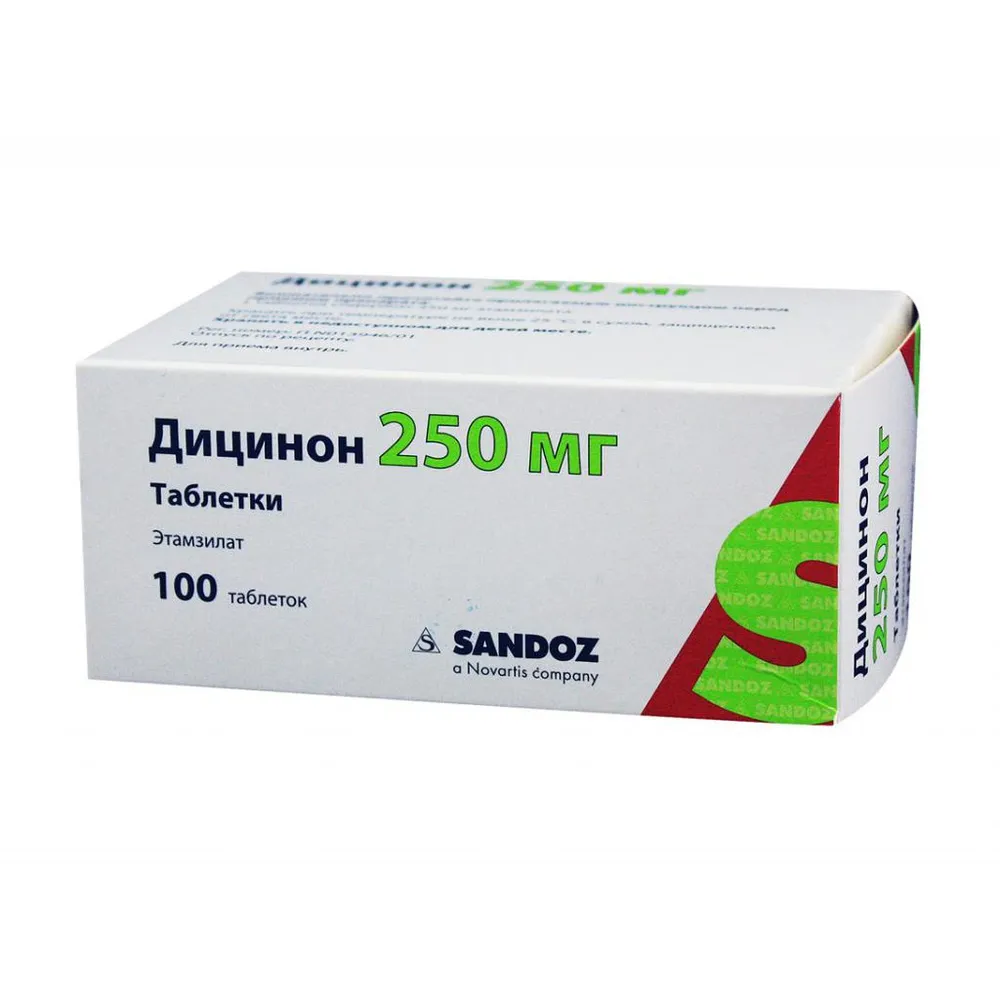
Table of Contents
INSTRUCTIONS FOR MEDICAL USE OF THE MEDICINAL PRODUCT DICYNONE
Composition:
Active substance: etamsylate;
1 tablet contains 250 mg of etamsylate;
Excipients: anhydrous citric acid, corn starch, lactose monohydrate, povidone, magnesium stearate.
Pharmaceutical form. Tablets.
Main physicochemical properties: white or almost white, round, biconvex tablets.
Pharmacotherapeutic group.
Antihemorrhagic agents. Other systemic hemostatic agents.
ATC code B02BX01.
Pharmacological properties.
Pharmacodynamics.
Etamsylate is an agent for prevention and cessation of bleeding. It affects the first stage of the haemostasis mechanism (interaction between endothelium and platelets). Dicynone increases platelet adhesiveness, normalizes capillary wall resistance thereby reducing their permeability, and inhibits biosynthesis of prostaglandins which cause platelet disaggregation, vasodilation, and increased capillary permeability. As a result, bleeding time is significantly reduced and blood loss is decreased.
Pharmacokinetics.
Etamsylate is almost completely absorbed in the gastrointestinal tract, reaching peak serum concentrations 4 hours after administration. Approximately 95% of the drug is bound to plasma proteins.
About 72–80% of the administered dose is excreted unchanged in urine within the first 24 hours. Etamsylate crosses the placental barrier. It is unknown whether etamsylate passes into breast milk.
Clinical characteristics.
Indications.
Ditsinon is indicated for the prevention and control of hemorrhages in superficial and internal capillaries of various etiologies, especially when bleeding is due to endothelial damage:
- prevention and treatment of bleeding during and after surgical procedures in otorhinolaryngology, gynecology, obstetrics, urology, dentistry, ophthalmology, and plastic surgery;
- prevention and treatment of capillary hemorrhages of various etiologies and localizations: hematuria, metrorrhagia, primary hypermenorrhea, hypermenorrhea in women with intrauterine contraceptive devices, epistaxis, gingival bleeding.
Contraindications.
Hypersensitivity to ethamsylate or to any other component of the drug. Acute porphyria, increased blood coagulation, thrombosis, thromboembolism. Hemoblastosis (lymphatic and myeloid leukemia, osteosarcoma) in children.
Interaction with other medicinal products and other forms of interaction.
Administration of ethamsylate prior to dextran infusion (e.g., reopolyglucin) prevents the anti-aggregant effect of the latter; administration of ethamsylate after dextran does not produce a hemostatic effect. Compatible with aminocaproic acid and vikasol.
Special precautions for use
The drug should be used with caution in patients who have previously experienced thrombosis or thromboembolism. The drug is ineffective in cases of reduced platelet count.
In hemorrhagic complications associated with anticoagulant overdose, specific antidotes are recommended.
Before initiating treatment, other causes of bleeding should be ruled out. If no improvement is observed with use of Ethamsylate for reduction of excessive and/or prolonged menstrual bleeding, possible pathological causes (e.g., presence of uterine fibroids) should be excluded.
If skin reactions or fever occur, treatment should be discontinued and medical advice sought, as these may be signs of hypersensitivity.
The drug contains lactose and therefore should not be administered to patients with rare hereditary forms of galactose intolerance, lactase deficiency, or glucose-galactose malabsorption syndrome.
Use in patients with renal impairment
The safety and efficacy of ethamsylate have not been studied in patients with renal impairment. Since ethamsylate is almost entirely excreted by the kidneys, the dose should be reduced in cases of renal insufficiency.
Laboratory tests
At therapeutic doses, ethamsylate may reduce creatinine values in laboratory tests.
Use during pregnancy or breastfeeding
There are no reliable data on the effects of Ethamsylate on the fetus; therefore, the drug is contraindicated during the first trimester of pregnancy. In the second and third trimesters of pregnancy, the drug may be used only if the benefit to the mother outweighs the potential risk to the fetus.
Breastfeeding should be discontinued during treatment with this drug.
Ability to influence the reaction rate while driving or operating machinery
The drug has no direct effect; however, dizziness may occur during treatment, which should be taken into account when driving or operating machinery.
Dosage and Administration.
Administer orally. Take tablets during or after meals, swallowing with a small amount of water.
The usual daily dose for adults is 2 tablets 2–3 times daily (1000–1500 mg).
Prior to surgery, administer 1–2 tablets (250–500 mg) 1 hour before the procedure.
After surgery, administer 1–2 tablets (250–500 mg) every 4–6 hours until the risk of bleeding has subsided.
In menorrhagia, administer 2 tablets 3 times daily (1500 mg) for 10 days, starting from the 5th day prior to the expected onset of menstruation until the 5th day of the following menstrual cycle.
The daily dose for children is half the adult dose.
The drug should be used with caution in patients with hepatic or renal impairment.
Children.
The drug may be administered to children aged 6 years and older. Do not administer to children with hemoblastosis.
Overdose.
Data are lacking. In case of overdose, symptomatic treatment should be administered.
Adverse Reactions.
Nervous system disorders: headache, dizziness, hot flushes, paresthesia of lower limbs.
Gastrointestinal disorders: nausea, vomiting, diarrhea, abdominal discomfort.
Immune system disorders: hypersensitivity, allergic reactions, skin rash, urticaria, pruritus; one case of angioneurotic edema has been reported.
Musculoskeletal and connective tissue disorders: arthralgia.
Blood and lymphatic system disorders: agranulocytosis, neutropenia, thrombocytopenia.
Vascular disorders: thromboembolism.
Other: asthenia, increased body temperature, acute porphyria.
All adverse effects are mild and transient.
In children treated with etamsylate for prevention of bleeding in acute lymphoblastic and myeloid leukemia, severe leukopenia was reported more frequently.
Shelf life. 5 years.
Storage conditions.
Store at a temperature not exceeding 25 °C in the original packaging.
Keep out of reach of children.
Packaging.
10 tablets in a blister; 10 blisters (10 × 10) in a cardboard box.
Prescription status. Prescription only.
Manufacturer.
Lek Pharmaceuticals d. d.
or
Lek Pharmaceuticals d. d.
Manufacturer's address and place of business.
Verovškova cesta 57, 1526 Ljubljana, Slovenia
or
Trimo 2d, 9220 Lendava, Slovenia.