Diclo-f
Ukraine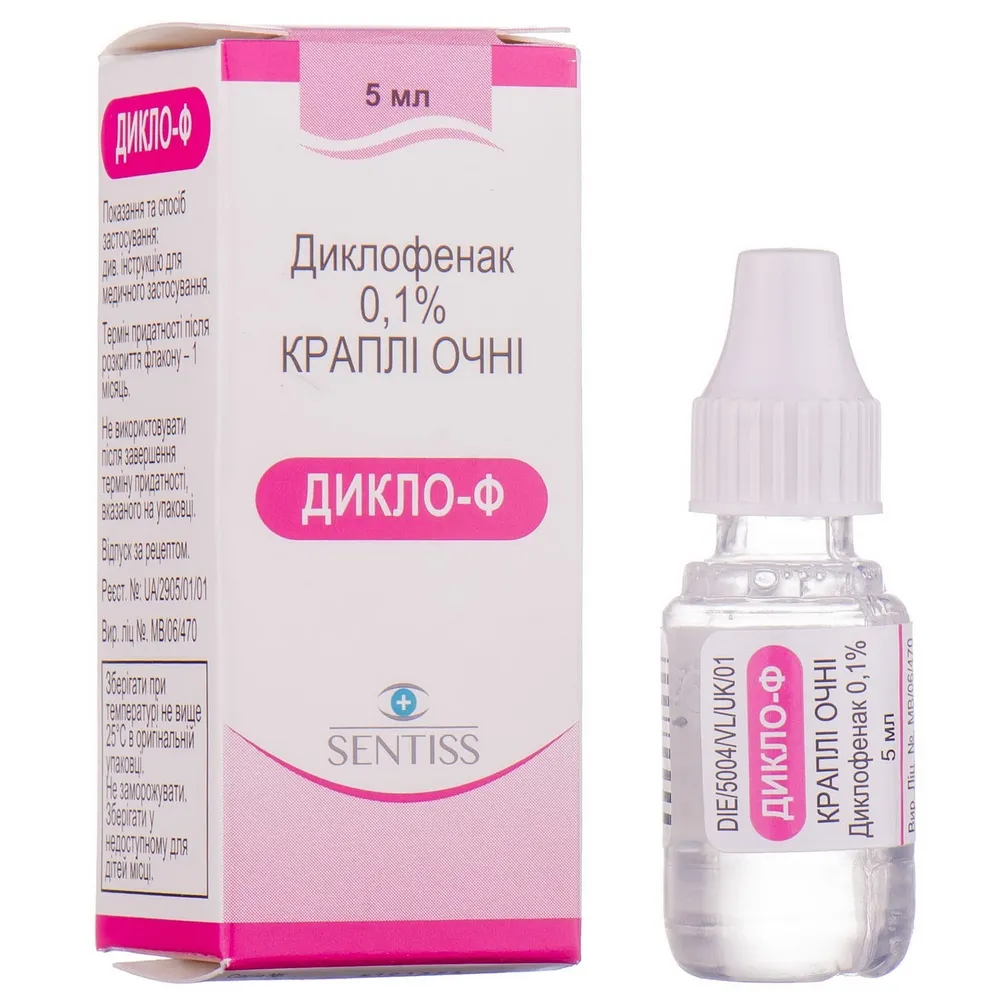
Table of Contents
INSTRUCTIONS FOR MEDICAL USE OF THE MEDICINAL PRODUCT DICLO-F (diclo-F)
Composition:
Active substance: diclofenac;
1 ml of solution contains sodium diclofenac 1.0 mg;
Excipients: benzalkonium chloride, disodium edetate, boric acid, tromethamine, polyoxyl 35 castor oil, povidone, hydrochloric acid diluted, sodium hydroxide, water for injections.
Pharmaceutical form. Eye drops.
Main physicochemical properties: clear solution ranging from colorless to light yellow.
Pharmacotherapeutic group. Agents used in ophthalmology. Non-steroidal anti-inflammatory agents. ATC code S01BC03.
Pharmacological properties.
Pharmacodynamics.
The medicinal product contains diclofenac sodium, a non-steroidal anti-inflammatory agent with analgesic properties. The mechanism of action of diclofenac sodium is related to a pronounced inhibition of prostaglandin synthesis.
Clinically proven, diclofenac inhibits miosis during cataract surgery and reduces ocular inflammation and pain caused by corneal epithelial damage following certain types of surgical interventions.
There is no data available regarding the effect of diclofenac on wound healing.
Pharmacokinetics.
After instillation, diclofenac is absorbed into the systemic circulation. Following instillation into the conjunctival sac, maximum concentrations of diclofenac in the cornea and conjunctiva were maintained for 30 minutes. The drug is rapidly eliminated from the body, with complete elimination observed within 6 hours.
However, the concentration of the active substance reaching the blood is significantly below the detection limit and has no clinical significance.
Clinical characteristics.
Indications.
- Inhibition of intraoperative miosis during cataract surgery.
(Diclo-F does not possess characteristic mydriatic properties and does not replace standard medicinal agents causing pupil dilation.)
- Treatment of postoperative inflammation following cataract extraction and other surgical procedures.
- Management of pain and discomfort in ophthalmology associated with corneal epithelial damage after excimer photorefractive keratectomy (PRK) or minor non-penetrating trauma.
- Control of inflammation following argon laser trabeculoplasty (ALT).
- Reduction of signs and symptoms of seasonal allergic conjunctivitis (SAC) in ophthalmology.
- Treatment of inflammation and discomfort following surgical correction of strabismus.
- Management of pain and discomfort in ophthalmology following radial keratotomy.
Contraindications.
Hypersensitivity to the active substance or to any of the excipients.
Intravitreal administration of the drug during surgical procedures.
Like other nonsteroidal anti-inflammatory drugs (NSAIDs), the drug is contraindicated in patients who have experienced asthma attacks, urticaria, or acute rhinitis following administration of acetylsalicylic acid or other agents inhibiting prostaglandin synthesis. There is a possibility of cross-sensitivity to acetylsalicylic acid, phenylacetic acid derivatives, and other NSAIDs. Therefore, the drug should be administered with caution in patients sensitive to these agents.
Interaction with other medicinal products and other forms of interaction.
If more than one type of eye drops is prescribed, they should be administered with an interval of at least 5 minutes.
Concomitant use of topically applied NSAIDs, such as diclofenac, and topical corticosteroids in patients with pre-existing significant corneal inflammation may increase the risk of corneal complications and delay corneal healing; therefore, the drug should be used with caution.
Concomitant use of the drug with agents that prolong bleeding time may increase the risk of hemorrhage.
Eye drops containing 0.1% diclofenac solution have been successfully used in clinical studies in combination with antibiotics and topical beta-blockers.
Special precautions for use.
The anti-inflammatory action of ophthalmic nonsteroidal anti-inflammatory drugs may mask the onset and/or progression of ocular infections. In the presence of infection or if there is a potential risk of developing infection, appropriate therapy (e.g., antibiotic treatment) should be administered concomitantly with the drug.
Although reports of such adverse effects are lacking, there is a theoretical possibility that patients receiving other medicinal products that may prolong bleeding time, or patients with diagnosed coagulation disorders, may experience exacerbation of their condition when using this drug.
It is known that topically applied NSAIDs can slow or delay healing. Topical corticosteroids may also delay corneal healing. Therefore, caution should be exercised when using topical NSAIDs such as diclofenac concomitantly with steroid agents in patients with corneal inflammation (see section "Interaction with other medicinal products and other forms of interaction").
Eye drops are not intended for injection. They must not be administered subconjunctivally or into the anterior chamber of the eye. During treatment with eye drops, to prevent microbial contamination, the dropper tip should not touch the eye, eyelids, surrounding areas, or any other surfaces.
The drug should be discontinued immediately in patients who develop symptoms indicating disruption of corneal integrity.
Patients who have undergone complex eye surgeries, corneal denervation, or who have corneal epithelial defects, diabetes mellitus, nonbacterial ocular diseases (e.g., dry eye syndrome), rheumatoid arthritis, or who have undergone repeated eye surgeries within a short period, are at increased risk of adverse effects of diclofenac on the cornea, which may threaten vision.
The use of NSAIDs within 24 hours before surgery or more than 14 days after surgery may increase the risk and severity of corneal adverse reactions in patients.
It is known that diclofenac sodium eye drops generally do not significantly affect intraocular pressure. However, diclofenac sodium eye drops should be used with caution after cataract surgery, as increased intraocular pressure may occur in such cases.
This medicinal product contains benzalkonium chloride as a preservative, which may cause eye irritation and may form deposits on the surface of soft contact lenses. Therefore, the product should not be used while wearing soft contact lenses: lenses must be removed before administration of the drug and reinserted no sooner than 15 minutes after instillation. It is recommended to avoid wearing contact lenses during treatment of inflammatory eye diseases.
After instillation of eye drops, occlusion (pressing with a finger) of the nasolacrimal ducts or closing the eyes for 3 minutes reduces systemic absorption.
This, in turn, decreases the risk of systemic adverse effects and enhances the local action of the drug.
Use during pregnancy or breastfeeding.
Pregnancy
Clinical data on the use of Diclo-F during pregnancy are lacking. Even though systemic exposure is lower compared to oral administration, it is unknown whether the systemic effects of Diclo-F achieved after topical application may be harmful to the embryo/fetus. Diclo-F should not be used during the first and second trimesters of pregnancy unless clearly needed. If used, the dose should be as low as possible and the duration of treatment as short as possible.
During the third trimester of pregnancy, systemic use of prostaglandin synthesis inhibitors, including Diclo-F, may cause cardiovascular and renal toxicity in the fetus. At late stages of pregnancy, prolonged bleeding may occur in both mother and child, and labor may be delayed. Therefore, Diclo-F is not recommended during the last trimester of pregnancy.
Breastfeeding
Diclofenac is excreted in breast milk. However, no effects of the drug at therapeutic doses on the breastfed infant are expected. The use of diclofenac in ophthalmology is not recommended during breastfeeding, except when the expected benefit outweighs the potential risk.
Ability to influence the speed of reactions when driving or operating machinery.
The use of the drug may temporarily reduce visual acuity and cause other visual disturbances or dizziness, which may affect the ability to drive or operate machinery. Therefore, patients experiencing adverse reactions should refrain from driving vehicles and operating machinery.
Method of administration and dosage.
Diclo-F solution, eye drops, is intended only for instillation into the conjunctival sac of the eye. It must never be administered subconjunctivally, nor should it be injected directly into the anterior chamber of the eye.
Adults
| Prevention of intraoperative miosis |
1 drop 4 times within 2 hours before surgery. |
|
| Control of inflammatory reaction in the postoperative period |
1 drop 4 times daily for up to 28 days. |
|
| Management of pain and discomfort following PRK |
1 drop 2 times per hour up to 1 hour before PRK, 1 drop 2 times within 5 minutes immediately after PRK, then 1 drop every 2–5 hours during waking hours for 24 hours in the postoperative period. |
|
| Management of ocular pain associated with corneal epithelial injury following minor non-penetrating trauma |
1 drop 4 times daily for 2 days. |
|
| Control of inflammatory reaction following ALT |
1 drop 4 times within 2 hours before ALT, then 1 drop 4 times daily for 7 days. |
|
| Reduction of signs and symptoms of seasonal allergic conjunctivitis in ophthalmology |
1 drop 4 times daily for as long as necessary. |
|
| Treatment of inflammation and discomfort following strabismus surgery |
1 drop 4 times daily during the 1st week, 3 times daily during the 2nd week, 2 times daily during the 3rd week, and if necessary during the 4th week. |
|
| Treatment of ocular pain and discomfort following radial keratotomy |
Preoperatively – 1 drop before surgery; postoperatively – 1 drop immediately after surgery, then 1 drop 4 times daily for up to 2 days. |
Children.
The drug should not be used in children. Experience with the use of diclofenac ophthalmic drops in this age group is limited to data from several published clinical studies obtained during surgical treatment of strabismus.
Overdose.
The risk of developing adverse effects due to accidental oral ingestion of the drug is almost negligible, as the 5 ml ophthalmic dropper bottle contains only 5 mg of sodium diclofenac, corresponding to approximately 3% of the recommended maximum daily dose of diclofenac for oral administration.
Adverse Reactions
Adverse reactions observed during clinical trials of the active substance can be categorized by frequency of occurrence: very common (≥ 1/10), common (≥ 1/100, <1/10), uncommon (≥1/1000, <1/100), rare (≥1/10000, <1/1000), very rare (<1/10000), frequency not known - cannot be estimated from available data.
Eye disorders
Common: punctate keratitis, eye pain, ocular mucosal irritation, itching, conjunctival hyperemia.
Uncommon: keratitis, increased intraocular pressure, corneal edema, conjunctival edema, corneal deposits, conjunctival follicles, eye discomfort, eye discharge, crusting on eyelid margins, increased lacrimation, eyelid irritation, eye redness.
Frequency not known: corneal perforation, ulcerative keratitis, corneal epithelial defects, corneal clouding, corneal thinning, allergic conjunctivitis and other allergic eye disorders, eyelid erythema, eyelid swelling and itching, blurred vision.
Immune system disorders
Uncommon: hypersensitivity reactions.
General disorders and administration site conditions
Uncommon: impaired healing.
Infections
Frequency not known: rhinitis.
Respiratory, thoracic and mediastinal disorders
Frequency not known: exacerbation of bronchial asthma, dyspnea, cough.
Skin and subcutaneous tissue disorders
Frequency not known: urticaria, rash, eczema, erythema, pruritus.
Reporting of suspected adverse reactions.
Reporting of suspected adverse reactions after marketing authorization is important. It allows ongoing monitoring of the benefit-risk balance of the medicinal product. Healthcare professionals and patients or their legal representatives should report all suspected adverse reactions and lack of efficacy through the automated pharmacovigilance information system at the following link: https://aisf.dec.gov.ua.
Shelf life. 2 years.
Shelf life after first opening of the container: 1 month.
Do not use after the expiry date stated on the packaging.
Storage conditions. Store at a temperature not exceeding 25 °C in the original packaging. Do not freeze. Keep out of reach of children.
Packaging. 5 ml in a dropper bottle, №1 in a carton.
Prescription status. Prescription only.
Manufacturer.
SENTISS PHARMA PVT. LTD., India /
SENTISS PHARMA PVT. LTD., India.
Manufacturer's address and place of business.
Village Khera Nihla, Tehsil Nalagarh, Distt. Solan, Himachal Pradesh, 174 101 /
Village Khera Nihla, Tehsil Nalagarh, Distt. Solan, Himachal Pradesh, 174 101.
Marketing authorization holder.
SENTISS PHARMA PVT. LTD., India /
SENTISS PHARMA PVT. LTD., India.
For reporting any suspected adverse reactions or lack of therapeutic effect, the pharmacovigilance contact person in Ukraine: [email protected], 24/7 phone: 068 129 18 58.
Address of the marketing authorization holder.
212/D-1, Ashirwad Commercial Complex, Green Park, New Delhi, 110016, India /
212/D-1, Ashirwad Commercial Complex, Green Park, New Delhi, 110016, India