Dibazol-darnitsa
Ukraine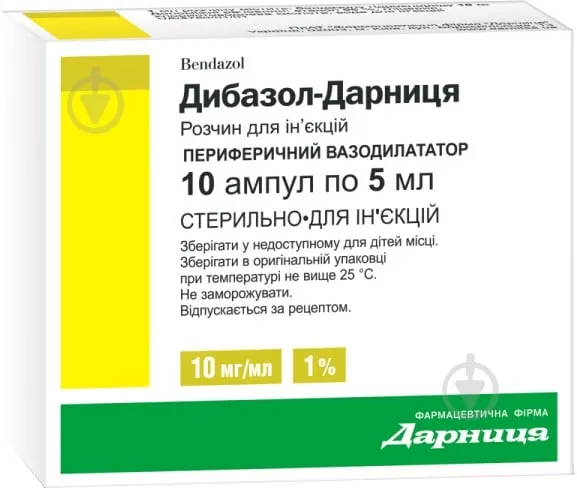
Table of Contents
INSTRUCTIONS FOR MEDICAL USE OF THE MEDICINAL PRODUCT Dibazol-Darnitsa (Dibazol-Darnitsa)
Composition:
Active substance: bendazol;
1 ml of solution contains bendazole hydrochloride 10 mg;
Excipients: ethanol 96%, glycerol, hydrochloric acid, water for injections.
Pharmaceutical form. Injection solution.
Main physicochemical properties: clear colorless liquid, or with a slightly yellowish or greenish tint.
Pharmacotherapeutic group. Peripheral vasodilators. ATC code C04AX.
Pharmacological Properties
Pharmacodynamics
A vasodilating and spasmolytic agent. Has hypotensive and vasodilating effects, stimulates spinal cord function, and exhibits moderate immunostimulatory activity.
Exerts a direct spasmolytic effect on smooth muscles of blood vessels and internal organs. The medicinal product produces a short-term (2–3 hours) and moderate hypotensive effect and is well tolerated. Causes transient dilation of cerebral vessels in chronic brain hypoxia due to local circulatory disturbances (cerebral arterial sclerosis). Facilitates synaptic transmission in the spinal cord. Possesses immunomodulatory activity. By regulating the balance between cyclic guanosine monophosphate (cGMP) and cyclic adenosine monophosphate (cAMP) concentrations in immune cells, it increases cGMP levels, thereby promoting proliferation of mature sensitized T- and B-lymphocytes, secretion of mutual regulatory factors, cooperative reactions, and activation of the final effector functions of cells. The medicinal product stimulates antibody production, enhances phagocytic activity of leukocytes and macrophages, improves interferon synthesis; however, the immunomodulatory effect develops gradually.
Pharmacokinetics
After intramuscular administration, the drug rapidly enters the systemic circulation. Maximum blood concentration is reached within 15–30 minutes after administration. Duration of action: 2–3 hours. Metabolized in the liver.
The biotransformation products of dibazol are two conjugates formed as a result of methylation and carboethoxylation of the imino group of the imidazole ring of dibazol: 1-methyl-2-benzylbenzimidazole and 1-carboethoxy-2-benzylbenzimidazole.
Metabolites are excreted predominantly in urine.
Clinical characteristics.
Indications.
As an adjunct in vascular spasms (exacerbations of hypertensive disease, hypertensive crises) and smooth muscle spasms of internal organs (spasms of the gastric pylorus, intestines); in the treatment of nervous system disorders (mainly residual effects of poliomyelitis, peripheral facial nerve paralysis, polyneuritis).
Contraindications.
Hypersensitivity to bendazole hydrochloride or to any of the excipients of the medicinal product. Conditions characterized by reduced muscle tone, convulsive syndrome, severe heart failure. Hypotension. Chronic nephritis with edema and impaired renal nitrogen excretory function. Bleeding gastric and duodenal ulcers. Diabetes mellitus.
Interaction with other medicinal products and other forms of interaction.
If the patient is taking any other medications, consultation with a physician is mandatory regarding the possibility of using this medicinal product.
Papaverine hydrochloride, theobromine, and salusin – when used in combination with dibazol, the pharmacological action spectrum of papaverine hydrochloride, theobromine, and salusin is expanded.
Barbiturates – when used in combination with dibazol, the efficacy of long-acting barbiturates, particularly phenobarbital, is enhanced.
Phentolamine, antihypertensive agents (drugs affecting the renin-angiotensin system), and saluretics – when used in combination with dibazol, the hypotensive effect is enhanced.
β-blockers – when used in combination with dibazol, the hypotensive effect of the latter remains unchanged; however, with prolonged use, dibazol prevents the increase in total peripheral resistance caused by β-blockers.
Special precautions for use
Consult a physician before starting treatment!
Dibazol-Darnitsya in the form of injections is an auxiliary agent used in arterial hypertension when sensitive to other antihypertensive agents. In the treatment of arterial hypertension, it is recommended to combine it with other antihypertensive drugs.
Prolonged use of Dibazol-Darnitsya as an antihypertensive agent in elderly patients is not advisable due to the possible worsening of ECG parameters and reduction of cardiac output.
Long-term use for the treatment of arterial hypertension is not recommended, especially in elderly patients.
Important information about excipients
This medicinal product contains a small amount of ethanol (alcohol), less than 100 mg/dose.
Use during pregnancy or breastfeeding
Do not use this medicinal product during pregnancy or breastfeeding.
Ability to influence reaction rate when driving or operating machinery
During treatment, caution should be exercised when driving vehicles or operating complex machinery. If dizziness occurs, avoid potentially hazardous activities requiring increased attention and rapid psychomotor reactions.
Dosage and Administration
For adults and children aged 12 years and older, Dibazol-Darnitsia should be administered intravenously, intramuscularly, or subcutaneously. To manage hypertensive crises, administer 3–5 ml of a 1% solution (30–50 mg) intravenously or intramuscularly. In cases of significant increase in arterial pressure, intramuscular administration of 2–3 ml of a 1% solution (20–30 mg) 2–3 times daily is recommended. The duration of treatment is determined individually by a physician; on average, 8–14 days.
Children
The drug is contraindicated for children under 12 years of age.
Overdose.
Symptoms: hypotension, sweating, sensation of warmth, dizziness, nausea, mild headache; symptoms rapidly resolve after discontinuation of the drug.
Treatment: Discontinue the drug. In cases of pronounced hypotension, while monitoring arterial pressure, administer transfusion therapy, vasoconstrictive agents, and cardiac glycosides. Further treatment is symptomatic.
Adverse Reactions.
Respiratory system, thoracic and mediastinal disorders: dry cough, nasal congestion, dyspnea.
Gastrointestinal disorders: nausea, heartburn.
Nervous system disorders: dizziness, headache.
Cardiovascular system disorders: palpitations, chest pain; with prolonged use – worsening of ECG parameters due to decreased cardiac output; hypotension.
Immune system disorders: pruritus, hyperemia, rash, urticaria.
General disorders: sensation of heat, increased sweating, facial flushing.
Administration site reactions: local pain, changes at the injection site.
Reporting of suspected adverse reactions.
Reporting of suspected adverse reactions after drug registration is an important procedure. It allows continuous monitoring of the benefit-risk balance of the medicinal product. Healthcare professionals should report any suspected adverse reactions through the national reporting system.
Shelf life. 4 years.
Storage conditions.
Store in the original packaging at a temperature not exceeding 25 °C. Do not freeze.
Keep out of reach of children.
Incompatibility.
Dibazol-Darnitsya is incompatible with salicylates and benzoates, as precipitation of dibazol salicylate or benzoate may occur.
Packaging.
1 ml or 5 ml in an ampoule; 5 ampoules in a blister pack; 2 blister packs in a carton.
Prescription category. Prescription only.
Manufacturer. JSC "Pharmaceutical Company "Darnitsya".
Manufacturer's address and location of business activity.
13, Borispilska Street, Kyiv, 02093, Ukraine.