Ducressa
Ukraine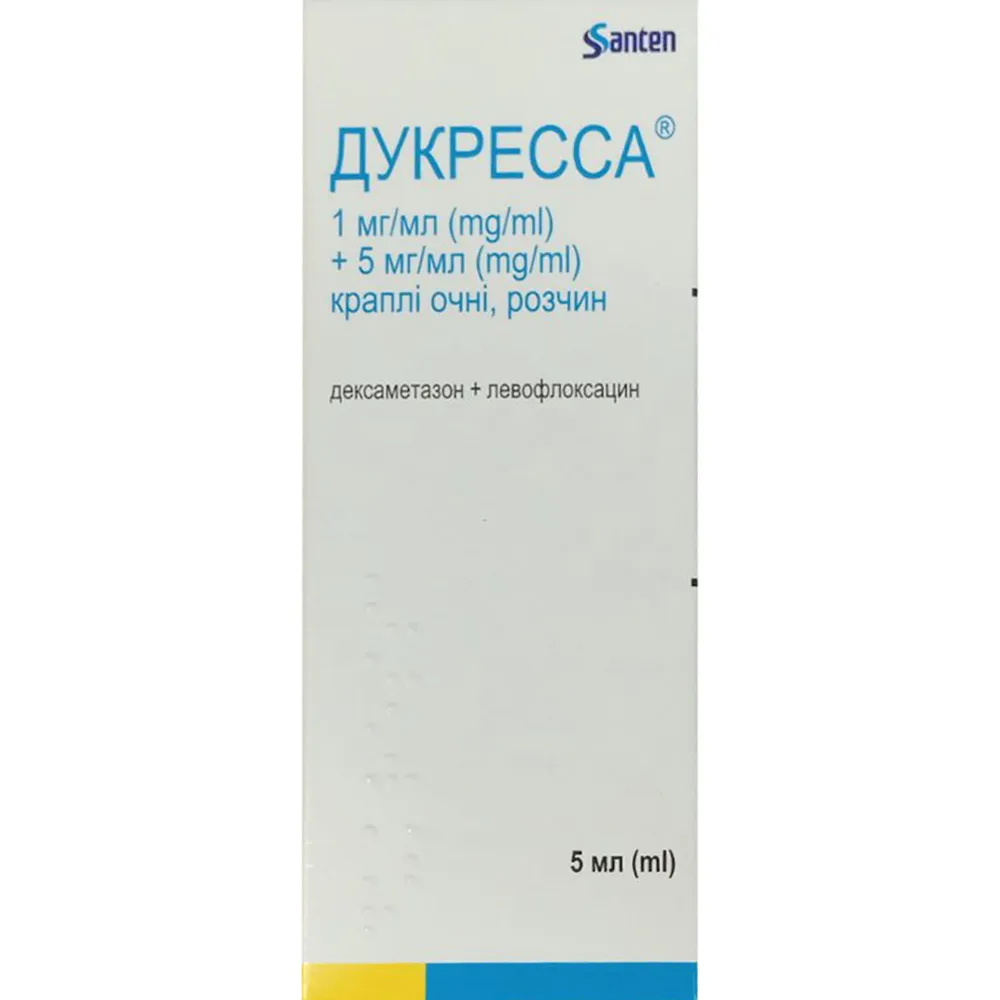
Table of Contents
INSTRUCTIONS FOR MEDICAL USE OF THE MEDICINAL PRODUCT DUCRESSA® (DUCRESSA®)
Composition:
Active substances: levofloxacin, dexamethasone;
1 ml of ophthalmic solution contains dexamethasone (as dexamethasone sodium phosphate) 1 mg and levofloxacin (as levofloxacin hemihydrate) 5 mg;
Excipients: sodium dihydrogen phosphate monohydrate; disodium hydrogen phosphate dodecahydrate; sodium citrate; benzalkonium chloride (50 % solution); sodium hydroxide / hydrochloric acid diluted; water for injections.
1 drop (approximately 30 µl) contains approximately 0.03 mg dexamethasone and 0.150 mg levofloxacin.
Pharmaceutical form. Eye drops, solution.
Main physicochemical properties: clear greenish-yellow solution, free from particles; pH 7.0–7.4; osmolarity 270–330 mOsm/kg. Individual drops appear clear and colorless.
Pharmacotherapeutic group. Ophthalmological agents. Anti-inflammatory and antibacterial agents in combination. Corticosteroids and antibacterial agents in combination. Dexamethasone and antibacterial agents.
ATC code S01C A01.
Pharmacological properties.
Pharmacodynamics.
Levofloxacin
Mechanism of action
Levofloxacin, the active L-isomer of ofloxacin, is a fluoroquinolone antibacterial agent that inhibits the activity of bacterial type II topoisomerases—DNA gyrase and topoisomerase IV. The action of levofloxacin in Gram-negative bacteria is directed primarily against DNA gyrase, while in Gram-positive bacteria it targets topoisomerase IV. The spectrum of activity against pathogens causing ocular diseases includes aerobic Gram-positive microorganisms (e.g., S. aureus MSSA, S. pyogenes, S. pneumoniae, Streptococcus viridans group), aerobic Gram-negative bacteria (e.g., E. coli, H. influenzae, M. catarrhalis, isolates of P. aeruginosa group), and other organisms (e.g., Chlamydia trachomatis).
Mechanisms of resistance development
There are two main mechanisms of bacterial resistance to levofloxacin: reduced intracellular concentration of the drug and alterations in the target enzymes. These changes arise due to mutations in chromosomal genes encoding DNA gyrase (gyrA and gyrB) and topoisomerase IV (parC and parE; grlA and grlB in Staphylococcus aureus). Causes of resistance due to reduced intracellular drug concentration include alterations in outer membrane porins (OmpF), which reduce the ability of fluoroquinolones to penetrate into Gram-negative bacteria, or efflux pumps. Efflux-mediated resistance has been described in pneumococci (PmrA), staphylococci (NorA), anaerobic, and Gram-negative bacteria. In addition, plasmid-mediated resistance to quinolones (mediated by the qnr gene) has been reported in Klebsiella pneumoniae and E. coli.
Cross-resistance
Cross-resistance among fluoroquinolones may occur. A single mutation does not lead to clinical resistance, but multiple mutations usually result in clinical resistance to all agents in the fluoroquinolone class. Alterations in outer membrane porins and efflux systems may have broad substrate specificity, affect multiple classes of antibacterial agents, and lead to the development of multidrug resistance.
Interpretive criteria for susceptibility testing
Interpretive criteria are not available.
Dexamethasone
Mechanism of action
Corticosteroids such as dexamethasone exert anti-inflammatory effects by suppressing endothelial vascular adhesion molecules, cyclooxygenase I and II, and cytokine expression. As a result, the expression of inflammatory mediators is reduced and leukocyte adhesion to vascular endothelium is inhibited, thereby preventing their migration into inflamed ocular tissues. Dexamethasone has potent anti-inflammatory activity with reduced mineralocorticoid effects compared to some other steroids and is one of the most potent anti-inflammatory agents available.
Clinical efficacy
The use of DUKESSA® was evaluated in a controlled clinical trial to confirm its non-inferiority compared to standard therapy with commercially available tobramycin (0.5%) and dexamethasone (0.1%) ophthalmic drops for the prevention and treatment of inflammation and prevention of infections associated with cataract surgery in adults. The investigator responsible for assessing study parameters was masked to the treatment assignment. Patients who underwent uncomplicated cataract surgery were administered DUKESSA® ophthalmic drops, one drop four times daily for 7 days, followed by 0.1% dexamethasone ophthalmic drops, one drop four times daily for another 7 days, or the comparator tobramycin + dexamethasone ophthalmic drops, one drop four times daily for 14 days.
Efficacy data were obtained from 395 patients who received DUKESSA® and 393 patients who received the comparator treatment after cataract surgery. At the end of the 14-day treatment period, the proportion of patients without signs of inflammation (primary endpoint) was 95.19% in the DUKESSA® and dexamethasone group compared to 94.91% in the tobramycin + dexamethasone group. The difference between the two groups was 0.0028 (95% CI: [-0.0275; 0.0331]), indicating no difference in efficacy between the two treatment regimens. No cases of endophthalmitis were reported in either group during the study. Absence of anterior chamber inflammation was observed in 73.16% of patients on day 4 and in 85.57% on day 8 in the DUKESSA® group, compared to 76.84% on day 4 and 86.77% on day 8 in the tobramycin + dexamethasone group. Conjunctival hyperemia resolved by day 4 in 85.75% of patients in the DUKESSA® group compared to 82.19% in the tobramycin + dexamethasone group. The safety profile was similar in both groups.
Children
The European Medicines Agency has waived the obligation to submit results of safety and efficacy studies of DUKESSA® for the prevention and treatment of inflammation and prevention of infections associated with cataract surgery in all pediatric subpopulations (for information on pediatric use, see section "Dosage and administration").
Pharmacokinetics
Instillation of DUKESSA® into the eye leads to absorption of both active substances into ocular tissues and to a much lesser extent into systemic circulation.
After ocular instillation in rabbits, plasma concentrations of levofloxacin increase with increasing dose following single or multiple administrations. Low plasma levels of dexamethasone sodium phosphate are detected. Dexamethasone sodium phosphate is rapidly metabolized in vivo to dexamethasone, which is the active metabolite. Serum concentrations of dexamethasone increase with dose, and slight accumulation of both levofloxacin and dexamethasone is observed after repeated dosing. Levels of levofloxacin and dexamethasone in ocular tissues (aqueous humor, cornea, and conjunctiva) after single and repeated instillations are higher than the maximum plasma concentration. In particular, after 28 days of treatment, levofloxacin and dexamethasone levels in ocular tissues are 50–100 times and 3–4 times higher, respectively, than the Cmax in blood plasma. One hundred twenty-five patients who underwent cataract surgery were randomly assigned to three treatment groups: levofloxacin, dexamethasone, and DUKESSA®. One drop of each medication was instilled 90 and 60 minutes prior to limbal paracentesis. The mean observed levofloxacin concentration was 711.899 ng/mL (95% CI: 595.538; 828.260) in the DUKESSA® group compared to 777.307 ng/mL (95% CI: 617.220; 937.394) with levofloxacin monotherapy. Levofloxacin concentrations in aqueous humor were significantly higher than the minimum inhibitory concentrations for ocular pathogens within the spectrum of levofloxacin activity.
When DUKESSA® was administered, dexamethasone concentration reached 11.774 ng/mL (95% CI: 9.812; 13.736), compared to 16.483 ng/mL (95% CI: 13.736; 18.838) with dexamethasone monotherapy. Both levofloxacin and dexamethasone are excreted in urine.
Clinical characteristics.
Indications.
The medicinal product DUKESSA®, eye drops, solution, is indicated for the prophylaxis and treatment of inflammation and prophylaxis of infections associated with cataract surgery in adults.
Consideration should be given to obtaining official recommendations regarding appropriate use of antibacterial agents.
Contraindications.
- Hypersensitivity to the active substances: levofloxacin (or other quinolones) and dexamethasone (or other steroids) – or to any of the excipients.
- Simplex herpes, keratitis, varicella, smallpox, and other viral diseases of the cornea and conjunctiva.
- Mycobacterial infections of the eye caused, in particular, by acid-fast bacteria such as Mycobacterium tuberculosis, Mycobacterium leprae, or Mycobacterium avium.
- Fungal infections of ocular structures.
- Untreated purulent eye infection.
- Corneal perforation.
Interaction with other medicinal products and other forms of interactions.
No interaction studies have been conducted.
Since maximum plasma concentrations of levofloxacin and dexamethasone after ocular administration are at least 1000 times lower than those reported after standard oral doses, interaction with other systemically used medicinal products is unlikely to be clinically significant.
Concomitant administration of probenecid, cimetidine, or cyclosporine with levofloxacin has altered some pharmacokinetic parameters of levofloxacin, but not to a clinically significant extent.
Concomitant use of topical steroids and topical NSAIDs may increase the risk of corneal healing problems.
CYP3A4 inhibitors (including ritonavir and cobicistat) may reduce dexamethasone clearance, leading to enhanced effect. This combination should be avoided unless the benefit outweighs the increased risk of systemic corticosteroid side effects, and in such cases, patients should be monitored to prevent the occurrence of systemic corticosteroid effects.
Special precautions for use.
Ocular effects
The medicinal product DURESSA® is intended for topical ophthalmic use only. DURESSA® must not be administered subconjunctivally. The solution should not be injected directly into the anterior chamber of the eye.
Prolonged use may lead to antibiotic resistance due to overgrowth of non-susceptible organisms, including fungi. If infection develops, treatment should be discontinued and alternative therapy initiated. In all cases where clinical judgment requires, patients should be examined using, for example, slit-lamp biomicroscopy and, when appropriate, fluorescein staining.
Prolonged use of topical ophthalmic corticosteroids may lead to ocular hypertension/glaucoma; however, this is unlikely with DURESSA® when used for the recommended treatment duration (7 days). Nevertheless, intraocular pressure should be monitored frequently. The risk of corticosteroid-induced elevation of intraocular pressure is increased in patients with risk factors (e.g., diabetes mellitus).
Visual disturbances may occur with both systemic and topical use of corticosteroids. If a patient develops symptoms such as blurred vision or other visual disturbances, they should be referred to an ophthalmologist for evaluation of possible causes, which may include post-cataract surgery complications, glaucoma, or rare conditions such as central serous chorioretinopathy (CSCR), which has been reported following both systemic and topical corticosteroid use.
Topical ophthalmic corticosteroids may delay healing of corneal wounds. It is also known that topical ophthalmic nonsteroidal anti-inflammatory drugs (NSAIDs) may slow or delay healing. Concomitant use of topical NSAIDs and ocular corticosteroids may increase the risk of healing complications.
Corneal or scleral perforations have been reported with topical corticosteroids in patients with diseases causing thinning of the cornea or sclera.
Systemic effects
Fluoroquinolones have been associated with hypersensitivity reactions even after a single dose. If an allergic reaction to levofloxacin occurs, the drug should be discontinued immediately.
With systemic fluoroquinolone therapy, including levofloxacin, tendon inflammation and tendon rupture may occur, particularly in elderly patients and in those receiving concomitant corticosteroid therapy. Therefore, caution is advised at the first signs of tendon inflammation, and treatment with DURESSA® should be discontinued (see section "Adverse reactions").
Cushing's syndrome and/or adrenal suppression due to systemic absorption of ocular dexamethasone may occur in susceptible patients after intensive or prolonged therapy, including children and patients receiving CYP3A4 inhibitors (including ritonavir and cobicistat). In such cases, treatment should be tapered gradually.
Effects on the immune system
Prolonged use may also lead to secondary ocular bacterial, viral, or fungal infections (typically observed within 2 weeks of starting treatment) due to suppression of the immune response or delayed recovery. In addition, topical ocular corticosteroids may promote, exacerbate, or mask signs and symptoms of ocular infections caused by opportunistic microorganisms. With short-term corticosteroid treatment, such as with DURESSA®, the occurrence of such conditions is limited.
Excipients
Benzalkonium chloride
Benzalkonium chloride has been reported to cause ocular irritation, dry eye, and may affect the tear film and corneal surface. It should be used with caution in patients with dry eye or in those with potentially damaged corneal surfaces. Patients should be monitored during prolonged use.
After cataract surgery, patients should not wear contact lenses throughout the entire treatment period with DURESSA®.
Use during pregnancy or breastfeeding.
Pregnancy
Data on the use of dexamethasone and levofloxacin in pregnant women are lacking or limited.
Corticosteroids cross the placenta. Prolonged or repeated use of corticosteroids during pregnancy has been associated with an increased risk of intrauterine growth retardation, low birth weight, and risks of hypertension, vascular disorders, and insulin resistance in adult life. Infants born to mothers who received significant doses of corticosteroids during pregnancy should be carefully monitored for signs of hypoadrenalism. Animal studies with corticosteroids have shown reproductive toxicity and teratogenic effects.
Since a relevant systemic effect of corticosteroids after ocular administration cannot be excluded, treatment with DURESSA® is not recommended during pregnancy, especially during the first trimester, and should only be used after careful risk-benefit assessment.
Breastfeeding
Systemic corticosteroids and levofloxacin are excreted in breast milk. There are no data on whether significant amounts of dexamethasone are excreted in breast milk or whether it may clinically affect the infant. A risk to the breastfed infant cannot be excluded. A decision should be made whether to discontinue breastfeeding or to discontinue/abstain from treatment with DURESSA®, taking into account the benefits of breastfeeding for the child and the benefits of therapy for the woman.
Fertility
Systemic use of corticosteroids may alter male and female fertility by affecting hypothalamic and pituitary hormone secretion as well as gametogenesis in testes and ovaries. It is unknown whether ocular administration of dexamethasone reduces human fertility.
Levofloxacin did not impair fertility in rats at exposures significantly exceeding the maximum human exposure following ocular administration.
Ability to affect reaction speed when driving or operating machinery.
As with any ophthalmic drops, transient blurred vision or other visual disturbances may affect the ability to drive or operate machinery. If blurred vision occurs, patients should wait until vision clears before driving or operating machinery.
Method of Administration and Dosage
Dosing
Instill 1 drop into the conjunctival sac of the eye after surgery every 6 hours. The duration of treatment is 7 days. Do not discontinue treatment prematurely.
If a dose is missed, continue treatment with the next scheduled dose.
It is recommended to repeat patient examination to assess the need for continuing corticosteroid eye drops as monotherapy after completion of the one-week treatment course with DUCRESSA® eye drops. The duration of such therapy may depend on the presence of risk factors and surgical outcomes, and should be determined by the physician based on slit-lamp microscopic examination and the severity of the clinical condition. Further treatment with steroid eye drops should not exceed 2 weeks. However, care must be taken to ensure that treatment is not discontinued prematurely.
Geriatric Patients
Dose adjustment in elderly patients is not required.
Renal/Hepatic Impairment
The use of DUCRESSA® in patients with renal or hepatic impairment has not been studied; therefore, this medicinal product should be used with caution in such patients.
Route of Administration
For ophthalmic use only.
Instill 1 drop of the preparation into the lateral canthus of the eye, while simultaneously applying pressure to the medial canthus to prevent leakage of the drops.
Patients should be instructed to wash their hands before instillation and to avoid contact between the tip of the bottle and the eyes or surrounding tissues, as this may lead to eye injury.
Patients should also be advised that ophthalmic solutions may become contaminated with common bacteria causing ocular infections if used improperly. Use of contaminated solutions may result in serious eye damage and potential loss of vision.
Occlusion of the nasolacrimal duct by applying pressure to the tear ducts may reduce systemic absorption.
If concomitant therapy with other ophthalmic drops is required, instillations should be administered at 15-minute intervals.
Children
The safety and efficacy of DUCRESSA® in children (under 18 years of age) have not been established. Data are lacking.
DUCRESSA® is not recommended for use in children (under 18 years of age).
Overdose
The total amount of levofloxacin and dexamethasone sodium phosphate in the DUCRESSA® bottle is too small to cause toxic effects following accidental oral ingestion.
In case of local overdose, discontinue treatment. If prolonged irritation occurs, rinse the eye(s) with sterile water.
Symptoms following accidental oral ingestion are unknown. The physician may consider the need for gastric lavage or induction of emesis.
Adverse reactions.
Summary of safety profile
A total of 438 patients were treated with DUKESSA® in clinical studies. No serious adverse reactions were reported. The most frequently reported adverse reactions were non-serious events – eye irritation, ocular hypertension, and headache.
Tabulated list of adverse reactions
The following adverse reactions were observed during clinical trials in patients following cataract surgery (within each frequency group, adverse reactions are listed in order of decreasing frequency).
The frequency of adverse reactions listed below is defined according to the following categories:
Very common: ≥ 1/10
Common: ≥ 1/100 to < 1/10
Uncommon: ≥ 1/1,000 to < 1/100
Rare: ≥ 1/10,000 to < 1/1,000
Very rare: ≤ 1/10,000
Not known: cannot be estimated from the available data
Table 1
DUKESSA® (levofloxacin/dexamethasone combination)
| System organ class |
Frequency |
Adverse reactions |
| Nervous system disorders |
Uncommon |
Headache, dysgeusia. |
| Eye disorders |
Uncommon |
Eye irritation, abnormal sensation in eye, ocular hypertension. |
| Skin and subcutaneous tissue disorders |
Uncommon |
Skin itching. |
| Investigations |
Uncommon |
Intraocular pressure increased*. |
| *Measurement > 6 mmHg, indicating a significant increase in intraocular pressure |
||
The adverse reactions observed with either of the ophthalmic active substances (levofloxacin or dexamethasone) that may occur during the use of DUKRESSA® are listed in Tables 2 and 3.
Table 2
Levofloxacin
| System organ class |
Frequency |
Adverse reactions |
| Immune system disorders |
Isolated |
Extraocular allergic reactions, including skin rash. |
| Rare |
Anaphylaxis. |
|
| Nervous system disorders |
Uncommon |
Headache. |
| Eye disorders |
Common |
Burning eyes, decreased vision, and mucus discharge. |
| Uncommon |
Granular eyelid surface, chemosis, conjunctival papillary reaction, eyelid edema, eye discomfort, eye itching, eye pain, conjunctival hyperemia, conjunctival follicles, dry eyes, eyelid erythema, and photophobia. |
|
| Respiratory, thoracic and mediastinal disorders |
Uncommon |
Rhinitis. |
| Rare |
Laryngeal edema. |
Table 3
Dexamethasone
| System organ class |
Frequency |
Adverse reactions |
| Eye disorders |
Very common |
Increased intraocular pressure*. |
| Common |
Discomfort*, irritation*, burning*, stinging*, itching* and blurred vision*. |
|
| Uncommon |
Allergic reactions and hypersensitivity reactions, delayed wound healing, posterior subcapsular cataract*, opportunistic infections, glaucoma*. |
|
| Rare |
Conjunctivitis, mydriasis, ptosis, corticosteroid-induced uveitis, corneal calcification, crystalline keratopathy, changes in corneal thickness*, corneal edema, corneal ulcer, and corneal perforation. |
|
| Skin and subcutaneous tissue disorders |
Rare |
Facial swelling. |
| Endocrine system disorders |
Not known |
Cushing's syndrome, adrenal gland suppression. |
| *See section "Description of selected adverse reactions" |
||
Description of reactions
Increased intraocular pressure
Elevation of intraocular pressure (IOP) and development of glaucoma may occur. Prolonged use of corticosteroids may lead to ocular hypertension/glaucoma (especially in patients with previous steroid-induced elevated IOP or pre-existing high IOP or glaucoma). Children and elderly patients may be particularly susceptible to steroid-induced elevation of IOP (see section "Special precautions"). Patients with diabetes mellitus are also more prone to develop subcapsular cataract after prolonged corticosteroid use.
Postoperative adverse reactions
During clinical trials, ocular disorders (e.g., corneal edema, eye irritation, abnormal sensation in eyes, increased lacrimation, asthenopia, corneal disorder, dry eye, eye pain, eye discomfort, uveitis, blurred vision, visual brightness, conjunctivitis) and nausea were reported. These reactions are generally mild and transient and are considered to be related to the cataract extraction procedure itself.
Potential corneal adverse reactions
In diseases causing corneal thinning, topical use of corticosteroids may rarely lead to corneal perforation (see section "Special precautions").
In some patients with significantly damaged cornea, cases of corneal calcification associated with the use of ophthalmic solutions containing phosphate have been very rarely observed.
Additional adverse reactions observed with prolonged use of levofloxacin and potentially also possible with DUCRESA®
In patients receiving systemic fluorquinolones, tendon ruptures of the shoulder, hand, Achilles tendon, or other tendons have been reported, requiring surgical intervention or resulting in prolonged disability. Post-marketing studies and experience with systemic quinolones indicate that the risk of such tendon ruptures may be increased when corticosteroids are used concomitantly, particularly in elderly patients. There is also an increased risk of tendon ruptures under high physical stress, including Achilles tendon rupture (see section "Special precautions").
Reporting of suspected adverse reactions
It is important to report suspected adverse reactions after marketing authorization of the medicinal product. This enables ongoing monitoring of the benefit-risk balance of the medicinal product. Healthcare professionals are requested to report any suspected adverse reactions via the national reporting system.
Shelf life.
3 years.
Discard 28 days after first opening.
Storage conditions.
Store in the original packaging at a temperature not exceeding 25 °C. Keep out of the reach of children.
Packaging.
5 mL in a bottle with dropper tip and cap. One bottle per cardboard box.
Prescription category.
Prescription only.
Manufacturer.
Santen AT / Santen Oy
Manufacturer's address and place of business.
Kelloportinkatu 1, Tampere, 33100, Finland / Kelloportinkatu 1, Tampere, 33100, Finland