Dorzoptik
Ukraine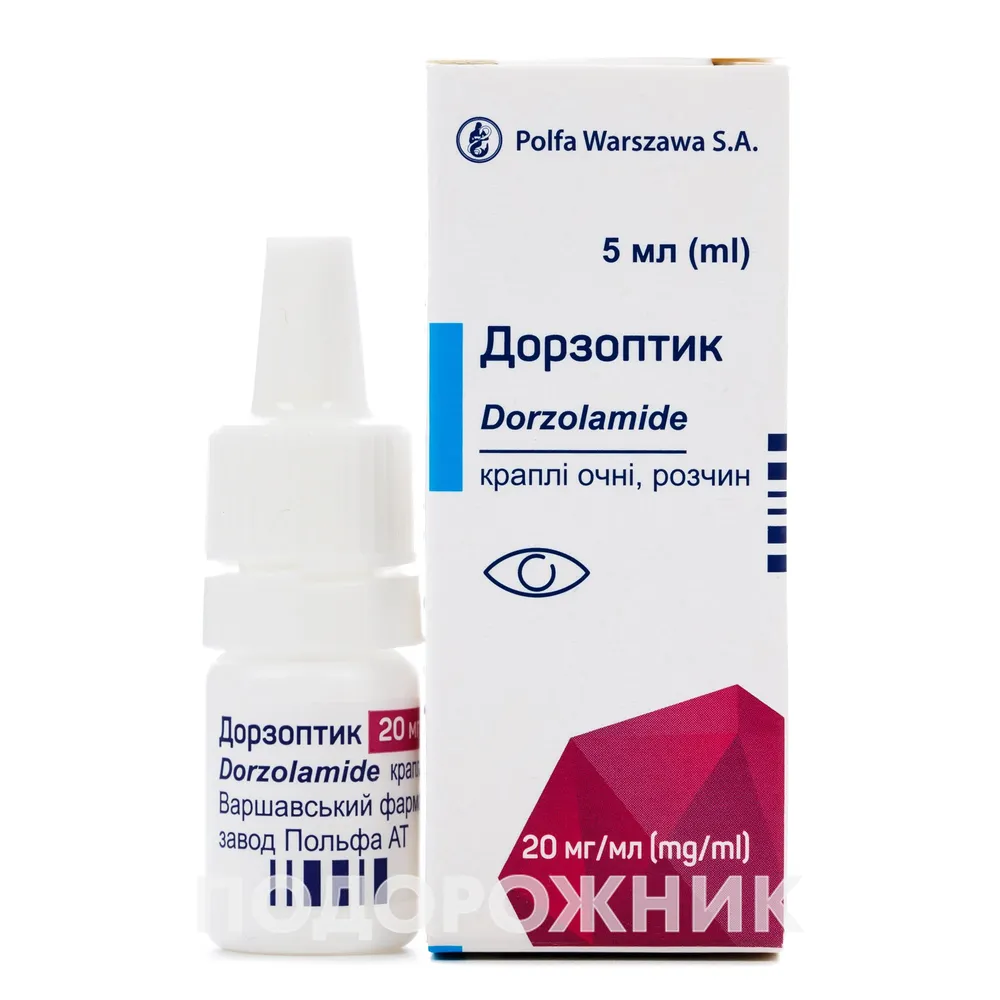
Table of Contents
INSTRUCTION FOR MEDICAL USE OF THE MEDICINAL PRODUCT Dorzoptik
Composition:
Active substance: dorzolamide;
1 ml of solution contains 20 mg of dorzolamide as dorzolamide hydrochloride;
Excipients: mannitol (E 421); hydroxyethylcellulose; sodium citrate dihydrate; sodium hydroxide; benzalkonium chloride, 50 % solution; water for injections.
Pharmaceutical form. Eye drops, solution.
Main physicochemical properties: clear, colorless, slightly viscous liquid.
Pharmacotherapeutic group. Anti-glaucoma agents for topical use. Carbonic anhydrase inhibitors. Dorzolamide. ATC code S01E C03.
Pharmacological Properties.
Pharmacodynamics.
Dorzolamide is a topically administered carbonic anhydrase inhibitor used as ophthalmic drops. Carbonic anhydrase is an enzyme present in many tissues of the body (including ocular tissues) and plays a role in the hydration of carbon dioxide and dehydration of carbonic acid. In humans, this enzyme exists in various isoenzymes, the most active of which is carbonic anhydrase II, primarily found in erythrocytes and later identified in cells of other tissues. Inhibition of carbonic anhydrase in the ciliary body of the eye reduces the secretion of aqueous humor (primarily by decreasing bicarbonate ion formation, followed by reduced transport of sodium ions and fluid).
After topical application, the drug lowers intraocular pressure regardless of whether its elevation is associated with glaucoma.
Dorzolamide reduces intraocular pressure without causing the typical side effects of miotic agents, such as night blindness, accommodative spasm, or pupillary constriction.
Pharmacokinetics.
When applied topically as a 2% ophthalmic solution, dorzolamide reduces elevated intraocular pressure, which is the main risk factor in the pathogenesis of optic nerve damage and glaucomatous visual field loss.
After oral administration, the effect of dorzolamide begins within 60–90 minutes and lasts for 8–12 hours. Dorzolamide enters systemic circulation. With continuous oral administration, dorzolamide accumulates in erythrocytes via selective binding to carbonic anhydrase type II. Very low concentrations of the drug remain in plasma in free form.
Dorzolamide is metabolized to N-desethyl-dorzolamide, which is a weaker inhibitor of carbonic anhydrase II but also inhibits the less active isoenzyme—carbonic anhydrase I. This metabolite accumulates in red blood cells, where it primarily binds to carbonic anhydrase I.
Dorzolamide is moderately bound to plasma proteins (approximately 33%). It is excreted in urine both unchanged (80%) and as metabolites (20%). Release from erythrocytes follows nonlinear kinetics, resulting in an initial rapid decline in concentration, followed by a phase of very slow elimination with a mean elimination half-life of 4 months. At steady state, renal excretion amounts to approximately 1.3 mg per day at a dose of 4 mg, assuming a renal clearance of 90 mL/min.
After oral administration of dorzolamide to simulate maximum systemic effects during prolonged topical use, steady-state concentration is reached after approximately 13 weeks. At steady state, no free form of the drug or its metabolites was detected in plasma. The degree of carbonic anhydrase inhibition in erythrocytes was below the threshold required to produce pharmacological effects on the respiratory system or kidney function.
In elderly patients with renal impairment (creatinine clearance 30–60 mL/min), higher concentrations of the metabolite were found in erythrocytes; however, no significant differences in carbonic anhydrase inhibition or clinically significant adverse effects were observed.
In contrast to oral administration, ophthalmic application allows for a localized effect at lower doses.
After topical ocular administration, carbonic anhydrase activity is inhibited in corneal endothelial cells, ciliary body, lens epithelial cells, and cornea within 1–8 hours after administration. Enzyme activity remains inhibited in cornea and lens epithelial cells even 10 hours after instillation.
Dorzolamide rapidly distributes into ocular tissues. Significant concentrations of dorzolamide appear in ocular tissues (cornea, aqueous humor, iris, ciliary body) within 15 minutes after instillation and reach peak levels approximately 1 hour after administration.
Clinical characteristics.
Indications.
Treatment of elevated intraocular pressure in patients with:
- ocular hypertension;
- open-angle glaucoma;
- pseudoexfoliative glaucoma;
as adjunctive therapy to beta-blockers or as monotherapy when treatment with beta-blockers has not been successful or beta-blockers are contraindicated.
Contraindications.
Hypersensitivity to dorzolamide or to any of the components of the medicinal product.
Severe renal impairment (creatinine clearance less than 30 mL/min).
Hyperchloremic acidosis.
Interaction with other medicinal products and other forms of interaction.
Specific studies on the interaction of dorzolamide with other agents have not been conducted.
In clinical studies, dorzolamide was administered concomitantly with timolol and betaxolol in the form of ophthalmic drops, and with systemically acting drugs: angiotensin-converting enzyme (ACE) inhibitors, calcium channel blockers, diuretics, and nonsteroidal anti-inflammatory drugs (NSAIDs), including acetylsalicylic acid, as well as with hormonal agents (e.g., estrogens, insulin, thyroxine), without the occurrence of drug interactions.
The interaction of dorzolamide with miotics and adrenergic agonists during glaucoma treatment has not been sufficiently studied.
Special precautions for use.
The use of Dorzoptic in patients with significant hepatic impairment has not been established (should be used with caution).
In the treatment of patients with acute angle-closure glaucoma, in addition to medications that reduce intraocular pressure, other therapeutic measures should also be applied. The use of dorzolamide in patients with acute angle-closure glaucoma has not been studied.
Dorzolamide contains a sulfonamide group and, although administered topically, undergoes systemic absorption. Therefore, when used as ophthalmic drops, adverse reactions typical of sulfonamides may occur, including Stevens–Johnson syndrome and toxic epidermal necrolysis (Lyell’s syndrome). If serious adverse reactions or signs of hypersensitivity occur, the drug should be discontinued.
The use of oral carbonic anhydrase inhibitors has been associated with the development of urinary tract stones due to water-electrolyte imbalances, particularly in patients with a history of nephrolithiasis. Although water-electrolyte disturbances have not been observed with dorzolamide use, rare cases of ureterolithiasis have been reported. Since dorzolamide is a locally-acting carbonic anhydrase inhibitor that enters systemic circulation, patients with a history of nephrolithiasis belong to a high-risk group for developing ureterolithiasis during dorzolamide treatment.
In patients receiving both oral carbonic anhydrase inhibitors and dorzolamide, there is a potential risk of additive systemic effects. Concomitant use of dorzolamide and oral carbonic anhydrase inhibitors is not recommended.
If allergic reactions occur (e.g., conjunctivitis or eyelid reactions), the drug should be discontinued and medical advice should be sought.
Corneal edema and irreversible corneal decompensation have been reported in patients with pre-existing chronic corneal abnormalities and/or a history of intraocular surgery during dorzolamide treatment. Patients with a low number of endothelial cells have a high likelihood of developing corneal edema. Precautions should be taken when prescribing dorzolamide to such patients.
Cases of choroidal detachment have been observed during the use of agents that suppress aqueous humor production following filtration procedures.
Dorzoptic contains a preservative (benzalkonium chloride) that may cause irritation. Contact with soft contact lenses should be avoided (remove contact lenses before applying the medication and reinsert them 15 minutes after administration). The solution may discolor soft contact lenses.
Use during pregnancy or breastfeeding.
Clinical studies on the safety of dorzolamide use during pregnancy have not been conducted; therefore, the drug is not recommended during pregnancy.
It is unknown whether dorzolamide is excreted in breast milk; therefore, it should not be used during breastfeeding.
Effect on the ability to drive or operate machinery.
No studies on the effect of the drug on the ability to drive or operate machinery have been conducted. Adverse reactions such as dizziness and blurred vision may occur; therefore, during treatment, potentially hazardous activities requiring concentration and rapid psychomotor reactions should be avoided, especially at the beginning of therapy.
Method of Administration and Dosage
In monotherapy, administer 1 drop into the affected eye 3 times daily.
In combination with beta-adrenergic blockers for topical use, administer 1 drop into the affected eye 2 times daily.
If several topical ophthalmic agents are used, administration of the drugs should be performed with an interval of 10 minutes. When switching from treatment with other ophthalmic drugs to Dorzoptik, discontinue the previous drug after the usual daily dose and start treatment with Dorzoptik the following day.
Patients should be advised to wash their hands thoroughly before use and not to touch the eye or surrounding surfaces with the dropper tip.
Patients should also be informed that improper handling of eye drops may result in bacterial contamination of the solution, which may lead to eye infections. Use of a contaminated solution may cause severe eye damage and subsequent vision loss.
If nasolacrimal occlusion is applied or eyelids are closed for 2 minutes, systemic absorption is reduced. This may help reduce systemic adverse effects and increase local activity.
Instructions for Use:
- Wash hands thoroughly before using the medication.
- Unscrew the cap from the bottle.
- Tilt the head backward and pull down the lower eyelid to create a space between the eyelid and the eyeball.
- Turn the bottle upside down, gently squeeze the sides with index and thumb fingers to instill 1 drop into the conjunctival sac. Do not touch the eye surface or surrounding tissues with the dropper tip. If the drop did not enter the conjunctival sac, administer another drop.
- If the physician has prescribed the medication for the other eye, repeat steps 3–4.
- The dispenser tip is designed to deliver exactly 1 drop; therefore, do not enlarge the opening of the dispenser.
- After instillation, screw the cap back on the bottle, but do not tighten it excessively.
Children
Not recommended for use in children.
Overdose
Limited data are available on overdose with accidental or intentional oral ingestion of dorzolamide hydrochloride.
Symptoms
Somnolence has been reported after oral ingestion. With topical administration, nausea, dizziness, headache, weakness, unusual dreams, and dysphagia (difficulty swallowing) have been observed.
Treatment
Treatment is symptomatic and supportive. Electrolyte imbalance and development of acidosis are possible, as well as central nervous system disturbances. Serum electrolyte levels (especially potassium) and blood pH should be monitored.
Adverse reactions.
From the nervous system: headache; dizziness, paraesthesia.
Cardiac disorders: palpitations. Frequency unknown: tachycardia.
Vascular disorders: Frequency unknown: hypertension.
Eye disorders: stinging and burning, superficial punctate keratitis, lacrimation, conjunctivitis, eyelid inflammation, eye itching, eyelid irritation, blurred vision, blepharitis, iridocyclitis, irritation and redness, eye pain, eyelid peeling, transient myopia (which resolves after discontinuation of treatment), corneal edema, ocular hypotony, uveitis following filtration surgery.
Frequency unknown: sensation of foreign body in the eyes.
Respiratory, thoracic and mediastinal disorders: epistaxis, sinusitis, rhinitis.
Frequency unknown: dyspnea.
Gastrointestinal disorders: nausea, bitter taste in the mouth, throat irritation, dry mouth.
Skin and subcutaneous tissue disorders: contact dermatitis, Stevens-Johnson syndrome, toxic epidermal necrolysis.
Renal and urinary disorders: urolithiasis.
General disorders and administration site reactions: asthenia/fatigue, hypersensitivity symptoms: local-palpebral reactions, systemic angioneurotic edema, urticaria, pruritus, rash, anaphylaxis, rarely – bronchospasm.
Laboratory test results: dorzolamide use has not been associated with clinically significant disturbances in electrolyte levels.
Shelf life.
2 years. Do not use after the expiry date stated on the packaging.
The shelf life of the medicinal product after first opening is 4 weeks.
Storage conditions.
Store in the original packaging at a temperature not exceeding 25 °C.
Keep out of the reach of children.
Packaging.
5 mL of the medicinal product in a 5 mL polyethylene dropper bottle with a cap equipped with a tamper-evident ring. One bottle per cardboard box.
Prescription category. Prescription only.
Manufacturer.
Rafarm S.A.
Rafarm S.A.
Manufacturer's address and place of business.
Thesi Pousi Xatzi Agiou Louka, Paiania, 190 02, Greece