Doritricin®
Ukraine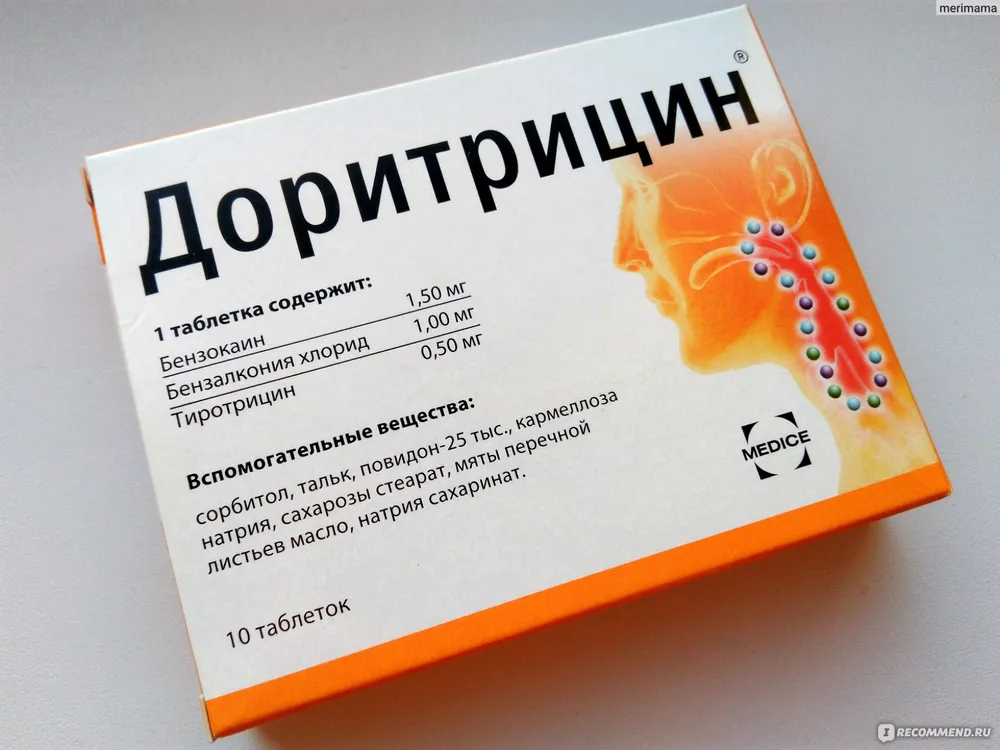
Table of Contents
INSTRUCTIONS FOR MEDICAL USE OF THE MEDICINAL PRODUCT DORITHRICIN® (DORITHRICIN®)
Composition:
Active substances: tyrothricin; benzocaine; benzalkonium chloride.
Each tablet contains 0.5 mg of tyrothricin, 1.5 mg of benzocaine, and 1 mg of benzalkonium chloride;
Excipients: sorbitol (E 420), talc, sucrose stearate Type 3, sodium saccharin, peppermint oil, povidone K25, sodium carboxymethylcellulose.
Dosage form. Effervescent tablets for oral administration.
Main physicochemical properties: white, round, biconvex tablets with a smooth surface, beveled edges, and the inscription "DORITHRICIN" on one side, with an odour resembling peppermint oil.
Pharmacotherapeutic group. Medicinal products for treatment of throat disorders.
ATC code R02A A20.
Pharmacological properties.
Pharmacodynamics.
The local antibiotic tyrothricin is a mixture of peptides containing 80% tyrocidines and 20% gramicidines. Tyrocidines initially inhibit the transport of nutrients across the bacterial membrane and ultimately induce lysis. As a result of impaired oxidative phosphorylation, bacterial energy metabolism ceases. When applied locally, tyrothricin enhances granulation and epithelialization.
Benzoic acid is a lipophilic local anesthetic agent (ethyl ester of para-aminobenzoic acid).
Benzalkonium chloride is a mixture of quaternary ammonium compounds with high surface activity and a broad spectrum of antimicrobial action, including both gram-positive and gram-negative bacteria. When applied locally, benzalkonium chloride is well tolerated and does not demonstrate cross-resistance with other antibiotics.
Pharmacokinetics.
Tyrothricin is not absorbed and therefore does not exert systemic effects in the gastrointestinal tract. Thus, damage to intestinal flora is excluded.
Benzoic acid is metabolized via hydrolysis to para-aminobenzoic acid. After administration of doses of 1.5–5 mg, the duration of action is approximately 3 hours.
Benzalkonium chloride—compounds of this class are poorly absorbed and very rapidly eliminated by the liver and kidneys; therefore, systemic effects can be excluded with proper use.
Clinical characteristics.
Indications.
For symptomatic treatment of oropharyngeal infection accompanied by sore throat and dysphagia.
Contraindications.
Hypersensitivity to the active substances or to any of the excipients of the medicinal product.
Interaction with other medicinal products and other forms of interactions.
There are no data available on interactions when used correctly.
Special precautions for use.
Information for diabetic patients: 1 tablet contains 870.925 mg of sorbitol.
The amount of the sugar substitute – sorbitol – contained in 1 tablet is equivalent to ≈ 0.07 bread units.
Doritricin®, effervescent tablets, should not be used in patients with hereditary intolerance to sorbitol or fructose.
In patients with a predisposition to skin allergic reactions (so-called allergic contact eczema), there is a possibility of increased sensitivity.
In all cases of purulent tonsillitis accompanied by fever, the physician must decide on an individual basis whether Doritricin® tablets should be used as an adjunct to first-line agents, such as systemic antibiotics.
Patients with severe pharyngitis and sore throat associated with high fever, headache, nausea, and vomiting should not use Doritricin®, effervescent tablets, for longer than 2 days without medical advice.
Tyrothricin does not cause tissue damage and is generally well tolerated when used locally at therapeutic doses. However, since tyrothricin has significant toxic potential when administered parenterally, it should not be applied locally in the presence of fresh, relatively large wounds in the oral cavity and pharynx.
Benzoic acid may cause methemoglobinemia if a large number of tablets are swallowed.
Benzalkonium chloride is non-toxic when used correctly. General intolerance reactions cannot be excluded in individual cases.
Use during pregnancy or breastfeeding.
No teratogenic effects of Doritricin® tablets have been reported to date. Nevertheless, strict adherence to the indications for use should be ensured.
Ability to affect reaction speed when driving or operating machinery.
Doritricin® has no effect or only a negligible effect on the ability to drive or operate machinery.
Method of Administration and Dosage
Doritricin® tablets should be slowly dissolved in the mouth.
Take 1-2 tablets every 2-3 hours for 5-7 days. Treatment should be continued for an additional 1 day after symptoms have disappeared.
Children
Do not use in children under 6 years of age. Since proper administration (dissolving) cannot be ensured in infants and young children, Doritricin® tablets should be administered only to children aged 6 years and older.
Overdose
Symptoms of intoxication. Poisoning with Doritricin® tablets is not possible when used as directed; no cases of intoxication have been reported to date. However, ingestion of a large number of tablets may lead to gastrointestinal symptoms and increased methemoglobin levels (especially in children).
Treatment of intoxication. Measures should be taken to reduce absorption (e.g., administration of activated charcoal, gastric lavage), and, if necessary, therapy to correct methemoglobinemia should be initiated.
Adverse reactions
Adverse effects are listed by frequency of occurrence: very common (≥ 1/10), common (≥ 1/100 to < 1/10), uncommon (≥ 1/1000 to < 1/100), rare (≥ 1/10000 to < 1/1000), very rare (< 1/10000), and not known (cannot be estimated from available data).
Rare
Allergic reactions (on the skin) may occur in isolated cases, particularly to ethyl ester of para-aminobenzoic acid (benzocaine).
Cases of methemoglobinemia may occur following topical application, especially in children or in the presence of sufficiently large wounds.
Frequency not known
In sensitive patients, the product may cause hypersensitivity to para-related compounds (e.g. penicillin, sulfonamides, sunscreen cosmetics, para-aminosalicylic acid).
In appropriately sensitized patients, hypersensitivity reactions (including dyspnea) may be triggered by peppermint oil.
Reporting of adverse reactions
Reporting suspected adverse reactions after authorization of the medicinal product is important. It allows continued monitoring of the benefit-risk balance of the medicinal product. Healthcare professionals are asked to report any suspected adverse reactions through the national reporting system.
Shelf life
3 years.
Do not use the medicinal product after the expiry date.
Storage conditions.
Store at temperatures not exceeding 25 °C in a place inaccessible to children.
Packaging.
10 tablets per blister. 1 or 2 blisters per cardboard box.
Category of supply.
Over-the-counter (without prescription).
Manufacturer
Medice Arzneimittel Pütter GmbH & Co. KG
Manufacturer's address and location of business operations
Kuhloweg 37, 58638 Iserlohn, Germany