Doramycin
Ukraine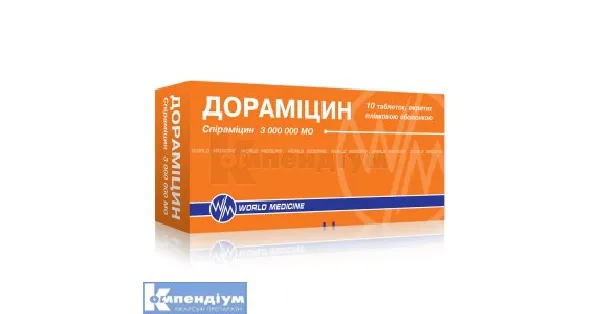
Table of Contents
INSTRUCTIONS FOR MEDICAL USE OF THE MEDICINAL PRODUCT DORAMYCIN (DORAMYCIN)
Composition:
Active substance: spiramycin;
One film-coated tablet contains spiramycin 3,000,000 IU;
Excipients: maize starch, sodium croscarmellose, magnesium stearate, hydroxypropylcellulose, colloidal anhydrous silicon dioxide, microcrystalline cellulose, coating Opadry® II White 85F18422 (partially hydrolyzed polyvinyl alcohol; titanium dioxide (E 171); macrogol 4000; talc).
Pharmaceutical form. Film-coated tablets.
Main physicochemical properties: white or almost white, round, biconvex film-coated tablets with an imprint "DORA" and "3" on one side.
Pharmacotherapeutic group.
Antibacterials for systemic use. Macrolides. ATC code J01FA02.
Pharmacological properties.
Pharmacodynamics.
Spiramycin is a macrolide group antibiotic that exerts a bactericidal effect.
Spectrum of antimicrobial activity.
Critical concentrations allowing differentiation of susceptible microbial species from those with intermediate susceptibility, and the latter from resistant species, are as follows: susceptible < 1 mg/L; resistant > 4 mg/L.
The prevalence of acquired resistance in certain microbial species may vary depending on geographical location and specific time periods. Therefore, it is useful to have local information on resistance prevalence, especially when treating severe infections.
The data provided allow only an estimation of the likelihood of bacterial strain susceptibility to this antibiotic. The prevalence of bacterial species resistance to spiramycin in France is presented in the table below.
| Category |
Prevalence of acquired resistance in France (>10 %) (range) |
| Susceptible species |
|
| Gram-positive aerobes Bacillus cereus Corynebacterium diphtheriae Enterococci Rhodococcus equi Staphylococcus methicillin-susceptible Staphylococcus methicillin-resistant* Streptococcus B Unspecified streptococcus Streptococcus pneumoniae Streptococcus pyogenes |
50–70 % 70–80 % 30–40 % 35–70 % 16–31 % |
| Gram-negative aerobes Bordetella pertussis Branhamella catarrhalis Campylobacter Legionella Moraxella |
|
| Anaerobes Actinomyces Bacteroides Eubacterium Mobiluncus Peptostreptococcus Porphyromonas Prevotella Propionibacterium acnes |
30–60 % 30–40 % |
| Miscellaneous Borrelia burgdorferi Chlamydia Coxiella Leptospira Mycoplasma pneumoniae Treponema pallidum |
|
| Moderately susceptible species (intermediate sensitivity in vitro) |
|
| Gram-negative aerobes Neisseria gonorrhoeae |
|
| Miscellaneous Ureaplasma urealyticum |
|
| Anaerobes Clostridium perfringens |
|
| Resistant species |
|
| Gram-positive aerobes Corynebacterium jeikeium Nocardia asteroides |
|
| Gram-negative aerobes Acinetobacter Enterobacteriaceae Haemophilus Pseudomonas |
|
| Anaerobes Fusobacterium |
|
| Miscellaneous Mycoplasma hominis |
|
* Methicillin resistance prevalence among all staphylococci ranges from 30–50%, and it is typical for hospital inpatient departments.
Spiramycin activity against Toxoplasma gondii has been demonstrated in vitro and in vivo.
Pharmacokinetics.
Absorption.
After oral administration, spiramycin absorption is rapid but incomplete and does not depend on food intake. After a dose of 6,000,000 IU of spiramycin, the maximum plasma concentration reaches 3.3 μg/mL.
Distribution.
The degree of spiramycin binding to plasma proteins is 10%. It does not cross the blood-brain barrier. However, it penetrates into breast milk.
Tissue and saliva distribution is very high (lungs – 20–60 μg/g, tonsils – 20–80 μg/g, infected sinuses – 75–110 μg/g, skeletal bones – 5–100 μg/g).
Ten days after discontinuation of treatment, spiramycin concentration in the spleen, liver, and kidneys ranges from 5 to 7 μg/g.
Macrolides penetrate and accumulate in phagocytes (neutrophils, monocytes, peritoneal and alveolar macrophages). In humans, concentrations within phagocytes are high. These properties provide spiramycin efficacy in treating infections caused by intracellular bacteria.
Metabolism.
Spiramycin metabolism occurs in the liver, resulting in active metabolites whose chemical structure remains unidentified.
Excretion.
The apparent elimination half-life of spiramycin is approximately 8 hours. A large amount is excreted via bile: spiramycin concentration in bile is 15–40 times higher than in plasma; it is excreted in considerable amounts in feces. 10% of the orally administered dose of spiramycin is excreted in urine.
Clinical characteristics.
Indications.
Treatment of infections caused by microorganisms sensitive to spiramycin:
- Confirmed tonsillopharyngitis caused by group A beta-hemolytic streptococci (as an alternative to beta-lactam antibiotic therapy, especially when they cannot be used);
- Acute sinusitis (due to the microbiological characteristics of the infection, macrolide use is indicated when treatment with beta-lactam antibiotics is impossible);
- Superinfection in acute bronchitis;
- Exacerbation of chronic bronchitis;
- Community-acquired pneumonia in patients without risk factors, severe clinical symptoms, or clinical signs suggesting pneumococcal etiology. In suspected atypical pneumonia, macrolide use is appropriate regardless of disease severity or patient history;
- Mild skin infections: impetigo, impetiginization, ecthyma, infectious dermohypodermitis (especially erysipelas), erythrasma;
- Oral cavity infections;
- Nongonococcal genital infections;
- Chemoprophylaxis of recurrent acute rheumatic fever in patients allergic to beta-lactam antibiotics;
- Toxoplasmosis in pregnant women;
- Prophylaxis of meningococcal meningitis in individuals contraindicated for rifampicin:
- for eradication of the microorganism (Neisseria meningitidis) from the nasopharynx;
- as prophylaxis: in patients after treatment and prior to returning to social life; in individuals who had contact with a person with sputum production during the 10 days preceding their hospitalization.
Spiramycin is not intended for the treatment of meningococcal meningitis.
Official recommendations regarding appropriate use of antibacterial agents should be followed.
Contraindications.
-
Hypersensitivity to the active substance and/or to any of the excipients of the medicinal product.
-
Use in patients belonging to the risk group for QT interval prolongation, namely:
-
Patients with personal or family history of congenital QT interval prolongation (except cases where this diagnosis has been excluded by ECG);
-
Patients with QT interval prolongation caused by medicinal products or of metabolic or cardiovascular origin.
-
Concomitant use with medicinal products that cause ventricular tachycardia of the "torsades de pointes" type, such as:
-
Class Ia antiarrhythmics (quinidine, hydroquinidine, disopyramide);
-
Class III antiarrhythmics (amiodarone, sotalol, dofetilide, ibutilide);
-
Sulpiride (a neuroleptic of the benzamide group);
-
Others: arsenic compounds, diphenylamine, intravenous dolasetron, mizolastine, levofloxacin, moxifloxacin, prucalopride, toremifene, intravenous vinca alkaloids, intravenous erythromycin, dronedarone, mequitazine, citalopram, disopyramide, dofetilide, domperidone, escitalopram, hydroquinidine, vandetanib (see section "Interaction with other medicinal products and other types of interactions").
Interaction with other medicinal products and other types of interactions.
Ventricular tachycardia of the "torsades de pointes" type.
This serious cardiac arrhythmia may be caused by certain antiarrhythmic drugs or other medicinal products. Intravenous spiramycin belongs to the group of medicinal products that may cause ventricular tachycardia of the "torsades de pointes" type. Contributing factors include hypokalemia (caused by potassium-depleting diuretics, stimulant laxatives, intravenous amphotericin B, glucocorticoids, tetracosactide), bradycardia, and pre-existing QT interval prolongation, whether congenital or acquired.
Medicinal products affecting QT interval prolongation.
Spiramycin, like other macrolides, should be used with caution in patients receiving medicinal products that prolong the QT interval (e.g., class Ia and III antiarrhythmics, tricyclic antidepressants, certain antibacterial agents, neuroleptics) (see section "Special precautions for use").
Contraindicated combinations.
See section "Contraindications".
Unwanted combinations.
Antiparasitic agents capable of causing ventricular tachycardia of the "torsades de pointes" type (halofantrine, lumefantrine, pentamidine).
Concomitant use of spiramycin with these agents increases the risk of ventricular rhythm disorders, including ventricular tachycardia of the "torsades de pointes" type. If possible, one of the drugs should be discontinued. If combined therapy cannot be avoided, QT interval should be checked beforehand and ECG monitoring should be performed.
Neuroleptics capable of causing ventricular tachycardia of the "torsades de pointes" type (amisulpride, chlorpromazine, tiaramide, droperidol, flupentixol, fluphenazine, haloperidol, levomepromazine, pimozide, pipamperone, pipotiazine, sulpiride, tiapride, zuclopenthixol).
Concomitant use of spiramycin with these agents increases the risk of ventricular rhythm disorders, including ventricular tachycardia of the "torsades de pointes" type.
Methadone.
Concomitant use with spiramycin increases the risk of ventricular rhythm disorders, including ventricular tachycardia of the "torsades de pointes" type.
Combinations requiring special precautions during use.
Beta-blockers in heart failure (bisoprolol, carvedilol, metoprolol, nebivolol), and agents causing bradycardia (e.g., class Ia antiarrhythmics, beta-blockers, certain class III antiarrhythmics, certain calcium antagonists, cardiac glycosides, pilocarpine, anticholinesterase agents (ambenonium, donepezil, galantamine, memantine, neostigmine, pyridostigmine, rivastigmine)).
Concomitant use of spiramycin with these agents increases the risk of ventricular rhythm disorders, including ventricular tachycardia of the "torsades de pointes" type. In case of combined therapy, clinical monitoring and ECG monitoring should be performed.
Agents causing hypokalemia (potassium-depleting diuretics, alone or in combination with other drugs, stimulant laxatives, glucocorticoids, tetracosactide, intravenous amphotericin B).
Concomitant use of spiramycin with these agents increases the risk of ventricular rhythm disorders, including ventricular tachycardia of the "torsades de pointes" type. In case of combined therapy, potassium levels should be corrected prior to administration, and clinical status, electrolyte levels, and ECG parameters should be monitored during treatment.
Azithromycin, clarithromycin, roxithromycin.
Concomitant use of spiramycin with these agents increases the risk of ventricular rhythm disorders, including ventricular tachycardia of the "torsades de pointes" type. In case of combined therapy, clinical monitoring and ECG monitoring should be performed.
Levodopa.
Concomitant use with spiramycin reduces the absorption of carbidopa and decreases plasma concentrations of levodopa. In case of combined therapy, clinical monitoring should be performed and dosage adjustment of levodopa may be necessary.
Hydroxyzine.
Concomitant use with spiramycin increases the risk of ventricular rhythm disorders, including ventricular tachycardia of the "torsades de pointes" type.
Specific warnings regarding imbalance of the International Normalized Ratio (INR).
Numerous cases of increased activity of oral anticoagulants have been reported in patients receiving antibiotic therapy. Severe infection or pronounced inflammatory process, patient age, and general condition are predisposing risk factors. Under these circumstances, it is difficult to determine to what extent the infection itself or its treatment causes INR imbalance. However, certain classes of antibiotics are more likely to cause this imbalance, namely: fluoroquinolones, macrolides, tetracyclines, co-trimoxazole, and certain cephalosporins.
Special precautions for use.
Risk of severe skin reactions.
Severe skin reactions, including Stevens-Johnson syndrome, toxic epidermal necrolysis, and acute generalized exanthematous pustulosis (AGEP), have been reported during spiramycin treatment. Patients should be informed about the signs and symptoms of these conditions, and skin condition should be closely monitored.
If any signs or symptoms of Stevens-Johnson syndrome, toxic epidermal necrolysis (e.g., progressive skin rash, often with blisters or mucosal lesions), or AGEP (see section "Side effects") occur, the drug should be discontinued immediately. Subsequently, any further use of spiramycin, either as monotherapy or in combination with other drugs, is contraindicated.
Patients with glucose-6-phosphate dehydrogenase deficiency.
Very rare cases of hemolytic anemia have been observed in such patients during treatment with spiramycin. The use of this medicinal product is not recommended in these patients.
QT interval prolongation risk.
Cases of QT interval prolongation have been reported in patients receiving macrolides, including spiramycin.
The medicinal product should be used with caution in patients with known risk factors for QT interval prolongation, such as:
- uncorrected electrolyte imbalances (e.g., hypokalemia, hypomagnesemia),
- congenital long QT syndrome,
- cardiac diseases (e.g., heart failure, myocardial infarction, bradycardia),
- concomitant use of medicinal products known to prolong the QT interval (such as class IA and III antiarrhythmics, tricyclic antidepressants, certain antibiotics, and certain antipsychotics).
Elderly individuals, newborns, and women may be more susceptible to QT interval prolongation (see sections "Dosage and administration", "Interaction with other medicinal products and other forms of interaction", "Side effects", and "Overdose").
Patients with renal impairment.
Since spiramycin is not excreted by the kidneys, dosage adjustment is not required in patients with renal insufficiency.
Warnings regarding excipients.
The medicinal product contains less than 1 mmol/dose of sodium, i.e., essentially "sodium-free".
Use during pregnancy or breastfeeding.
Pregnancy.
The medicinal product may be used during pregnancy if necessary. To date, no teratogenic or fetotoxic effects have been observed following widespread use of spiramycin in pregnant women.
Breastfeeding period.
Spiramycin passes into breast milk in significant amounts. Cases of digestive disturbances in newborns have been reported. If treatment with the medicinal product is necessary, breastfeeding should be discontinued.
Ability to influence the speed of reactions while driving or operating machinery.
No influence of spiramycin on the ability to drive or operate machinery has been observed.
Dosage and Administration
The medicinal product is intended for oral administration. Tablets should be swallowed whole with a glass of water.
Adults
The medicinal product should be administered at a dose of 6,000,000–9,000,000 IU (2–3 tablets) 2–3 times daily.
The duration of treatment is determined by the physician depending on the clinical situation (on average up to 10 days).
The duration of therapy for tonsillopharyngitis is 10 days.
Prophylaxis of meningococcal meningitis
The medicinal product should be administered at a dose of 3,000,000 IU every 12 hours for 5 days.
Patients with renal impairment
There is no need to adjust the dosage of the medicinal product.
Children
The medicinal product should not be used in children.
Overdose
Symptoms
The toxic dose of spiramycin is unknown. Following administration of high doses, signs of gastrointestinal disturbances may occur, particularly nausea, vomiting, and diarrhea.
Cases of QT interval prolongation, which resolved after discontinuation of spiramycin, have been observed in newborns treated with high doses, as well as after intravenous administration of spiramycin in patients belonging to the risk group for QT interval prolongation.
Treatment
In case of overdose, symptomatic treatment should be administered. It is recommended to monitor QT interval duration by ECG, especially if other risk factors are present (hypokalemia, congenital QTc prolongation, concomitant use of medicinal products causing QT prolongation and/or bidirectional (polymorphic) ventricular tachycardia of the type "torsades de pointes"). There is no specific antidote.
Adverse Reactions
Adverse reactions are listed by frequency: very common (≥ 1/10), common (≥ 1/100, < 1/10), uncommon (≥ 1/1000, < 1/100), rare (≥ 1/10000, < 1/1000), very rare (< 1/10000), unknown (frequency cannot be estimated from available data).
Immune system disorders:
unknown – vasculitis, including Henoch-Schönlein purpura or rheumatic purpura, anaphylactic shock (see section "Special precautions for use").
Blood and lymphatic system disorders:
unknown – leukopenia, neutropenia, hemolytic anemia (see section "Special precautions for use").
Cardiovascular system disorders:
unknown – QT interval prolongation, ventricular arrhythmia, ventricular tachycardia, bidirectional (polymorphic) ventricular tachycardia (torsades de pointes), which may lead to cardiac arrest (see section "Special precautions for use").
Gastrointestinal disorders:
common – dyspepsia, including stomach pain, nausea, vomiting, diarrhea, pseudomembranous colitis.
Skin and subcutaneous tissue disorders:
common – rash; unknown – angioneurotic edema, anaphylactic shock, generalized acute exanthematous pustulosis (GEP), urticaria, pruritus, Stevens-Johnson syndrome, Lyell's syndrome.
Nervous system disorders:
very common – transient paresthesia; common – transient dysgeusia.
Hepatobiliary disorders:
very rare – liver function test abnormalities; unknown – mixed or, in more rare cases, cytolytic cholestatic hepatitis.
Reporting suspected adverse reactions.
Reporting of suspected adverse reactions following marketing authorization is very important. It allows continuous monitoring of the benefit-risk balance of the medicinal product. Healthcare professionals should report any suspected adverse reactions via the national pharmacovigilance system.
Shelf life.
5 years.
Storage conditions.
Store at temperatures not exceeding 25 °C in a place inaccessible to children.
Packaging.
10 tablets in a blister pack, 1 blister pack in a cardboard box.
Prescription status.
Prescription only.
Manufacturer.
UORLД MEDICIN ILAC SAN. VE TIC. A.Ш., Turkey /
WORLD MEDICINE ILAC SAN. VE TIC. A.S., Turkey.
Manufacturer's address and location of operations.
15 Temmuz Mahallesi Cami Yolu Caddesi No:50 Gunesli Bagcilar/Istanbul, Turkey /
15 Temmuz Mahallesi Cami Yolu Caddesi No:50 Gunesli Bagcilar/Istanbul, Turkey.
Marketing authorization holder.
LLC "WORLD MEDICINE", Ukraine /
WORLD MEDICINE, LLC, Ukraine.