Dopegit®
Ukraine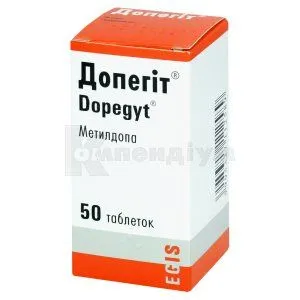
Table of Contents
INSTRUCTION FOR MEDICAL USE OF THE MEDICINAL PRODUCT DOPEGYT® (DOPEGYTÒ)
Composition:
active substance: methyldopa;
1 tablet contains 250 mg of methyldopa (as sesquihydrate 282 mg);
excipients: magnesium stearate, stearic acid, sodium starch glycolate (type A), ethylcellulose, maize starch, talc.
Pharmaceutical form. Tablets.
Main physicochemical characteristics: white or greyish-white, round, flat tablets with bevelled edges, smooth on one side, engraved with “DOPEGYT” on the other side, odorless or almost odorless.
Pharmacotherapeutic group. Antiadrenergic agents with central mechanism of action.
ATC code C02AB01.
Pharmacological Properties.
Pharmacodynamics.
Dopegit® (methyldopa) is an antihypertensive agent with a central mechanism of action. Its mechanism of action is not fully understood. After entering the central nervous system, the drug exerts its antihypertensive effect through its active metabolites (alpha-methyl-epinephrine and alpha-methyl-norepinephrine). By stimulating alpha2-adrenergic receptors of brainstem neurons, it reduces the tone of the sympathetic nervous system.
It moderately decreases plasma renin levels and systemic vascular resistance.
By inhibiting the enzyme dopa-decarboxylase, it reduces the synthesis of norepinephrine, dopamine, and serotonin, as well as tissue concentrations of norepinephrine and epinephrine.
Methyldopa does not directly affect cardiac function. It causes minimal changes in cardiac output. It does not provoke reflex tachycardia, increases glomerular filtration rate and renal blood flow, as well as filtration fraction. It slightly reduces heart rate. It effectively lowers arterial pressure both in the supine and standing positions, and rarely causes orthostatic hypotension.
Pharmacokinetics.
After oral administration, approximately 50% of the drug is absorbed in the gastrointestinal tract. Plasma protein binding is low—up to 20%. Maximum reduction in arterial pressure occurs 4–6 hours after oral administration and lasts for 12–24 hours. After repeated dosing, maximum antihypertensive effect is achieved within 2–3 days. After discontinuation of the drug, arterial pressure returns to baseline levels within 1–2 days.
Methyldopa is extensively metabolized, primarily in the liver. Its active metabolite, alpha-methylnorepinephrine, originates from central adrenergic neurons.
In addition, many other metabolites are known, which are excreted in urine.
Approximately 70% of methyldopa is excreted in urine as methyldopa or its sulfated conjugates. The remainder is excreted in feces as methyldopa. With normal renal function, the elimination half-life is 1.7 hours. Complete elimination of the drug occurs within 36 hours.
Methyldopa is removed from the body by dialysis. During a 6-hour hemodialysis session, up to 60% of absorbed methyldopa can be removed from the bloodstream; during peritoneal dialysis, 22–39% is removed.
Methyldopa crosses the placental barrier and is excreted into breast milk.
Special patient group
In renal impairment, methyldopa excretion is slowed in proportion to the degree of kidney damage. In severe kidney damage (without dialysis), the elimination half-life of methyldopa is 10 times shorter than under normal conditions.
Clinical Characteristics.
Indications.
Arterial hypertension.
Contraindications.
Hypersensitivity reactions to components of the drug; liver dysfunction associated with previous methyldopa therapy; acute liver function disorders (including acute hepatitis and active cirrhosis of the liver); concomitant use with monoamine oxidase inhibitors (MAO inhibitors); depression; pheochromocytoma; porphyria.
Interaction with other medicinal products and other types of interactions.
Dopegyt® should be used with particular caution in combination with any of the following drugs:
- sympathomimetics (possible enhancement of vasopressor effect);
- tricyclic antidepressants;
- phenothiazines;
- oral iron preparations (bioavailability of methyldopa may be reduced);
- nonsteroidal anti-inflammatory drugs;
- estrogens.
The antihypertensive effect of methyldopa is enhanced when used with other antihypertensive drugs and anesthetics.
Idiosyncratic reactions may occur during concomitant use with antihypertensive medicinal products.
Methyldopa and the following drugs may alter each other's effects:
- lithium (possible enhancement of lithium toxicity);
- levodopa [reduced antiparkinsonian effect, enhanced adverse effects on the central nervous system (CNS)];
- alcohol and drugs that suppress the central nervous system (enhanced depressant effects on the central nervous system);
- anticoagulants (increased anticoagulant effect, risk of bleeding);
- bromocriptine (may adversely affect prolactin concentration).
Special precautions for use.
Prior to initiating methyldopa therapy, a blood count should be performed, and after the first 6–10 weeks of treatment, a Coombs test should be conducted. This test should be repeated every 6–12 months during prolonged therapy. Approximately 10–20% of patients treated with methyldopa develop a positive Coombs test, particularly when receiving more than 1 g of methyldopa daily for 6 months to 1 year.
Hemolytic anemia has been reported occasionally during methyldopa therapy. If symptoms of anemia occur, hemoglobin and hematocrit levels should be determined. If anemia is confirmed, additional investigations should be performed to assess the degree of hemolysis. If hemolytic anemia is diagnosed, Dopagit should be discontinued.
Hemolytic anemia resolves after discontinuation of the drug. In some cases, steroid therapy may be required. Discontinuation of methyldopa therapy (with or without corticosteroid treatment) usually results in rapid remission. However, isolated fatal cases have been reported. Other potential causes of hemolytic anemia should also be considered. If hemolytic anemia is attributed to methyldopa, the drug should be discontinued. A positive Coombs test typically becomes negative within several weeks or months after stopping methyldopa therapy.
A positive Coombs test is not a contraindication for methyldopa therapy. If a positive Coombs test occurs during treatment, the physician should rule out hemolytic anemia or determine whether the positive test has clinical significance. Problems may arise if the patient requires blood transfusion. In such cases, both direct and indirect Coombs tests should be performed. In the absence of hemolytic anemia, only the direct Coombs test will be positive. If the indirect Coombs test is also positive, complications may occur. In such cases, consultation with a blood transfusion specialist or hematologist is recommended.
Liver function tests should be performed during the first 6–12 weeks of treatment or if unexplained jaundice occurs. If abnormalities in liver enzymes or jaundice develop, a hypersensitivity reaction should be suspected, which may lead to cholestasis, hepatocellular damage, or hepatitis. Very rarely, liver necrosis with fatal outcome may occur. Therefore, methyldopa therapy should be discontinued immediately if abnormalities in liver enzymes or hepatic failure occur. These patients must never receive methyldopa again. If body temperature and liver function tests, previously impaired due to methyldopa, return to normal after discontinuation of the drug, methyldopa should not be re-administered to these patients.
Patients with pre-existing liver disease or impaired liver function require special caution during methyldopa therapy.
Very rarely, agranulocytosis and thrombocytopenia may develop. These conditions usually resolve upon discontinuation of methyldopa.
Some patients may develop edema or weight gain during methyldopa therapy, which may be managed by adding a diuretic. Methyldopa therapy should not be continued if edema worsens or symptoms of heart failure develop.
Methyldopa is removed by dialysis. Therefore, arterial hypertension may recur after this procedure (see also section "Dosage and administration").
Since methyldopa fluoresces at the same wavelength as catecholamines, elevated urinary catecholamine levels may be detected, suggesting the presence of pheochromocytoma. It is important to recognize this phenomenon before a patient with suspected pheochromocytoma undergoes surgery. Methyldopa is contraindicated in patients with catecholamine-secreting tumors such as pheochromocytoma or paraganglioma.
However, methyldopa does not interfere with vanillylmandelic acid (VMA) measurements.
Patients receiving methyldopa should be given lower doses of anesthetics. If arterial hypotension occurs during anesthesia, it can be managed with vasoconstrictors. Adrenergic receptors remain responsive during methyldopa therapy (see also section "Interaction with other medicinal products and other forms of interaction").
In patients with severe bilateral cerebrovascular disease, involuntary pathological movements may rarely occur. Therefore, if such movements appear, methyldopa therapy should be discontinued immediately.
Methyldopa should be used with particular caution in patients whose close relatives suffer from hepatic porphyria.
During methyldopa therapy, consumption of alcoholic beverages should be avoided.
Reversible leukopenia and fever may occur during methyldopa treatment.
Changes in laboratory tests may also be observed, such as darkening of urine due to the breakdown of methyldopa or its metabolites.
Methyldopa may interfere with the determination of urinary uric acid by the phosphotungstic acid method, serum creatinine by the alkaline picrate method, and aspartate aminotransferase (AST (SGOT)) by colorimetric methods.
No interference of methyldopa with AST (SGOT) determination by spectrophotometric methods has been reported.
Use during pregnancy or breastfeeding.
Treatment of arterial hypertension in pregnant women with methyldopa should be under strict medical supervision.
No harmful effects of methyldopa on the fetus or newborn have been observed during treatment of pregnant women or women who are breastfeeding.
Published reports on methyldopa use during all trimesters of pregnancy suggest a potential for delayed adverse effects on the fetus.
Methyldopa crosses the placental barrier and is excreted into breast milk and umbilical cord blood.
Although no data on teratogenic effects have been reported, the risk cannot be entirely excluded. The drug may be prescribed to pregnant women or women planning pregnancy, as well as to breastfeeding women, only if the expected benefit outweighs the potential risk.
Ability to affect reaction speed when driving or operating machinery.
During treatment with this medicinal product, patients should refrain from driving or engaging in potentially hazardous activities requiring high concentration.
Method of Administration and Dosage
Treatment with methyldopa requires individual dose titration. Tablets should be taken orally, with or after food.
Adults.
The usual initial dose of methyldopa in adults is 250 mg once daily (at bedtime) for the first 2 days. The daily dose may then be gradually increased by 250 mg every 2 days until adequate blood pressure control is achieved. Since a sedative effect of the drug may occur during the first 2–3 days of treatment, as well as after each subsequent dose increase, the increased dose should preferably be taken once in the evening.
The maintenance dose usually ranges from 500 mg to 2 g daily, divided into 2–4 doses. The maximum daily dose should not exceed 3 g. If blood pressure reduction is insufficient with a daily dose of 2 g, combination therapy with other antihypertensive agents is recommended. Tolerance to the drug may develop, typically between the second and third month of treatment. Adding a diuretic or increasing the methyldopa dose usually restores effective blood pressure control.
Discontinuation of methyldopa is associated with reversible elevation of blood pressure, which typically occurs within 48 hours.
Dopegit® may be prescribed to patients already receiving other antihypertensive drugs, provided these medications are gradually withdrawn. In such cases, the initial dose of Dopegit® should not exceed 500 mg daily. Dose increases should be performed as needed, with intervals of at least 2 days.
When Dopegit® is used as an addition to previously prescribed antihypertensive therapy, dose adjustments of the concomitant antihypertensive agents may be necessary to ensure a smooth transition.
Elderly patients.
For elderly patients, the initial dose should be as low as possible and should not exceed 250 mg daily due to the frequent occurrence of sedative effects. The dose may be increased if necessary. Dose increments should be separated by intervals of at least 2 days. The maximum daily dose of Dopegit® should not exceed 2 g.
Children with body weight above 25 kg.
Tablets should be administered in doses corresponding to the prescribed amount.
The initial dose in children is 10 mg/kg body weight per day, divided into 2–4 doses. The dose may be gradually increased as needed to achieve the desired effect. Dose increases should be separated by intervals of at least 2 days.
The maximum daily dose of Dopegit® is 65 mg/kg body weight per day, but not more than 3 g daily.
Patients with renal impairment require reduced doses. In mild renal impairment (glomerular filtration rate – 60–89 mL/min/1.73 m²), the dosing interval should be extended to 8 hours; in moderate impairment (glomerular filtration rate – 30–59 mL/min/1.73 m²), to 8–12 hours; and in severe renal impairment (glomerular filtration rate – < 30 mL/min/1.73 m²), to 12–24 hours.
Methyldopa is removed by dialysis. After hemodialysis, an additional 250 mg dose of the drug should be administered to prevent rebound hypertension.
Children.
The drug should be prescribed to children with body weight of at least 25 kg, taking into account the active ingredient content in this dosage form.
Overdose.
Symptoms: pronounced arterial hypotension, marked drowsiness, weakness, bradycardia, dizziness, constipation, abdominal distension, flatulence, diarrhea, nausea, vomiting.
Treatment: gastric lavage immediately after overdose; induction of vomiting may reduce the amount of absorbed drug. If the drug has already been absorbed, intravenous fluid administration may enhance its renal excretion. Close monitoring of cardiac rhythm, blood volume, electrolyte balance, intestinal function, renal and cerebral function is required. Symptomatic treatment is indicated.
Adverse Reactions.
Hypersensitivity reactions may occur in individuals with individual intolerance to any component of the medicinal product.
At the beginning of therapy with Dopaget®, as well as when increasing the dose, sedative effects (which quickly resolve), headache, general weakness, and increased fatigue may be observed.
Central nervous system: Sedation (usually transient), headache, paresthesia, dizziness, anxiety, depression, psychosis (mild and temporary), nightmares, decreased libido, impotence; parkinsonism, choreoathetosis, cerebrovascular insufficiency (may be accompanied by hypotension), peripheral facial paralysis (Bell's palsy); decreased mental activity, carotid sinus syndrome, psychiatric disorders.
Cardiovascular system: Exacerbation of angina pectoris, congestive heart failure, sinus bradycardia, carotid sinus hypersensitivity, orthostatic hypotension (dose reduction is recommended), peripheral edema, weight gain, myocarditis, pericarditis, atrioventricular block.
Gastrointestinal tract: Pancreatitis, colitis, vomiting, diarrhea, sialadenitis, inflammation or black discoloration of the tongue, nausea, vomiting, constipation, abdominal distension, flatulence, dry mouth, glossodynia.
Liver: Jaundice, hepatitis, cholestasis, changes in liver function tests, necrotic hepatitis.
Blood and lymphatic system: Bone marrow suppression, leukopenia, granulocytopenia, thrombocytopenia, hemolytic anemia, eosinophilia, positive antinuclear antibody test, lupus erythematosus cells, rheumatoid factor, positive Coombs test.
Immune system: Vasculitis, drug-induced prostration, eosinophilia.
Endocrine system: Hyperprolactinemia, gynecomastia, galactorrhea, amenorrhea, breast enlargement.
Skin and subcutaneous tissue: Erythema; toxic epidermal necrolysis, eczema or rash resembling lichen, angioneurotic edema, urticaria.
Musculoskeletal system: Arthralgia, joint swelling, muscle pain, myalgia.
Respiratory system: Nasal congestion.
Laboratory parameters: Positive antinuclear antibody tests, LE cells, rheumatoid factor, increased liver transaminase activity, increased blood urea concentration.
Other: Impotence, ejaculation disorders, sialadenitis, breast enlargement, gynecomastia, amenorrhea, lactation disorders, psychiatric disorders including nightmares, reversible mild psychoses or depression, decreased libido.
In elderly patients, syncope is observed more frequently. This may be related to increased sensitivity to the drug and pronounced atherosclerotic vascular lesions. Syncope can be prevented by reducing the dose of Dopaget®.
Shelf life. 5 years.
Storage conditions. Store at temperatures not exceeding 25°C, in a place inaccessible to children.
Packaging. 50 tablets in a glass bottle; 1 bottle per cardboard box.
Prescription category. Prescription only.
Manufacturer.
Egis Pharmaceuticals Plc., Hungary.
Manufacturer's address and place of business.
65 Matyas Kiraly Street, Kermend, 9900, Hungary.