Donna
Ukraine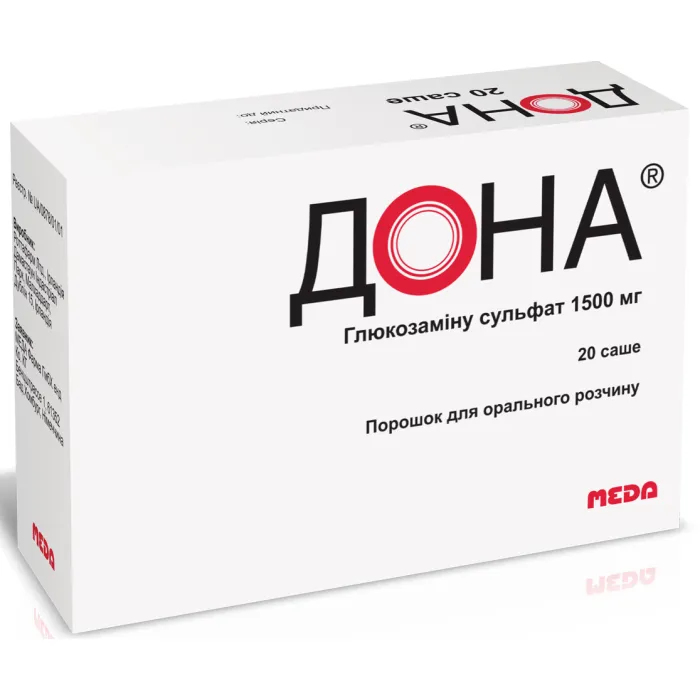
Table of Contents
INSTRUCTIONS FOR MEDICAL USE OF THE MEDICINAL PRODUCT DОNAâ (DONAâ)
Composition:
active ingredient: glucosamine sulfate;
one sachet contains 1884 mg of crystalline glucosamine sulfate, equivalent to 1500 mg of glucosamine sulfate and 384 mg of sodium chloride;
excipients: aspartame (E 951), sorbitol (E 420), anhydrous citric acid, macrogol 4000.
Pharmaceutical form. Powder for oral solution.
Main physicochemical properties: white odourless crystalline powder.
Pharmacotherapeutic group. Other non-steroidal anti-inflammatory and antirheumatic agents. ATC code M01A X05.
Pharmacological properties.
Pharmacodynamics.
The active ingredient is a salt of the aminomonosaccharide glucosamine sulfate, which is naturally present in the human body and is used together with sulfates for the biosynthesis of hyaluronic acid in synovial fluid and glycosaminoglycans of the ground substance of articular cartilage.
The mechanism of action of glucosamine sulfate involves stimulation of glycosaminoglycan synthesis and, consequently, of joint proteoglycans. In addition, glucosamine exhibits anti-inflammatory properties and slows down the degradation processes of articular cartilage primarily due to its metabolic activities and ability to inhibit the activity of interleukin-1 (IL-1), thus contributing both to symptomatic relief in osteoarthritis and to delaying structural joint damage, as evidenced by long-term clinical studies.
The efficacy of glucosamine sulfate in osteoarthritis becomes apparent within 2–3 weeks after the start of treatment.
Results from clinical studies of daily continuous treatment over 3 years indicate a progressive increase in efficacy with regard to both symptoms and slowing of structural joint damage, as confirmed by radiographic findings.
Glucosamine sulfate has demonstrated good tolerability. No significant effects of glucosamine sulfate on the cardiovascular, respiratory, autonomic, or central nervous systems have been observed.
Pharmacokinetics.
Approximately 90% of a dose of glucosamine sulfate is rapidly and completely absorbed from the gastrointestinal tract, passes through biological barriers, and penetrates into tissues, primarily into articular cartilage tissue. Bioavailability is 26%. Elimination half-life is 68 hours.
Clinical characteristics.
Indications. For relief of symptoms in mild to moderate knee osteoarthritis.
Contraindications. Hypersensitivity to glucosamine or to any of the excipients; hepatic and renal impairment in the decompensated stage, tendency to bleeding. DONA® must not be used in patients with allergy to shellfish, since the active substance is derived from shellfish.
Interaction with other medicinal products and other forms of interaction. There are limited data on possible interactions of medicinal products with glucosamine; however, an increase in INR (International Normalized Ratio) has been observed during concomitant use of oral vitamin K antagonists. Therefore, patients receiving oral vitamin K antagonists should be closely monitored when starting or stopping glucosamine therapy. Concomitant treatment with glucosamine may enhance the absorption and thus the serum concentration of tetracyclines. However, the clinical significance of this interaction is likely limited.
Given that only limited data are available on potential interactions with glucosamine, particular attention should be paid to any altered response due to changes in serum concentrations of concomitantly administered medicinal products.
Special precautions for use
Before using the medication, consult a physician to rule out joint diseases for which alternative treatment methods are indicated.
Patients with impaired glucose tolerance should exercise caution when taking glucosamine. Patients with diabetes mellitus are advised to closely monitor blood glucose levels and, if necessary, assess insulin requirements before starting treatment and periodically throughout the course of therapy.
Patients with known risk factors for cardiovascular diseases should undergo monitoring of blood lipid levels, as hypercholesterolemia has been observed in several cases among patients receiving glucosamine.
The medication should be used with caution in patients with asthma, as such patients may be more susceptible to allergic reactions to glucosamine, potentially leading to exacerbation of their disease symptoms.
The oral powder contains aspartame, a phenylalanine derivative, which poses a risk for patients with phenylketonuria.
One sachet contains 6.6 mmol (151 mg) of sodium. This should be taken into account by patients on a sodium-controlled diet.
The oral powder contains sorbitol. This pharmaceutical form is not recommended for patients with rare inherited fructose intolerance.
Use under medical supervision in patients with hepatic or renal dysfunction and in those with thrombophlebitis.
Use in children and adolescents. Glucosamine should not be used in children and adolescents (under 18 years of age), as the safety and efficacy of the drug have not been established in this patient group.
Use in elderly patients. No specific clinical studies have been conducted in elderly patients; however, according to clinical experience, no dose adjustment is required for this patient group.
Use in patients with renal and/or hepatic impairment. Dosage recommendations cannot be provided for patients with renal and/or hepatic dysfunction, as no studies have been conducted in these populations.
Use during pregnancy or breastfeeding. There are no data available on the use of the drug during pregnancy or breastfeeding; therefore, the medication should not be used in these patient groups.
Ability to influence reaction rate when driving or operating machinery. Studies on the effect of the drug on the ability to drive or operate machinery have not been conducted. Caution should be exercised when driving vehicles or performing tasks requiring attention. If somnolence, fatigue, dizziness, or visual disturbances occur, driving and operating machinery are prohibited.
Method of Administration and Dosage
For oral use.
Adult and elderly patients: Dissolve the contents of 1 sachet, equivalent to 1500 mg of glucosamine sulfate, in a glass of water and take once daily, preferably during a meal.
Glucosamine is not intended for the treatment of acute pain symptoms. Symptomatic relief (particularly pain relief) may occur only after several weeks of use, and in some cases, even later.
If no symptomatic improvement occurs after 2–3 months of treatment, the therapy should be re-evaluated.
Children. Do not use in children and adolescents (under 18 years of age), as the safety and efficacy of the medicinal product in this patient group have not been established.
Overdose. Cases of overdose have not been reported. Based on studies of acute and chronic toxicity in animals, toxic symptoms are unlikely even with doses 200 times higher than the therapeutic dose. However, in case of overdose, adverse reactions may be intensified; therefore, symptomatic treatment aimed at restoring fluid and electrolyte balance should be administered.
Adverse reactions.
The most common adverse reactions associated with the use of glucosamine are nausea, abdominal pain, dyspepsia, flatulence, constipation, diarrhea, headache, fatigue, and somnolence. These adverse reactions are generally transient and of mild severity.
Criteria for assessing the frequency of adverse drug reaction:
| Very common: |
≥ 1/10 |
| Common: |
≥ 1/100 – < 1/10 |
| Uncommon: |
≥ 1/1000 – < 1/100 |
| Rare: |
≥ 1/10000 – < 1/1000 |
| Very rare: |
< 1/10000 |
| Frequency not known: |
frequency cannot be estimated. |
Immune system disorders: frequency not known – allergic reactions (hypersensitivity);
Nervous system disorders: common – headache, somnolence; frequency not known – dizziness;
Eye disorders: frequency not known – visual disturbances;
Vascular system disorders: uncommon – flushing;
Respiratory, thoracic and mediastinal disorders: frequency not known – asthma, exacerbation of asthma;
Gastrointestinal disorders: common – abdominal pain, flatulence, dyspepsia, diarrhea, constipation, nausea; frequency not known – vomiting;
Hepatobiliary disorders: frequency not known – jaundice;
Skin and subcutaneous tissue disorders: uncommon – exanthema, pruritus, erythema, rash; frequency not known – angioneurotic edema, urticaria;
General disorders: common – fatigue; frequency not known – swelling, peripheral edema;
Investigations: frequency not known – increased liver enzymes.
Frequency not known – in patients with diabetes mellitus, a negative effect on blood glucose monitoring may occur.
There have been reports of isolated spontaneous cases of hypercholesterolemia; however, a causal relationship has not been established.
Shelf life. 3 years.
The expiry date is valid only for the product in intact manufacturer’s packaging, provided it has been stored correctly.
Storage conditions. Keep out of reach and sight of children. Store at a temperature not exceeding 30 °C.
Packaging. Sachets made of a three-layer material consisting of paper/aluminum/polyethylene, heat-sealed on all four sides. Pack sizes: 20 or 30 sachets in a cardboard box.
Prescription status. Prescription only.
Manufacturer. Rottapharm Ltd. / Rottapharm Ltd.
Address of the manufacturer’s place of business. Damastown Industrial Park, Mulhuddart, Dublin 15, Ireland / Damastown Industrial Park, Mulhuddart, Dublin 15, Ireland.