Disgren
Ukraine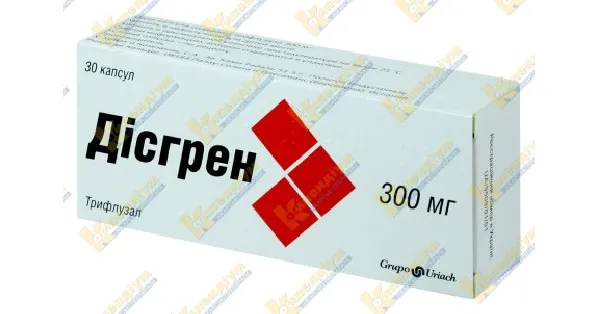
Table of Contents
INSTRUCTIONS FOR MEDICAL USE OF THE MEDICINAL PRODUCT DISGREN (DISGREN)
Composition:
Active ingredient: triflusal;
1 capsule contains 300 mg of triflusal;
Excipient: gelatin.
Pharmaceutical form. Capsules.
Main physicochemical properties: colorless hard gelatin capsules of size 1, containing a white or almost white powder.
Pharmacotherapeutic group.
Antithrombotic agents. Platelet aggregation inhibitors, excluding heparin.
ATC code B01AC18.
Pharmacological Properties.
Pharmacodynamics.
Triflusal reduces thromboxane biosynthesis by irreversible inhibition of platelet cyclooxygenase, while due to its minimal effect on vascular cyclooxygenase at therapeutic doses, it does not affect prostacyclin biosynthesis. Additionally, the main metabolite of triflusal, 2-hydroxy-4-(trifluoromethyl)benzoic acid (HTB), is a reversible inhibitor of platelet cyclooxygenase and, due to its long half-life (approximately 34 hours), contributes to the antithrombotic effect of triflusal. Both triflusal and HTB may increase the concentration of cyclic adenosine 5'-monophosphate (c-AMP) in platelets by inhibiting platelet phosphodiesterases. Moreover, in vitro and ex vivo studies have demonstrated that triflusal stimulates the release of nitric oxide from human neutrophils, which also contributes to its antithrombotic effect. Triflusal has demonstrated inhibition of platelet aggregation in both healthy volunteers and patients. In ex vivo studies in healthy volunteers, 24 hours after administration of triflusal at a dose of 600 mg, arachidonic acid-induced platelet aggregation decreased by 65%. Repeated administration of triflusal (600 mg/day for 7 days) resulted in 50–75% inhibition of platelet aggregation induced by arachidonic acid, ADP (adenosine diphosphate), epinephrine, or collagen.
Pharmacokinetics.
After oral administration, triflusal is rapidly absorbed (t½abs = 0.44 hours), demonstrating absolute bioavailability ranging from 83% to 100%. Under the action of esterases, it is rapidly hydrolyzed into its main active metabolite—2-hydroxy-4-(trifluoromethyl)benzoic acid (HTB). A secondary conjugated metabolite, HTB-glycine, is detected in urine. The elimination half-life (t½) in plasma is 0.53 ± 0.12 hours for triflusal and 34.3 ± 5.3 hours for HTB. Elimination occurs primarily via the kidneys (renal clearance >60% within 48 hours). Unmetabolized triflusal, HTB, and the HTB-glycine conjugate are detectable in urine.
After administration of a single oral dose of 300 or 900 mg of triflusal in healthy volunteers, the mean maximum plasma concentration (Cmax) of triflusal was 3.2 ± 1.9 μg/mL and 11.6 ± 1.7 μg/mL, respectively. The Cmax for HTB reached 36.4 ± 6.1 μg/mL and 92.7 ± 17.1 μg/mL, respectively. The time required to reach Cmax (tmax) was 0.88 ± 0.26 hours for triflusal and 4.96 ± 1.37 hours for HTB at the 900 mg dose. Pharmacokinetic parameters of HTB after repeated dosing (triflusal, 300 mg three times daily or 600 mg once daily for 13 days) showed that the steady-state maximum plasma concentration of HTB (Cmax,ss) was 178 ± 42 μg/mL and 153 ± 37 μg/mL, respectively. HTB, at therapeutic concentrations, exhibits 98–99% binding to plasma albumin. This binding is not significantly altered in the presence of caffeine, theophylline, glipizide, enalapril, cimetidine, or warfarin. However, the free fraction of HTB increases significantly in the presence of NSAIDs such as diclofenac, ibuprofen, indomethacin, naproxen, piroxicam, or salicylic acid. At high concentrations, HTB displaces NSAIDs, glipizide, and warfarin from protein-binding sites. These substances have affinity for the same protein-binding sites and may displace each other depending on their affinity for the protein and the concentration of the displacing substance.
In elderly volunteers after administration of 300 mg of triflusal twice daily, plasma concentrations of triflusal and HTB reach steady state within 3–5 days. Pharmacokinetic parameters (AUC, Cmax, tmax) in elderly volunteers do not differ significantly from those observed in younger volunteers. The elimination half-life (t½) in plasma is 0.92 ± 0.16 hours for triflusal and 64.4 ± 6.6 hours for HTB—both values are higher than in younger volunteers. However, this increase is not clinically significant and does not require dose adjustment in elderly patients.
In patients with end-stage chronic renal failure undergoing conventional hemodialysis, plasma concentrations of HTB before and after hemodialysis were identical.
Clinical characteristics.
Indications.
Prevention of recurrent ischemic vascular events, such as:
- myocardial infarction;
- stable and unstable angina pectoris;
- non-hemorrhagic cerebrovascular transient or permanent circulation disorders.
Prevention of shunt occlusion following aortocoronary bypass surgery.
Contraindications.
Hypersensitivity to the active substance or to other salicylates. Active peptic ulcer disease in medical history and its complications. Acute bleeding.
Interaction with other medicinal products and other forms of interaction.
In vitro studies have shown an increase in the free fraction of the main metabolite of triflusal, 2-hydroxy-4-(trifluoromethyl)benzoic acid (HTB), in the presence of NSAIDs. On the other hand, increased HTB concentration enhances the effect of NSAIDs, glycosides, and warfarin. Dose adjustment of these drugs may be necessary when used concomitantly with triflusal.
The safety of using triflusal in combination with thrombolytic agents (rt-PA and streptokinase) was evaluated in patients with acute myocardial infarction. The incidence of intracranial hemorrhage was lower than in patients treated with acetylsalicylic acid and thrombolytic agents (0.1% vs. 1.1%, p=0.04).
Special precautions for use
Renal or hepatic impairment: Clinical experience with the use of this medicinal product in patients with renal or hepatic impairment is limited. Therefore, special caution is recommended when treating patients with these conditions.
In patients with severe renal impairment undergoing hemodialysis, plasma concentrations of the main metabolite of triflusal, 2-hydroxy-4-(trifluoromethyl)benzoic acid (HTB), are not significantly altered; therefore, dose adjustment is not required.
Although triflusal has demonstrated a low level of bleeding in clinical trials, the drug should be used with caution in patients at increased risk of bleeding due to trauma or other pathological conditions. Concomitant use of drugs that may increase the risk of bleeding, such as acetylsalicylic acid and other non-steroidal anti-inflammatory drugs (NSAIDs), should be approached with caution during triflusal treatment. For planned surgical procedures, the risk of bleeding should be carefully considered, and treatment with Disgren should be discontinued at least 7 days prior to the scheduled surgery, if necessary.
Use during pregnancy or breastfeeding
There are no data available on the effects of triflusal during pregnancy; therefore, the use of this medicinal product is not recommended during this period. Animal studies have not shown any direct or indirect adverse effects on pregnancy, embryo-fetal development, parturition, or postnatal development. There are no data on the excretion of triflusal in human milk; therefore, the potential benefit of the drug for the mother should be weighed against the potential risk for the infant. Breastfeeding should be discontinued during treatment.
Ability to influence reaction speed when driving or operating machinery
Not specifically reported; however, the possibility of adverse reactions affecting the nervous system should be taken into account.
Dosage and Administration.
For oral use in adults. The recommended dose is 600 mg (2 capsules) daily, taken either as a single dose or divided into two doses, or 900 mg (3 capsules) daily divided into three doses. The drug should be taken with food.
Children.
The safety and efficacy of the drug in children have not been established.
Overdose.
Cases of overdose have not been reported. If a very high dose is taken, symptoms of salicylate intoxication may occur (headache, tinnitus, dizziness, nausea, vomiting, rapid breathing). In such cases, the drug should be discontinued and symptomatic therapy administered.
Side effects
The most common adverse reactions occur in the gastrointestinal tract and usually resolve within a few days even without discontinuation of the drug.
Skin:
Uncommon: rash, pruritus.
Central and peripheral nervous system:
Common: headache;
Uncommon: confusion, dizziness, vertigo, seizures.
Auditory system:
Uncommon: tinnitus, hypoacusis.
Sensory organs:
Uncommon: taste disturbances.
Gastrointestinal tract:
Very common: dyspeptic disorders;
Common: abdominal pain, nausea, constipation, vomiting, flatulence, anorexia;
Uncommon: diarrhea, gastrointestinal hemorrhage, melena, rectal bleeding.
Cardiovascular system:
Uncommon: arterial hypertension, transient ischemic attack, intracerebral hemorrhage.
Respiratory system:
Uncommon: asthma, upper respiratory tract infections.
Hematopoietic system:
Uncommon: anemia; coagulation disorders and bleeding: epistaxis, hematoma, purpura, gingival bleeding.
Urinary and reproductive system:
Uncommon: hematuria, urinary tract infections.
General reactions:
Uncommon: abdominal distension, fever, influenza-like symptoms.
Isolated cases of photosensitization have been reported.
Shelf life. 2 years.
Storage conditions.
Store in the original packaging at a temperature not exceeding 25 °C. Keep out of reach of children.
Do not use after the expiry date stated on the packaging.
Packaging.
10 capsules in a blister; 3 blisters in a cardboard box.
Prescription status.
Prescription only.
Manufacturer.
H. Uriach & Company, S.A. / J. Uriach y Compania, S.A.
Manufacturer's address and place of business.
Av. Camí Reial 51-57, Polígon Industrial Riera de Caldes, 08184 Palau-Solità i Plegamans (Barcelona), Spain / Av. Camí Reial, 51-57, Polígon Industrial Riera de Caldes, 08184 Palau-Solità i Plegamans (Barcelona), Spain.