Dialipon® turbo
Ukraine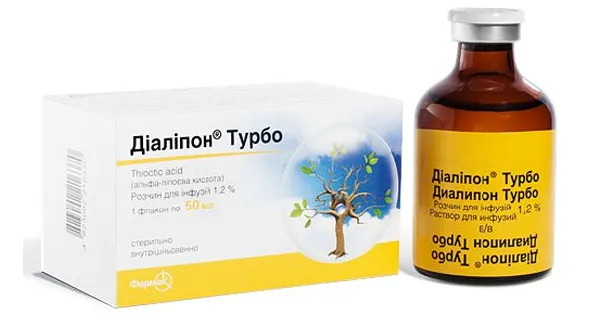
Table of Contents
INSTRUCTION FOR MEDICAL USE OF THE MEDICINAL PRODUCT DIALIPON® TURBO (DIA LIPON TURBO)
Composition:
Active substance: alpha-lipoic acid;
1 ml of solution contains 23.354 mg of the meglumine salt of alpha-lipoic acid, equivalent to 12 mg of alpha-lipoic acid;
Excipients: meglumine, polyethylene glycol 300 (macrogol 300), water for injections.
Pharmaceutical form. Infusion solution.
Main physicochemical properties: clear yellow-green liquid.
Pharmacotherapeutic group. Agents affecting the gastrointestinal tract and metabolic processes. ATC code A16AX01.
Pharmacological properties.
Pharmacodynamics.
Alpha-lipoic acid is a substance synthesized in the body and functions as a coenzyme in the oxidative decarboxylation of α-keto acids; it plays an important role in cellular energy production. It promotes a reduction in blood glucose levels and increases glycogen content in the liver. Deficiency or impaired metabolism of alpha-lipoic acid (thioctic acid) due to intoxications or excessive accumulation of certain breakdown products (e.g., ketone bodies) leads to impaired aerobic glycolysis. Alpha-lipoic acid can exist in two physiologically active forms (oxidized and reduced), both of which possess antitoxic and antioxidant effects. Alpha-lipoic acid influences cholesterol metabolism, participates in the regulation of lipid and carbohydrate metabolism, and improves liver function (due to hepatoprotective, antioxidant, and detoxifying effects). Alpha-lipoic acid is pharmacologically similar to the B-group vitamins.
Pharmacokinetics.
Alpha-lipoic acid undergoes significant changes during first-pass metabolism in the liver. Considerable inter-individual variability in systemic availability of alpha-lipoic acid is observed. It is excreted by the kidneys predominantly as metabolites. Metabolite formation occurs via side-chain oxidation and conjugation. The half-life of DIALIPON® Turbo from blood serum is 10–20 minutes.
Clinical characteristics.
Indications.
Impaired sensation in diabetic polyneuropathy.
Contraindications.
Hypersensitivity to α-lipoic acid or to any of the excipients of the medicinal product.
Interaction with other medicinal products and other forms of interaction.
α-Lipoic acid may enhance the blood glucose-lowering effect of insulin and/or other antidiabetic agents; therefore, regular monitoring of blood glucose levels is recommended, especially at the beginning of treatment with thioctic acid (α-lipoic acid). In individual cases, to prevent symptoms of hypoglycemia, it may be necessary to reduce the dose of insulin or oral antidiabetic agent.
Ethanol reduces the therapeutic efficacy of α-lipoic acid.
Warning: regular alcohol consumption is a significant risk factor for the development and progression of neuropathy symptoms and may thus negatively affect treatment with the drug. Therefore, patients with diabetic neuropathy are generally advised to abstain from alcohol consumption. The restriction on alcohol intake also applies to intervals between treatment courses.
Special precautions for use
During intravenous administration of the medicinal product Dialipon® Turbo, light-protective black bags should be used, placed over the vial.
The main factor in effective treatment of diabetic polyneuropathy is optimal correction of the patient's blood glucose levels.
When administering Dialipon® Turbo parenterally, there is a risk of allergic reactions, including anaphylactic shock; therefore, patients should be monitored for such reactions. If symptoms such as itching, nausea, or malaise occur, administration of the drug must be stopped immediately and appropriate therapeutic measures initiated.
In rare patients with decompensated or inadequately controlled diabetes mellitus and worsening general health, severe anaphylactic reactions associated with the use of Dialipon® Turbo may develop.
During treatment of polyneuropathy, transient increased sensitivity may occur due to regenerative processes, accompanied by paresthesia with sensations of "crawling ants."
A relative limitation for intravenous administration of α-lipoic acid preparations is advanced age (over 75 years).
Cases of autoimmune insulin syndrome have been reported during treatment with α-lipoic acid. Patients with certain human leukocyte antigen (HLA) genotypes, such as HLA-DRB1*04:06 and HLA-DRB1*04:03, are more susceptible to developing autoimmune insulin syndrome (a hormonal disorder regulating blood glucose, characterized by marked hypoglycemia) during treatment with α-lipoic acid. The HLA-DRB1*04:03 allele (odds ratio for susceptibility to autoimmune insulin syndrome 1.6) occurs primarily in individuals of Caucasian ethnicity and is more prevalent in Southern Europe than in Northern Europe; the HLA-DRB1*04:06 allele (odds ratio for susceptibility to autoimmune insulin syndrome 56.6) is predominantly found in patients from Japan and Korea.
Autoimmune insulin syndrome should be considered in the differential diagnosis of spontaneous hypoglycemia in patients receiving α-lipoic acid.
Use during pregnancy or breastfeeding
There is insufficient experience regarding the use of this medicinal product during pregnancy or breastfeeding; therefore, it should not be administered during these periods.
Ability to affect reaction speed when driving or operating machinery
Caution is required while using this medicinal product when driving vehicles or operating other potentially hazardous machinery requiring increased attention and rapid psychomotor responses.
Method of Administration and Dosage
The medication should be administered directly from the vial (i.e., without diluent) as an intravenous infusion over at least 30 minutes at a dose of 600 mg per day (the contents of one vial) in adults.
Since α-lipoic acid is light-sensitive, vials should be stored in the cardboard packaging until immediately before use.
At the beginning of therapy, administer the medicinal product DIALIPON® TURBO intravenously. The treatment course lasts 2–4 weeks.
For subsequent therapy, use oral formulations of α-lipoic acid at a daily dose of 300–600 mg.
Children
The efficacy and safety of the medicinal product in children have not been established; therefore, it should not be prescribed to this age group of patients.
Overdose
Symptoms: Possible nausea, vomiting, and headache. When very high doses ranging from 10 to 40 g of α-lipoic acid are used in combination with alcohol, severe intoxication may occur, potentially leading to a fatal outcome. The clinical picture of poisoning initially manifests as psychomotor agitation or impaired consciousness, followed by generalized seizures and development of lactic acidosis. Consequences of intoxication may include hypoglycemia, shock, rhabdomyolysis, hemolysis, acute skeletal muscle necrosis, disseminated intravascular coagulation, bone marrow suppression, and multiorgan failure.
Treatment: In case of suspected significant intoxication (ingestion of 6000 mg in adults or > 50 mg/kg body weight in children), immediate hospitalization and implementation of standard measures are indicated. Treatment of life-threatening conditions such as generalized seizures, lactic acidosis, and other consequences of intoxication should follow modern principles of intensive care and be conducted symptomatically. Currently, there is no data available on the appropriateness of hemodialysis, hemoperfusion, or hemofiltration for enhanced elimination of α-lipoic acid.
Adverse reactions.
Criteria for determining the frequency of adverse reactions: very common (≥ 10%), common (≥ 1% — < 10%), uncommon (≥ 0.1% — < 1%), rare (≥ 0.01% — 0.1%), very rare (< 0.01%), frequency not known.
Injection site reactions. Very rare: reactions at the injection site.
Immune system disorders. Frequency not known: insulin autoimmune syndrome.
Hypersensitivity reactions: skin allergic reactions, skin rashes, urticaria, pruritus, eczema, as well as systemic reactions up to the development of anaphylactic shock.
Nervous system disorders. Very rare: altered or impaired taste sensations.
After intravenous administration of α-lipoic acid, seizures and double vision (diplopia) have been observed very rarely.
Blood and lymphatic system disorders: following intravenous administration of α-lipoic acid, hemorrhagic rashes (purpura) and thrombopathies have been observed very rarely.
General adverse reactions: during rapid intravenous infusion, increased intracranial pressure and respiratory distress syndrome may occur very commonly; these symptoms resolve spontaneously.
Due to improved glucose utilization, blood glucose levels may decrease in some cases, and symptoms resembling hypoglycemia such as dizziness, increased sweating, headache, and visual disturbances may occur very rarely.
Shelf life. 4 years.
Do not use the medicinal product after the expiry date stated on the packaging.
Storage conditions. Store in the original packaging at a temperature not exceeding 25°C.
Keep out of reach of children.
Incompatibilities.
α-lipoic acid reacts in vitro with ionic metal complexes (e.g., with cisplatin). With sugar molecules, α-lipoic acid forms poorly soluble complex compounds (e.g., levulose solution).
α-lipoic acid solution is incompatible with glucose solution, Ringer's solution, and solutions that may react with SH-groups or disulfide bonds.
Do not use simultaneously with medicinal products containing metals (e.g., iron, magnesium preparations).
If necessary, only saline solution may be used as a solvent for administration of Diaplipon® Turbo solution.
Packaging. 50 ml in a vial. 1 or 10 vials per carton.
Prescription status. Prescription only.
Manufacturer. JSC "Farmak".
Address of manufacturer and location of business activity.
74, Kyrylivska Street, Kyiv, 04080, Ukraine.