Desaminooxytocin
Ukraine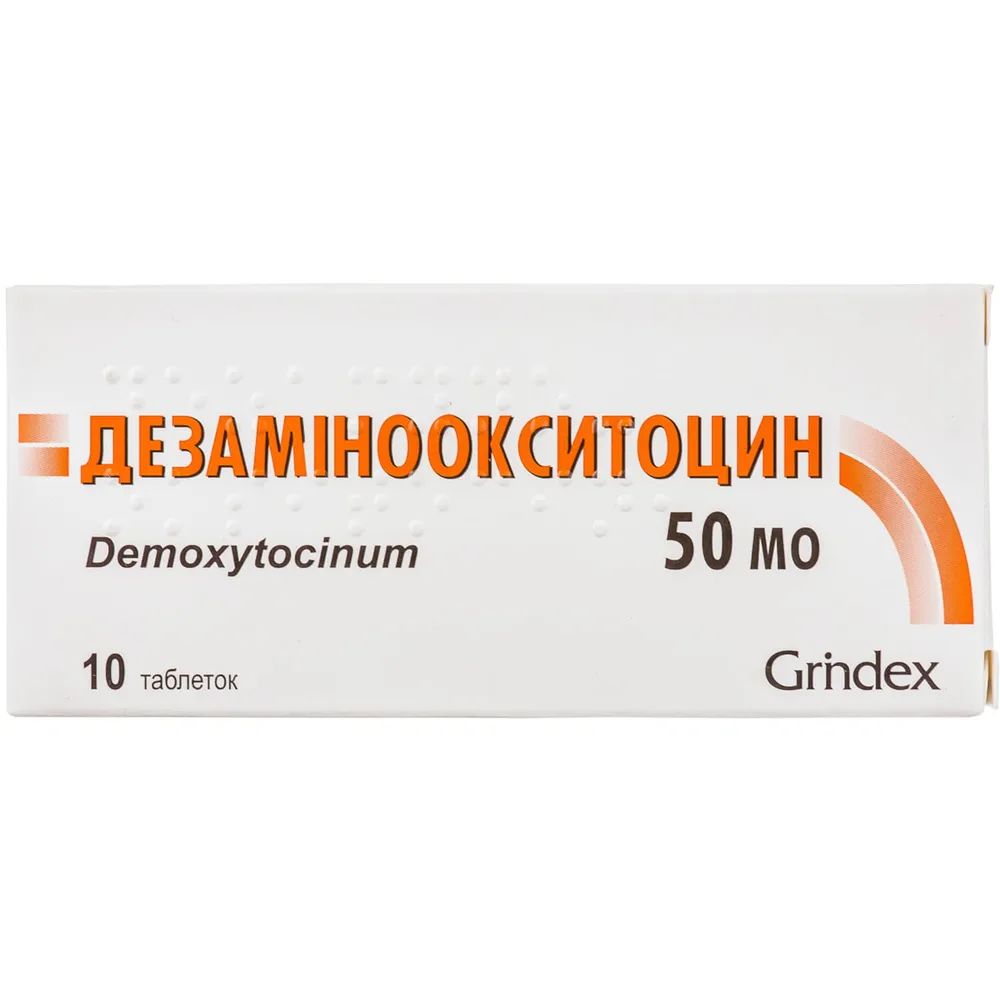
Table of Contents
INSTRUCTIONS FOR MEDICAL USE OF THE MEDICINAL PRODUCT DESAMINOXYTOCIN (DEZAMINOOXYTOCIN)
Composition:
Active substance: demoxytocinum;
1 tablet contains 50 IU of demoxytocin;
Excipients: sucrose; lactose monohydrate; methylcellulose; calcium stearate; potato starch.
Medicinal form. Tablets.
Main physico-chemical properties: white, round, flat cylindrical tablets with beveled edges and a score line.
Pharmacotherapeutic group.
Pituitary and hypothalamic hormones and analogues. Posterior pituitary hormones. Oxytocin and its derivatives. ATC code H01BB01.
Pharmacological properties.
Pharmacodynamics.
Demoxitocin is chemically similar to oxytocin—a hormone of the posterior pituitary gland. It can be considered a synthetic analogue of oxytocin. The mechanism of action and pharmacological properties of demoxitocin are similar to those of oxytocin. Demoxitocin affects cell membrane permeability, increasing intracellular calcium ion concentration, thereby enhancing contractions of smooth muscle cells. The drug stimulates contractions of the uterine smooth musculature and, by stimulating myoepithelial cells of the mammary gland, enhances milk secretion.
When administered transbuccally, demoxitocin—unlike oxytocin—is not degraded by salivary enzymes and readily penetrates through the oral mucosa into systemic circulation. Uterine contractions begin within 20–40 minutes (up to 50–60 minutes maximum) after transbuccal administration of demoxitocin. The effect is dose-dependent and lasts up to 180 minutes. The uterotonic activity of demoxitocin is twice that of oxytocin. In the postpartum period, demoxitocin accelerates uterine involution and shortens the duration of postpartum bleeding.
The lactogenic effect of demoxitocin begins earlier, is more pronounced, and lasts longer compared to oxytocin, which is explained by its resistance to enzymatic inactivation. Demoxitocin stimulates milk production and ejection, normalizes the lactation process, and prevents breast engorgement and mastitis development.
Demoxitocin lacks pronounced vasopressor and antidiuretic activity; therefore, it can be used in women with arterial hypertension, late toxemia of pregnancy, and impaired renal function.
Pharmacokinetics.
Demoxitocin is rapidly and completely absorbed through the oral mucosa into the bloodstream. After transbuccal administration of one 50 IU tablet, demoxitocin is absorbed within 15–30 minutes. The drug is not degraded by salivary enzymes due to its resistance to oxytocinase; elimination of demoxitocin occurs within 30–60 minutes.
Clinical characteristics.
Indications.
- To stimulate and enhance uterine contractions in cases of primary and secondary uterine inertia.
- To stimulate lactation in the postpartum period.
Contraindications.
Hypersensitivity to demoxitocin and/or to any excipient of the medicinal product. Hypertonic uterine contractions, mechanical obstruction of the birth canal, fetal hypoxia, intrauterine fetal death.
Cephalopelvic disproportion, transverse or oblique fetal presentation, placenta previa or vasa previa, premature separation of the placenta, prolapsed umbilical cord, impending uterine rupture due to grand multiparity, uterine overdistension (multiple pregnancy, polyhydramnios), invasive carcinoma of the cervix, polyhydramnios, grand multiparity, and presence of uterine scars from previous surgeries, including cesarean section.
The drug must not be used for prolonged periods in cases of severe pre-eclamptic toxaemia and severe cardiovascular diseases, as well as in cases of uterine inertia (resistance to demoxitocin/oxitocin).
Interaction with other medicinal products and other forms of interaction.
Inhalation anaesthetics (cyclopropane, halothane) may reduce the effect of demoxitocin (increasing the risk of hypotension and arrhythmia). During caudal anaesthesia, demoxitocin may enhance the sympathomimetic vasoconstrictor pressor effect.
Since prostaglandins increase the uterotonic effect of demoxitocin, demoxitocin must not be administered within 6 hours after vaginal administration of prostaglandins.
Demoxitocin is incompatible with other drugs having oxytocin-like effects.
Beta-adrenomimetics reduce the effectiveness of demoxitocin.
Special precautions for use.
Demoxitocin may be used only under medical indications and under the supervision of medical personnel in an obstetric care setting. During pharmacological stimulation of labor, careful monitoring of the parturient woman is required (monitoring of uterine contraction intensity, cervical dilation, fetal progression through the birth canal, fetal heart rate and position, individual patient response to demoxitocin, and dose adjustment if necessary). If uterine activity becomes excessively strong, administration of the drug must be discontinued.
Particular caution is required:
- in cases of suspected disproportion between fetal size and maternal pelvis (demoxitocin should not be used if the risk is significant);
- in the presence of secondary uterine inertia;
- in cases of pregnancy-induced arterial hypertension or cardiac disease;
- when administering the drug to pregnant women aged 35 years or older;
- in patients with a history of cesarean section involving a lower uterine segment incision;
- in cases of confirmed intrauterine fetal death or presence of meconium in amniotic fluid (risk of amniotic fluid embolism).
The effect of demoxitocin is enhanced when used concomitantly with prostaglandins (requires very careful monitoring), as well as with caudal anesthesia (which may potentiate the hypertensive effect of sympathomimetic vasopressor agents) (see section "Interaction with other medicinal products and other forms of interaction").
There are data indicating that administration of oxitocin, an analogue of demoxitocin, to induce labor may increase the risk of rare postpartum disseminated intravascular coagulation (DIC). This risk is higher in women aged 35 years or older, as well as in women with pregnancy complications or gestational age exceeding 40 weeks. In such cases, oxitocin and its analogues should be used with caution, and the physician must remain vigilant for signs of DIC.
Desaminooxytocin tablets contain sucrose and lactose monohydrate. This medicinal product is not recommended for patients with rare hereditary fructose intolerance, glucose-galactose malabsorption, or sucrase-isomaltase deficiency, as well as for patients with rare hereditary galactose intolerance or Lapp lactase deficiency.
Use during pregnancy or breastfeeding.
During pregnancy, demoxitocin should be used with caution and only under strict medical indications due to increased risk of complications for both mother and fetus.
Demoxitocin may pass into breast milk in small amounts. Adverse effects are unknown. The drug is degraded in the infant's gastrointestinal tract.
Ability to influence reaction rate while driving or operating machinery.
No studies have been conducted to evaluate the effect on the ability to drive or operate machinery. The drug is administered only in a hospital setting.
Method of Administration and Dosage
The tablet should be administered transbuccally by placing it alternately on the right and left side of the cheek and holding it in the mouth until completely dissolved and absorbed. For induction and stimulation of labor activity, the usual dose is 50 IU (1 tablet) every 30 minutes; the required amount should be determined individually. When regular strong contractions appear, subsequent single doses should be halved (½ tablet) or the interval between doses should be increased (up to 1 hour). The maximum dose usually amounts to 500 IU (10 tablets), rarely up to 900 IU or more. If no effect is observed, the drug may be readministered after 24 hours, provided it is permissible.
For stimulation of lactation, desmopressin should be administered from the 2nd to the 6th postpartum day at a dose of 25–50 IU (½–1 tablet) 5 minutes before each feeding, 2–4 times daily.
Children
Do not administer to children.
Overdose
There are no reported cases of overdose to date. When taken orally, desmopressin is rapidly inactivated in the gastrointestinal tract.
Symptoms: when high doses are administered transbuccally, severe adverse effects may occur (see section "Adverse Reactions").
Treatment: administration of the drug should be discontinued immediately. Treatment is symptomatic. There is no specific antidote.
Adverse Reactions
Demoxitocin at therapeutic doses does not cause clinically significant adverse effects. However, high doses of demoxitocin and increased uterine sensitivity may cause the following adverse effects:
- In the mother: uterine spasms (also with small doses), uterine hypertonus, tetanic contractions, uterine hyperactivity leading to uterine and vaginal tissue ruptures; nausea, vomiting, hypersalivation, increased arterial pressure, tachycardia, arrhythmia; potentially fatal outcome.
In cases of complicated pregnancy and delivery, life-threatening afibrinogenemia, postpartum hemorrhage, and anaphylactic shock may occur. There is a risk of disseminated intravascular coagulation.
- In the fetus: bradycardia, arrhythmia, asphyxia, acute fetal hypoxia, meconium staining of amniotic fluid; potentially fatal outcome.
- In newborns: jaundice, retinal hemorrhage.
The adverse effects listed below are classified according to MedDRA organ system classifications and frequency: very common (≥ 1/10), common (≥ 1/100 to < 1/10), uncommon (≥ 1/1000 to < 1/100), rare (≥ 1/10000 to < 1/1000), very rare (< 1/10000), frequency not known (cannot be estimated from available data).
Immune system disorders
Rare: hypersensitivity reactions, including anaphylactic reactions (with breathing difficulties, arterial hypotension, or shock).
Nervous system disorders
Common: headache.
Cardiac disorders
Common: tachycardia, bradycardia.
Uncommon: arrhythmias.
Gastrointestinal disorders
Common: nausea, vomiting.
Skin and subcutaneous tissue disorders
Rare: rash.
Shelf life: 5 years.
Do not use after the expiry date.
Storage conditions
Store in the original packaging to protect from light and moisture at a temperature not exceeding 25 °C.
Keep out of reach and sight of children.
Packaging
10 tablets in a blister; 1 blister in a cardboard box.
Prescription status
Prescription only.
Manufacturer
JSC "Grindeks"
Manufacturer's address and place of business:
53 Krustpils Street, Riga, LV-1057, Latvia.
Tel./Fax: +371 67083205 / +371 67083505
E-mail: [email protected]
Marketing Authorization Holder
JSC "Grindeks"
Address of Marketing Authorization Holder:
53 Krustpils Street, Riga, LV-1057, Latvia.