Detralex® 1000 mg
Ukraine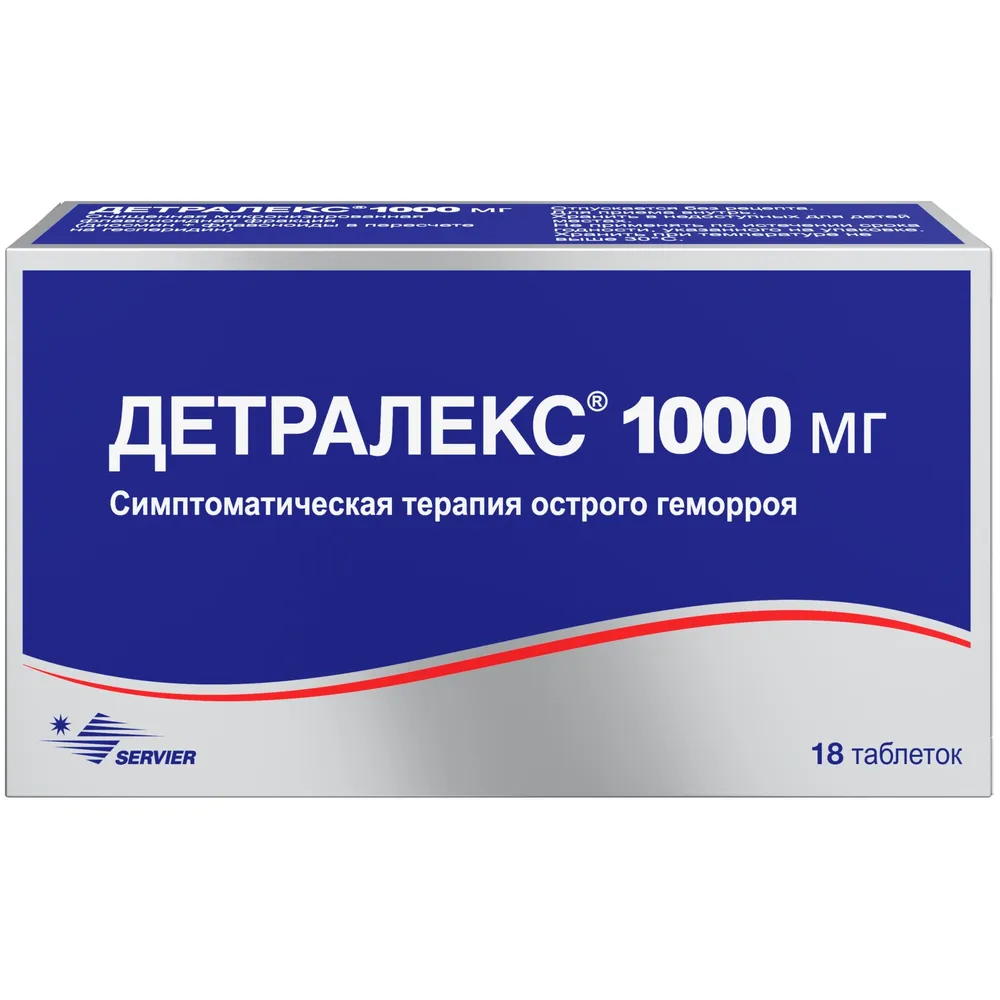
Table of Contents
INSTRUCTIONS FOR MEDICAL USE OF THE MEDICINAL PRODUCT DETRALEX® 1000 mg (DETRALEX® 1000 mg)
Composition:
Active substance: micronized purified flavonoid fraction (diosmin + flavonoids as hesperidin);
One tablet contains 1000 mg of micronized purified flavonoid fraction, which contains 900 mg of diosmin (90%) and 100 mg of flavonoids as hesperidin (10%);
Excipients: microcrystalline cellulose, gelatin, magnesium stearate, sodium starch glycolate (type A), talc, purified water;
Film coating: glycerin, hypromellose, macrogol 6000, magnesium stearate, iron oxide red (E 172), sodium lauryl sulfate, titanium dioxide (E 171), iron oxide yellow (E 172).
Pharmaceutical form. Film-coated tablets.
Main physicochemical properties: elongated-shaped film-coated tablet of orange-pink color, with notches on both sides.
Pharmacotherapeutic group.
Angioprotectives. Capillary stabilizing agents. Bioflavonoids. Diosmin, combinations.
ATC code C05CA53.
Pharmacological Properties
Pharmacodynamics
Pharmacology
Detralex® 1000 mg exerts a venotonic and angioprotective effect, reduces venous distensibility and venous stasis, improves microcirculation, decreases capillary permeability and increases their resistance, as well as enhances lymphatic drainage by increasing lymphatic outflow.
Preclinical Pharmacology
Experimental studies in animals using the "ischemia/reperfusion" model demonstrated that administration of micronized purified flavonoid fraction is more effective in reducing vascular wall permeability and plasma extravasation compared to plain diosmin. This result is attributed to the protective effect on microcirculation provided by flavonoids such as hesperidin, diosmetin, linarin, and isorhoifolin present in the fraction in the form of hesperidin. The reduction in vascular wall permeability and plasma extravasation observed with the micronized purified flavonoid fraction is significantly greater than that observed with plain diosmin or with each individual component of the flavonoid fraction administered separately.
Clinical Pharmacology
The above-mentioned pharmacological properties have been confirmed in double-blind, placebo-controlled studies using methods capable of assessing the drug's effect on venous hemodynamics.
Dose–Response Relationship
A statistically significant dose-dependent effect of the medicinal product was established according to the following venous plethysmographic parameters: venous volume, venous distensibility, and venous outflow time. The optimal dose–response relationship was achieved with a daily dose of 1000 mg.
Venotonic Activity
Detralex® 1000 mg increases venous tone: venous occlusion plethysmography demonstrated a reduction in venous outflow time.
Microcirculatory Activity
In double-blind, placebo-controlled studies, a statistically significant difference was demonstrated between the use of the drug and placebo. In patients with symptoms of capillary fragility, treatment increased capillary resistance, as determined by angio-stereometry.
The drug also reduces leukocyte–endothelium interaction and leukocyte adhesion in postcapillary venules. This reduces the damaging effects of inflammatory mediators on venous walls and venous valve leaflets.
In Clinical Practice
Double-blind, placebo-controlled studies have demonstrated the therapeutic efficacy of the drug in phlebology for the treatment of functional and organic chronic venous insufficiency of the lower limbs, as well as in proctology for the treatment of hemorrhoids.
Pharmacokinetics
Elimination of the active substance occurs primarily via feces. On average, 14% of the administered dose is excreted in urine.
The elimination half-life is 11 hours.
The drug is actively metabolized, as evidenced by the presence of various phenolic acids in urine.
Clinical characteristics.
Indications.
Symptomatic treatment of venous and lymphatic insufficiency (leg heaviness, pain, nocturnal cramps, edema, trophic disorders, including varicose ulcers).
Symptomatic treatment of hemorrhoids.
Contraindications.
Hypersensitivity to the active substance or to any of the excipients.
Interaction with other medicinal products and other forms of interaction.
Studies on interactions have not been conducted. During post-marketing use of the medicinal product, no clinically significant interactions with other medicinal products have been reported.
Special precautions for use.
The use of this medicinal product in acute hemorrhoids does not replace specific therapy and does not preclude the treatment of other proctological diseases. If symptoms do not rapidly resolve during a short course of treatment, a proctological examination should be performed and the treatment regimen reviewed.
For venous circulation disorders, therapy is more effective when combined with adherence to the following lifestyle recommendations:
- avoid prolonged sun exposure, extended periods of standing, and excess body weight;
- walk regularly and, in some cases, wear special compression stockings to improve circulation.
Excipients.
Sodium content.
Detraleks® 1000 mg contains less than 1 mmol of sodium (23 mg) per tablet, i.e., it is practically sodium-free.
Use during pregnancy or breastfeeding.
Pregnancy
Data on the use of micronized purified flavonoid fraction in pregnant women are lacking or limited in quantity.
Animal studies have not demonstrated a teratogenic effect.
As a precautionary measure, it is advisable to avoid using the drug during pregnancy.
Breastfeeding
It is unknown whether the active substance or its metabolites are excreted in breast milk.
Risk to newborns/infants cannot be excluded.
The decision to discontinue breastfeeding or to discontinue/abstain from treatment with this medicinal product should be made by weighing the benefits of breastfeeding for the child against the benefits of treatment for the mother.
Fertility
Reproductive toxicity studies in animals showed no effect on fertility.
Ability to influence reaction speed when driving or operating machinery.
Studies on the effect of the flavonoid fraction on the ability to drive or operate machinery have not been conducted. However, based on the overall safety profile of the flavonoid fraction, Detraleks® 1000 mg has no effect or a negligible effect on this ability. If adverse reactions occur (see section "Undesirable effects"), caution is advised.
Dosage and Administration
For oral use.
The score on the tablet is intended to facilitate swallowing only and is not intended for dividing the tablet into equal doses.
For adults only.
Venous Lymphatic Insufficiency
The recommended dose is 1 tablet daily in the morning with a meal.
The usual recommended duration of treatment is up to 3 months. A longer treatment duration, from 6 to 12 months, was well tolerated in clinical studies.
Hemorrhoidal Disease
Treatment of acute hemorrhoidal episodes: 3 tablets daily for 4 days, followed by 2 tablets daily for the next 3 days. Take with meals. The daily dose should be divided into 2–3 doses. Maintenance therapy: 1 tablet daily, with a treatment duration of up to 3 months.
Children
There are no data on the use of Detralex® 1000 mg in children.
Overdose
Symptoms
There is limited information on cases of overdose with this medicinal product. The most commonly reported adverse reactions in cases of overdose were gastrointestinal reactions (such as diarrhea, nausea, abdominal pain) and skin reactions (such as pruritus, rash).
Treatment
Management of overdose should be symptomatic.
Adverse Reactions
During clinical trials, administration of micronized purified flavonoid fraction was associated with adverse effects of moderate intensity, primarily affecting the gastrointestinal tract (diarrhea, dyspepsia, nausea, vomiting).
The adverse reactions listed below have been reported and are categorized by frequency as follows: very common (≥ 1/10); common (≥ 1/100, < 1/10); uncommon (≥ 1/1000, < 1/100); rare (≥ 1/10000, < 1/1000); very rare (< 1/10000); frequency not known (cannot be estimated from available data).
Nervous system disorders:
Rare: dizziness, headache, malaise.
Gastrointestinal disorders:
Common: diarrhea, dyspepsia, nausea, vomiting;
Uncommon: colitis;
Frequency not known*: abdominal pain.
Skin and subcutaneous tissue disorders:
Rare: pruritus, rash, urticaria;
Frequency not known*: isolated facial, lip, or eyelid swelling, angioedema (Quincke's edema) in exceptional cases.
*Post-marketing observations.
Reporting suspected adverse reactions. Reporting of suspected adverse reactions after marketing authorization of the medicinal product is important. This enables continuous monitoring of the benefit-risk balance of the medicinal product. Healthcare professionals are required to report any suspected adverse reactions through the national reporting system.
Shelf life. 4 years.
Storage conditions.
No special storage conditions required. Keep out of reach and sight of children.
Packaging.
9 tablets in a blister pack made of aluminum foil and PVC film; 2 blisters per cardboard box.
10 tablets in a blister pack made of aluminum foil and PVC film; 3 or 6 blisters per cardboard box.
Pharmaceutical category. Over-the-counter (without prescription).
Manufacturer.
Laboratoires Servier Industrie / Les Laboratoires Servier Industrie.
Manufacturer's address.
905 route de Saran, 45520 Gidy, France.
Marketing authorization holder.
Les Laboratoires Servier.
Address of marketing authorization holder.
50, rue Carnot, 92284 Suresnes Cedex, France.
For any information regarding this medicinal product, please contact LLC "Servier Ukraine" at tel. (044) 490 3441, fax (044) 490 3440.