Dexa-health
Ukraine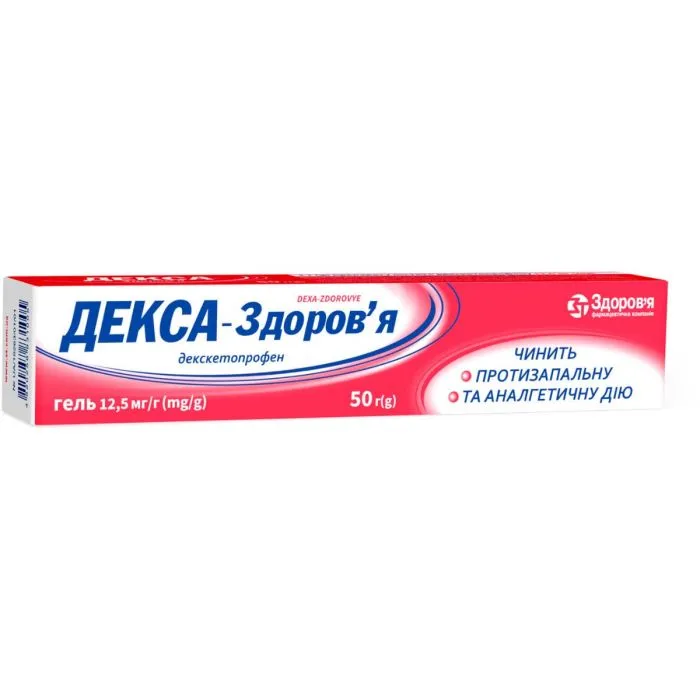
Table of Contents
INSTRUCTIONS FOR MEDICAL USE OF THE MEDICINAL PRODUCT DEXA-ZDOROVYE (DEXA-ZDOROVYE)
Composition:
Active ingredient: dexketoprofen;
1 g of the preparation contains dexketoprofen 12.5 mg;
Excipients: carbomer, tromethamine, ethanol 96%, peppermint oil, purified water.
Pharmaceutical form. Gel.
Main physicochemical properties: colorless, transparent or nearly transparent viscous gel with a slight mint odor.
Pharmacotherapeutic group. Non-steroidal anti-inflammatory drugs for topical use. ATC code M02A A27.
Pharmacological Properties
Pharmacodynamics
Dexketoprofen is S-(+)-2-(3-benzoylphenyl)propionic acid, the active enantiomer of ketoprofen, a non-steroidal anti-inflammatory drug (NSAID) that exerts anti-inflammatory and analgesic effects.
The mechanism of action of NSAIDs is associated with reduced synthesis of prostaglandins through inhibition of cyclooxygenase. Specifically, the conversion of arachidonic acid into cyclic endoperoxides, PGG2 and PGH2, is inhibited, from which prostaglandins PGE1, PGE2, PGF2α, and PGD2, as well as prostacyclin PGI2 and thromboxanes (TxA2 and TxB2), are formed. Thus, suppression of prostaglandin synthesis may affect other mediators of inflammation, such as kinins, which may also indirectly influence the primary action of the drug.
It has been demonstrated that the pharmacological activity of ketoprofen—an effective analgesic, anti-inflammatory, and antipyretic agent—is exclusively due to the S-(+) configuration, or dexketoprofen. Cyclooxygenase inhibition assays show that the R-(-) enantiomer is completely inactive, and that the S-(+) enantiomer accounts for the pharmacological activity of racemic ketoprofen. In vivo studies, both in experimental animals and in humans, confirm these findings.
Pharmacokinetics
Following topical application of dexketoprofen gel, significant local drug levels are achieved, while its plasma concentration remains very low. Pharmacokinetic studies in humans show that after topical administration of dexketoprofen gel, maximum plasma concentration is reached within 4 hours, followed by an elimination phase within 24 hours.
Therapeutically active concentrations of the active substance are maintained in synovial fluid. It has been observed that drug concentrations in synovial fluid after application of dexketoprofen gel at a concentration of 12.5 mg/g are equivalent to or higher than those observed after application of racemic ketoprofen gel at a concentration of 25 mg/g.
Complete absence of inversion of the active S-(+) enantiomer into the inactive R-(-) enantiomer has been confirmed.
Clinical characteristics.
Indications.
Pain, inflammation, traumatic or degenerative conditions of joints, tendons, ligaments, and muscles.
Contraindications.
- Hypersensitivity to the active substance or to any of the excipients of the medicinal product.
- Known hypersensitivity reactions such as asthma symptoms, allergic rhinitis occurring after administration of dexketoprofen, ketoprofen, tiaprofenic acid, fenofibrate, acetylsalicylic acid, other NSAIDs, or any of the excipients of the medicinal product.
- History of photosensitization reactions.
- History of skin allergic reactions upon use of dexketoprofen, ketoprofen, tiaprofenic acid, fenofibrate, ultraviolet (UV) blockers, or perfumed products.
- Exposure to sunlight (even diffused light) or artificial UV irradiation (sunlamps, solarium) during treatment and for 2 weeks after discontinuation of treatment.
− The medicinal product should not be applied to open wounds, infected skin, in cases of eczema, acne eruptions, or on mucous membranes, genital area, eyes, or around the eyes.
- Third trimester of pregnancy.
Interaction with other medicinal products and other forms of interaction.
Interaction with other medicinal products is unlikely, as the serum concentration achieved with topical application is very low.
Special precautions for use
If any skin reactions develop, including those associated with concomitant use of medicinal products containing octocrylene, treatment with the gel should be discontinued immediately.
During treatment and for 2 weeks after its completion, it is recommended to wear clothing that covers the application area to avoid photosensitivity.
After each application of the medicinal product, hands should be thoroughly washed to prevent its spread to other areas that come into contact with the hands.
After applying the gel, tight clothing or occlusive dressings should not be used.
Cross-sensitivity reactions may occur with the use of certain sunscreen creams, fenofibrate, and other agents containing benzophenone in their chemical structure.
Use during pregnancy or breastfeeding
Pregnancy
Clinical data on the use of dexketoprofen during pregnancy are lacking. Although systemic exposure following topical application is lower than with oral administration, it is unknown whether the level of systemic exposure to dexketoprofen achieved after topical use may have a harmful effect on the embryo/fetus. During the first and second trimesters of pregnancy, dexketoprofen should be used only if clearly necessary. If use is required, the dose should be as low as possible and the duration of treatment as short as possible.
During the third trimester of pregnancy, systemic use of prostaglandin synthetase inhibitors, including dexketoprofen, may cause cardiovascular and renal toxicity in the fetus. Towards the end of pregnancy, prolonged bleeding time may occur in both the mother and the child, as well as delay in labor. Therefore, dexketoprofen is contraindicated during the third trimester of pregnancy (see section "Contraindications").
Breastfeeding
There is insufficient data on the passage of dexketoprofen into breast milk; therefore, its use is not recommended in women who are breastfeeding.
Ability to influence the speed of reactions while driving or operating machinery
Not reported.
Method of Administration and Dosage.
In general, it is recommended to apply the gel 2–3 times daily. The amount of gel used will depend on the area to be treated, and it should be gently massaged in to promote absorption.
The total daily dose should not exceed 7.5 g per day, corresponding to approximately 14 cm of gel. Continuous treatment should be limited to a maximum of 7 days.
Children. Doses and indications for use in children have not been established.
Overdose.
Given that the medicinal product is intended for topical use, the likelihood of overdose is very low.
In case of accidental ingestion of the gel, gastric lavage should be performed and symptomatic treatment initiated.
Dexketoprofen is eliminated by dialysis.
Adverse reactions
Adverse reactions are classified below by organ systems.
The frequency of occurrence is defined as follows: very common (≥ 1/10); common (≥ 1/100 to < 1/10); uncommon (≥ 1/1000 to < 1/100); rare (≥ 1/10000 to < 1/1000); very rare (< 1/10000); unknown (frequency cannot be estimated based on available data).
Uncommon: dermatitis (erythema, pruritus, inflammation, burning sensation).
Rare: serious reactions such as bullous or vesicular eczema, which may spread or become generalized.
Very rare: systemic hypersensitivity reactions (urticaria and bronchospasm).
Unknown: photosensitivity reactions (erythema, inflammation, and in some cases mild vesiculation).
Reporting of suspected adverse reactions
Reporting suspected adverse reactions after medicine authorization is of great importance. It allows continuous monitoring of the benefit-risk balance of the medicine. Healthcare professionals are requested to report any suspected adverse reactions.
Shelf life
3 years.
Storage conditions
Store in the original packaging at a temperature not exceeding 25 °C.
Do not freeze.
Keep out of reach and sight of children.
Packaging
50 g or 100 g in a tube, in a carton.
Prescription status
Prescription only.
Manufacturer
LIMITED LIABILITY COMPANY "CORPORATION "ZDOROVIYA".
Manufacturer's address and location of business activity
22 Shevchenka Street, Kharkiv, Kharkiv Oblast, 61013, Ukraine.