Dacepton
Ukraine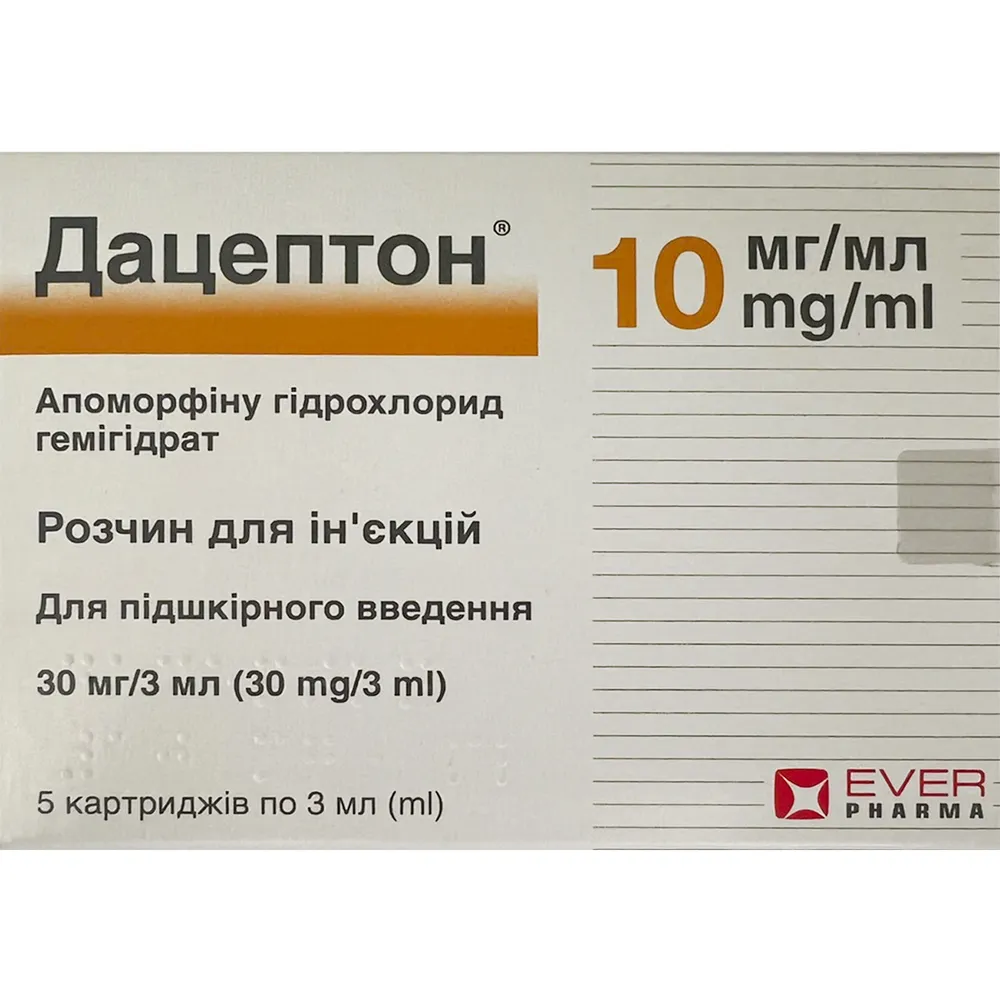
Table of Contents
INSTRUCTIONS FOR MEDICAL USE OF THE MEDICINAL PRODUCT DACEPTON® (DACEPTON®)
Composition:
Active substance: apomorphine hydrochloride hemihydrate;
1 ml of solution contains 10 mg of apomorphine hydrochloride hemihydrate;
Excipients: sodium metabisulfite (E 223), hydrochloric acid (for pH adjustment), sodium hydroxide (for pH adjustment), water for injections.
Pharmaceutical form. Injection solution.
Main physicochemical properties: clear, colorless to slightly yellow solution, free from mechanical particles.
Pharmacotherapeutic group.
Agents acting on the nervous system. Antiparkinsonian agents. Dopaminergic agents. Dopamine agonists. Apomorphine.
ATC Code: N04BC07.
Pharmacological properties.
Pharmacodynamics.
Mechanism of action.
Apomorphine is a direct stimulator of D1 and D2 dopamine receptors. The transport and metabolic pathways of apomorphine and levodopa are different.
Although in intact experimental animals administration of apomorphine reduces the firing rate of neurons in the nigrostriatal system, and at low doses apomorphine decreases motor activity (presumably due to presynaptic inhibition of endogenous dopamine release), its effect on motor disorders in Parkinson's disease is likely mediated via postsynaptic receptors. This biphasic effect is also observed in humans.
Pharmacokinetics.
Distribution and elimination.
The pharmacokinetics of apomorphine after subcutaneous administration are described by a two-compartment model, with a distribution half-life of 5 ± 1.1 minutes and an elimination half-life of 33 ± 3.9 minutes. The clinical effect depends on the concentration of apomorphine in cerebrospinal fluid; the distribution of the active substance is best described by a two-compartment model.
Absorption and metabolism.
Apomorphine is rapidly and completely absorbed from subcutaneous tissues; the clinical effect of the drug begins quickly (within 4–12 minutes) and lasts for a short duration (approximately 1 hour), which is explained by its rapid clearance. Apomorphine is metabolized via glucuronidation and sulfation of at least 10% of the total dose; other metabolic pathways have not been described.
Clinical characteristics.
Indications.
Treatment of motor fluctuations ("on-off" phenomenon) in patients with Parkinson's disease whose condition is not adequately controlled by oral anti-Parkinson medicinal products.
Contraindications.
- Hypersensitivity to the active substance or to any of the excipients.
- Respiratory depression, dementia, psychotic disorders, or hepatic impairment.
- Apomorphine hydrochloride hemihydrate must not be used in patients who experience an "on" response to levodopa associated with severe dyskinesia or dystonia.
- Concomitant use with ondansetron (see section "Interaction with other medicinal products and other types of interactions").
- The medicinal product Dacepton®, solution for injection 10 mg/mL, is contraindicated in children (under 18 years of age).
Special precautions.
Do not use the solution if it has turned green.
The solution should be inspected visually before administration. Only clear, colorless or slightly yellowish solutions free from particulate matter and contained in undamaged containers should be used.
Any unused medicinal product or waste material must be disposed of in accordance with applicable requirements.
All cartridges containing unused medicinal product must be discarded no later than 15 days after first opening.
Patients should be instructed on safe disposal of the needle after each injection.
This package does not contain either a pen-injector device or pen-injector needles.
Dacepton® cartridges are intended for use only with the specifically designated "D-mine-Pen" device and disposable pen needles, as specified in the pen-injector instructions for use.
The "D-mine-Pen" pen-injector device and disposable pen needles can be purchased at a pharmacy.
Interaction with other medicinal products and other types of interactions.
Patients receiving treatment with apomorphine hydrochloride hemihydrate are almost certainly taking other medicinal products for the treatment of Parkinson's disease. Therefore, close monitoring for unusual adverse reactions or signs of potentiated drug effects is required during the initial stages of treatment with apomorphine hydrochloride hemihydrate.
Antagonistic interactions may occur when used concomitantly with neuroleptics. Interaction between clozapine and apomorphine is possible; however, clozapine may also be used to alleviate symptoms of neuropsychiatric complications.
The potential effect of apomorphine on plasma concentrations of other medicinal products has not been studied. Therefore, caution is required when using apomorphine in combination with other medicinal products, particularly those with a narrow therapeutic index.
Antihypertensive and cardioactive medicinal products
Even when used concomitantly with domperidone, apomorphine may potentiate the antihypertensive effect of such medicinal products (see section "Special warnings and precautions for use").
Concomitant use of apomorphine with other medicinal products that prolong the QT interval should be avoided.
Due to reports of profound hypotension and loss of consciousness when apomorphine is used concomitantly with ondansetron, the combined use of apomorphine and ondansetron is contraindicated (see section "Contraindications"). Similar effects may also occur with other 5-HT3 receptor antagonists.
Special precautions for use.
Apomorphine hydrochloride hemihydrate should be used with caution in patients with renal, pulmonary, or cardiovascular disorders, as well as in patients prone to nausea and vomiting.
Particular caution is required during the initial treatment period in elderly and/or debilitated patients.
Since apomorphine may cause arterial hypotension even when premedicated with domperidone, special attention should be paid to patients with cardiac disorders, patients receiving vasoactive medicinal products, particularly antihypertensive agents, and especially patients with a history of orthostatic hypotension.
As apomorphine, particularly at high doses, may prolong the QT interval, caution is required when treating patients at risk of developing "torsades de pointes" type cardiac arrhythmias.
When used in combination with domperidone, individual patient risk factors should be carefully assessed. This assessment should be performed both before starting treatment and during treatment. Important risk factors include serious underlying cardiac conditions such as congestive heart failure, severe hepatic impairment, or significant electrolyte imbalances. Concomitant medicinal products that may affect electrolyte balance, CYP3A4 metabolism, or QT interval should also be evaluated. Monitoring of the effect on the QTc interval is recommended. ECG should be performed:
- before starting domperidone treatment;
- during the initial treatment phase;
- subsequently as clinically indicated.
Patients should be advised to report possible cardiac symptoms, including palpitations, syncope, or near-syncope episodes. Patients should also report clinical conditions that may lead to hypokalemia, such as gastroenteritis or initiation of diuretic therapy.
Risk factors should be reviewed at every medical visit.
Apomorphine treatment may cause local subcutaneous reactions. These may sometimes be minimized by rotating injection sites. Ultrasound examination may be used, if available, to avoid injections into areas with nodules or indurations.
Hemolytic anemia and thrombocytopenia have been reported in patients receiving apomorphine. Hematological parameters should be monitored periodically, as well as when apomorphine is used concomitantly with levodopa.
Caution is required when using apomorphine in combination with other medicinal products, especially those with a narrow therapeutic index (see section "Interaction with other medicinal products and other forms of interaction").
Many patients with progressive Parkinson’s disease exhibit neuropsychiatric disturbances. Evidence suggests that apomorphine may exacerbate neuropsychiatric disturbances in some patients. Special caution is required when administering apomorphine to such patients.
Apomorphine may cause somnolence and episodes of sudden sleep, particularly in patients with Parkinson’s disease. Patients should be warned about this possibility and advised to exercise caution when driving or operating machinery during treatment with apomorphine. Patients who experience somnolence and/or episodes of sudden sleep should refrain from driving and operating machinery. In such cases, dose reduction or discontinuation of therapy should also be considered.
Impulse control disorders
Patients require regular monitoring for the development of impulse control disorders. Patients and caregivers should be informed that treatment with dopamine agonists, including apomorphine, may lead to symptoms of impulse control disorders such as pathological gambling, increased libido, hypersexuality, compulsive shopping or spending, binge eating, and compulsive overeating. If such symptoms occur, dose reduction or gradual discontinuation of the drug should be considered.
Dopamine dysregulation syndrome is an addictive disorder leading to excessive drug use. This syndrome has been observed in some patients receiving apomorphine. Patients and caregivers should be informed about the potential risk of developing dopamine dysregulation syndrome prior to initiating treatment.
Excipients with known effects
The medicinal product Dacepton®, solution for injection 10 mg/ml in cartridges, contains 1 mg of sodium metabisulfite (E 223) per 1 ml, which may rarely cause severe hypersensitivity reactions and bronchospasm.
The product contains less than 1 mmol (23 mg) of sodium in 10 ml, i.e., essentially "sodium-free."
Use during pregnancy or breastfeeding.
Pregnancy.
There is no experience with the use of apomorphine in pregnant women.
In reproductive toxicity studies in animals, no teratogenic effects were observed, but administration of toxic doses to pregnant rats caused respiratory insufficiency in offspring. The potential risk for humans is unknown.
The medicinal product Dacepton® should not be used during pregnancy unless clearly necessary.
Breastfeeding.
There is no information on the excretion of apomorphine into human breast milk. The decision to discontinue breastfeeding or to discontinue/continue treatment with Dacepton® should be made taking into account the importance of breastfeeding for the child and the expected benefit of treatment for the woman.
Ability to affect reaction speed when driving or operating machinery
Apomorphine hydrochloride hemihydrate has a minor or moderate influence on the ability to drive or operate machinery.
Patients treated with apomorphine who experience somnolence and/or episodes of sudden sleep should refrain from driving or other activities (e.g., operating machinery) where reduced alertness may endanger themselves or others from serious injury or fatal outcomes, until such episodes and somnolence have resolved (see also section "Special precautions for use").
Method of Administration and Dosage
Patient Selection for Treatment with Dacepton® Injection Solution 10 mg/mL in Cartridges
Patients selected for treatment with Dacepton® must be able to recognize the onset of their "off" symptoms and be capable of self-administering the injection, or have a responsible caregiver who can administer the injection when needed.
Patients prescribed apomorphine should usually start taking domperidone at least 2 days prior to initiating therapy. The dose of domperidone should be titrated to the lowest effective dose and discontinued as soon as possible. Before initiating treatment with domperidone and apomorphine, a careful assessment of QT interval prolongation risk factors should be performed for each patient to ensure that benefits outweigh risks (see section "Special Warnings and Precautions for Use").
Apomorphine therapy should be initiated under medical supervision in a specialized clinical setting. The patient must be under the care of a physician experienced in managing Parkinson’s disease (e.g., a neurologist). Prior to initiating Dacepton®, the patient’s treatment with levodopa, with or without dopamine agonists, should be optimized.
Adults
Method of Administration
Dacepton® injection solution in cartridges is intended for multi-dose use via intermittent subcutaneous bolus injections using only the dedicated delivery device “D-mine-Pen”.
Patients and caregivers must be provided with detailed instructions on the preparation and administration of the medicinal product, with special attention to the correct use of the required dosing pen device (see the instructions for use accompanying the dosing pen device). There are specific differences between the dosing pen device for this medicinal product and other apomorphine preparations available on the market. Therefore, even if a patient has previously used another pen device, switching to Dacepton® requires retraining under the supervision of a healthcare professional.
Before use, any residual air in the cartridge must be removed (see the instructions for use of the dosing pen device).
Apomorphine must not be administered intravenously!
Do not use the solution if it has turned green. The solution should be visually inspected before administration. Only clear, colorless or slightly yellowish solutions free of particulate matter should be used.
Determination of Threshold Dose
The appropriate dose for each patient should be determined using a dose escalation schedule. The following schedule is recommended:
Administer 1 mg of apomorphine hydrochloride hemihydrate (0.1 mL of the medicinal product), approximately equivalent to 15–20 mcg/kg body weight, subcutaneously during a period of hypokinesia or "off" state, and observe the patient for motor response for 30 minutes.
If there is no response or an inadequate response, administer a second subcutaneous dose of 2 mg apomorphine hydrochloride hemihydrate (0.2 mL of the medicinal product) and continue to observe the patient for another 30 minutes, awaiting an adequate motor response.
Doses may be gradually increased with a minimum interval of at least 40 minutes between subsequent injections until a satisfactory motor response is achieved.
Optimization of Treatment Regimen
After determining the appropriate dose, a single subcutaneous injection of the medicinal product should be administered into the lower abdominal area or the outer thigh at the first signs of an "off" episode. Variability in apomorphine absorption in the same patient when administered at different body sites cannot be ruled out. Therefore, the patient should remain under medical supervision for 1 hour after injection to assess the adequacy of the therapeutic response. The dose may be adjusted based on the patient’s response.
The optimal dose of apomorphine hydrochloride hemihydrate may vary among patients, but remains relatively constant for an individual patient once established.
Precautions During Continued Treatment
The daily dose of Dacepton® varies widely among patients, typically ranging from 3 to 30 mg, with the number of injections ranging from 1 to 10, and occasionally up to 12 times per day.
It is recommended that the total daily dose of apomorphine hydrochloride hemihydrate should not exceed 100 mg, and individual bolus doses should not exceed 10 mg.
The “D-mine-Pen” device required for administration of Dacepton® injection solution in cartridges is not suitable for patients requiring doses higher than 6 mg per bolus.
Such patients should use alternative medicinal products.
During clinical trials, levodopa doses were generally reduced to some extent, but this effect varies significantly among patients and therefore requires careful monitoring by an experienced physician.
After optimization of the treatment regimen, domperidone dosage may be gradually reduced in some patients, although complete discontinuation without symptoms of nausea or arterial hypotension is possible only in a small number of patients.
Elderly Patients
Many patients with Parkinson’s disease are elderly and were included in clinical trials of apomorphine. Treatment regimens for elderly patients do not differ from those for younger patients. However, special caution is required at the beginning of treatment in elderly patients due to the risk of orthostatic hypotension.
Patients with Renal Impairment
Patients with renal impairment may follow a dosing regimen similar to that recommended for adult and elderly patients (see section "Special Warnings and Precautions for Use").
Description of the Pen Device
- To prevent contamination, a new needle must be used for each injection.
- Needles and the pen device must not be shared with other individuals.
- Before using Dacepton®, the instructions for use of the pen device must be read thoroughly to understand its operation and proper handling.
- If the pen device is damaged or not functioning properly (due to mechanical defects), refer to the instructions for use of the pen device.
Where and how to administer Dacepton® injections:
- First, wash your hands.
- Before using the pen device, prepare surgical wipes and one needle in a conical protective cap.
- Follow the instructions for use of the pen device.
Preparing the Pen Device / Cartridge Replacement
Remove the pen device from its case and remove the pen cap.
Unscrew the cartridge holder by turning it clockwise.
Insert a new cartridge into the cartridge holder.
Fully push back the threaded plunger. This is most easily done using the fingertip.
Insert the cartridge holder into the body of the pen and turn counterclockwise until it locks into place.
Attaching the Needle to the Pen Device
Follow the instructions for use of the needles intended for this pen device. Pull and remove the peelable foil.
Attach the needle intended for the pen device to the cartridge holder by pressing until a click is heard or by screwing it on.
Remove the outer protective needle cap. Keep the outer protective needle cap for safe removal and disposal of the needle after use.
Remove and dispose of the inner protective needle cap.
Initial Priming / Function Check
Before use, any residual air in the cartridge must be removed. Set a test dose by rotating the dose dial. Verify the set dose by viewing the display vertically from above, not at an angle, ensuring the symbol “S” is clearly visible. This is called “initial priming” and is essential to ensure delivery of the full dose when using the pen device.
To check function, hold the pen with the needle pointing upward and gently tap the cartridge holder to allow air bubbles to rise to the top.
Press the button.
Several drops of the medicinal product will emerge from the tip of the needle. If no drops appear, repeat the step.
Dose Setting
Set the required dose by rotating the dose dial clockwise. Adjust the dose by rotating counterclockwise.
Injection
- Using a surgical wipe, clean the area of skin where the injection is to be administered and the surrounding area.
- Dacepton® must be administered subcutaneously into the anterior waist area (abdomen) or the outer thigh.
- Use the injection technique recommended by the physician and/or healthcare professional.
Fully press the button to administer the injection. Keep the button fully pressed during administration. After complete delivery of the medicinal product, wait 6 seconds before slowly withdrawing the needle. You may either keep the button pressed or release it during these 6 seconds. Ensure that “0.0” appears on the display, confirming full dose delivery.
- The injection site must be rotated each time Dacepton® is administered. This reduces the risk of skin reactions at the injection site. Dacepton® must not be administered into areas of skin that are painful, red, infected, or damaged.
- Never administer this pen device directly into a vein (intravenously) or into muscle (intramuscularly).
Needle Removal After Each Injection
After each injection, the needle must be removed and disposed of.
Carefully reattach the outer protective needle cap to the needle.
Unscrew the needle from the pen device by turning the outer cap clockwise, and dispose of it properly.
Alternative method
Place the outer needle cap into the designated left recess of the storage case. The opening of the cap should face upward. Carefully insert the needle (attached to the pen device) into the cap opening. Without holding the cap, press firmly downward and turn counterclockwise to unscrew the needle.
After each use, securely close the pen device with its cap.
- The cartridge remains in the pen device.
- A new cartridge may be used for up to 15 days (see section "Shelf Life").
- If there is insufficient solution remaining for the next dose, the cartridge must be removed and disposed of.
- Needles must be disposed of safely, as described in the instructions for use of the pen device.
From a microbiological standpoint, unless the method of opening and subsequent handling excludes the risk of microbial contamination, the medicinal product should be used immediately. If not used immediately, storage conditions and duration after opening are the responsibility of the user.
Children
Dacepton® injection solution 10 mg/mL in cartridges is contraindicated in children (under 18 years of age) (see section "Contraindications").
Overdose
There is limited clinical information on apomorphine overdose following subcutaneous administration. Symptomatic treatment may be administered empirically as suggested below.
For excessive nausea and vomiting: domperidone may be used.
For respiratory depression: naloxone may be used.
For arterial hypotension: appropriate measures (e.g., elevating the legs).
For bradycardia: atropine may be used.
Adverse Reactions
Adverse reactions are categorized according to frequency as follows: very common (≥1/10), common (≥1/100, <1/10), uncommon (≥1/1,000, <1/100), rare (≥1/10,000, <1/1,000), very rare (<1/10,000), and frequency not known (cannot be estimated from the available data).
Blood and lymphatic system disorders
Uncommon: hemolytic anemia and thrombocytopenia have been reported in patients receiving apomorphine.
Rare: eosinophilia was rarely observed during treatment with apomorphine hydrochloride hemihydrate.
Immune system disorders
Rare: since the medicinal product contains sodium metabisulfite, allergic reactions (including anaphylaxis and bronchospasm) are possible.
Psychiatric disorders
Very common: hallucinations.
Common: neuropsychiatric disorders (including mild transient confusion and visual hallucinations) have been observed during treatment with apomorphine hydrochloride hemihydrate.
Frequency not known: impulse control disorders (pathological gambling, increased libido, hypersexuality, compulsive shopping or spending, binge eating, and compulsive overeating) may occur in patients treated with dopamine agonists, including apomorphine (see section "Special precautions"); aggression, anxiety agitation.
Nervous system disorders
Common: a transient sedative effect upon administration of each dose of apomorphine hydrochloride hemihydrate may occur at the beginning of treatment; this effect usually resolves within a few weeks after initiation of therapy; apomorphine treatment is associated with somnolence; dizziness has also been reported.
Uncommon: apomorphine may induce dyskinesias during the "on" period, which in some cases may be severe and lead to discontinuation of therapy in some patients; episodes of sudden sleep onset have been reported with apomorphine use (see section "Special precautions").
Frequency not known: syncope; headache.
Vascular disorders
Uncommon: orthostatic hypotension is uncommon and usually transient (see section "Special precautions").
Respiratory, thoracic and mediastinal disorders
Common: yawning has been observed during apomorphine treatment.
Uncommon: dyspnea has been reported.
Gastrointestinal disorders
Common: nausea and vomiting, particularly during the initial period of apomorphine treatment, usually in the absence of domperidone co-administration (see section "Dosage and administration").
Skin and subcutaneous tissue disorders
Uncommon: localized and generalized rashes have been reported.
General disorders and administration site conditions
Very common: injection site reactions are observed in most patients, especially with continuous use, including subcutaneous nodules, induration, erythema, pain, and panniculitis; other local reactions (such as irritation, pruritus, bruising, and pain) may also occur.
Uncommon: necrosis and ulcers at the injection site have been reported.
Frequency not known: peripheral edema has been reported.
Investigations
Uncommon: positive Coombs test has been reported during treatment of patients with apomorphine.
Reporting of suspected adverse reactions
Reporting of adverse reactions after marketing authorization is important. It allows continued monitoring of the benefit-risk balance of the medicinal product. Healthcare professionals, pharmacists, patients, or their legal representatives are requested to report all suspected adverse reactions and lack of efficacy via the Automated Pharmacovigilance Information System at the following link: https://aisf.dec.gov.ua.
Shelf life. 2 years.
After first opening — 15 days.
Storage conditions.
Store in the original packaging, out of reach of children, at a temperature not exceeding 25°C. Do not refrigerate or freeze!
Incompatibilities.
Due to lack of compatibility studies, this medicinal product must not be mixed with other medicinal products.
Packaging.
3 mL in a cartridge; 5 cartridges in a plastic blister pack in a cardboard box.
Prescription status.
Prescription only.
Manufacturer.
EVER Pharma Jena GmbH / EVER Pharma Jena GmbH.
Manufacturer's address.
Otto-Schott-Strasse 15, Sued, Jena, Thuringia, 07745, Germany / Otto-Schott-Strasse 15, Sued, Jena, Thuringia, 07745, Germany.
Marketing Authorization Holder.
EVER Neuro Pharma GmbH / EVER Neuro Pharma GmbH.
Address of the Marketing Authorization Holder.
Obervogau 3, 4866 Unterach am Attersee, Austria / Oberburgau 3, 4866 Unterach am Attersee, Austria.