Brimogen
Ukraine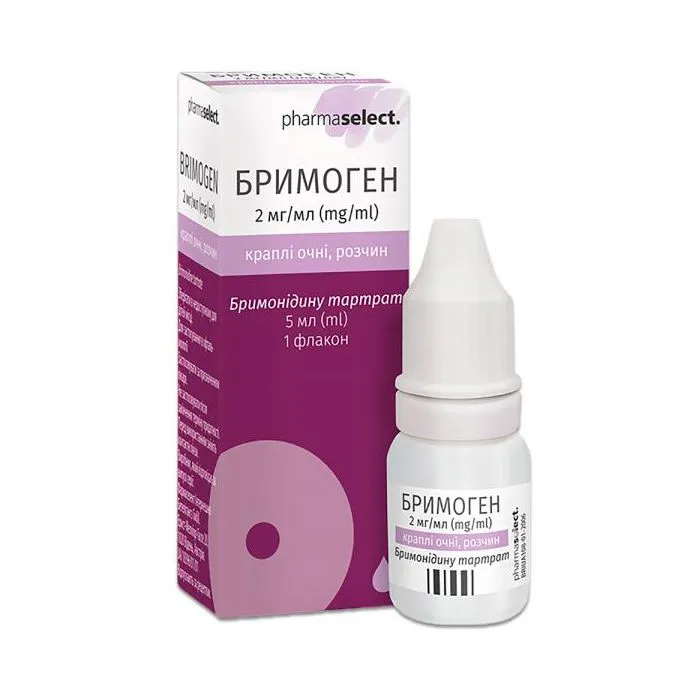
Table of Contents
INSTRUCTIONS FOR MEDICAL USE OF THE MEDICINAL PRODUCT BRIMOGEN (BRIMOGEN)
Composition:
Active substance: brimonidine tartrate;
1 ml of solution contains brimonidine tartrate 2 mg, equivalent to 1.32 mg of brimonidine;
Excipients: benzalkonium chloride; polyvinyl alcohol; sodium chloride; sodium citrate; citric acid monohydrate; 1 M solution of sodium hydroxide / 25 % solution of hydrochloric acid (for pH adjustment); water for injections.
Pharmaceutical form. Eye drops, solution.
Main physicochemical properties: clear, slightly yellow solution, not more intensely coloured than reference standard GY3, free from visible particles.
Pharmacotherapeutic group. Anti-glaucoma and miotic agents. ATC code S01E A05.
Pharmacological Properties.
Pharmacodynamics.
Brimonidine is an α-2 adrenergic receptor agonist. Brimonidine has an affinity for α-2 adrenergic receptors that is 1000 times greater than its affinity for α-1 adrenergic receptors. As a result, brimonidine avoids causing miosis and vasoconstriction in the microvessels associated with xenogenic human retinal transplants.
After administration into the conjunctival sac, brimonidine tartrate reduces intraocular pressure with minimal effects on the cardiovascular and respiratory systems.
Limited data on the use of the drug in patients with bronchial asthma did not confirm the occurrence of adverse reactions.
Brimonidine is characterized by a rapid onset of action, and its maximum hypotensive effect occurs 2 hours after administration. In two clinical studies conducted over one year, brimonidine reduced intraocular pressure by approximately 4–6 mmHg.
According to fluorophotometric studies in animals and human volunteers, brimonidine tartrate exhibits a dual mechanism of action. Brimonidine likely reduces intraocular pressure by decreasing the production of aqueous humor and enhancing uveoscleral outflow.
Clinical studies confirm that brimonidine can be effectively combined with topically applied beta-adrenergic blockers. Short-term clinical studies also confirm that brimonidine exerts a significant additive clinical effect when used in combination with travoprost (6 weeks) and latanoprost (3 months).
Pharmacokinetics.
After 10 days of administration into the conjunctival sac of a 0.2% solution twice daily, a low plasma concentration of brimonidine was observed (mean Cmax was approximately 0.06 ng/mL).
After repeated administration of the drug (twice daily for 10 days), a slight accumulation of the drug in the blood was recorded. The area under the plasma concentration–time curve over 12 hours at steady state (AUC0–12h) was 0.31 ng·h/mL compared to 0.23 ng·h/mL after the first dose. The mean elimination half-life from systemic circulation after topical administration was approximately 3 hours.
Plasma protein binding of brimonidine after topical administration is approximately 29%.
In ocular tissues, brimonidine reversibly binds to melanin in vitro and in vivo. After two weeks of ocular administration, concentrations of brimonidine in the iris, ciliary body, and choroidal/retinal tissues were 3–17 times higher than after a single dose. Accumulation does not occur in the absence of melanin.
The significance of binding to melanin is not fully understood. However, biomicroscopic examination of patients who received brimonidine tartrate ophthalmic drops for up to 1 year did not reveal any significant ocular adverse reactions. In monkeys receiving doses approximately 4 times higher than the recommended dose of brimonidine tartrate, no significant ocular toxicity was observed.
In humans, brimonidine is well absorbed from the gastrointestinal tract and rapidly eliminated after oral administration. A significant portion of the dose (approximately 75%) is excreted in urine as metabolites within 5 days; unchanged drug has not been detected in urine. In vitro studies using animal and human liver tissues indicate that its metabolism is primarily mediated by aldehyde oxidase and cytochrome P450. Systemic clearance is believed to be predominantly due to hepatic metabolism.
Kinetic profile.
No significant deviations from dose-proportionality were observed between brimonidine dose, maximum plasma concentration (Cmax), and AUC after single administration of the drug at concentrations of 0.08%, 0.2%, and 0.5%, respectively.
Geriatric patients.
Cmax, AUC, and elimination half-life of brimonidine after a single dose are similar in elderly patients (aged 65 years and older) and younger patients, indicating that age does not significantly affect systemic absorption and elimination of the drug.
Three-month clinical studies involving elderly patients confirmed that the overall systemic impact of brimonidine was very minimal.
Clinical characteristics.
Indications.
Reduction of elevated intraocular pressure in patients with open-angle glaucoma or ocular hypertension:
- as monotherapy in the form of eye drops, when local use of beta-blockers is contraindicated;
- as part of combination therapy with other medicinal products that reduce intraocular pressure, if pressure reduction with these agents alone is insufficient.
Contraindications.
- Hypersensitivity to brimonidine tartrate or to any of the excipients.
- Pediatric age.
- Concomitant use of monoamine oxidase inhibitors (MAOIs), or antidepressants affecting noradrenergic transmission (e.g., tricyclic antidepressants, mianserin).
Interaction with other medicinal products and other forms of interaction.
The medicinal product is contraindicated in patients receiving treatment with MAO inhibitors and in patients taking antidepressants that affect noradrenergic transmission (i.e., tricyclic antidepressants and mianserin).
Although specific studies on the interaction of brimonidine with other medicinal products have not been conducted, potential enhancement of the effect of central nervous system (CNS) depressants (alcohol, barbiturates, opiates, sedatives, or anesthetics) should be considered.
Caution is advised when prescribing the medicinal product to patients receiving medicinal products that may affect amine metabolism and their distribution in the vascular bed (e.g., chlorpromazine, methylphenidate, reserpine).
Reduction in systemic blood pressure has been observed in some patients after administration of brimonidine, although this effect was not clinically significant. Antihypertensive agents and cardiac glycosides should be used with caution.
Care should be taken when using brimonidine concomitantly with antihypertensive agents and/or cardiac glycosides. Caution is recommended at the beginning of treatment (or when increasing the dose) during combination therapy with systemic agents (regardless of their pharmaceutical form) that may interact with alpha-adrenergic agonists or affect their efficacy, i.e., adrenergic receptor agonists or antagonists (e.g., isoprenaline, prazosin).
Special precautions for use
The drug should be used with caution in patients with acute or unstable and uncontrolled cardiovascular diseases. Hypersensitivity reactions in the eye area have been reported in some patients (12.7%) during clinical trials following administration of brimonidine.
If allergic reactions occur, brimonidine should be discontinued.
Delayed hypersensitivity reactions related to the eyes have been observed following the use of brimonidine; some of these were associated with increased intraocular pressure.
The drug should be used with caution in patients with depression, cerebral circulatory insufficiency, coronary insufficiency, Raynaud's syndrome, orthostatic hypotension, and thromboangiitis obliterans.
The effect of the drug in patients with hepatic or renal insufficiency has not been studied; therefore, caution should be exercised when administering the drug to patients with such conditions.
The preservative contained in the medicinal product, benzalkonium chloride, may cause eye irritation. Therefore, contact of the product with soft contact lenses should be avoided. Contact lenses must be removed prior to instillation of the medicinal product, and at least 15 minutes should elapse before they are reinserted. The substance may cause discoloration of soft contact lenses.
Use during pregnancy or breastfeeding
Safety studies of brimonidine tartrate use in pregnant women have not been conducted. During pregnancy or breastfeeding, the drug should be used only if the expected benefit to the woman clearly outweighs the potential risk to the fetus or infant.
If use of the drug is necessary, breastfeeding should be discontinued.
Ability to affect reaction speed when driving or operating machinery
Brimonidine may cause fatigue and/or drowsiness, which may impair the ability to drive or operate machinery. Brimonidine may also cause visual disturbances, including reduced visual acuity and/or blurred vision, which may interfere with the ability to drive or operate machinery, particularly at night or under conditions of reduced lighting. Patients should wait until these symptoms have resolved before driving or operating machinery.
Method of Administration and Dosage
Use in adults, including elderly patients
The recommended dosage is 1 drop of the medicinal product instilled into the affected eye (eyes) twice daily, approximately 12 hours apart. Dose adjustment is not required for elderly patients.
As with any other ophthalmic drops, to reduce the likelihood of brimonidine entering the bloodstream and lymphatic system, it is recommended to press and hold the lacrimal sac at the inner corner of the eye (punctal occlusion) for 1 minute immediately after instillation of the medicinal product. This procedure should be performed immediately after the instillation of each drop.
If more than one ophthalmic medicinal product for local use is being administered, an interval of at least 5–15 minutes between applications is recommended.
Use in patients with hepatic or renal impairment
Studies on the use of the medicinal product in patients with hepatic or renal impairment have not been conducted.
Children
The safety and efficacy of brimonidine in children have not been established.
Overdose
Overdose following ocular administration (adults)
Reported cases generally described events already known as adverse effects.
Systemic overdose due to accidental ingestion (adults)
Data on accidental oral intake of brimonidine in adult patients are limited. The only reported adverse effect was a reduction in blood pressure. Following an episode of hypotension, a rebound hypertension was observed.
Treatment of oral overdose includes supportive care and symptomatic therapy; maintaining airway patency is essential.
Overdose with other alpha-2 agonists has been reported to cause symptoms such as arterial hypotension, asthenia, vomiting, lethargy, sedation, bradycardia, arrhythmia, miosis, apnea, hypotonia, hypothermia, respiratory failure, and seizures.
Overdose following topical administration and systemic overdose due to accidental oral ingestion (in children)
Serious adverse effects have been reported following accidental administration of the product to children.
Symptoms of brimonidine overdose observed include apnea, bradycardia, coma, arterial hypotension, hypothermia, hypotonia, lethargy, pallor, respiratory failure, and somnolence, reported in neonates, infants, and children who received brimonidine eye drops (0.1–0.2%) as part of treatment for congenital glaucoma or following accidental ingestion of brimonidine.
Some of these symptoms required intensive therapy including intubation. All patients fully recovered within 6–24 hours.
Side effects.
The most commonly occurring side effects (in 22–25% of patients) are dryness of the oral mucosa, conjunctival hyperemia, and burning/stinging sensation in the eyes. These symptoms are usually temporary and do not require discontinuation of treatment.
Ocular allergic symptoms occurred in 12.7% of patients participating in clinical studies (11.5% of patients discontinued the study). Such reactions most commonly occurred between the 3rd and 9th month of treatment.
Within each of the following system organ classes, adverse events are listed in order of decreasing severity. The frequency of adverse reactions is classified as follows: very common (˃ 1/10); common (from ≥1/100 to <1/10); uncommon (˂ 1/100); rare (from ≥1/1000 to <1/100); very rare (˂1/10000); not known (frequency cannot be estimated from available data).
Immune system disorders: uncommon – systemic allergic reactions.
Psychiatric disorders: uncommon – depression; very rare – insomnia.
Nervous system disorders: very common – headache, drowsiness; common – dizziness, taste disturbances; very rare – loss of consciousness.
Eye disorders: very common – eye irritation (conjunctival hyperemia, burning and stinging sensation, itching, conjunctival follicles, foreign body sensation), decreased visual acuity – allergic blepharitis and conjunctivitis, allergic conjunctivitis, allergic reactions in the eye area, and follicular conjunctivitis; common – local irritation (eyelid swelling and redness, eyelid inflammation, conjunctival edema and discharge from the conjunctival sac, eye pain, and lacrimation), photophobia, corneal epithelial damage and discoloration, dry eyes, conjunctival pallor, visual disturbances, conjunctivitis; very rare – iritis, miosis.
Cardiac disorders: not known – arrhythmia (including bradycardia and tachycardia).
Vascular disorders: very rare – hypertension, arterial hypotension.
Respiratory, thoracic and mediastinal disorders: common – upper respiratory tract symptoms; uncommon – dryness of the nasal mucosa; rare – dyspnea.
Gastrointestinal disorders: very common – dryness of the oral mucosa; common – gastrointestinal disturbances.
General disorders and administration site conditions: very common – fatigue; common – weakness (asthenia).
The following adverse effects have been reported during post-marketing use of brimonidine tartrate as an ophthalmic solution. Reports are based on voluntary submissions from an unknown number of patients, therefore it is not possible to estimate the frequency of these events.
Eye disorders: iritis and cyclitis (anterior segment uveitis); eyelid itching.
Skin and subcutaneous tissue disorders: skin reactions including erythema, facial swelling, itching, rash, and blood vessel dilation (vasodilation).
In neonates and infants treated with brimonidine as part of therapy for congenital glaucoma, symptoms of overdose have been observed, such as loss of consciousness, lethargy, drowsiness, decreased blood pressure, hypotonia, bradycardia, hypothermia, cyanosis, pallor, respiratory depression, and apnea.
Shelf life: 2 years.
Shelf life after first opening of the bottle – 28 days.
Storage conditions.
Store at temperatures not exceeding 25 °C.
Keep out of reach of children.
Packaging.
5 ml in a bottle with dropper and cap; 1, 3, or 6 bottles per cardboard box.
Prescription status. Prescription only.
Manufacturer.
Manufacturer responsible for batch release:
Pharmaselect International Betriebsgesellschaft mbH.
Manufacturer's address and place of business.
Ernst-Melchior-Gasse 20, 1020 Vienna, Austria.
Phone/fax: +43 178603860 / +43 1786038620
Email: [email protected]