Bronles
Ukraine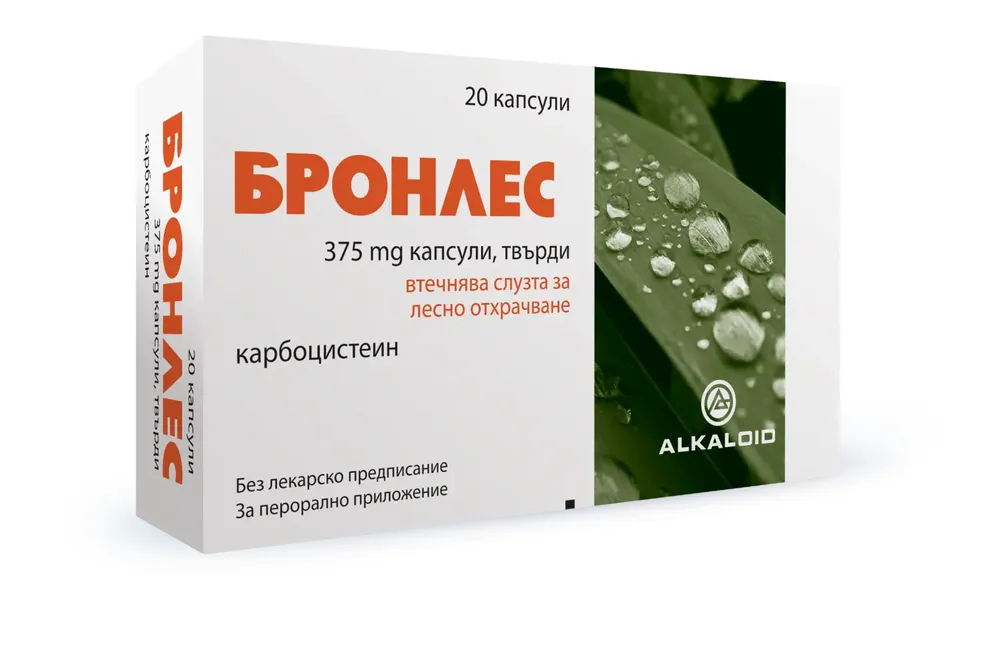
Table of Contents
INSTRUCTIONS FOR MEDICAL USE OF THE MEDICINAL PRODUCT BRONLES® (BRONLES®)
Composition:
Active substance: carbocisteine;
One capsule contains 375 mg of carbocisteine;
Excipients: mannite, maize starch, sodium croscarmellose, sodium lauryl sulfate, colloidal anhydrous silicon dioxide, magnesium stearate;
Capsule shell composition: gelatin, titanium dioxide (E 171), red iron oxide (E 172), yellow iron oxide (E 172).
Pharmaceutical form. Hard capsules.
Main physico-chemical properties: hard gelatin capsules, size № 1, filled with a homogeneous powder ranging from white to almost white;
capsule body and cap color: light-yellow, opaque.
Pharmacotherapeutic group. Medicinal products used in cough and colds. Mucolytic agents. Carbocisteine. ATC code R05CB03.
Pharmacological Properties.
Pharmacodynamics.
Carbocysteine affects the gel phase of respiratory tract mucus: by cleaving disulfide bridges of glycoproteins, it causes liquefaction of excessively viscous bronchial secretions, thereby facilitating expectoration.
The mucoregulatory effect of carbocysteine is associated with activation of sialyltransferase—an enzyme of goblet cells in the bronchial mucosa. Carbocysteine normalizes the quantitative ratio of acidic and neutral sialomucins in bronchial secretions, restores their viscosity and elasticity. It activates the function of ciliated epithelium and improves mucociliary clearance. It promotes regeneration of the respiratory tract mucosa, normalizes its structure, reduces hyperplasia of goblet cells, and consequently decreases mucus production. It restores secretion of immunologically active IgA (specific protection) and increases the number of sulfhydryl groups in mucus components (nonspecific protection). It exhibits anti-inflammatory effects due to kinin-inhibiting activity of sialomucins, leading to reduced edema and bronchoobstruction.
Pharmacokinetics.
Carbocysteine is rapidly absorbed from the gastrointestinal tract. In an in-house study under steady-state conditions (7 days), administration of carbocysteine 375 mg capsules—2 capsules three times daily—to healthy volunteers yielded the following pharmacokinetic parameters:
| Plasma parameters |
Mean value |
Range |
| Tmax (Hr) |
2.0 |
1.0−3.0 |
| T 1/2 (Hr) |
1.87 |
1.4−2.5 |
| KEL (Hr-1) |
0.387 |
0.28−0.50 |
| AUC0-7,5 (mcg.Hr.ml-1) |
39.26 |
26.0−62.4 |
Interpretation of obtained pharmacokinetic parameters
٭ CLs (L·hr-1) 20.2 -
CLs (ml·min-1) 331 -
Vd (L) 105.2 -
Vd (L·kg-1) 1.75 -
*Calculated based on dose on day 7 of the study.
Clinical characteristics.
Indications.
Adjunctive therapy of respiratory tract disorders characterized by excessive viscous mucus production, including chronic obstructive respiratory diseases.
Contraindications.
Hypersensitivity to carbocisteine or to any of the excipients of the medicinal product.
Active peptic ulcer disease.
Interaction with other medicinal products and other forms of interaction.
During treatment with this medicinal product, antitussives and agents that suppress bronchial secretion should not be used. Enhances the effectiveness of glucocorticoid therapy (mutually) and antibacterial therapy.
Special precautions for use
It is recommended to use the medicinal product with caution in elderly patients, in patients with a history of gastrointestinal bleeding, or in patients who are concurrently taking medicinal products that may cause gastrointestinal bleeding. If gastrointestinal bleeding occurs, patients should discontinue the use of the product.
In the presence of thick or purulent sputum, elevated body temperature, or chronic bronchial or pulmonary disease, the clinical condition should be re-evaluated.
Productive cough should not be suppressed, as it is one of the most important protective mechanisms of the bronchopulmonary system.
Combining medicinal products that affect bronchial secretion with antitussive agents or substances that reduce secretory secretions (anticholinergic-like drugs) is irrational.
If disease symptoms do not resolve or worsen, medical advice should be sought to reassess the treatment.
This medicinal product contains less than 1 mmol (23 mg)/dose of sodium, i.e., it is practically sodium-free.
Use during pregnancy or breastfeeding
Although animal studies have not shown teratogenic effects, carbocysteine is not recommended during the first trimester of pregnancy.
There are no data regarding the passage of carbocysteine into breast milk.
During pregnancy and breastfeeding, the medicinal product should be used only after careful assessment of the benefit-risk ratio for mother and fetus (child), as determined by a physician.
Ability to influence reaction rate while driving or operating machinery
Not known.
Method of Administration and Dosage
Dosage
Adults and elderly patients
The dosage is based on an initial daily dose of 2250 mg of carbocisteine given in divided doses, which should be gradually reduced to 1500 mg per day in divided doses upon achieving a satisfactory response: administer 2 capsules three times a day, reducing the dose to 1 capsule four times a day.
Duration of therapy
The drug is intended for short-term use. Treatment with Bronles should not exceed 5 days without consulting a physician.
Route of administration
For oral use.
Children
The drug is not intended for use in children.
Overdose.
Gastric lavage may be beneficial, followed by subsequent monitoring.
The most common symptoms of overdose are gastrointestinal disturbances.
Adverse Reactions
The following MedDRA frequency classification is used to describe adverse reactions, when applicable: very common (≥1/10); common (≥1/100 to <1/10); uncommon (≥1/1,000 to <1/100); rare (≥1/10,000 to <1/1,000); very rare (<1/10,000); frequency not known (cannot be estimated from the available data).
Immune system disorders
Reports of anaphylactic reactions, allergic skin rash, and fixed drug eruptions have been received.
Gastrointestinal disorders
There have been reports of diarrhea, nausea, epigastric discomfort, and gastrointestinal hemorrhage occurring during treatment with carbocysteine.
Frequency not known (cannot be estimated from the available data): vomiting, gastrointestinal hemorrhage.
Skin and subcutaneous tissue disorders
There have been reports of skin rashes and allergic skin eruptions. Isolated cases of bullous dermatitis, such as Stevens-Johnson syndrome and erythema multiforme, have also been reported.
Reporting of adverse reactions following marketing authorization is important. It allows continued monitoring of the benefit-risk balance of the medicinal product. Healthcare and pharmaceutical professionals, as well as patients or their legal representatives, should report all suspected adverse reactions and lack of efficacy via the Automated Information System for Pharmacovigilance at the following link: http://aisf.dec.gov.ua.
Shelf life
3 years. Do not use after the expiry date stated on the packaging.
Storage conditions
Store at a temperature not exceeding 30 °C.
Keep out of the reach and sight of children.
Packaging
10 capsules in a blister (PVC/PVDC/aluminum foil). 30 capsules (3 blisters) in a cardboard pack.
Availability category
Over-the-counter (without prescription).
Manufacturer
ALKALOID AD Skopje.
ALKALOID AD Skopje.
Manufacturer's address and location of operations
Boulevard Aleksandar Makedonski 12, Skopje, 1000, Republic of North Macedonia.
Boulevard Aleksandar Makedonski 12, Skopje, 1000, Republic of North Macedonia.