Bronhomax
Ukraine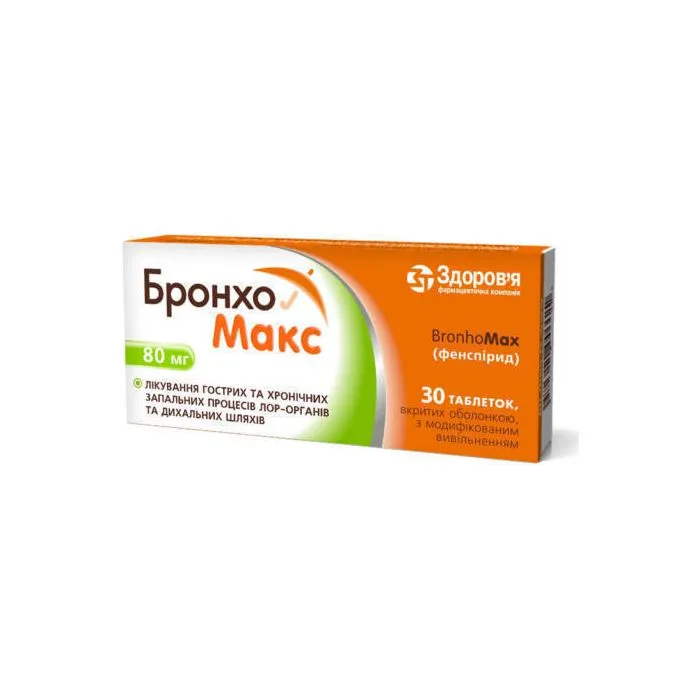
Table of Contents
INSTRUCTION FOR MEDICAL USE OF THE MEDICINAL PRODUCT BRONCHOMAX
Composition:
Active ingredient: 1 tablet contains 80 mg of fenspiride hydrochloride;
Excipients: calcium hydrogen phosphate, povidone, hypromellose, magnesium stearate, colloidal anhydrous silicon dioxide, titanium dioxide (E 171), talc, polyethylene glycol.
Pharmaceutical form. Modified-release coated tablets.
Main physicochemical properties: coated tablets, white-colored, round, biconvex.
Pharmacotherapeutic group. Agents acting on the respiratory system. Other systemic preparations used in obstructive respiratory diseases.
ATC code R03DX03.
Pharmacological properties.
Pharmacodynamics. Phenospiridum hydrochloride has anti-bronchoconstrictor and anti-inflammatory properties caused by the interaction of several related mechanisms:
- blockade of H1-histamine receptors and spasmolytic effect on bronchial smooth muscle;
- anti-inflammatory effect resulting from reduced production of various pro-inflammatory factors (cytokines, TNFα, arachidonic acid derivatives, prostaglandins, leukotrienes, thromboxane, free radicals); some of these also exert bronchoconstrictor effects;
- blockade of α1-adrenoreceptors, which stimulate secretion of viscous mucus.
Pharmacokinetics. Maximum plasma concentration is reached on average 6 hours after oral administration. Elimination half-life is 12 hours. Phenospiridum is excreted from the body mainly via urine.
Clinical characteristics.
Indications.
- Treatment of acute and chronic inflammatory conditions of the ear, nose, throat, and respiratory tract (otitis, sinusitis, rhinitis, rhinopharyngitis, tracheitis, rhinotracheobronchitis, bronchitis), chronic obstructive pulmonary disease (COPD), as part of combination therapy for bronchial asthma.
- Seasonal and perennial allergic rhinitis and other respiratory and ENT manifestations of allergy.
- Respiratory manifestations of measles and influenza.
- Symptomatic treatment of whooping cough.
Contraindications. Hypersensitivity (allergy) to the active substance or to any of the excipients of the medicinal product.
Interaction with other medicinal products and other forms of interaction. Relevant studies have not been conducted. Concomitant use of fenspiride and sedative agents or alcohol consumption is not recommended. Sedative agents and alcohol may enhance the sedative effect of drugs possessing H1-histamine receptor blocking properties (including fenspiride).
Special precautions for use.
Treatment with the drug does not replace antibiotic therapy.
Use during pregnancy or breastfeeding. Data on the use of fenspiride during pregnancy are limited. Therefore, the use of the drug during pregnancy is not recommended. However, if pregnancy is diagnosed during fenspiride treatment, this is not an indication for termination of pregnancy. It is not known whether fenspiride is excreted in breast milk; therefore, the drug should not be used during breastfeeding. There is no toxic effect on fertility.
In animal studies, cases of cleft palate were observed in rats and rabbits.
Ability to influence reaction speed when driving vehicles or operating machinery. Studies on the effect of the drug on the ability to drive vehicles or operate machinery have not been conducted. Since the drug may cause drowsiness, it may have a minor effect on the ability to drive vehicles or operate machinery, particularly at the beginning of treatment or during concomitant alcohol consumption.
Method of Administration and Dosage.
Recommended for use in adults.
For oral administration.
Administer before meals.
Daily dose. The usual recommended therapeutic dose for the treatment of chronic inflammatory conditions is 2 tablets per day (in the morning and evening).
For enhanced effect and/or in acute conditions – 3 tablets per day (in the morning, afternoon, and evening).
Duration of treatment. The length of treatment depends on the course of the disease and is determined individually by the physician.
Children. The drug should be administered to children aged 2 to 18 years only in the form of syrup.
Overdose. In case of ingestion of a large amount of the drug, symptoms such as drowsiness or excitement, nausea, vomiting, and sinus tachycardia may occur.
Treatment. Gastric lavage is necessary; ECG monitoring should be performed. Apply symptomatic therapy.
Adverse reactions.
The most common adverse reactions associated with the use of fenspiride are gastrointestinal disorders.
Gastrointestinal system: digestive disturbances, diarrhea, vomiting, nausea, stomach pain.
Cardiovascular system: moderate sinus tachycardia, which decreases after dose reduction, palpitations, arterial hypotension.
Nervous system: drowsiness, dizziness.
Skin and subcutaneous tissue: erythema, fixed pigmented erythema, rash, urticaria, angioedema, pruritus, toxic epidermal necrolysis, Stevens-Johnson syndrome.
General disorders: asthenia (weakness), increased fatigue.
Shelf life. 2 years.
Do not use the medicinal product after the expiry date stated on the packaging.
Storage conditions. Store in the original packaging at a temperature not exceeding 25 °C.
Keep out of reach and sight of children.
Packaging. Tablets, 10x2, 30 in blisters in a box.
Prescription status. Prescription only.
Manufacturer. Limited liability company "Pharmaceutical Company "Zdorovye".
Manufacturer's address. 22 Shevchenko Street, Kharkiv, Kharkiv Oblast, 61013, Ukraine.