Bronchophyt
Ukraine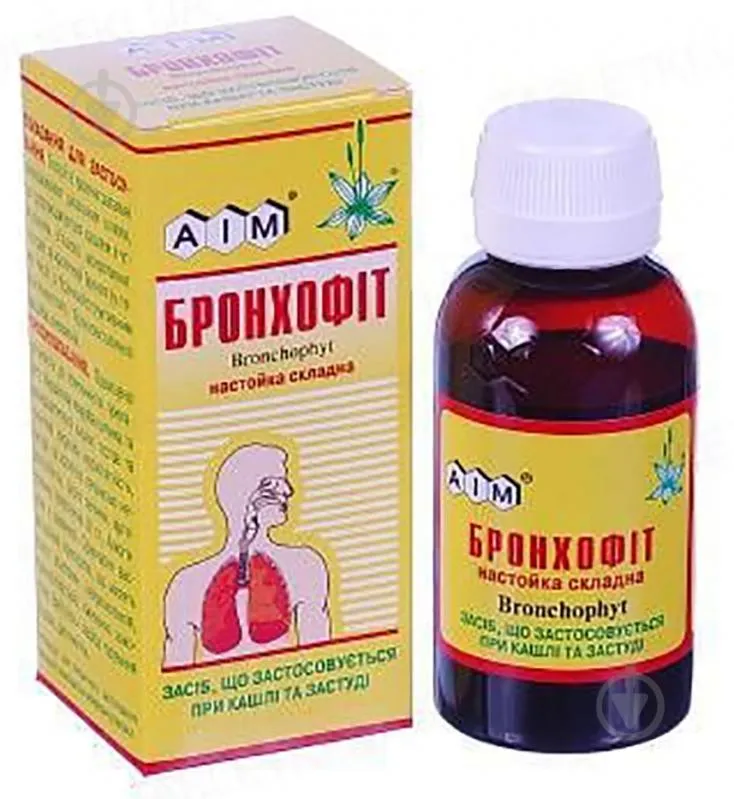
Table of Contents
INSTRUCTIONS FOR MEDICAL USE OF THE MEDICINAL PRODUCT BROMKHOFIT
Composition:
Active substances: 1 ml of the preparation contains a complex tincture from a mixture of herbal raw materials BROMKHOFIT (sweet flag rhizomes (Calami radix) 9 mg, marshmallow roots (Althaeae radix) 9 mg, lime flowers (Tiliae flos) 9 mg, marigold flowers (Calendulae flos) 9 mg, licorice roots (Liquiritiae radix) 9 mg, sage leaves (Salviae officinalis folium) 9 mg, elder flowers (Sambuci flos) 8 mg, nettle leaves (Urticae folium) 8 mg, peppermint leaves (Menthae piperitae folium) 8 mg, creeping thyme herb (Serpylli herba) 8 mg, elecampane roots (Inulae helenii radix) 7 mg, chamomile flowers (Matricariae flos) 7 mg) (1:10) (extraction solvent – ethanol 40%).
Pharmaceutical form. Complex tincture.
Main physicochemical properties: Clear liquid ranging in color from yellowish-brown to reddish-brown, with a characteristic odor. Presence of sediment is permissible.
Pharmacotherapeutic group. Medicinal products used for cough and colds. Expectorants.
ATC code R05C A.
Pharmacological properties.
Pharmacodynamics.
The pharmacological activity of the medicinal product is determined by biologically active substances derived from medicinal plants, which can be grouped according to their properties as follows: anti-inflammatory (Acorus calamus, Inula helenium, Tilia europaea, Chamomilla recutita, Sambucus nigra, Euphrasia officinalis, Salvia officinalis, Glycyrrhiza glabra); expectorant (Althaea officinalis, Sambucus nigra, Glycyrrhiza glabra, Inula helenium, Thymus serpyllum); spasmolytic (Acorus calamus, Mentha piperita, Thymus serpyllum, Euphrasia officinalis, Chamomilla recutita); antiseptic (Acorus calamus, Sambucus nigra, Salvia officinalis, Euphrasia officinalis, Mentha piperita, Chamomilla recutita, Inula helenium, Thymus serpyllum); tissue and mucous membrane regeneration-promoting (Althaea officinalis, Tilia europaea, Urtica dioica); and vitamin-containing (Urtica dioica, Glycyrrhiza glabra, Inula helenium).
The preparation exerts an expectorant effect. It stimulates serous gland cells of the bronchial mucosa, increasing the amount of mucous secretion, thereby altering the ratio between mucous and serous components of sputum. This facilitates sputum expectoration by increasing bronchial secretion and reducing its viscosity. The preparation also has anti-inflammatory action and prevents the development of pulmonary tissue edema; it exhibits antioxidant and spasmolytic effects. Additionally, the preparation has a beneficial effect on the overall condition of the body during illness.
Clinical characteristics.
Indications. Acute and chronic inflammatory diseases of the respiratory tract accompanied by cough with the production of viscous sputum: acute and chronic bronchitis (including with broncho-obstructive component), bronchiectasis, pneumonia.
Contraindications. Hypersensitivity to any component of the drug or to other plants of the Lamiaceae family, as well as allergy to celery and birch pollen (possible cross-reaction). Peptic ulcer of the stomach and duodenum, acute and chronic renal failure, acute and chronic hepatic failure, liver cirrhosis, cholestatic disorders, hypokalemia, grade III arterial hypertension, severe cardiovascular diseases. Bleeding caused by cysts, polyps, and other tumors of the uterus and its appendages. History of alcoholism. Concomitant use of medicinal products containing ethanol; neuroleptics, tranquilizers; alcohol consumption.
Interaction with other medicinal products and other types of interactions. The drug should not be used together with cough suppressants due to the risk of sputum accumulation in the respiratory tract.
Prolonged concomitant use with cardiac glycosides, adrenocorticosteroids, antiarrhythmic agents (quinidine), laxatives, thiazide and loop diuretics may lead to disturbances in water-electrolyte balance and worsening of hypokalemia.
The drug may enhance the effects of sedatives and tranquilizers.
Special precautions for use.
If symptoms persist or worsen during one week of treatment, or if dyspnea, fever, or purulent sputum develop, medical advice must be sought.
Caution should be exercised when administering to patients with increased blood coagulability, bronchial asthma, or spasmophilia.
Use during pregnancy or breastfeeding. This medicinal product is contraindicated during pregnancy. If use of the drug is necessary, breastfeeding should be discontinued.
Ability to affect reaction speed when driving or operating machinery. During treatment with this drug, potentially hazardous activities requiring heightened attention and rapid psychomotor reactions (such as driving vehicles or operating complex machinery) should be avoided.
Method of administration and dosage.
BROKHOFIT should be administered orally to adults for acute disease, 2 teaspoons (10 ml) twice daily, 30 minutes before or 1 hour after a meal. After reduction of symptom severity, it is recommended to take the medication 5 ml (1 teaspoon) three times daily, 30 minutes before or 1 hour after a meal. The preparation should preferably be taken warm (5–10 ml in half a glass (120 ml) of warm water). Maximum daily dose – 40 ml.
The duration of treatment is determined individually by a physician. Usually, the treatment course lasts 7–14 days.
Children. The drug is contraindicated in children.
Overdose. Overdose is accompanied by acute alcohol intoxication, the symptoms of which are similar to those of ethanol poisoning. When blood alcohol concentration reaches 3–4 g/l (300–400 mg/%), pronounced intoxication develops.
Treatment: gastric lavage, symptomatic therapy.
Also possible are the occurrence of dyspeptic symptoms, increased arterial pressure, chest pain, and intensification of adverse reaction manifestations.
Adverse reactions.
The medicinal product is generally well tolerated by patients. However, due to its multi-component composition, allergic reactions may occur, mostly in cases of individual hypersensitivity to any of the components or in case of improper administration regimen. These may include hyperemia, skin rash, itching, skin swelling, contact dermatitis, urticaria; gastrointestinal disturbances such as nausea, vomiting, diarrhea; water-electrolyte imbalance, increased arterial pressure; hypokalemic myopathy and myoglobinuria. In case of any adverse reactions, medical advice should be sought immediately.
Shelf life. 2 years. Do not use after the expiry date stated on the packaging.
Storage conditions. Store in the original packaging at a temperature not exceeding 25 °C and in a place inaccessible to children.
Packaging. 100 ml in bottles No. 1; 100 ml in flacons No. 1.
Prescription status. Over-the-counter.
Manufacturer. LLC "Scientific and Production Pharmaceutical Company "EYM".
Manufacturer's address and place of business. Ukraine, 61091, Kharkiv region, city of Kharkiv, str. Kharkivskih Diviziy, 20 lit. "A-5".