Broxinak
Ukraine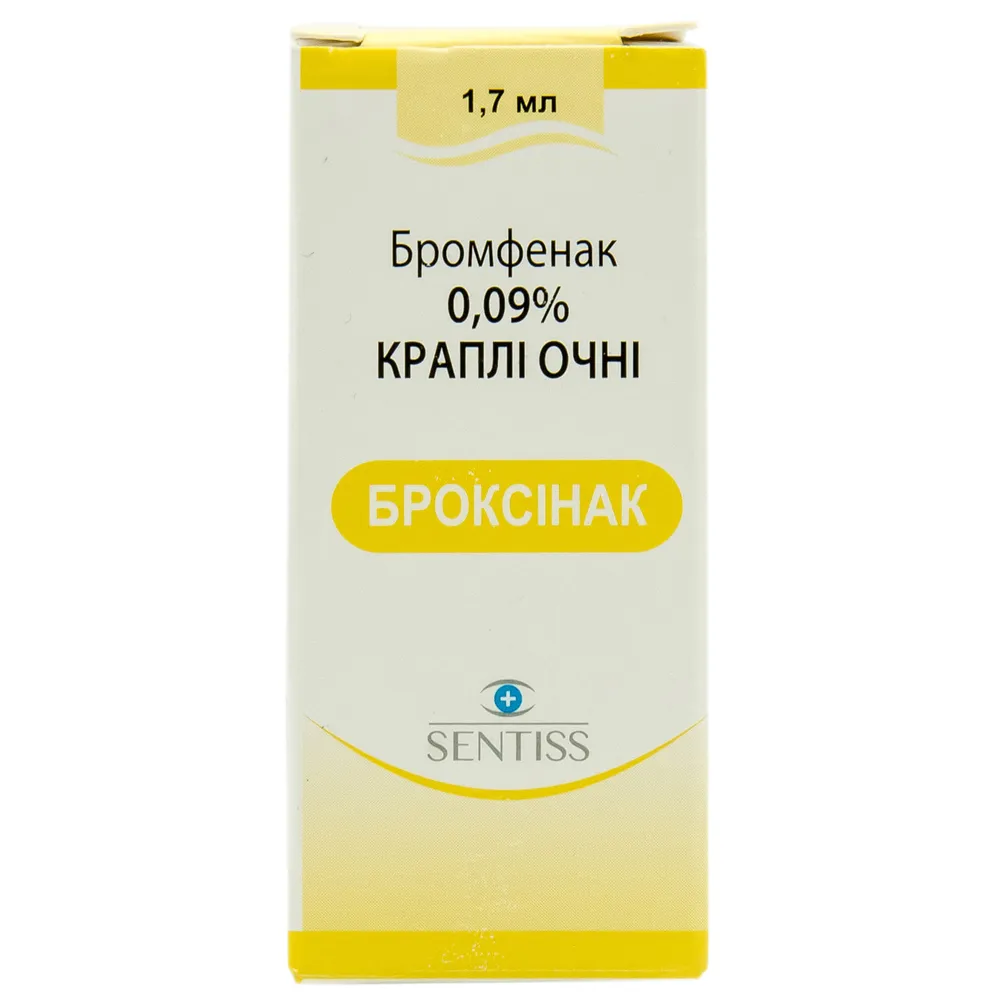
Table of Contents
INSTRUCTIONS FOR MEDICAL USE OF THE MEDICINAL PRODUCT BROXINAC (BROXINAC)
Composition:
Active substance: bromfenac;
1 ml of ophthalmic solution contains 1.035 mg of sodium bromfenac sesquihydrate, equivalent to 0.9 mg of bromfenac free acid;
Excipients: benzalkonium chloride, boric acid, disodium edetate, polysorbate 80, povidone K-30, sodium borate, anhydrous sodium sulfite (E 221), sodium hydroxide, water for injections.
Pharmaceutical form. Eye drops.
Main physicochemical characteristics: clear greenish-yellow solution.
Pharmacotherapeutic group.
Non-steroidal anti-inflammatory drugs.
ATC code S01BC11.
Pharmacological Properties.
Pharmacodynamics.
Bromfenac is a nonsteroidal anti-inflammatory drug (NSAID) with anti-inflammatory and analgesic effects. It inhibits the synthesis of prostaglandins from arachidonic acid by inhibiting cyclooxygenase-1 and 2, thereby reducing inflammation and pain response.
In vivo studies have shown that prostaglandins are mediators in certain types of ocular inflammation. Animal studies have demonstrated that prostaglandins contribute to disruption of the blood-ocular barrier, increased vascular permeability, vasodilation, leukocytosis, and elevated intraocular pressure.
Pharmacokinetics.
Absorption.
Bromfenac penetrates effectively into the cornea: after a single instillation, the concentration in the aqueous humor of the eye is 79 ± 68 ng/mL 150–180 minutes after administration.
Distribution.
The plasma concentration of the drug is significantly below the measurable limit and has no clinical significance.
The above-mentioned concentration is maintained in the aqueous humor for up to 12 hours, with therapeutically relevant concentrations preserved in ocular tissues, including the retina, for up to 24 hours.
Metabolism and Excretion.
The half-life of elimination from the aqueous humor is approximately 1.4 hours.
Clinical characteristics.
Indications.
Treatment:
- postoperative inflammation and reduction of pain in patients after cataract extraction;
- noninfectious inflammatory conditions of the anterior segment of the eye.
Contraindications.
Hypersensitivity to any component of the drug, as well as to other nonsteroidal anti-inflammatory drugs.
The drug is contraindicated in patients who experience exacerbations of bronchial asthma, urticaria, or acute rhinitis symptoms following administration of acetylsalicylic acid or other nonsteroidal anti-inflammatory agents.
The drug is contraindicated in patients under 18 years of age (safety and efficacy of the drug in children have not been studied).
Interaction with other medicinal products and other forms of interaction.
The drug may be used concomitantly with other ophthalmic medicinal products:
α-adrenomimetics, β-blockers, carbonic anhydrase inhibitors, cycloplegics, mydriatics, as well as antibiotics.
When used concomitantly, the medicinal products should be administered with an interval of at least five minutes.
Special precautions for use.
Excipients.
Sodium sulfite contained in the product may cause allergic reactions, including anaphylactic reactions and asthma attacks (including life-threatening attacks) in susceptible individuals. Sensitivity to sulfites is more common in patients with bronchial asthma and a history of allergic reactions.
The product contains benzalkonium chloride, therefore continuous monitoring is required during frequent or prolonged use. Benzalkonium chloride is known to discolor soft contact lenses; therefore, contact with soft contact lenses should be avoided. It may cause eye irritation, punctate keratopathy, and/or toxic ulcerative keratopathy.
Nonsteroidal anti-inflammatory drugs (NSAIDs).
The use of NSAIDs may delay healing, especially when used concomitantly with topical corticosteroids.
Patients should be informed that delayed healing may occur during NSAID use.
Cross-sensitivity.
When using Broxinak, there is a possibility of developing cross-sensitivity to acetylsalicylic acid, phenylacetic acid derivatives, and other nonsteroidal anti-inflammatory drugs. The use of such medicinal products should be avoided in patients who have previously shown sensitivity to them.
Increased sensitivity in certain individuals.
Topical NSAID use may lead to the development of keratitis. In some susceptible patients, prolonged use of topical NSAIDs may cause epithelial breakdown, corneal thinning, corneal erosion, corneal ulceration, or corneal perforation. These adverse effects carry a risk of vision loss. Patients showing signs of corneal epithelial disruption should immediately discontinue the use of the product and remain under medical supervision until corneal status normalizes.
Post-marketing experience.
Experience with topical NSAIDs indicates that patients with complications following ophthalmic surgical procedures, corneal denervation, corneal epithelial defects, diabetes mellitus, ocular surface diseases (e.g., dry eye syndrome), rheumatoid arthritis, and patients undergoing repeated surgical procedures within a short time interval have an increased risk of corneal adverse reactions.
NSAIDs may increase bleeding time due to impaired platelet aggregation. The use of topical NSAIDs in conjunction with ophthalmic surgery may increase ocular tissue bleeding (including in the anterior chamber of the eye (hyphema)). Broxinak should be used with caution in patients with a history of bleeding tendencies or in patients receiving other medicinal products that may prolong blood clotting time.
In rare cases, after discontinuation of bromfenac, an exacerbation of inflammatory response, such as macular edema, has been observed following cataract surgery.
Ocular infections.
Acute ocular infections may be masked by the local use of anti-inflammatory medicinal products.
Contact lenses.
Patients should not wear contact lenses during treatment with Broxinak.
The use of topical NSAIDs within 24 hours before ocular surgery and for 14 days after ophthalmic surgery increases the risk and severity of corneal adverse reactions.
Patients should be advised not to touch the dropper tip or allow it to contact any surface, as this may lead to contamination of the bottle contents.
Use during pregnancy or breastfeeding.
Pregnancy
The safety of 0.09% bromfenac ophthalmic solution during pregnancy has not been studied. The drug may be used only if the expected benefit to the mother outweighs the potential risk to the fetus.
The drug should be avoided during the third trimester of pregnancy due to the known effects of prostaglandin synthesis inhibitors on the fetal cardiovascular system (closure of the ductus arteriosus).
Breastfeeding
Caution should be exercised when administering to nursing women.
Fertility.
No effects of bromfenac on fertility were observed in animal studies. Furthermore, the systemic exposure to bromfenac is negligible; therefore, pregnancy testing and contraceptive measures are not required.
Ability to influence reaction speed when driving or operating machinery.
The drug has a minor influence on the ability to drive or operate machinery. Transient blurred vision may occur after instillation of the drug; therefore, patients are advised to wait until vision is fully restored before driving or operating machinery.
Method of Administration and Dosage
Adults (including elderly patients)
For the treatment of postoperative inflammation and reduction of pain in patients following cataract extraction, instillation of 1 drop into the conjunctival sac once daily is recommended. Treatment should begin 1 day before surgery and continue throughout the first 14 postoperative days (including the day of surgery).
For the treatment of non-infectious inflammatory conditions of the anterior segment of the eye, instillation of 1 drop into the conjunctival sac twice daily is recommended. The duration of treatment is determined by the physician depending on the severity of the condition.
When using several locally acting ophthalmic medicinal products, an interval of at least 5 minutes between administrations should be maintained.
Contact lenses should be removed before instillation of eye drops. They may be reinserted 15 minutes after instillation.
If a dose is missed, the medication should be administered as soon as possible at the dosage specified in the instructions. If nearly 24 hours have passed since the missed dose, the medication should be taken at the next scheduled time, without doubling the dose to compensate for the missed one.
For elderly patients, the dosing regimen does not differ from that in younger patients.
Children
Age under 18 years (safety and efficacy of the drug in children have not been studied).
Overdose
Do not instill more drops than prescribed before the next regular dose.
In case of overdose, eye irritation and conjunctival hyperemia may occur.
Treatment is symptomatic. In case of overdose, rinse eyes with warm water.
There is practically no risk of adverse consequences from accidental ingestion. Swallowing the contents of a 5 ml bottle corresponds to an oral dose of less than 5 mg of bromfenac, which is 30 times lower than the daily oral dose of bromfenac previously used. In case of accidental oral ingestion, drink a large amount of fluid immediately to reduce the concentration of the drug in the stomach and seek medical advice.
Adverse reactions.
Ocular disorders:
With administration of the drug once daily: eye discomfort and unusual sensations, eye irritation, eye pain, itching and burning in eyes, eye redness, conjunctival hyperemia, iridocyclitis.
With administration of the drug twice daily:
Decreased visual acuity, retinal hemorrhage, corneal edema, photophobia, eyelid vessel bleeding, exudates in the fundus, corneal erosion, conjunctivitis, blepharitis, irritation, transient eye pain, superficial punctate keratitis, itching, blurred vision, eyelid edema, eye discharge.
There have been isolated post-marketing reports of corneal perforation, corneal thinning, corneal epithelial breakdown, corneal ulcer, scleromalacia, corneal infiltrates, corneal scarring, and corneal disorders.
Nervous system disorders: headache.
Respiratory system disorders: epistaxis, cough, nasal discharge, bronchospasm attacks.
General disorders: facial swelling, contact dermatitis.
Shelf life. 2 years.
Shelf life after opening the bottle is 28 days.
Do not use after the expiry date stated on the packaging.
Storage conditions.
Store at temperatures not exceeding 25 °C in the original packaging.
Keep out of reach of children.
Packaging.
1.7 mL of ophthalmic solution in a dropper bottle, in a cardboard package.
Prescription category. Prescription only.
Manufacturer.
SENTISS PHARMA PVT. LTD., India.
Manufacturer's address and location of business operations.
Village Khera Nihla, Tehsil Nalagarh, Distt. Solan, Himachal Pradesh, 174 101, India.
Marketing authorization holder.
SENTISS PHARMA PVT. LTD., India.
Address.
212/D-1, Ashirwad Commercial Complex, Green Park, New Delhi, 110016, India.