Blimol
Ukraine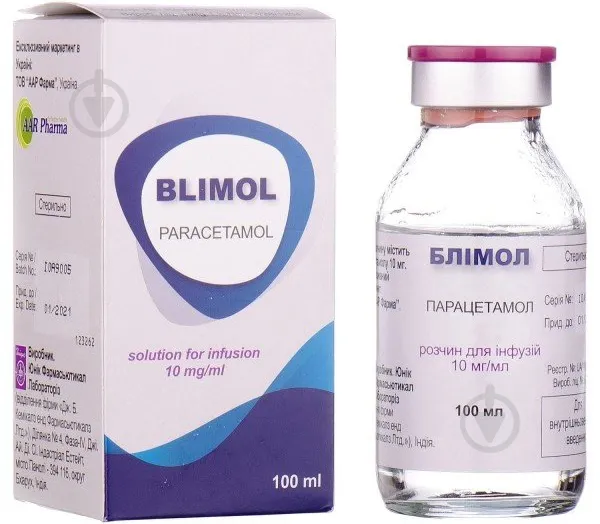
Table of Contents
INSTRUCTIONS FOR MEDICAL USE OF THE MEDICINAL PRODUCT BLIMOL (BLIMOL)
Composition:
Active substance: paracetamol;
1 ml of solution contains 10 mg of paracetamol;
Excipients: propylene glycol; citric acid, monohydrate; sodium metabisulfite (E 223); sodium hydrogen phosphate, dihydrate; sodium chloride; water for injections.
Pharmaceutical form. Infusion solution.
Main physicochemical properties: clear, colorless or slightly yellow solution without visible mechanical inclusions.
Pharmacotherapeutic group.
Analgesics and antipyretics. ATC code N02B E01.
Pharmacological properties.
Pharmacodynamics.
Paracetamol exerts analgesic and antipyretic effects by inhibiting cyclooxygenase (COX) I and II only within the central nervous system, affecting pain and thermoregulation centers. In inflamed tissues, cellular peroxidases neutralize the effect of paracetamol on COX, which explains the almost complete lack of anti-inflammatory activity. The absence of influence on prostaglandin synthesis in peripheral tissues accounts for the lack of negative effects on water-electrolyte balance (sodium and water retention) and the gastrointestinal mucosa.
Pharmacokinetics.
Maximum plasma concentration is reached within 15 minutes; maximum concentration is 15–30 μg/mL. The volume of distribution is 1 L/kg. Paracetamol is weakly bound to plasma proteins. It crosses the blood-brain barrier. Metabolism occurs in the liver, forming glucuronide and sulfate conjugates. A small portion (4%) is metabolized by cytochrome P450 into an intermediate metabolite (N-acetyl-p-benzoquinone imine), which under normal conditions is rapidly detoxified by reduced glutathione and excreted in urine after conjugation with cysteine and mercapturic acid. However, in cases of massive overdose, the amount of this toxic metabolite increases. Elimination half-life in adults is 2.7 hours, in children 1.5–2 hours, and in infants 3.5 hours. Total clearance is 18 L/hour. Paracetamol is primarily excreted in urine; 90% of the administered dose is eliminated by the kidneys within 24 hours, mainly as glucuronide conjugate (60–80%) and sulfate conjugate (20–30%). Less than 5% is excreted unchanged. In severe renal impairment (creatinine clearance below 10–30 mL/min), paracetamol elimination is slightly prolonged, and the half-life extends to 2–5.3 hours. The excretion rate of glucuronide and sulfate metabolites in patients with severe renal impairment is three times slower than in healthy individuals. Pharmacokinetics in children is practically similar to that in adults, except for a shorter plasma half-life (1.5–2 hours). In children under 10 years of age, glucuronidation is significantly reduced, while sulfation is relatively increased compared to adults.
Clinical characteristics.
Indications.
Adults: short-term treatment of moderate-intensity pain, particularly in the postoperative period.
Short-term treatment of hyperthermic reactions when intravenous administration of the drug is exclusively necessary.
Children: symptomatic treatment of pain and hyperthermia in postoperative patients.
Contraindications.
- Hypersensitivity to paracetamol or propacetamol hydrochloride (a prodrug of paracetamol) and to other components of the medicinal product;
- severe hepatocellular insufficiency;
- severe impairment of liver and/or kidney function;
- congenital hyperbilirubinemia;
- glucose-6-phosphate dehydrogenase deficiency;
- alcoholism;
- blood disorders;
- Gilbert's syndrome;
- pronounced anemia;
- leukopenia.
Interaction with other medicinal products and other forms of interaction.
Probenecid reduces paracetamol clearance by half by blocking its conjugation with glucuronic acid; therefore, when used concomitantly with probenecid, the dose of paracetamol should be reduced.
Salicylates may increase the elimination half-life of paracetamol.
Inducers of hepatic microsomal oxidation (phenytoin, ethanol, barbiturates, rifampicin, phenylbutazone, tricyclic antidepressants) may promote the development of severe intoxications even with minor overdoses.
Barbiturates reduce the antipyretic effect of paracetamol.
Concomitant use of high doses of paracetamol with isoniazid increases the risk of developing hepatotoxic syndrome.
Oral anticoagulants. Concomitant use of paracetamol (4 g per day for 4 days) with oral anticoagulants may lead to minor variations in the international normalized ratio (INR). Monitoring of INR values is required during concomitant therapy and for one week after discontinuation of paracetamol treatment.
Caution is advised when paracetamol is used concomitantly with flucloxacillin, as this combination has been associated with metabolic acidosis with a high anion gap due to pyroglutamic acidosis**, particularly in patients with risk factors (see section "Special precautions")**.
Paracetamol reduces the effectiveness of diuretics.
Paracetamol must not be used concomitantly with alcohol.
Special precautions.
It is important to avoid dosing errors due to confusion between milligrams (mg) and milliliters (mL), which may lead to accidental overdose and fatal outcomes. Oral paracetamol is recommended if possible.
To avoid the risk of overdose, do not use concomitantly with medicinal products containing paracetamol or propacetamol. Do not exceed the specified doses.
When paracetamol is used at doses higher than recommended, the risk of liver damage increases. Clinical signs of liver injury (including hepatic failure, hepatitis, including fulminant, cholestatic, cytolytic forms) usually appear from the 2nd day after initiation of treatment and peak on days 4–6. Antidotal therapy should be initiated as soon as possible.
Use with caution in patients with:
- Hepatocellular insufficiency, Gilbert’s syndrome;
- Severe renal impairment (creatinine clearance less than 30 mL/min);
- Chronic alcoholism;
- Alimentary exhaustion (reduced glutathione reserves in the liver);
- Dehydration;
- Glucose-6-phosphate dehydrogenase deficiency (may lead to hemolytic anemia).
Exceeding the recommended doses may lead to serious liver function disorders.
In patients with liver or kidney disease, consult a physician before using the medicinal product.
The risk of liver damage during treatment with the medicinal product Blimol increases in patients with alcoholic hepatosis.
Paracetamol may cause serious skin reactions. Patients should be informed about early signs of serious skin reactions, and if skin rash or any other signs of hypersensitivity occur, the use of the medicinal product should be discontinued immediately.
If the patient is taking warfarin or similar agents with anticoagulant effects, consult a physician before using the medicinal product.
In patients with severe infections such as sepsis, which are associated with reduced glutathione levels, the use of paracetamol may increase the risk of metabolic acidosis. Symptoms of metabolic acidosis include deep, rapid, or labored breathing, nausea, vomiting, and loss of appetite. Immediate medical attention is required if these symptoms occur.
Cases of metabolic acidosis with high anion gap due to 5-oxoproline (pyroglutamic) acidosis have been reported in patients with severe conditions such as severe renal impairment and sepsis, or in patients with inadequate nutrition or other causes of glutathione deficiency (e.g., chronic alcoholism), who were treated with paracetamol at therapeutic doses for prolonged periods or in combination with flucloxacillin.
If metabolic acidosis with high anion gap due to pyroglutamic acidosis is suspected, immediate discontinuation of paracetamol is recommended, along with careful monitoring of the patient’s condition. Measurement of 5-oxoproline levels in urine may be helpful in identifying pyroglutamic acidosis as the underlying cause of high anion gap metabolic acidosis in patients with multiple risk factors.
The use of the medicinal product Blimol may negatively affect laboratory test results for quantitative determination of glucose and uric acid in blood plasma.
During prolonged treatment, monitoring of peripheral blood parameters and liver function is required.
Excipients. The medicinal product Blimol contains less than 1 mmol (23 mg)/dose of sodium, i.e., practically sodium-free.
Use during pregnancy or breastfeeding.
Pregnancy. Clinical experience with intravenous administration of paracetamol is limited. There are no data indicating negative effects of intravenous paracetamol on fetal development or fetotoxic effects; however, the benefit-risk ratio should be carefully evaluated before administration, and close monitoring of the pregnant woman is required during treatment. Epidemiological studies on the neurological development of children exposed to paracetamol in utero have yielded conflicting results. If clinically indicated, paracetamol may be prescribed during pregnancy, but it should be used at the lowest effective dose, for the shortest possible duration, and with the least possible frequency.
Breastfeeding. After oral administration, paracetamol is excreted in breast milk in small amounts. No adverse reactions in infants related to maternal intake of paracetamol during breastfeeding have been reported. Therefore, paracetamol may be used by breastfeeding women.
Ability to affect reaction speed when driving or operating machinery.
No effect.
Administration and Dosage
Blimol is indicated for rapid relief of pain and/or hyperthermic syndrome when intravenous administration of the drug is strictly required.
The duration of intravenous infusion should be 15 minutes.
Prior to administration, the medicinal product should be visually inspected. Do not use Blimol if particulate matter or discoloration is observed.
Adults and children with body weight ≥ 50 kg
The maximum single dose is 1 g of paracetamol, i.e., 1 vial (100 mL). The maximum daily dose is 4 g. For patients with additional risk factors for hepatotoxicity, the maximum daily dose is 3 g. The interval between doses should be at least 4 hours. Typically, 1 to 4 infusions should be administered during the first 24 hours following the onset of pain (e.g., postoperative period). If necessary, treatment duration may be extended, but should not exceed 72 hours (3 days) or a total of 12 infusions.
Adults and children with body weight from 33 kg to 50 kg
15 mg/kg paracetamol per dose, i.e., 1.5 mL/kg. The maximum daily dose should not exceed 60 mg/kg body weight, but not more than 3 g. The minimum interval between doses should be 4 hours. Treatment duration typically does not exceed 4 infusions within 24 hours.
Children with body weight from 10 kg to 33 kg
15 mg/kg paracetamol per dose, i.e., 1.5 mL/kg. The maximum daily dose should not exceed 60 mg/kg body weight, but not more than 2 g. The minimum interval between doses should be 4 hours. Treatment duration typically does not exceed 4 infusions within 24 hours.
When administering the drug to children, prior to starting the infusion, remove excess volume from the vial so that only the volume corresponding to the required single dose remains.
Adult patients with severe renal impairment
In adult patients with severe renal impairment (creatinine clearance ≤ 30 mL/min), the dosing interval should be extended to 6 hours. Treatment duration should not exceed 48 hours.
Adult patients with hepatic insufficiency, chronic alcoholism, chronic malnutrition (low hepatic glutathione stores), dehydration, Gilbert’s syndrome, or body weight < 50 kg
The maximum daily dose should not exceed 3 g.
Elderly patients
Elderly patients generally do not require dose adjustment.
To avoid dosing errors due to confusion between milligrams (mg) and milliliters (mL), doses should be carefully calculated when prescribing and administering the medicinal product. Calculation errors may lead to accidental overdose and even fatal outcomes. When writing a prescription, both the total dose in milligrams (mg) and the total volume in milliliters (mL) should be clearly indicated.
Paracetamol solution should be administered as a 15-minute intravenous infusion.
Children
Do not use in children under 1 year of age or with body weight less than 10 kg.
Use in children aged 1 year and older with body weight > 10 kg only for symptomatic treatment of pain and hyperthermia in postoperative patients.
Overdose
The risk of toxic effects of the drug (including fulminant hepatitis, hepatic failure, cholestatic hepatitis, cytolytic hepatitis) increases in elderly patients, children, patients with hepatic insufficiency, chronic alcoholism, alimentary dystrophy, or reduced enzymatic activity. In such cases, overdose may be fatal.
Symptoms appear within the first 24 hours and include nausea, vomiting, anorexia, pallor, and abdominal pain.
Overdose in adults may occur with a single dose of 7.5 g or more; in children, at doses of 140 mg/kg body weight. This leads to liver cytolysis, hepatic failure, metabolic acidosis, and encephalopathy, which may progress to coma and death. Within 12–48 hours, levels of liver transaminases (AST, ALT), lactate dehydrogenase, bilirubin increase, and prothrombin levels decrease. Clinical signs of liver damage appear after two days and peak on days 4–6.
In patients with risk factors (chronic use of carbamazepine, phenobarbital, phenytoin, primidone, rifampicin, St. John’s wort, or other hepatic enzyme inducers; alcohol abuse; glutathione deficiency due to malnutrition, AIDS, fasting, cystic fibrosis, or cachexia), ingestion of 5 g or more of paracetamol may cause liver injury. Glucose metabolism disturbances may also occur. Acute renal failure with acute tubular necrosis may manifest as severe lumbar pain, hematuria, and proteinuria, and may develop even in the absence of severe liver damage. Cardiac arrhythmias and pancreatitis have also been reported. With high-dose use, hematological complications such as aplastic anemia, pancytopenia, agranulocytosis, neutropenia, leukopenia, and thrombocytopenia may develop. High doses may also cause central nervous system effects such as dizziness, psychomotor agitation, and disorientation; urinary system effects such as nephrotoxicity (renal colic, interstitial nephritis, papillary necrosis); and gastrointestinal effects such as hepatonecrosis.
Treatment:
- Immediate hospitalization of the patient;
- As soon as possible, before initiating treatment, determine plasma paracetamol concentration after overdose;
- Intravenous or oral administration of the antidote N-acetylcysteine (NAC), ideally within 10 hours of overdose. NAC may still be administered later than 10 hours, but treatment will be longer;
- Symptomatic treatment;
- Perform liver function tests before starting treatment and repeat every 24 hours. Liver transaminase levels usually return to normal within one to two weeks, with full recovery of liver function. In some cases, liver transplantation may be required.
Adverse Reactions
Blood and lymphatic system disorders: thrombocytopenia, leukopenia, neutropenia, agranulocytosis, anemia, sulfhemoglobinemia and methemoglobinemia (cyanosis, dyspnea, chest pain), hemolytic anemia, bruising or bleeding.
Immune system disorders: angioneurotic edema.
Gastrointestinal disorders: nausea, epigastric pain.
Hepatobiliary disorders: increased levels of hepatic transaminases, elevated activity of "hepatic" enzymes, usually without development of jaundice, liver function abnormalities.
Skin and subcutaneous tissue disorders: erythema multiforme (including Stevens-Johnson syndrome), toxic epidermal necrolysis (Lyell's syndrome).
Cardiac disorders: dyspnea, arterial hypotension, tachycardia.
Metabolism and nutrition disorders: hypoglycemia, up to hypoglycemic coma.
Metabolic acidosis with high anion gap (frequency unknown).
General disorders: malaise, weakness, pain and burning at the injection site, skin redness, hypersensitivity reactions, anaphylactic shock.
Isolated cases of simple or urticarial skin rashes have been reported.
Bronchospasm may occur in patients sensitive to acetylsalicylic acid and other NSAIDs.
Description of selected adverse reactions.
Metabolic acidosis with high anion gap. Cases of metabolic acidosis with high anion gap due to pyroglutamic acidosis have been observed in patients with risk factors who were taking paracetamol (see section "Special precautions for use"). Pyroglutamic acidosis may develop due to low glutathione levels in these patients.
Shelf life. 2 years.
Storage conditions.
Store in the original packaging, protected from light, at a temperature not exceeding 25 °C.
Keep out of reach and sight of children.
Incompatibility.
Blimol must not be mixed with other medicinal products.
Packaging.
50 ml or 100 ml in a vial, 1 vial in a cardboard box.
Prescription category. Prescription only.
Manufacturer.
"Unique Pharmaceutical Laboratories" (a division of "J. B. Chemicals and Pharmaceuticals Ltd.").
Manufacturer's address and place of business.
Plot No. 4, Phase-IV, G.I.D.C. Industrial Estate, Panoli – 394 116, Bharuch District, India.